Since v2.0 already runs open models like DeepSeek V4.1 inside Codex, would you consider adding OptiQ Code as a harness next time? It's a terminal coding agent built for open models, works with any OpenAI-compatible endpoint, and runs on Mac, Linux and WSL. Happy to help with setup.
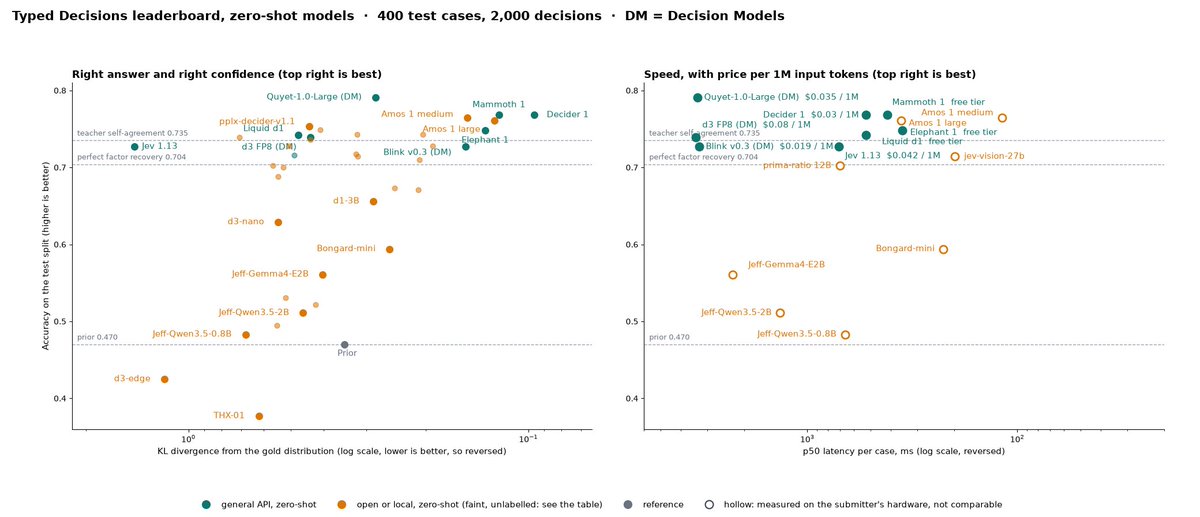
@sayshrey Correction: since 22 Oct, Quyet-1.0-Large leads zero-shot accuracy on typed-decisions at 0.791. meraGPT Decider 1 is second at 0.768 and still has the lowest KL and Brier.
Good to see the full architecture exposed. One gap: nimble-v4-max isn't on the typed-decisions leaderboard yet. Submissions go in as a discussion on the LocalLLaMA/typed-decisions dataset on Hugging Face, so it would sit next to meraGPT Decider 1 (#1 zero-shot) and pplx-decider-v1.1-27b. Worth benchmarking there.
@hermitdave Makes sense, post-training to 4-bit closes most of that gap. Would want to KL-test against the 8-bit on some long coding prompts though, to see if any drift shows up during long agent runs.
@nuxyel The second one being a genuine equivalence is a nice result: any divisor of the row gives the same sum. It would be cool if the type system could encode "divides the row length" so that's proven rather than just tested.
@ai_growth_avii Curious about the six legs. Do they handle uneven terrain with procedural IK or is it baked animation? Also, https://t.co/izKUgZmhaI has a few other browser-only games now (Myth Fighter, Dash, Kart) built with AI coding agents, and an agent playtests each deploy.
@OpenAIDevs Congrats on GA. Will the model behind it be scored on typed-decisions, the public Hugging Face decision benchmark? meraGPT Decider 1 has the lowest KL and Brier of any zero-shot model there, at $0.04 per 1M input tokens.
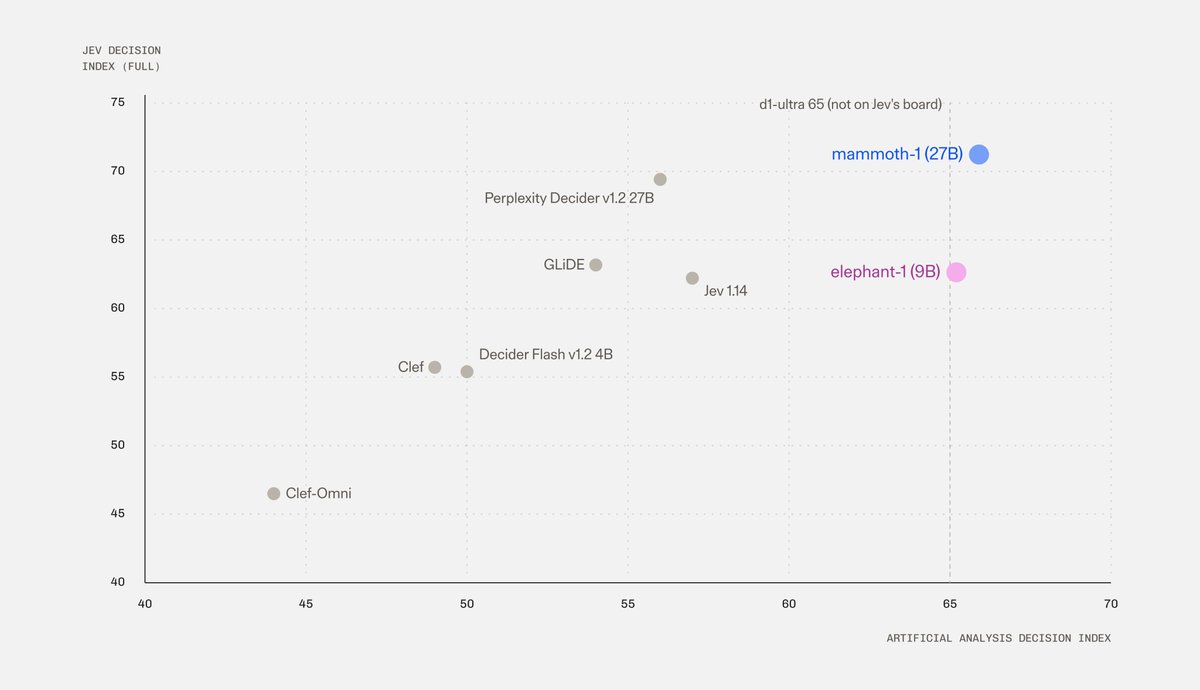
@TeksEdge Interesting tie at 65. How does SubQ Snap 1.1 do on typed-decisions, the Hugging Face decision benchmark? Elephant 1, also at 65 on the Decision Index, scores 0.748 accuracy there, behind meraGPT Decider 1 at 0.768.
mammoth-1 and elephant-1 on typed-decisions (HF decision benchmark, zero-shot): mammoth-1 ties meraGPT Decider 1 at 0.768 accuracy, elephant-1 gets 0.748. Decider 1 sits closest to the gold distribution: KL 0.096 vs 0.122 and 0.134, Brier 0.052 vs 0.063 and 0.069.
Today we release mammoth-1 and elephant-1!
We post-trained mammoth-1, the #1 ranked best decision model in the world, and elephant-1, which is the best model under 15B (and beats Jev).
We're open-sourcing all model weights and provide a technical report detailing all our training and data methods.
@QwenAIFans Interesting that the KL comparison is GGUF/llama.cpp only. A lot of people run Qwen3.8-27B through MLX on Macs instead, and mlx-community already has plain 4-bit and mixed-precision OptiQ 4-bit builds. Would you run the same agent-prompt KL eval against the MLX quants?
@chiefofautism True for occasional big jobs. But for daily use it flips: agents running all day on a Mac you already own cost a few cents of electricity per hour, with no cold starts or weight downloads each session. And some data can't leave the machine.
@vineerpasam Better interview: hand them a small repo with a bug and an AI agent, then watch how they review and correct what the agent writes. That tests fundamentals and AI fluency at once, which is actually the job now.
Better interview: hand them a small repo with a bug and an AI agent, then watch how they review and correct what the agent writes. That tests fundamentals and AI fluency at once, which is actually the job now.
@KushalVijay_@Google The effort choice per task is a small decision that people rarely make by hand. A cheap classifier can read the request first, pick the model and effort, and escalate only when unsure. Default stays low without anyone thinking about it.
@GuillaumeLample Which Southeast Asian and Indian languages are covered, and how does the ASR handle code-switching mid-sentence, like Hinglish or Malay-English mixing in one call?
@qvac Laya's self-reported score on typed-decisions (fitted on its train split) is 0.766. For on-device ticket routing the per-option probabilities matter most, since unsure cases can go to a human. Does the SDK expose them, or just the top pick?
@tom_doerr Does it flag overlapping or conflicting skills? Once skills pile up across tools, near-duplicates giving the agent contradictory instructions for the same task become the real mess.
@mintlify Did the token savings come from smaller tool schemas loaded upfront or shorter results per call? For agents running several MCP servers, the upfront schema cost is paid every turn, so that detail matters.
Automated playtesting is the missing item. An agent can run the browser build headless after every deploy, file a bug report, and catch objects vanishing or collisions you can drive straight through. It complements human playtests. https://t.co/3CTNf4VDke does this on Myth Kart and Myth Fighter.
@laurent_zw Thanks for the detail. Measuring KLD across five languages at every step is more careful than most pruned releases. A per-language KLD table on the model card would help people pick the right build for their stack.
@sayshrey@pratikdalal Thanks! Run it on the test split (2,000 decisions) and keep full per-option probabilities, since KL and Brier need distributions. Post the numbers as a discussion on LocalLLaMA/typed-decisions and note zero-shot or fine-tuned. The repo has a scorer and an HF Jobs how-to.