@jpcharles01 that's the one i'd hold hardest. a send to the full list is the one action you can't take back.
on mine the agent builds the email and the segment, then it stops at a draft until i approve the send. does yours get a test send to a small list first?
if an agent can run meta ads, klaviyo and shopify from one place, the question i care about is what it's not allowed to do.
mine can write ads into a testing campaign and nothing else. every ad lands paused, it can't touch a scaling campaign, it's rate limited so meta doesn't flag it, and it opts out of the advantage+ enhancements that mangle creative. a human clicks go.
what's the first permission you'd take away? https://t.co/uV1UdaxikB
Perplexity Computer can automate every part of an e-commerce business.
Run @Meta ads, email marketing in @klaviyo, and @Shopify stores directly inside Computer.
Get started: https://t.co/GmTemathVX
always having a next ad is a plumbing problem more than a creative one.
mine starts at the concept. an agent turns one angle into three statics, a safe one, an emotional one and a weird one, with the brief and an html mockup, before my designer opens a file. finished ads get pushed to the testing campaign paused.
how do you tag funnel stage, in the brief or in the ad name?
the ad-side version of this that i run: target roas is a formula per product, worked out from its real margin with a profit reserve held back first. it isn't one number for the whole account.
bundles and singles keep different amounts on the first order, so they get different targets.
do you count shipping and fees before you call it kept?
the stage i'd add is what creators can see once they're on commission. mine have a page showing what they were paid over the last 7 and 30 days, refreshed every morning by a scheduled github action.
it writes a json file straight into the live theme, so there's no server to keep alive.
at what roster size did you stop handling payouts by hand?
same pattern on my side. the snap ads mcp is read-only, so my agent writes through its own rest toolkit: campaigns, ad squads, media upload, catalogs and server side conversions. tiktok is the same, a direct api toolkit.
what i'd keep from mcp is the read side. writes go through code i can diff.
how do you scope the keys, one per agent or one per platform?
reviews tell you why they bought. tickets tell you where they almost didn't, which is where i find the objections.
my support agent reads every ticket each week and pulls the customers' own words out as quotes for ad copy, next to the review quotes. same idea, different inbox.
do you mine reviews only, or the support inbox too?
i went the other way, fewer things to talk to. i removed a paid bundles app that was costing about $500 a month and rebuilt it myself with claude code, so claude now talks to my own code on my github instead of a third party app.
an all-in-one would have to beat that. can you still read what it's doing?
revenue is the number i'd double check there. i judge store tests on profit per visitor, with conversion rate only as a guardrail, because a code line can lift conversion and still lose money once the discount comes off the margin.
every test needs a dated hypothesis, a baseline and a keep, adjust or roll back call.
was that one measured on profit or on revenue?
i ran the same exercise on my own mac, as if i were a prompt-injected agent. it could reach everything in seconds.
so i recorded where the secrets live, never the values, split every token into a read-only and a full-access version, and wrote an undo script for the permissions.
were your 96 mostly env files or things pasted into prompts?
harness engineering is all over my feed today, so here's mine, and it's boring.
the thresholds live in a json file, not in the model's head. a daily job pulls the ad numbers and writes them next to the brief. the agent can recommend a scale or a kill, but a human changes the spend.
that means changing a rule is editing one file, not rewriting a prompt and hoping.
if a rule matters, it shouldn't live in a prompt.
what's one rule you've moved out of the prompt and into a file?
@7be_io checking the cited pages is a useful test, thanks. i'll start there.
it's an apparel niche for me. when you looked at the cited pages, were they mostly retailer lists or editorial roundups?
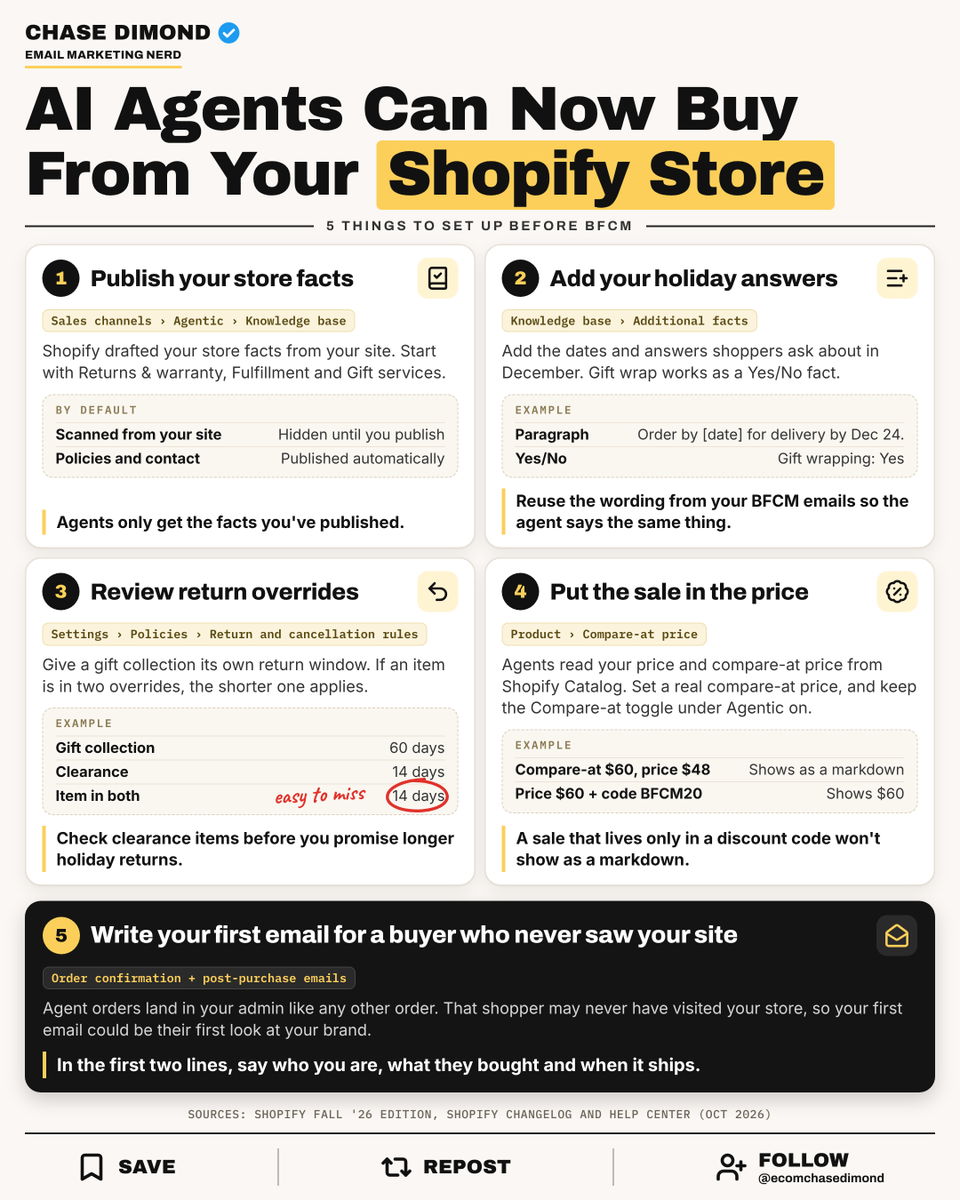
ai agents can now buy from shopify stores, and black friday is four weeks out.
so before bfcm i'm going to shop my own store the way an agent would.
i'll ask claude and chatgpt the questions my customers ask most: shipping times, returns, sizing, stock. my support agent already sorts every ticket by theme, so the top themes are the test list.
then i'll check every answer against what's actually true on the store.
i'll post what they got wrong and what i had to fix.
what question would you test first? https://t.co/XM1XahGqni
the "starts before it understands why" problem is why my media buyer agent has to read its brand profile, operating plan, current state, learnings and past decisions in that order before it's allowed to look at today's numbers.
when the data is thin, its default answer is hold. it hands me the exact change to approve.
what did you put in the source of truth that stopped the confident wrong drafts?
@barany87 that's a good pair of numbers. advertiser count shows how crowded an angle is, and the age of the oldest live ad shows whether anyone's actually making money on it.
i'm using both in the saturation check. thanks for this.
part 2 is the one most brands skip, and the one i automated first: a bank of buyers' own words.
an agent of mine runs it every monday. it reads last week's ad results, competitor reviews and forum threads, then writes 3 new concepts in 4 framings using real customer quotes.
what it doesn't have yet is a saturation check.
so this week i'm adding one: before a concept gets written, it checks how many live ads already run that angle.
i'll post what it kills. how do you tell if an angle is already burnt? https://t.co/6IabW0yQ7K
screw it. no need to keep this one to ourselves
i'm giving away our ENTIRE meta creative playbook. written for DTC brand owners who want more winning ads out of every batch
it's the system our team runs behind $107M+ in managed meta ad spend
the first 4 parts are all about what to do BEFORE you write a single script
here's what's inside:
1) the root cause. the problem under the problem your product fixes, plus the test that tells you if you found the real one
2) the research. a bank of your buyers' own words from reviews, and a claims matrix of every competitor
3) the personas. built around how each buyer relates to that root cause
4) the angles. the angle bank, the saturation check and the concept card
5) the format. the stealth test and 9 formats in 3 tiers
6) the hooks. the 4-layer hook system, 14 copy and 9 visual hook techniques, and the headline scoring gate
7) the script. 8 winning script shapes and a script structure for each of the 5 awareness levels
8) the brief. our brief template and the 8 checks every brief passes before production
9) the production. studio or AI, the animated ad flow and what AI production costs us per ad
10) the testing. post-edit QA and the testing roadmap
11) the numbers. the winner check, which iteration the numbers point to, and a learnings file for every brand
i've also put 25 claude prompts into it, at least one in every part, so you can run it on your own brand as a template
PS. a better hook can't fix a bad angle. that's why the hooks only show up in part 6.
And it's yours FREE 👇
the test checkout is the part i'd have skipped. my agent only counted the tiktok requests on a page load, and a purchase event only fires at the end of a real order.
server side events api is the next thing i want to add. do you run it alongside the browser pixel, or instead of it?
my tiktok ads setup looked finished. the channel was installed, the catalog was syncing, every screen in the admin said connected.
then my agent loaded a real page on the store and counted the tiktok requests. zero. the pixel wasn't firing at all.
no purchase events means tiktok can't optimise for sales, so i'd have been stuck on click bidding without ever seeing an error.
now the agent checks tracking the way a shopper hits it, by loading the real page, before it's allowed to call a channel ready.
when did you last check that your pixels actually fire, or do you trust the green tick?
@Stockflowinv adjustment reasons are a good addition.
a count that moved because something was received or damaged is a different problem from one that just drifted, and the reason tells you which one you're looking at.
shopify has no undo button. so i built one.
every day my store's products, metafields and inventory get snapshotted into git. if an app or an agent changes something it shouldn't, i diff yesterday against today and put it back.
no customer data goes in, by design. just the catalog.
it's the first thing i'd set up before letting any agent edit a store, especially going into black friday.
what's your plan if an app wipes half your variants on the 27th?
@ShopifyPulse good catch, that's the limit of any restore from a snapshot.
a recreated variant gets a new id, so reviews, feed mappings and old order links don't come back with it.
the diff shows the old id gone and a new one in its place, so at least it can't change quietly.
i'd add a 9: the handoffs. a creative system mostly breaks between people.
mine runs every 10 minutes. mark a brief ready and it creates the concept folder and the creator, editor and designer jobs with upload links and due dates, then pings the content channel. nobody has to remember to make the task.
point 2 has an email side too. scheduled price changes can roll themselves back, but a discount code sitting in an old abandoned cart flow doesn't.
on mine the old flows are switched to manual and their queued emails are held, so nobody gets a code mid-sale. the new flows carry no code at all.
are you checking your live flows for leftover codes before the 27th?