Shopify Stocky is gone, and the read-only export ends around Nov 29. That's 27 days. Here's the 5-step checklist to move your inventory without losing data 🧵
Still on Stocky? The read-only export runs until about Nov 29.
One thing it won't export: your suppliers.
This week, copy each supplier's name, contact, lead time, minimum order and the SKUs they supply into a sheet. It's what you'll miss most at your next reorder.
The fix for next time is a reorder point built on the vendor's real lead time.
Sell 10/day, vendor needs 21 days, keep 5 days of safety stock:
10 x (21 + 5) = 260 units. That's when you reorder.
Wait until 100 are left and you're out for 11 days.
despite my best efforts i got nailed by the infamous "my vendor cannot fulfill my restock in time" ecom trap. the shopify notifications have turned from a happy chemical in my brain to an impulse in my chest. feeling very grateful for these problems.
@doss_hq The three numbers rarely disagree at random. Usually it's stock in transit, returns not restocked yet, or a channel buffer. Splitting on-hand into available, committed and incoming clears most of it. Which gap do you see most with brands?
@rosaticorp 10K+ SKUs is where migrations quietly break: variants mapped wrong, barcodes dropped, stock counts a day behind. A full count of the top sellers right after cutover catches most of it. Did you pause sales during the switch or migrate live?
@markdmei Email is the cheapest BFCM channel until the hero SKU sells out on day one. Before each send, check units on hand vs last year's peak day for every featured product and swap in a backup if it's thin. Do you plan the email calendar around stock levels?
@EffectiveAppsHQ Agreed, top sellers first. For the long tail, a flat 1-2 weeks of extra cover is usually enough and keeps cash free for the SKUs that actually spike. Do your merchants set that buffer per SKU or one rule for the whole store?
@wpsuite Testing on a sold-out size is a smart check. Same trap shows up after a restock: the feed can lag and keep size S marked out of stock while it's live again. How often does your feed re-sync during sale week?
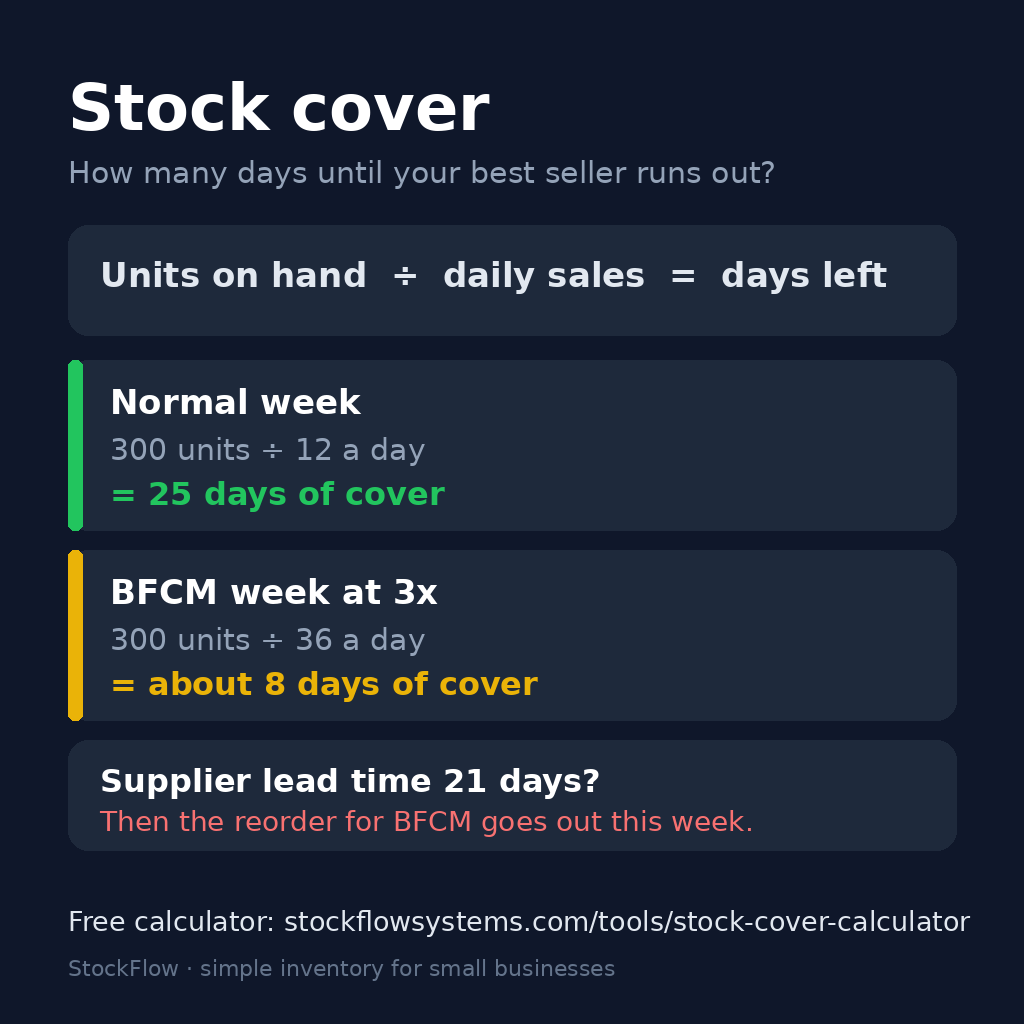
Will your best seller last through BFCM?
Days of cover = stock / daily sales
Normal: 300 / 12 = 25 days
BFCM at 3x: 300 / 36 = 8 days
Supplier needs 21 days? Reorder this week.
Free tool: https://t.co/1tGsEHBPHp
How many days of cover do you have?
Add one more date to the November plan: the day your best seller runs out. 300 units at 12/day lasts 25 days, but at 3x during BFCM it's gone in about a week. If the supplier needs 3 weeks, that reorder date is probably this week.
It’s November 2nd, and if your month still isn’t planned, you’re not as late as you think
You can plan the whole of November in one afternoon if you do it in the right order, and most of the stress comes from doing it the other way around
Start with the three dates that actually matter: early access around the 17th, Black Friday on the 27th and Cyber Monday on the 30th. Put those on the calendar first and everything else works backwards from them
Then lock your offer before you write a single email. When the offer keeps changing, every email has to be rewritten, and that’s how teams end up writing copy the night before
The two weeks before early access are for warming people up. Send a few emails at full price that give your list a reason to open, a story, a best seller, a customer review, and then a teaser that invites them onto your early access list
While that’s going out, update your welcome, cart and checkout flows so they sell the same offer as your campaigns. If someone joins on Black Friday and gets a 10% off welcome email, you’ve just undercut your own sale
If you write everything this week, design next week and schedule it all by the 16th, Black Friday week becomes the week you watch it work instead of the week you build it
And if you’d rather not do it alone, we freed up room for 3 ecom brands. We’ll make you 3 BFCM campaigns ready to send, audit your account and give you a full retention strategy, before you pay a cent
DM me “BFCM” and I’ll send you the details
And not any generic emails but ones like these 👇
You can find the biggest cash bottleneck without an agent too: stock value per product ÷ its monthly sales over the last 90 days = months on hand. Anything at 6+ months is cash sitting on a shelf. Fix those before ordering more.
Oracle NetSuite has launched SuiteAgents, a set of industry-specific AI agents built directly into NetSuite Next to help small businesses spot operational risks and cash flow bottlenecks before they impact the bottom line.
Key takeaways for small business owners:
Continuous proactive monitoring: Unlike standard reactive chatbots, SuiteAgents continuously oversee workflows, flagging cash flow issues like missed contract renewals or inventory shortages.
Targeted operational agents: The initial rollout delivers dedicated agents for software, production, and construction businesses, with future releases planned for services, healthcare, and nonprofits.
Unified business intelligence: By anchoring into NetSuite unified data model, these tools draw on nearly thirty years of industry expertise to automate recommendations and routine workflows.
Subscribe for more small business news + real owner stories.
Hashtags:
#SmallBusiness #NetSuite #Oracle #ERP #ArtificialIntelligence #BusinessTech #CashFlow #Operations #Automation #BusinessNews
One check before picking a Q4 niche as a beginner: the order math. Sells 15/day x 30 days = 450 units. If the supplier needs 25 days plus ~10 to reach FBA, that order goes out over a month before the peak, or you miss most of it.
🎄 Q4 is coming - but which product niches should beginner Amazon sellers actually be looking at?
In our latest video, we break down some of the best Q4 niches for beginner Amazon sellers, including what to look for and how to identify opportunities without getting caught out by seasonal demand.
If you're planning your Q4 sourcing, this is a great place to start.
👉 Watch the full video: Best Q4 Niches For Beginner Amazon Sellers : https://t.co/MvW9Xc2LKt
@TnovaApp Good one. Also cap each box item at what's on hand minus a small buffer, so one component can't hit zero mid-checkout. Do you show low stock per item on the box page, or just hide it?
@ScaleWithShayne Worth adding the stock side: peak fees hurt most on slow movers, because they also rack up storage into January. Send FBA what sells in ~6 weeks and keep the rest at a 3PL to top up. Do you see brands repricing per SKU or across the range?
@Pangolinfo_API The inventory cutoff is the gate sellers miss. Work backwards: FBA check-in can take 1-2 weeks at peak, so stock shipped late may land after the deals start. Do you see sellers keeping some FBM stock as a backup?
@ShopifyPulse Useful benchmark. In units: a SKU selling 10 a day in October would need ~46 on Black Friday alone, and far more over the whole weekend. Anything with a 3+ week lead time needs that order out this week. Is there a per-category spread?
@samewes_ Agree. Two numbers worth tracking per supplier: promised vs actual lead time, and % of orders that arrive complete. A supplier quoting 14 days but averaging 21 needs a bigger reorder buffer. Do the owners you talk to keep a backup supplier for top sellers?
@AlinaWan98 Inventory is the classic case: sales wants "never out of stock", finance wants less cash on shelves. What works is one shared number, like days of cover per product, instead of each side chasing its own metric. Who would own that number in your setup?
@hustlin_heev Nice. The counter is where a lot of POS stock errors start: a 6-pack barcode scanned as 1 unit, or the wrong variant scanned. Does scan2sell handle case barcodes vs unit barcodes?
@JasonFlowLab Nice rule. The most manual part I see is the reorder point itself: typed once, never updated. Make column D a formula too (daily sales x lead time in days + buffer) so it moves when sales do. Do you pull daily sales from another sheet?
@MoneyMaster_HQ Clean example. One thing for Q4: daily sales won't stay at 10. If BFCM week runs 3x, the reorder point that week is (30 x 6) + 20 = 200, so the order goes out much earlier. Do you adjust the buffer by season too?