met an anthropic engineer making $1.2M a year.
asked him how he ships alone at the pace of a full team.
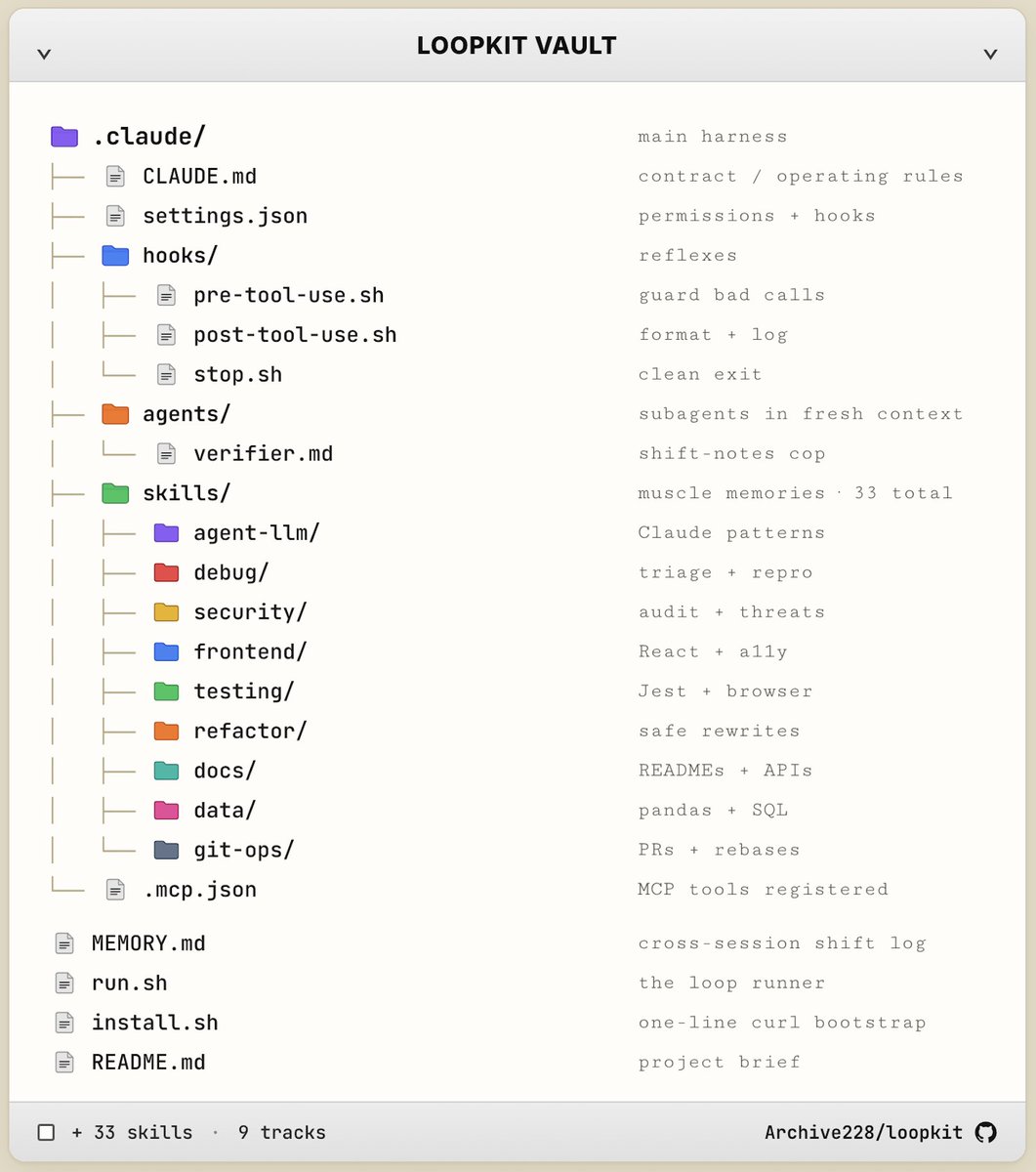
he didn't answer. sent me his .claude/. one folder.
SAME MODEL - DIFFERENT RESULT.
everyone's still picking between opus and sonnet like the model is the ceiling. it isn't.
the real lever is what the model wakes up into:
CLAUDE.md → hooks → verifier subagent → skills → mcp → memory → shift notes.
you stop chatting with the model.
you write the folder once. the folder runs the model.
- CLAUDE.md - the contract
- settings.json - the permissions
- hooks/ - the reflexes
- agents/verifier - the shift-notes cop
- skills/ - 33 muscle memories
- .mcp.json - the tools
- MEMORY.md - the shift log
that's the stack.
full breakdown in the article below. bookmark before he realizes i posted it.
Prompt, context, harness & loop engineering, clearly explained!
An agent is a while loop with four layers of engineering wrapped around it:
- Prompt engineering
- Context engineering
- Harness engineering
- Loop engineering
Each one wraps the last, and the model sits in the middle, so none of them compete with the others. Instead, they just zoom one level further out.
> Prompt engineering:
This defines the input the model sees on one call, often composed of a role, instructions, examples, and an output format.
The techniques here alter the internal computation and reasoning the model goes through due to the wording it sees:
- Chain-of-thought makes it work in steps before answering
- Few-shot examples define the format and the edge cases
- A JSON schema or XML tags make the output parseable by code
- Self-consistency samples a few chains and takes the majority
> Context engineering:
It's everything the model sees on a turn, not just the prompt. That includes the query, retrieved docs, memory, prior turns, and tool outputs from earlier steps.
The window is finite and fills up fast, so the engineering work is to rank inputs and cut everything that isn't pulling weight.
You do this by:
- Retrieving only the chunks relevant to the query, then reranking them
- Keeping key facts out of the middle, where accuracy drops
- Summarizing old turns, evict stale outputs, push big blobs to files
> Harness engineering:
It's the code around the model that defines the tools, parses the calls, retries on failure, and can route work to sub-agents so one handles retrieval and another handles code.
A verifier then grades the result by running tests, validating a schema, etc.
Prompt and context involve getting one call right. The harness involves everything that has to happen around that call for it to run in a real system.
> Loop engineering:
In the usual setup, you manage the outer loop, i.e, you write a prompt, read the turns the agent runs, write the next prompt, and repeat, while catching failures.
This layer hands that job to the agent itself. It kicks off on a schedule or an event, and runs many turns with no prompt in between.
A loop inherently doesn't know when it's finished. An agent can report that it's done and halt while the tests still fail. So the stop can't be the agent's word, but rather it has to be a real signal, like:
- A turn and token cap to stop stuck runs
- A no-progress detector to catch repeated calls
- A completion check to verify the goal with a separate model or a deterministic test
By this layer, you're operating on the whole run, so the engineering moves from writing each prompt to setting the goal and the stop conditions up front and letting it run.
If you want to dive deeper into loop engineering, my co-founder wrote a full breakdown of that outer loop.
It goes from the basic while loop to a run that finishes on its own, with the code behind each part, and the parts that are hard to get right, like knowing when to stop, context rot over a long run, and keeping the checker separate from the maker.
Read it below.
Two Anthropic engineers have just revealed in 24 minutes all the hidden Claude features that almost nobody knows about.
This video is going to completely change the way you use AI.
Watch it and save it.
🚨 Anthropic just showed a 27-minute workshop on how to actually do prompts for Claude.
Taught by the people who built it.
Free. No registration. No paywall.
I've seen $300 courses that don't cover what they teach in the first 8 minutes.
Watch it and bookmark it now.
Claude Code can now autonomously test your entire iOS app.
Every screen. Every flow. Debug logs included. Structured bug report at the end.
One prompt. No scripts. No setup.
AVD (Animated Vector Drawables) exist since Android 5.0 - still underused
Devs just don’t know where to get good animated icons
We fixed that
Built together with @romankhrupa
Vector Motion Kit - ready-to-use animated icons for Android
More coming
https://t.co/JXhNo2f366
🤖 Kotlin Coroutines Skill: enseña coroutines a tu agente IA
Un recurso pensado para que la IA entienda cómo usar coroutines correctamente en Kotlin y evite errores comunes.
► Buenas prácticas claras para IA
► Uso correcto de scopes y jobs
► Manejo de cancelación y errores
► Guía lista para integrar en agentes
👇🏻👇🏻👇🏻
→ https://t.co/tw7YwXWlVw ←
🎉 After one year of teamwork, we are excited to release our 3D foundation model — LingBot-Map!
Unlike DA3/VGGT, LingBot-Map is a purely autoregressive model for streaming 3D reconstruction ⚡
It achieves ~20 FPS on 518×378 resolution over sequences exceeding 10,000 frames — and beyond 🚀
Two key insights behind LingBot-Map:
🔑 Keep SLAM's structural wisdom: build Geometric Context Attention with long-context modeling while maintaining a compact streaming state
🔑 Make everything end-to-end learnable — no optimization, no post-processing
Let's check out our demos 👇
Microsoft sold every spare CPU it had to Anthropic and OpenAI. Amazon tripled its CPU buys year over year and still can't keep up. Two of AWS's biggest customers asked Andy Jassy if they could buy the entire 2026 production run of Graviton chips. He said no.
The ratio inside an AI datacenter used to be 100 megawatts of GPUs to 1 megawatt of CPUs. CPUs handled storage, checkpointing, pre-processing. Light work. GPUs did the actual training and inference.
Then OpenAI shipped o1-preview in September 2024. RL post-training went from "check the model output with a regex" to "run classifiers" to "compile the code and run the unit tests" to "spin up a sandbox, call three databases, run a physics simulation, verify the answer."
Every rollout now needs a CPU-backed environment to verify against.
Codex 5.4 runs agentically for 6-7 hours at a time. Each database call, each cron job, each scraped URL is CPU work. Coding agent revenue went from a couple billion to north of $10B in six months. That compute is sitting on CPUs.
The CPU to GPU ratio is now approaching 1:1. The entire global cloud was built for 1:8.
That's why GitHub has been unstable for weeks. Nvidia and Arm both announced they're entering the server CPU market in March. TSMC will only meet 80% of server CPU wafer demand this year. High-end server CPU prices are already up 50%.
When the GPU king and the IP licensor both pivot to CPUs in the same month, the boring chip isn't boring anymore.
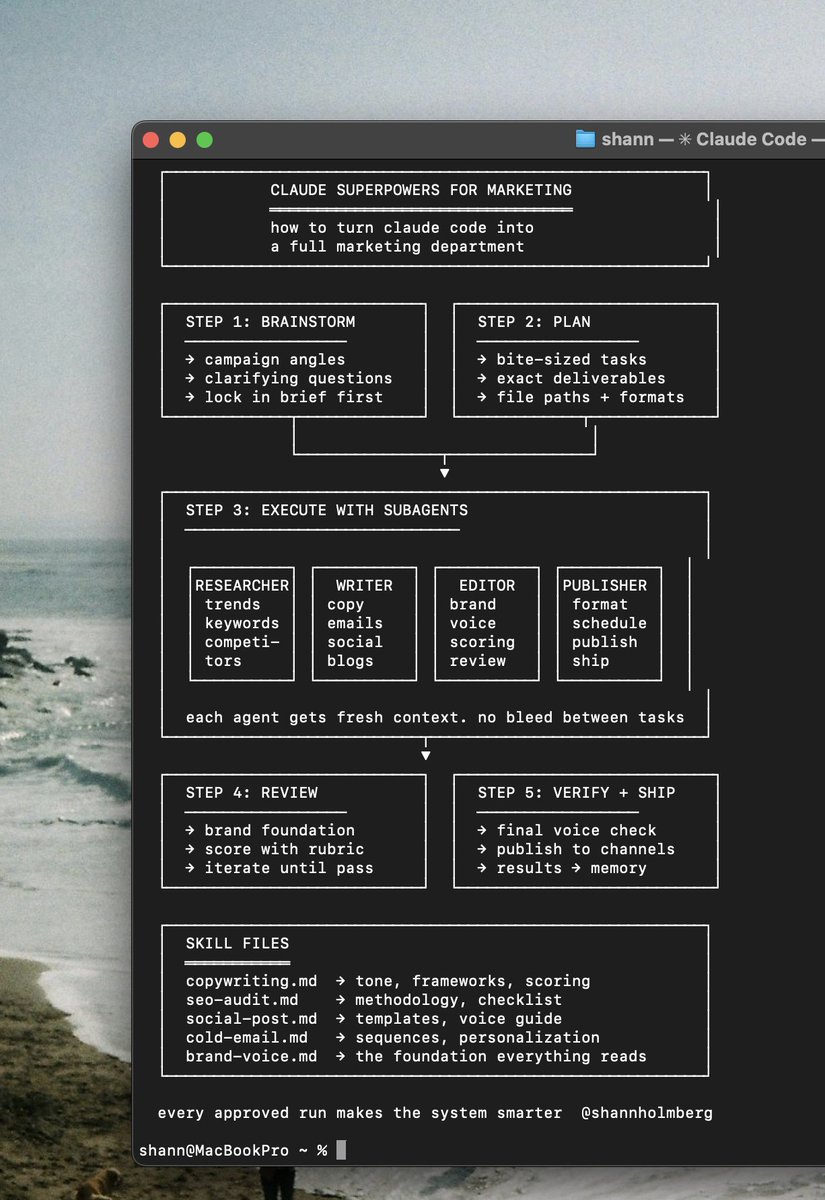
claude superpowers is the most underrated plugin for marketers right now
83,000 github stars. trending daily. but almost everyone using it is a developer
here´s how it works and how to apply it to marketing 🧵
Damnn 😱
Most developers are using Claude Code wrong.
They open the terminal...
write a prompt...
and expect magic.
That’s not where the real power is.
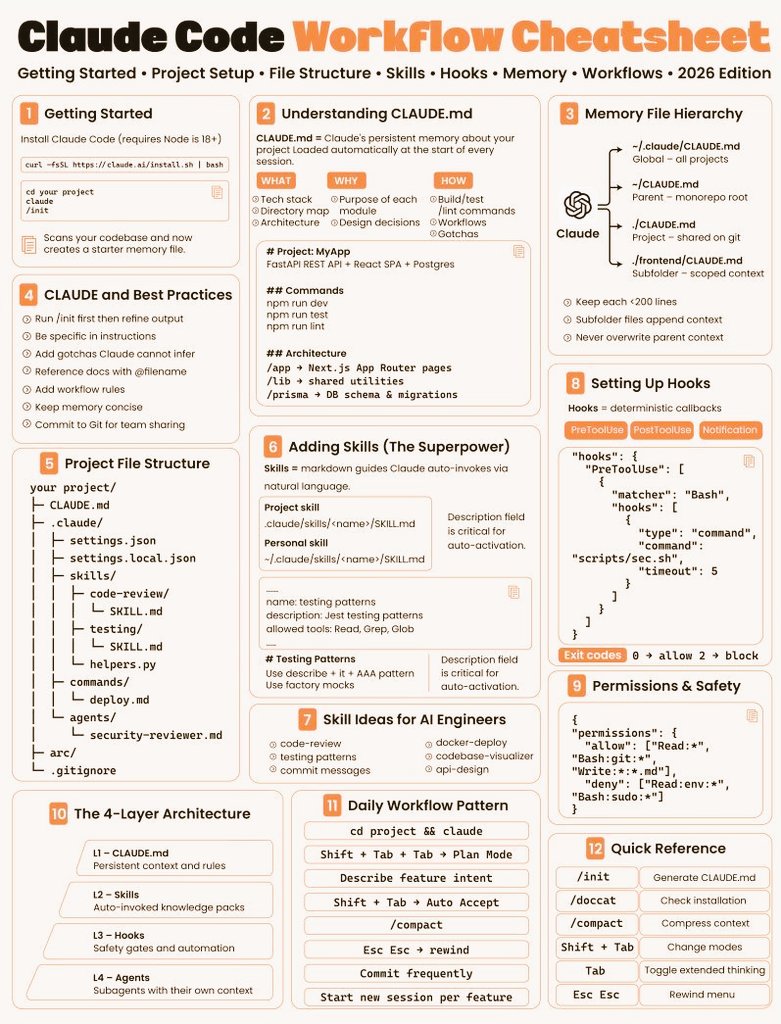
Claude Code is actually a 4-layer AI engineering system:
1️⃣ CLAUDE.md → project memory
Architecture, rules, commands, conventions
2️⃣ Skills → reusable knowledge packs
Testing workflows, code review guides, deploy patterns
3️⃣ Hooks → deterministic guardrails
Security checks, enforced rules, automation
4️⃣ Agents → specialized sub-agents
Break complex tasks into parallel workflows
Once you structure these properly, something interesting happens:
Claude stops behaving like a chatbot.
It starts behaving like a real AI dev system.
Most engineers miss this because they jump straight to prompting.
But the difference between average output and production-level results usually comes down to setup.
If you're building with AI agents in 2026, learn the system — not just the prompt.
I made a Claude Code Starter Pack explaining everything.
If you want it:
Follow
Like + RT
Comment CLAUDE
I'll DM it to a few people.
Future AI dev workflows won't be prompt-first.
They’ll be system-first. 🚀
#AI #Claude #AIAgents #LLM #GenAI
Compose HotSwan meets AI.
You can watch AI modify style code through Hot Reload in real time on your real physical device, allowing you to choose the better direction through a decision tree and quickly arrive at better results.