You don't even want to know what sending 80,000 emails would cost you in 1 week.
Postmark: $100+
SendGrid: $90+
Resend: $80+
Mailgun: $80+
OpenShip: $0.
Deploy it on your 5$ VPS.
Unlimited domains.
Unlimited inboxes.
No per-email bill.
No vendor lock-in.
And yes - it works with one-click setup.
No deep infrastructure work.
Just add a few DNS records, and you're ready to go.
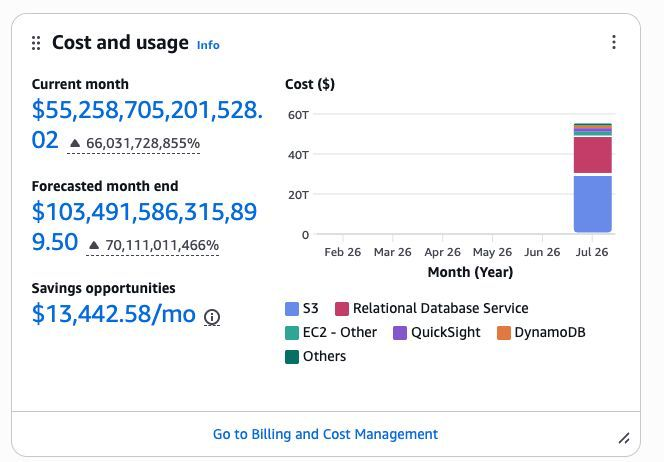
Current bill situation:
Codex $100
Claude code $200
AWS $17,622,128,552
Openrouter $45
Not able to understand how to reduce my bill. Any help would be appreciated
@awscloud@AWSSupport
Something is wrong here. I have alerts at $75 & 100 USD. I haven’t used my account in last 10 days and suddenly I’m getting alert for $20000. Can you please check urgently?
We're open sourcing a 9B model that extracts structured data from documents at near-frontier performance.
- 90.2% on our bench, vs Gemini 3.5 Flash at 91.3%
- Leads extraction models like NuExtract3 (81.5%)
- 9.5s p50 timings
- Pass JSON schema
If I got laid off tomorrow & had to replace my salary asap, here’s exactly what I’d do:
1. Go to Instagram and start a fresh account. Use a spare email. No one has to know.
@SureshBind38899@Bajaj_Finserv It is very unfortunate that a simple common man has to suffer so much because of bad practices of banks/government authorities & businesses.
Serious concern: The service road from Metro Station Sector 137 to Advant Navis is turning into a dumpyard due to irresponsible behavior. This is creating unhygienic and unsafe conditions.
Requesting Noida Authority to take immediate cognizance and protect the greenbelt.
The West poured $50 billion into fast breeder nuclear reactors and abandoned every single one. India poured $900 million and just achieved criticality on the first commercially viable one outside Russia.
The US spent $15 billion. Gave up. Japan spent $12 billion. Their Monju prototype had one sodium fire in 1995 and never recovered. The UK spent $8 billion. Germany spent $6 billion. France, Italy, all walked away. Six of the richest nations on Earth concluded this technology was too hard and too expensive to pursue.
India started building in 2004 with an initial budget of $420 million. Twenty-two years, a dozen missed deadlines, and a cost doubling later, the Prototype Fast Breeder Reactor at Kalpakkam just sustained a controlled fission chain reaction. The reactor is now alive.
The reason India never quit is a constraint most people have never thought about. India has only 1-2% of the world's uranium reserves. For a country of 1.4 billion people trying to build energy independence, that's a death sentence if you're running conventional nuclear.
But India has 25% of the world's thorium. The single largest national reserve on Earth.
The problem: you can't just burn thorium the way you burn uranium. A physicist named Homi Bhabha designed a three-stage nuclear program in the 1950s specifically to solve this. Stage 1: burn natural uranium in heavy water reactors, collect plutonium as a byproduct. Stage 2: feed that plutonium into fast breeder reactors, where it breeds MORE plutonium AND converts thorium into fissile uranium-233. Stage 3: burn thorium directly at scale.
India just entered Stage 2. Seventy years after Bhabha drew it up on paper.
The math on the thorium endgame is wild. At current energy consumption rates, India's thorium reserves could power the country for over 700 years. Most nuclear nations are playing a uranium game with maybe 80-100 years of runway. India is playing a completely different game with a 7x longer fuel supply.
The West quit because uranium stayed cheap and sodium coolant is terrifying. It catches fire on contact with air. It explodes on contact with water. Russia's BN-600 had 27 sodium leaks and 14 sodium fires between 1980 and 1997. And Russia kept going anyway because Russia doesn't quit nuclear projects. India watched all of that and kept going too.
When you have 1% of the uranium but 25% of the thorium, the engineering difficulty stops being a reason to quit. It becomes the price of admission to a 700-year energy supply that nobody else can access.
Someone just poisoned the Python package that manages AI API keys for NASA, Netflix, Stripe, and NVIDIA.. 97 million downloads a month.. and a simple pip install was enough to steal everything on your machine.
The attacker picked the one package whose entire job is holding every AI credential in the organization in one place. OpenAI keys, Anthropic keys, Google keys, Amazon keys… all routed through one proxy. All compromised at once.
The poisoned version was published straight to PyPI.. no code on GitHub.. no release tag.. no review. Just a file that Python runs automatically on startup. You didn’t need to import it. You didn’t need to call it. The malware fired the second the package existed on your machine.
The attacker vibe coded it… the malware was so sloppy it crashed computers.. used so much RAM a developer noticed their machine dying and investigated. They found LiteLLM had been pulled in through a Cursor MCP plugin they didn’t even know they had.
That crash is the only reason thousands of companies aren’t fully exfiltrated right now. If the code had been cleaner nobody notices for weeks. Maybe months.
The attack chain is the part that gets worse every sentence.
TeamPCP compromised Trivy first. A security scanning tool. On March 19. LiteLLM used Trivy in its own CI pipeline… so the credentials stolen from the SECURITY product were used to hijack the AI product that holds all your other credentials.
Then they hit GitHub Actions. Then Docker Hub. Then npm. Then Open VSX. Five package ecosystems in two weeks. Each breach giving them the credentials to unlock the next one.
The payload was three stages.. harvest every SSH key, cloud token, Kubernetes secret, crypto wallet, and .env file on the machine.. deploy privileged containers across every node in the cluster.. install a persistent backdoor waiting for new instructions.
TeamPCP posted on Telegram after: “Many of your favourite security tools and open-source projects will be targeted in the months to come.. stay tuned.”
Every AI agent, copilot, and internal tool your company shipped this year runs on hundreds of packages exactly like this one… nobody chose to install LiteLLM on that developer’s machine. It came in as a dependency of a dependency of a plugin. One compromised maintainer account turned the entire trust chain into a credential harvesting operation across thousands of production environments in hours.
The companies deploying AI the fastest right now have the least visibility into what’s underneath it.
🚨 Andrej Karpathy just explained the scariest thing happening in software right now..
someone poisoned a Python package that gets 97 million downloads a month.. and a simple pip install was enough to steal everything on your machine..
SSH keys.. AWS credentials.. crypto wallets.. database passwords.. git credentials.. shell history.. SSL private keys.. everything..
and here's the part that should terrify every developer alive..
the attack was only discovered because the attacker wrote sloppy code.. the malware used so much RAM that it crashed someone's computer.. if the attacker had been better at coding.. nobody would have noticed for weeks..
one developer.. using Cursor with an MCP plugin.. had litellm pulled in as a dependency they didn't even know about.. their machine crashed.. and that crash saved thousands of companies from getting their entire infrastructure stolen..
Karpathy's take is the real wake up call.. every time you install any package you're trusting every single dependency in its tree.. and any one of them could be poisoned..
vibe coding saved us this time.. the attacker vibe coded the attack and it was too sloppy to work quietly.. next time they won't make that mistake.