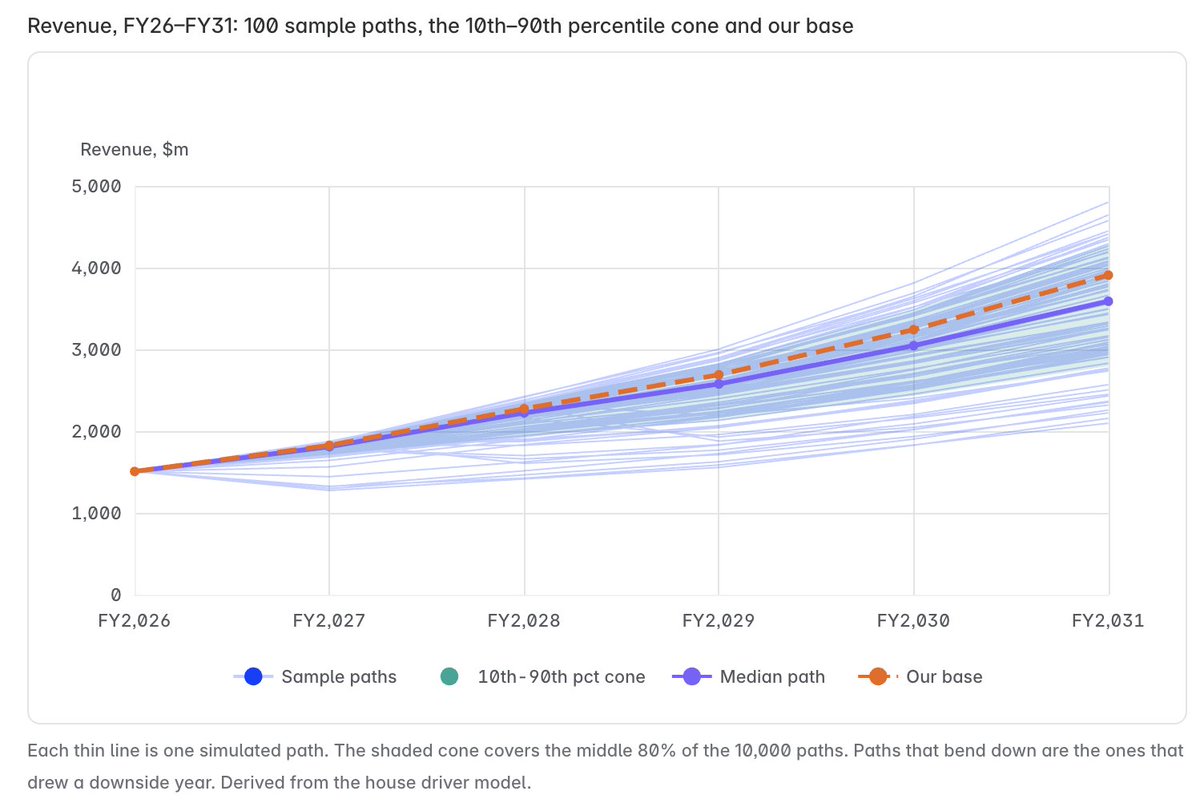
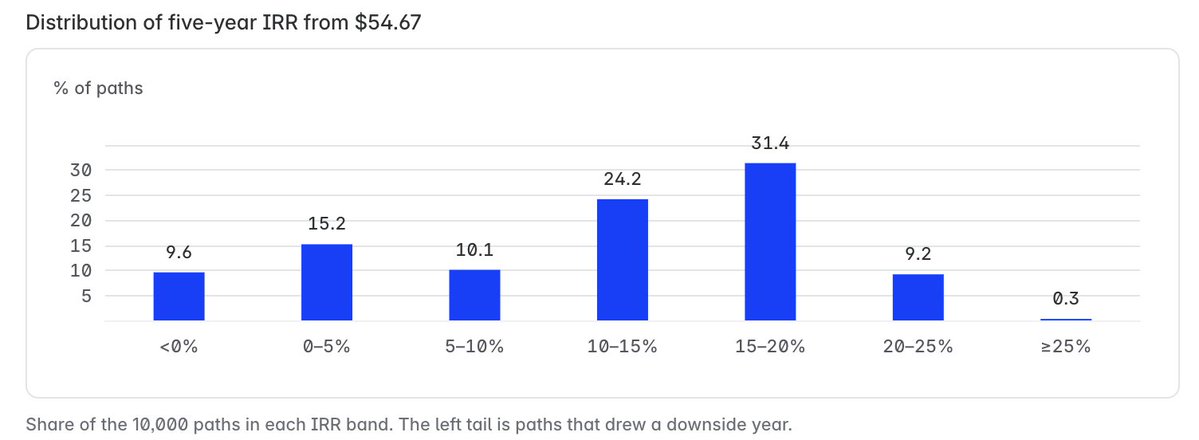
AlphaSense cites all their data very clearly so one can go deeper into each piece of analysis and view the source content. Investors choose how deeply they want to diligence a decision all the time even before AlphaSense. Some are better at that than others. Nothing has changed. Used correctly AlphaSense allows investors to use the time saved to do deeper and more differentiated analysis.
We were thinking about how swarms will change the investment process… and I blew my own mind with this one.
I saw CAVA down 10% and ran my automated investment analysis on it – came away thinking it was a good long.
My AlphaSense skill creates its own forecast, reasons on comparisons, store growth / penetration vs peers, sensitivities, waterfalls, etc. It does work how I’d do the work.
But then, since SuperAnalyst leverages the fully drivable Canalyst models as a tool, I asked it to run my model scenarios like a weather forecast for me. It ended up running 10,000 !
You have to start from the right base: Canalyst model, leveraging our forecasting skills (dissecting drivers in a HF manner), leveraging my investment analysis skill. But then from that base, we can run this at scale.. And this is the worst it’s ever going to be?
Disclaimer: this is not investment advice. (though I spent 10 years as a hedge fund analyst, and this is better analysis than I could run).
@ICONIQCapital@AnthropicAI@WeAreLegora@SierraPlatform@ElevenLabs@OpenAI@glean Please do a Part 2 that shows relative gross margins to see any correlation. Reminds me of the late 90’s when I saw perpetual license software and internet 1.0 companies grow at similar rates. Companies like Verticalnet, Inktomi, Vignette, Webmethods, etc
The ARR multiple fallacy
ARR multiple is not the right way to think about sub-20% growers.
Simple framework:
If you’re growing sub-20%, you get a 10-30x EBIDTA or FCF multiple. If you use this rubric, Miro is very fairly valued by Bending Spoons.
Only 30%+ growers get the luxury of an ARR multiple.
The reason is that 30% growth means you’re doubling in 3 years and so the revenue base will be 2x in 36 months, and the margin structure will look different at 2x scale. Cash flow today is a rounding error against that. So you value the trajectory, and ARR is the cleanest proxy for trajectory.
At 15% growth, doubling takes 5 years. That's close enough to "never" that the market stops paying for the future and starts paying for the present. The present is earnings. If you're not producing them, you're not a growth company anymore. You're a bad value company.
The mistake founders make is anchoring to the multiple they had at 40% growth and thinking the ARR multiple just compresses. It doesn't compress. It gets replaced. You cross 30% on the way down and the entire valuation framework switches out from under you.
Which is why the worst place to be is 20-30% growth with no FCF. Growth investors won't pay for it. Value investors can't. You're priced by whoever is least excited,a really painful place to be.
Radical is getting ready to take the next step in our growth as a company. We are the best self-driving lab company in the world, and now we will have the space to prove it.
You're busy. Your digital Twin isn't.
So when a colleague needs the context you're carrying, they don't have to wait for a gap in your calendar. Your Twin answers, in your voice, drawing on what you've already written.
You stay the expert. You just stop being the bottleneck.
Book a demo and see what Twin1 can do for you.
https://t.co/FDES5PpHk0