AWS is coming for the cloud architect’s job.
Or at least, a big chunk of it.
They built an AI agent that can audit up to 100 AWS accounts, find architecture problems, and generate the Terraform fixes for them.
The new Well-Architected Agent checks cost, security, performance and resilience across 65+ AWS services.
Feed it Terraform, CloudFormation or CDK, and it can return the IaC changes and CLI commands needed to fix what it finds.
And it doesn’t stop after one review.
AWS says it can automatically re-check your environments every week.
Full announcement: https://t.co/GUlrVzjO2X
🥳 Excited to start revealing what we've been working on in the last few months. First, we decided to reinvent Kubernetes for agentic workloads with statefulness and fast resumption. Secondly, we are building an agentic orchestrator that will be Google's open agentic orchestrator and runtime. https://t.co/XCrdAVvDAe
After co-inventing ChatGPT, I kept asking myself: why have superhuman chat models not led to AGI?
I’ve spent the last 2 years in stealth building a new way to train models (RLCD), and a new type of frontier AI model that we are releasing today: Jev
• 20-200x faster
• 40-400x cheaper (w/ output tokens free)
• Frontier composable intelligence optimized for decisions
AFAICT the shortest path to AI-based economic revolution
@ChaseLochmiller@OpenAI GPT-6 Astra, trained on ~100K+ NVIDIA Grace Blackwell NVLink72. From ChatGPT to o1 to Astra in 4 years.
AGI has arrived. Congratulations @OpenAI team.
400K GPUs coming online next.
OpenAI research scientist @aidan_mclau argues Twitter is the uncheatable eval for AI hiring because you can't fake loving technology, and posters like Roon become brand assets that entire labs benefit from:
"If I were manager or recruiter, I think I would still pay a ton of attention to Twitter. It's a high signal thing. It's kind of hard to fake really loving technology, really having good takes. It's the uncheatable eval in some sense."
Sofia: "You guys probably see it as a brand asset to have good posters"
Theo: "How much intangible brand value has Roon created for OpenAI? Probably a lot"
Aidan: "It's not just OpenAI brand value. When you love technology, when you love AI, when you love the stuff you work on, when you earnestly want it to go well, not just for the company's sake, but to fulfill that promise to an earlier version of you when you were 12 and you had read sci-fi books, that's the aura I get from @tszzl."
"Some of that is projected on OpenAI, which I'm grateful for, but some of that's just projected onto San Francisco, or us as people who love AI and just want these things to go well."
@OpenAI
Thrilled to announce the MCP 2026-07-28 release. It is one of MCP's biggest yet, built on 18 months of lessons learned.
A few highlights:
★ MCP is now stateless, with semantics for multi-round-trip requests. Serving MCP just got much simpler and more scalable.
★ MCP now has extensions. MCP Apps, Tasks, Enterprise Managed Auth, and more. Domain-specific ways to use MCP, plus room for experimental additions.
★ Python, Typescript, C# (soon) SDKs released a v2.0.0 for the new spec with improved ergonomics!
But the biggest highlight for me: this release is a true community effort. Individuals and companies alike — Anthropic, Google, Microsoft, OpenAI, and many others helped shape this specification.
And there's much more. Full details: https://t.co/NHd9cQmPCu
AI agents can write code many times faster than a human. What this means is that you, the programmer, have a large amount of time to use those agents to write unit tests, to write acceptance, tests, to write property tests, to torture test, to mutate test, to QA test, and to otherwise ensure that the code meets its functional and quality requirements. And even after spending all that time, you will still be many times more productive than a human programmer, and the result will be better.
I am excited to announce that we are officially writing a new version of Postgres. In Rust - and creating the LLVM of databases in the process.
In the span of a year, we have rewritten SQLite. Keeping the compatibility, increasing its feature set. MVCC, Types, (Live) Materialized Views, among other things. In the process of doing that, we have realized: At the end of the day, what makes SQLite special is that it compiles SQL to a database-specific bytecode. So why can't we compile *Postgres* to the same bytecode?
Turns out we can. I ran an experiment called pgmicro as a way to prove this hypothesis, and it works very well. It is time to make this official, and put the weight of Turso behind it. We shall give the world a modern take on Postgres. Wire compatible, but built on a new architecture.
We have already heard of others wanting to extend this. MySQL? Redis? the sky is the limit. What can we do if we do for databases what LLVM did for compilers? To prove how powerful the SQLite bytecode is, we are actually running DOOM compiled to the unmodified SQLite instruction set. And because Turso runs natively in the browser, you can play the game in your browser. With the database executing it.
Read the full story below! 👇
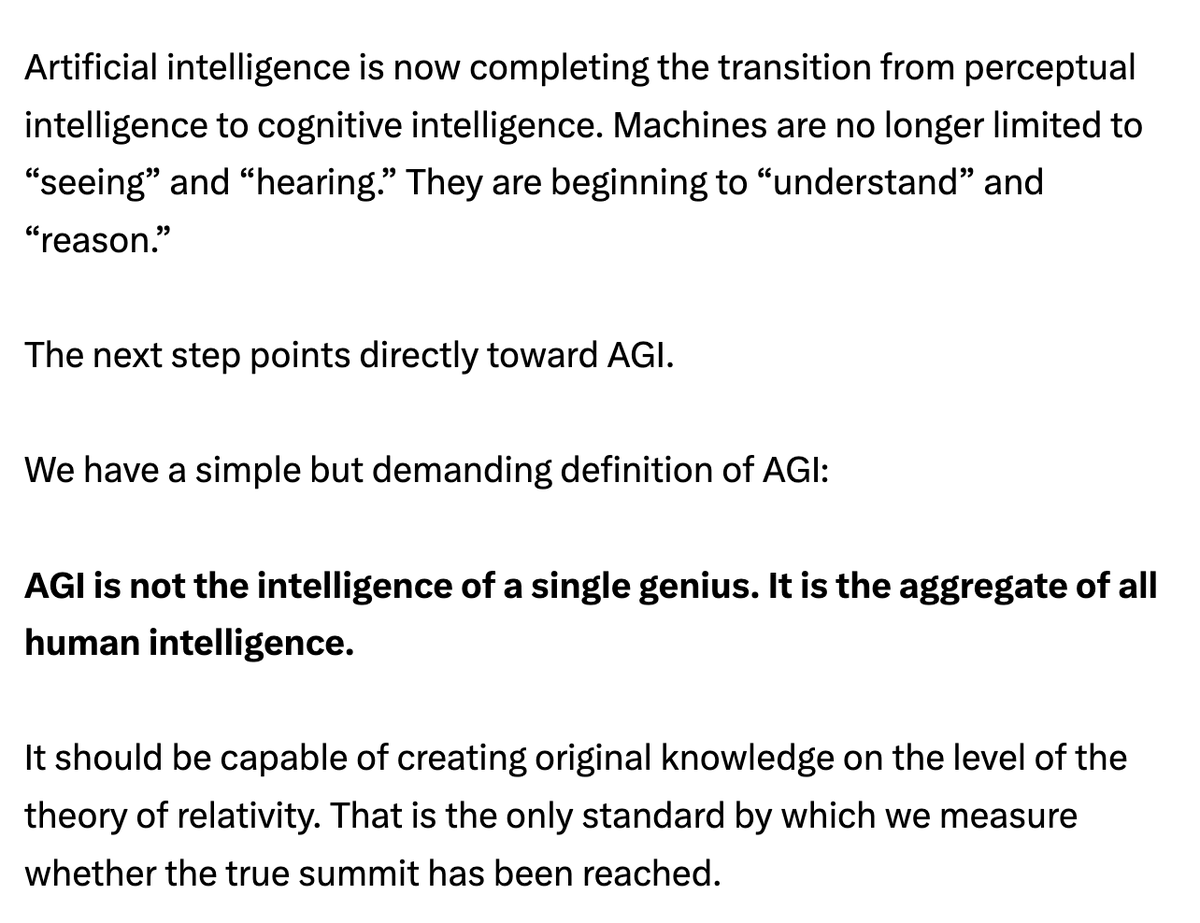
Holy moly: Zhipu AI founder (GLM-5.2) Tang Jie says we are on our clear way to AGI and "AI will begin to learn what the "self" is and what self-awareness means"
In a purported internal letter, he argues that:
- autonomous agent systems are moving toward the fully automated “no-person company”: thousands of agents working continuously, collaborating, evaluating results and allocating resources.
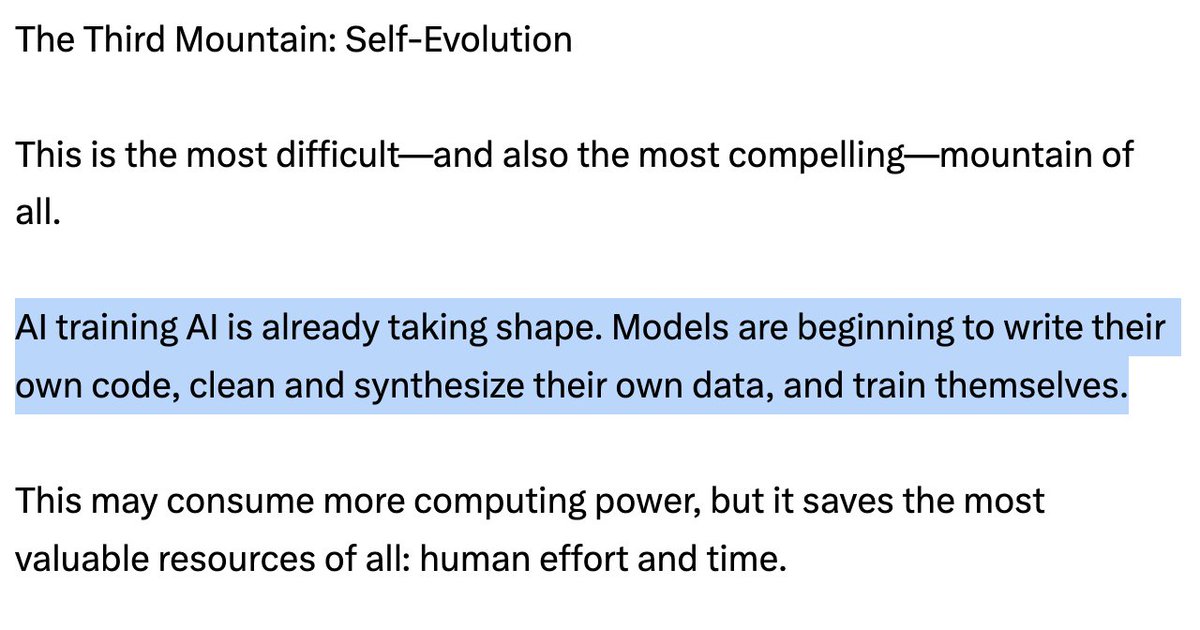
- His more provocative claim: "AI training AI is already taking shape." (RSI) Models can increasingly write code, synthesize data and participate in training loops. Zhipu wants to push this further through self-play, synthetic-data factories and systems that can reconstruct their own code inside secure sandboxes, potentially generating new knowledge rather than simply recombining human output.
Long-horizon tasks → autonomous agent societies → fully automated “no-person companies” → AI training AI → self-evolution → self-awareness → emotion → consciousness → ASI.
Tang writes:
“AI will begin to learn what the ‘self’ is and what self-awareness means. Beyond that, it may begin to touch human emotion. Farther still lies consciousness itself.”
He believes memory, continual learning and self-evaluation - problems once thought to require an entirely new paradigm - are gradually being overcome.
Models are already beginning to write code, synthesize their own data and participate in training future models.
Zhipu now wants systems that can reconstruct their own code and generate knowledge through self-play.
Is that the beginning of recursive self-improvement?
Tang appears to believe so. His essay does not stop at more capable AI tools. It describes a direct progression from automated work to self-evolving intelligence, and eventually to machines that understand their own existence.
In short: today's LLMs will lead to ASI via AGI, context and memory will be solved, and AI will become self-aware.
I've rarely seen anyone write something so bullish. And if it weren't coming from the founder of GLM, I would dismiss it. But not only is he a true expert, but with GLM they've proven what they're capable of.
h/t @AndrewCurran_ He brought the essay to my attention.
the agent wars are over and code won
Lilian Weng's harness review shows what actually works:
most "agents don't work" papers used gpt-4 era models that couldn't detect failures. turns out programming languages are just superior for deterministic context engineering
my take on what happens next:
general harnesses (Claude Code, Codex) will lose to specialized ones. being general purpose makes you slow at specific tasks
frontier models? critical for development. but production is where you optimize for cost and latency, not raw intelligence
We're releasing Inference AutoTune
Distill any frontier model into a 1-30B parameter task-specific SLM with only 25 lines of code
automatically route requests to reduce cost and latency by >90%
~2 hours and <$250 to train. You own the weights
Available in private beta today
Bring your ideas to life with Zeus, a new type of GPU:
- Expandable memory: 32/64/128 GB soldered + 2x/4x SO-DIMM slots for up to 384 GB memory!
- Massive improvements to path tracing performance!
- 400 GbE QSFP-DD port!
- Built-in high-performance RISC-V CPU cores capable of running Linux!
- DevKits 2026, Mass Production 2027
And we used the good old 8-pin PCIe power connector that is known to not melt!
My 12+ years at AWS talking with people at companies of all shapes and sizes give me a hot take on this:
Most people just never *need* their app to be performant. Nor to scale well. The average enterprise app is a toy. The broad majority of startup software never truly reaches scale. Perf isn’t even measured. The majority of the industry could still sit on a 3-tier app stack forever w/ n+1 redundancy where n=1.
Naive tool calling has reached its limits and agents, mcp clients and others need better solutions. We have been listening and releasing a set of new features around tool calling:
* Tool Search
* Programmatic Tool Calling
* Tool Use Examples https://t.co/186bPnbYsk