🦔AI companies are bulk-buying rare books, scanning them through high-speed machines that cut the spines off, and shredding the originals. A service called ISBNdb facilitates orders of up to a million books and keeps buyers anonymous. Pre-2022 books are premium because they're free of AI-generated text. A federal judge ruled the practice is fair use because eliminating the original means only one copy exists at a time. Anthropic hired the former head of Google Books partnerships to obtain "all the books in the world."
My Take
This got to me. A bookseller told 404 Media that rare books with almost no surviving copies are being fed into this pipeline. Books that survived wars, fires, and centuries of handling are being shredded so an AI can learn to write a better marketing email.
ISBNdb's website literally says "'AI company destroys two million books' is not a headline that generates sympathy," and they still built an entire business around making it happen quietly. They offer NDAs as a feature. They coach clients to call it "digital preservation."
I've covered AI companies scraping the internet, torrenting libraries, and stealing music. This is worse because it's irreversible. You can re-upload a website. You can reprint a bestseller. You can't replace the last three copies of an 18th-century botanical text once someone shreds them for training data. And the judge said it's legal. So it's going to accelerate.
"We shred rare books and offer NDAs so nobody finds out" is a legitimate business model in 2026. What a timeline.
Hedgie🤗
Der da besaß übrigens ein kleines privates Telefonbuch mit den Nummern aller Orts- und Landesvorsitzenden, kommunalen Größen und wichtigen innerparteilichen Akteuren - die er jede Woche anrief. Darum war er 16 Jahre an der Macht und hatte die Partei im Griff. Aber nicht nur deswegen: er wusste durch die Landschaftspflege auch, was die alle brauchen, wie die ticken und organisierte so Unterstützung und die Macht.
Typische Anlässe waren meist: Krisen in den Orts- oder Landesverbänden, bevorstehende Wahlen oder personelle Weichenstellungen.
Machtabsicherung, Machtausübung, menschliche Hilfe, Geben und Nehmen, personelle Entscheidungen um die Ecke denken, das ist das Salz in der Suppe des Handelns eines Kanzlers.
#Merz
🚨 In Xi Jinping’s CCP China, even a library Wi-Fi signal can become a government informant.
On July 21, Hunan Library announced that its monitoring system had detected readers using circumvention software to visit websites outside China’s censorship wall. The institution said the activity had been recorded by cyberspace authorities. It then published partially masked phone numbers belonging to three readers and shut down public Wi-Fi beginning July 22 for “rectification.”
The threats did not stop there. The library promised “zero tolerance,” permanent network bans for offending phone numbers, and referrals to police and cyberspace agencies in cases it deemed serious.
This was not network maintenance. It was political intimidation dressed up as cybersecurity.
The Chinese Communist Party (CCP) has built repression into the ordinary infrastructure of daily life. Official public-security guidance requires public Wi-Fi providers, including libraries, hotels, malls, hospitals, and tourist sites, to implement real-name authentication, audit user activity, retain logs, and provide authorities with compatible data interfaces. A phone number can connect a browsing session to a real identity. A router can become a checkpoint.
The method is brutally effective. First, block information. Then force citizens to identify themselves before going online. Monitor attempts to cross the firewall. Publicly expose enough personal information to frighten others. Finally, threaten police action until self-censorship does the regime’s work for it.
A library should open doors to knowledge. Under the CCP, it is being turned into another surveillance post guarding ignorance.
Governments, universities, companies, and travelers must understand the risk. Public networks in China should be treated as monitored environments. Sensitive accounts and data should be kept off them, and clean devices should be considered for travel.
The Hunan episode is not a technical anomaly. It is a warning: when a dictatorship fears what people might read, even free Wi-Fi becomes an instrument of control.
ACI — Aric Chen | Insights
Editor’s note: The video is a related news segment from the World News I anchor.
On July 13, 1936, yes, around this time 90 years ago, a young American journalist, introduced by Soong Ching-ling (宋庆龄), widow of Sun Yat-sen who founded the Republic of China, defied enormous political pressure from Chiang Kai-shek (蒋介石)'s government and broke through layer after layer of obstruction to reach a small place in northern Shaanxi called Bao'an (保安), now the County of Zhidan (志丹) under Yan'an (延安).
He had come to interview a group Chiang Kai-shek had branded as "bandits"-people outsiders were warned they might not come back alive from meeting.
That same day, he met Mao Zedong (毛泽东).
To him, Mao looked like Lincoln.
In the days that followed, the young American, Edgar Snow, interviewed Mao and other Chinese Communist leaders again and again. He and Mao talked deep into the night, many times, inside a cave dwelling that was far from spacious.
The next year, Snow published Red Star Over China.
It was not just a book of reportage. It was one of the first works to introduce Mao Zedong, the Chinese Communists, and their ideas to the outside world in a serious, direct, and vivid way.
The book caused a sensation around the world.
More importantly, it changed the way many people outside China understood the Chinese Communists.
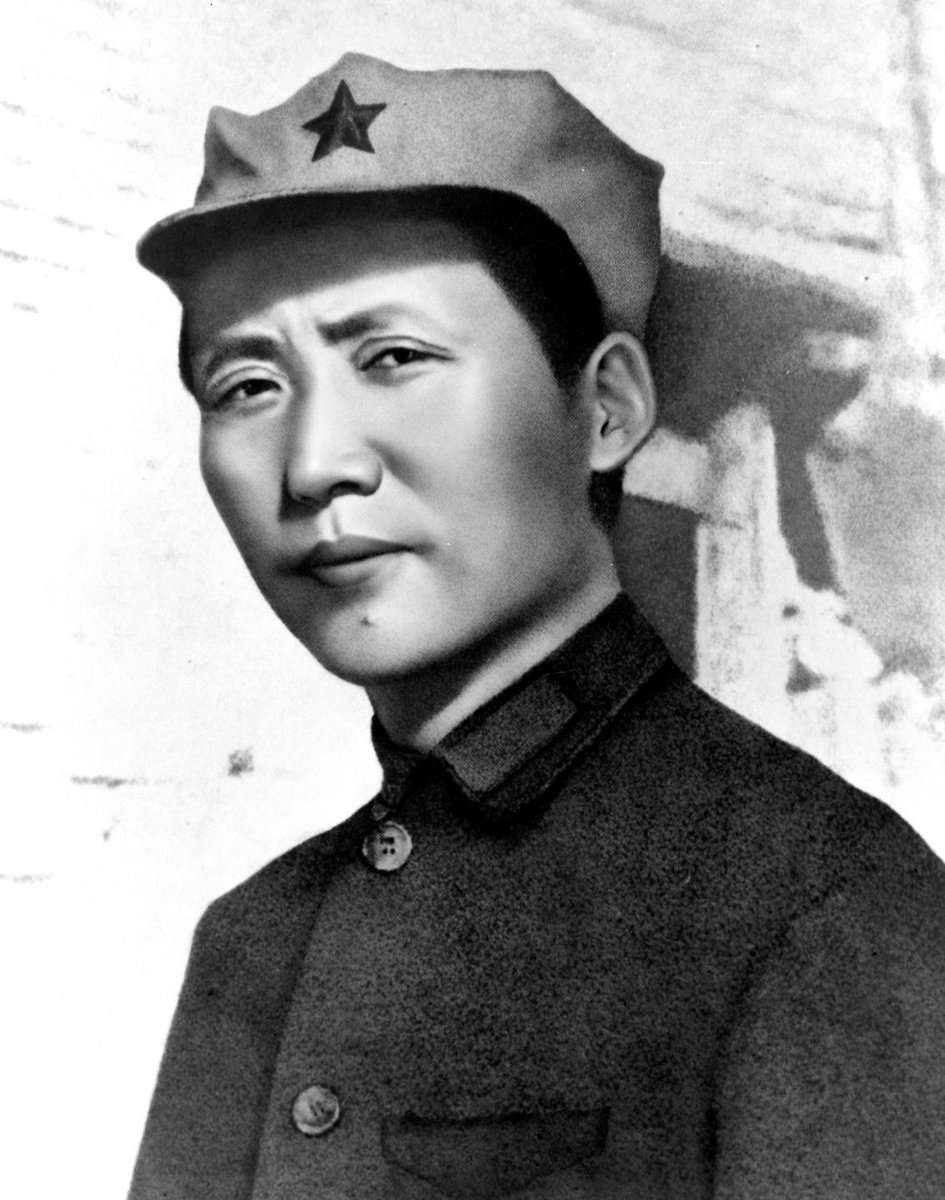
He insisted on photographing Mao Zedong, and asked him to put on a Red Army cap (top left). But Mao's own cap was old, soft, and collapsed out of shape. So Snow took off the brand-new military cap from his own head and placed it on Mao's.
It fit perfectly.
Snow kept that cap for the rest of his life. After his death, his family donated it to the National Museum of China.
In 1937, when Snow's wife went to Yan'an for interviews, she brought the photograph to Mao. Looking at it, Mao laughed and said:
"I never imagined that someone as untidy as me could look this good in a photograph. Thank you, Comrade Snow."
That photograph would later become one of the most iconic images of Chairman Mao, known in almost every Chinese household.
Yet most people still do not know it was taken by an American.
Red Star Over China did not merely record history. It changed history. Snow mattered not because he sympathized with the Chinese revolution, but because he entered northern Shaanxi as a true journalist-curious, skeptical, and professionally alert.
For so many readers, the most convincing thing was never that "he liked China." It was that he saw China, and was willing to tell the world honestly what he had seen.
At the beginning of 1941, Chiang Kai-shek was not only fighting the Japanese. He turned his guns on his nominal allies-the Communist-led forces. Snow reported the truth in the New York Herald Tribune.
Chiang got furious. Snow's press credentials were revoked. In February, he was forced to leave China and return to the United States.
Chiang's sister-in-law, Soong Ching-ling personally came to the airport to see him off. "You will come back. We think of you as a younger brother. You belong to China."
Snow replied that his body was leaving, but his heart remained in China. On February 24, shortly after Snow returned to the United States, he was received by President Franklin D. Roosevelt at the White House.
FDR greeted him with humor: I came to know you by reading Red Star Over China. You must be quite a China hand by now. Today, I'd like to be the reporter and interview you. How does that sound?”
Snow was disarmed by the president's warmth and ease.
Roosevelt asked what was really happening in China and how did the Chinese people think of Americans.
Snow answered that Chiang Kai-shek was a dictator-intelligent, but incapable. Chiang did not understand what the Chinese people truly needed, nor did he know how to govern for them.
In this, Snow said, Chiang was very different from Mao Zedong. China was an agricultural country. Peasants made up the overwhelming majority of its people. A man who did not understand the peasants could not govern China.
As for the Communist-led army, Snow told Roosevelt he had never seen a more heroic force: Their morale remained high. From generals to ordinary soldiers, they were confident of victory. Compared with the US military, their material conditions were almost nothing. But they had their own strategy and tactics. Their guerrilla warfare left the Japanese constantly on edge.
Roosevelt listened closely, and agreed.
In May 1944, during his second meeting with Edgar Snow, Roosevelt told him that promoting reconciliation between the Nationalists and the Communists had become an established policy of the United States.
Washington, FDR said, would also send a military observer mission to Yan'an.
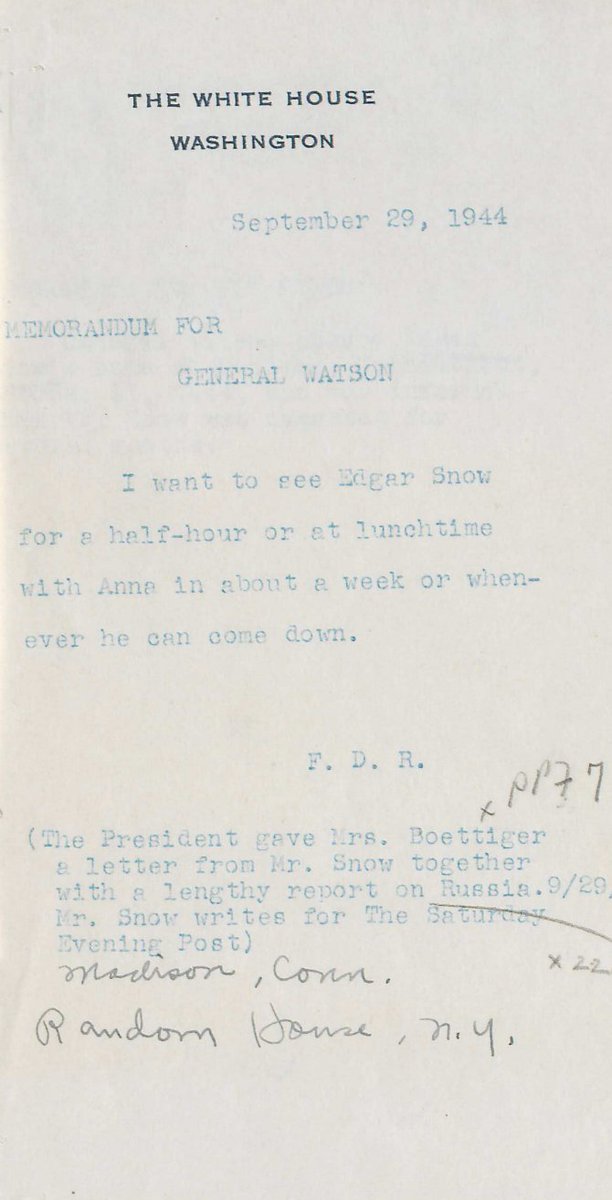
On September 29 that same year, Roosevelt told his aides that he hoped to meet Snow again, or have lunch with him soon (top right). On October 11, the White House called Snow's home, only to learn that he was abroad.
In early March 1945, Roosevelt met Snow for a third time.
He told Snow that the United States intended to elevate China's international status, placing it alongside the United States, Britain, and the Soviet Union, because China was too important, and America could not afford to lose China.
He also told Snow that the American observer mission in Yan'an had been treated with courtesy and respect, and that Washington was considering direct assistance to the Chinese Communists.
A little more than a month later, Roosevelt died suddenly.
As I have written before, FDR had a remarkably favorable impression of the Chinese Communists. He had even corresponded with Mao Zedong. His conversations with Snow also reveal a little-known but strikingly perceptive judgment about China.
Had Roosevelt lived longer, the history of China-US relations might have taken a very different path. Then came Truman, and he messed it all up.
MacArthur would later discover that he, too, could be Trumaned.
The Chinese never forget an old friend. In 1951, just two years after the CPC came to power in China, the Chinese government wrote to Edgar Snow, inviting him to visit and offering to cover his travel expenses.
Snow declined. He believed that accepting money might compromise the objectivity of his reporting.
In 1960, Snow finally returned to China for a visit that lasted nearly five months. On October 1, the National Day, he stood atop Tiananmen.
When he met Mao Zedong again, Mao greeted him:
"Long time no see."
Snow replied:
"Twenty-one years."
Then he joked: since then, your cave dwelling has expanded quite a bit.
Mao answered:
"But you and I have not changed."
Snow looked around and said:
"But China has changed completely."
On October 22, Mao invited Snow to his home at Zhongnanhai (中南海) for dinner (bottom left). The two men ate together and talked for nine hours.
Mao told him this was the first time since 1949 that he had spoken with an American.
China was going through a period of great hardship at the time. Snow noticed that Mao left the meat for his guests, while eating none himself.
But during that trip, what struck Snow most was not Mao. Not Tiananmen. It was an ordinary Chinese college student.
Her surname was Jiang.
She asked Snow: The United States has 200 military bases overseas. Why do young Americans tolerate this?
Snow's response was to prevent Communist invasion.
The young woman looked at him and asked, word by word:
"Have the Communists occupied Hawaii?"
"Have Chinese planes flown over American skies?"
"Have Chinese troops marched into Canada or Mexico?"
Snow fell silent. More than sixty years later, those three questions still hit hard.
In 1964, Snow visited China again. On January 9 the following year, Mao Zedong invited him to dinner at the Great Hall of the People. History has a funny way of rhyming: President Trump also came to China this May, and both Zhongnanhai and the Great Hall of the People were once again part of the story.
By then, China-US relations were already extremely tense. But Mao told Snow that he regretted the historical forces that had cut off contact between the Chinese and American peoples. But Mao did not believe the two countries would ultimately go to war, which Mao defined as one of the greatest tragedies in history.
Mao also told him that there was still hope for improving relations between the two countries. But it would take time.
In the summer of 1970, Snow came to China for the last time.
This time, he returned to Yan'an and revisited the cave dwelling where he had first met Mao. That was also where their friendship began.
On October 1, 1970, Mao reviewed the National Day parade from Tiananmen Gate.
Snow not only stood on the tower. He stood right beside Mao (bottom right).
Close to two months later, the photograph appeared on the front page of People's Daily, on the day before Mao's birthday.
At a time when China and the United States were locked in Cold War rivalry, yet quietly searching for rapprochement, this was a signal.
A signal sent to one man far away in Washington: Richard Nixon.
Most of the world did not understand it. Kissinger did.
On December 18, Mao and Snow met for the last time.
They had breakfast together and talked for five hours.
Mao told him this was not an interview. It was a conversation between old friends.
He said he had read Snow's reports, including those with which he disagreed. But he did not expect everyone to agree with him on everything.
"You have the right to keep your own views," Mao told him, "and to make your own independent judgments."
That was what made Snow different from many foreign observers. He neither demonized China nor romanticized it. What he tried to do was understand why China had become what it was.
He was not a foreign friend who only praised China. He had his own judgment. He kept his right to criticize.
China respected him not because he always agreed with China, but because he endeavored honestly to understand it.
During that meeting, Mao also revealed to Snow that he was prepared to invite Nixon to Beijing.
At that moment, only four months remained before Ping-Pong diplomacy would break the ice between China and the United States.
Only one year and two months remained before Nixon would set foot in Beijing. And only one year and two months remained before Edgar Snow would leave this world.
In 1971, Edgar Snow was diagnosed with pancreatic cancer in Switzerland.
Mao Zedong invited him to come to China for treatment, promising that he would receive the country's best medical care available. China even prepared a carefully arranged hospital room for him, along with first-class plane tickets for his entire family.
Snow declined the invitation. But China still sent a medical team to Switzerland to care for him.
They did more than treat his illness. They prepared a special diet for him, cooked the Chinese food he loved, and sat with him in conversation, doing everything they could to bring this old friend a little less pain, and a little more warmth, in the final days of his life.
On February 15, 1972, Edgar Snow passed away.
Less than a week later, Nixon arrived in China. Snow did not live to see the ice between China and the United States finally break.
But in truth, he had already helped break it. From Roosevelt to Nixon, Snow stood in one of the most difficult and most necessary places in the world: between China and the United States.
His life proved that history is not changed only by presidents, generals, and diplomats. It is also changed by those willing to cross through prejudice, enter unfamiliar lands, and tell the truth about what they see.
He helped the world see China more honestly. And he helped China remember an American who truly wanted to understand her.
How ALL Climate Models Failed to Represent Reality Revealing a Flawed CO2 Hypothesis!
It’s called the Holocene Conundrum! All the peer-reviewed proxy data from paleoclimatologists find that after the Holocene Maximum (10,000-6,000 years ago) temperatures cooled for the next 6,000 years until the end of the Little Ice Age in the 1800s. In contrast the CO2 driven climate models all suggested the earth warmed during that time. Why such a horrendous difference?
Graphic A shows terrestrial proxies, marine proxies, glacier extent, ocean temperatures ALL indicate 6000 years of a cooling Neoglacial. Whether Greenland ice cores or southeast Asia’s tropical waters, the cooling trend (Graphic B) is significant.
Combining all the proxy temperatures Marcott (2013) showed a very variable Holocene climate dominated by an overall cooling trend. In comparison, graphic C shows rising CO2 ppm for the past 7000 years did not stop the cooling.
Because the climate models’ algorithms give CO2 warming exaggerated weight, ALL the models recreate a constant Holocene warming trend as seen in the black and yellow trend lines of graphic D.
Clearly CO2 biased models have egregiously misrepresented climate warming for thousands of years and continue to falsely represent CO2’s effect on climate change now!
🚨 BRANKAS RAHASIA BERISI EMAS 74 KG DI SENTUL!
Polisi geledah rumah mewah dan nemu harta gila ini:
- 74 kg emas batangan tersimpan rapi di brankas tersembunyi balik dinding
- Uang tunai ratusan miliar rupiah (dollar AS + Singapura) dalam koper mewah
- Ditemukan saat geledah terkait korupsi PLN batu bara, Asabri, & Krakatau Steel
- Brankas super rahasia + koper branded Louis Vuitton jadi bukti
- Sebelumnya di Cafe de'Clan Cipete juga disita Rp60 miliar!
Gila yaaa, harta segini disembunyikan di balik tembok. Korupsi level sultan nih? Edan gak tuh!!💀🔥
Australia's Bureau of Meteorology has been audited station by station. The report reveals that the agency has systematically erased cooling trends from the historical record, replacing them with synthetic warming.
At Rutherglen, Victoria for example, raw data from 1913 to 2006 showed a cooling trend. But the Bureau's adjusted chart flips this into warming. No physical justification, just statistical sleight of hand.
Comparisons at Deniliquin also reveals the tactic - how past highs have been lowered to fit the narrative. Minimums from 1910 onward here are reduced by as much as 1.8C. These edits weren't based on new evidence. They were applied decades later by opaque homogenization models.
The report's author calls it the rewriting of Australia's temperature history. But it's not just happening in Australia. Climate agencies in the UK and US have also cooled the past so as to exaggerate or even fabricate modern warming trends.
This manipulated data is then paraded as truth by politicians and the media with the original measurements buried.
Taiwan solved tax evasion in 1951 with a trick so cheap it should embarrass every tax authority on the planet.
The problem was an all-cash economy full of small shops. A merchant pockets the cash, skips the receipt, and the sale never existed. Auditors can't catch what was never recorded, and hiring enough of them to watch every noodle stand costs more than the missing tax.
So finance chief Ren Xianqun flipped the incentive. Print a lottery number on every receipt. Draw winners every two months on live TV. Top prize today: NT$10 million, about $310K.
Suddenly the customer and the shopkeeper want opposite things. The merchant wants the sale off the books. The customer wants the ticket. And there are millions more customers than merchants. Every transaction now carries a built-in witness demanding the paper trail.
Year one, reported tax revenue jumped 75%, from NT$29 million to NT$51 million. Seventy-five years later, roughly 70% of Taiwanese still play. Convenience stores redeem the smallest NT$200 prizes at the register, so even a coffee receipt feels like a scratch card.
The elegant part is what the audit force costs. The prize pool runs about NT$7 billion a year, roughly $20 million. In exchange, the government gets 23 million unpaid auditors working every checkout line in the country, forever. No inspector general on earth delivers that coverage at that price.
Greece, Italy, Portugal, and Slovakia all copied it. The most effective compliance tool ever built looks like a game, and that's exactly why it works.
🇬🇧 THEY TOLD YOU A STORY. 🇬🇧
Colonisers. Slavers. Oppressors. And you were supposed to feel ashamed.
Not for what you done... But for WHO YOU ARE. 🇬🇧
So we tested it. Britain wrote everything down, so we opened the books. 📖
Turns out fewer than 1 man in 10 could vote in the year Britain banned the slave trade. No woman could. Your ancestors could hang for stealing a sheep, get shipped across the world for petty theft, or go down a mine at 8 years old. In Manchester, the average age of death in a labouring family was 17.
They weren't running the slave trade. They were underneath it too.
Which is what makes what happened next worth knowing.
In 1772 an enslaved man named James Somerset walked free from an English court, because English law couldn't hold a slave.
In 1791, 300,000 families just stopped buying slave sugar. No march, no riot, just a decision made at 300,000 kitchen tables.
In 1792, 519 petitions carrying 390,000 names hit Parliament, most signed by people who couldn't vote themselves.
In 1807, Britain banned the trade.
Then the slave owners sent Britain a bill for the 800,000 people they still held. 💷 £20 million. About 40% of the entire government budget at the time.
The Treasury says it wasn't paid off until 2015. So if your family paid British tax before then, they helped buy 800,000 people their freedom.
From 1808 the Royal Navy spent 60 years hunting slave ships at sea: 1,600 stopped, 150,000 people freed, and 1,600 British sailors dead, mostly of disease, buried thousands of miles from home. ⚓
In 1816 they ended two centuries of Barbary corsairs enslaving Europeans.
In 1896 a war that lasted 38 minutes ended slavery in Zanzibar. 🇹🇿
Almost every country on Earth outlaws slavery today.
That fight was paid for largely at British expense, by British hands.🇬🇧
So why haven't you heard any of this?
Because within living memory, someone rewrote the story. You got taught the crime. Not the cure.
The powerful exploited the world. They exploited their own people first. It was those people who ended slavery. 🇬🇧
━━━━━━━━━━━━━━
History got rewritten once, in living memory, by no one who was ever named or held to account.
We are ordinary people doing what ordinary people have always done. Opening the books. Refusing to look away.
This is how we fight back. Fact by fact. Story by story. Name by name.
We are the home of British heroes. There is a place for you in it.
If you can afford to support what we do: https://t.co/rih7iKwnvf
Be part of us. ☝️🇬🇧 Be Proud Of Us. 🙏🇬🇧
Komandan Operasi TPNPB West Papua, Hon. Lekagak Telenggen, menyatakan:
"Meninggalnya pilot tersebut merupakan dampak dari konflik politik yang berkaitan dengan perjuangan kemerdekaan West Papua. Menurut saya, Amerika Serikat bekerja sama dengan NKRI dalam pemanfaatan SDA Papua".
Intan Jaya, West Papua
Hundreds of Indigenous West Papuans took to the streets today to protest the recent killings of civilians and raids by the Indonesian military.
The killing of a heavily pregnant woman and her unborn child yesterday appears to have been the tipping point.
🇷🇺🇺🇦 Fuel lines stretching for miles in Russia's Far East, thousands of kilometers from the front line, as Ukrainian drone and missile strikes on oil terminals, refineries and pipelines work their way through the supply chains.
The Far East feeling it means the disruption has traveled the full length of Russia's geography and that's not a localized logistics problem anymore, that's a systemic one.
Source: CIG on Telegram / Writer: Oliver
Son of Iran’s former Ambassador to Venezuela flaunts his lavish lifestyle on Instagram as he caresses his girlfriend onboard private jet.
While the children of the Iranian regime live lavish lifestyles abroad, millions of Iranians struggle to survive on just $4 per day.
via Stefan Klinkigt:
WINDGERÜMPEL – DEUTSCHLANDS »ZUKUNFTSENERGIE«
Windräder unterliegen extremen dynamischen Beanspruchungen, wie man in diesem Video sehen kann. Daraus resultierten in der Vergangenheit u.U. schwere Fundamentschäden, was zur Folge haben konnte, dass die betroffenen Anlagen nicht einmal die Hälfte ihrer betriebsgewöhnlichen Nutzungsdauer erreichten und bereits nach weniger als 10 Jahren stillgelegt werden mussten. Ich habe vor 18 Jahren mal für den dänischen Windkraftanlagenhersteller Vestas gearbeitet und konnte solche Schrottanlagen selbst in Augenschein nehmen. Man redete damals nicht gern über solche Probleme, da man damit mögliche Investoren nicht verschrecken wollte. Stattdessen bot man den Betreibern Fundamentprüfungen und ggf. aufwändige und kostenintensive Sanierungskonzepte an.
Dem Problem des Fundamentverschleißes will man offenbar heute damit entgegenwirken – zurzeit baut man Windräder mit 7 MW Nennleistung und einer Gesamthöhe von über 280 m –, indem Fundamente mit martialischen Dimensionen verbaut werden: über 6.000 t wiegt ein solcher Stahlbeton-Koloss (nur das Fundament !!!) mit 32 m Durchmesser heute (zum Vergleich: Dresdens legendäre Stahlbrücke »Blaues Wunder« bringt ganze 3.500 t auf die Waage). Dennoch wage ich zu bezweifeln, dass man Materialermüdung durch die extreme Schwingungsbeanspruchung der Anlagen verhindern kann, auch wenn man bei heutigen Anlagen das oberste Turmsegment mittels vertikal verlaufender Spannstähle im Inneren der Stahlbetonsegmente mit dem Fundament verspannt.
Deshalb mein wiederholter Appell: Baut endlich moderne Kernkraftwerke, statt noch mehr von diesem grässlichen Windgerümpel in unser schönes Land zu pappen!
Viele Städte und Dörfer des deutschen Ostens haben ihre Massengräber, in denen ein Teil der Deutschen verschwand, die nicht rechtzeitig vor der Roten Armee und den nachfolgenden Besatzern oder Partisanen fliehen konnten. Eines davon wurde in Marienburg/ Westpreußen entdeckt.
Den deutschen Soldaten, die nach der Kapitulation ihre Waffen niedergelegt hatten, ging es oftmals nicht besser. Von den 2 Millionen ihrer Vermißten dürfte der größte Teil gegen und nach Kriegsende blindwütiger Mordpolitik zum Opfer gefallen sein.
Wie Spiegel Online am 3.4.2009 meldete, wurde in der kroatischen Gemeinde Harmica an der Grenze zu Slowenien ein weiteres Massengrab mit den sterblichen Überresten von schätzungsweise 4.500 deutschen Soldaten entdeckt. Den Ermittlungen des stellvertretenden Vorsitzenden des "Helsinki Komitees" ~ der kroatischen Menschenrechtsorganisation ~ Zvonimir Cicak zufolge seien diese Soldaten im Mai 1945 von jugoslawische Partisanen getötet worden.
Sein Verein habe der kroatischen Staatsanwaltschaft Knochen aus diesem Grab vorgelegt, die von Bauern bei der Arbeit auf ihren Äckern zutage gefördert worden seien, sagte Cicak weiter. Es sei ein Antrag zur Exhumierung der sterblichen Überreste gestellt worden. Nach diesen Informationen sollen sich unter den Getöteten rund 500 deutsche Offiziere befinden.
Am gleichen Tag berichteten einige Medien, daß nahe der kroatischen Stadt Cakovec, im Grenzgebiet zu Ungarn bei Bauarbeiten ein weiteres Massengrab mit vermuteten 1.500 Leichen entdeckt wurde. Bei diesen Toten handele es sich um kroatische Soldaten, die auf deutscher Seite gekämpft hatten und im Juni 1945 von jugoslawischen Partisanen umgebracht worden sind.
Nach Darstellung von Kroatiens Innenminister Tomislav Karamarko gibt es in Kroatien rund 840, im benachbarten Slowenien 600 und in Bosnien-Herzegowina etwa 90 solcher Massengräber.
Die Zahl der in jugoslawische Gefangenschaft geratenen deutschen Soldaten wird mit 200.000 bis 240.000 Mann angegeben, davon sollen etwa 80.000 Soldaten nach ihrer Gefangennahme ermordet worden sein.
Neben den deutschen Soldaten wurde von den Tito-Partisanen auch die deutsche Minderheit in Jugoslawien nahezu ausgerottet. Die Leichen dieser Zivilisten werden unzählige Massengräber füllen. Nach Schätzungen sind während der Vertreibung aus Jugoslawien mindestens 175.000 von ehemals ca. 500.000 Donauschwaben in Jugoslawien ermordet worden.
Keines dieser unverjährbaren Verbrechen ist jemals gesühnt worden! Kein Vertreter des "Weltgewissens" hat je Anklage erhoben!
Von den BRD-Politikern hat lediglich die Regierung Konrad Adenauer, wie dies im Bundestag am 27. Januar 1950 deutlich zum Ausdruck gebracht wurde, sich für die letzten deutschen Kriegsgefangenen in Jugoslawien - 1.400 ~ eingesetzt, die vor allem im Offizierslager Werschetz (dortige Todesquote = 40%) - noch 1949 in Schauprozessen mit Folterungen zu harten Strafen, z.T. zum Tode, verurteilt worden waren. Adenauer forderte die Hilfe des Kontrollrats zur Abstellung derartiger Praktiken und Rückführung dieser noch zurückgehaltenen Männer.
Über die bis zu diesem Zeitpunkt im Zuge "der Befreiung" nach Kriegsende von den Tito-Partisanen umgebrachten oder auf Grund unmenschlicher Behandlung verstorbenen 80.000 deutschen Soldaten und 175.000 zivilen Deutschen sowie den zusätzlich zu Tausenden ermordeten Kroaten, Slowenen und antikommunistischen Serben breitete sich indessen weltweit amtliches Schweigen aus.
Selbst hier ist die Geschichte noch lange nicht zu Ende erzählt...
Half a million Yezidis were facing Genocide by lSlS and the UN ignored them!
10,000 were killed,7000 were kidnapped and raped for refusing to convert to lsIam.
2599 still missing.
No one marched for them!
Not a single MusIim protested for missing Yezidis.
DANANTARA KATANYA PERUSAHAAN INVESTASI,
TAPI KOK NAMBAH UTANG MULU YA?
DALAM 1 TAHUN LEBIH SUDAH NGUTANG HINGGA 362 TRILIUN RUPIAH !!!
SUDAHLAH LAPORAN KEUANGAN GAK ADA, GIMANA RAKYAT NGAWASINNYA?
Banyak yang bingung.
Danantara disebut-sebut sebagai lembaga investasi raksasa dengan aset kelolaan lebih dari US$ 900 miliar setara Rp 14.000 triliun lebih. Tapi sejak berdiri Februari 2025, Danantara justru agresif mencari utang ke mana-mana. Gimana ceritanya?
DULU STARTUP, SEKARANG SUDAH BANYAK UTANG
Danantara berdiri 24 Februari 2025. Dalam waktu kurang dari 16 bulan, lembaga ini sudah mengumpulkan utang yang luar biasa besar.
Berikut rincian lengkapnya:
1. PINJAMAN BANK ASING — US$ 10 MILIAR (Rp 163 TRILIUN)
Ini pinjaman pertama dan terbesar. Danantara mendapat fasilitas kredit revolving senilai US$ 10 miliar dari 12 bank asing internasional. Lima lead arranger-nya adalah DBS, HSBC, Natixis, Standard Chartered, dan UOB. Yang bikin geleng kepala: pinjaman ini tanpa agunan apapun. Tidak ada jaminan saham BUMN, tidak ada gadai dividen. Alasannya? Danantara dianggap sendiri sudah merupakan "jaminan negara."
2. PINJAMAN DARI SWF NEGARA LAIN — US$ 7 MILIAR (Rp 114 TRILIUN)
Danantara juga mendapat komitmen co-investasi dari sesama sovereign wealth fund negara lain, dengan rincian: Qatar Investment Authority (QIA) sebesar US$ 4 miliar, China Investment Corporation (CIC) senilai US$ 2 miliar, dan Russian Direct Investment Fund (RDIF) sekitar US$ 1 miliar.
3. PATRIOT BOND (RUPIAH) — Rp 61 TRILIUN
Di dalam negeri, Danantara menerbitkan obligasi rupiah yang dijuluki "Patriot Bond." Terbit dua tahap: Oktober 2025 sebesar Rp 50 triliun dan Desember 2025 sebesar Rp 11 triliun. Kuponnya hanya 2% per tahun — jauh di bawah bunga pasar. Tenor Seri A lima tahun, Seri B tujuh tahun. Yang beli antara lain BUMN seperti Sampoerna.
4. GLOBAL BOND USD — US$ 1,5 MILIAR (Rp 24 TRILIUN)
Ini yang paling baru. Tanggal 11 Juni 2026, Danantara menandatangani transaksi global bond perdana senilai US$ 1,5 miliar kepada investor internasional. Terdiri dari dua tranche: US$ 750 juta tenor 5 tahun (yield 5,35%) dan US$ 750 juta tenor 10 tahun (yield 5,95%). Demand meledak orderbook tembus US$ 4,6 miliar atau 3 kali lipat dari yang ditawarkan.
Dana masuk rekening Danantara 18 Juni 2026.
TOTAL UTANG DAN KOMITMEN PENDANAAN EKSTERNAL DANANTARA
Pinjaman bank asing (12 bank): US$ 10 miliar / Rp 163 triliun
Komitmen SWF asing (Qatar, China, Rusia): US$ 7 miliar / Rp 114 triliun
Patriot Bond rupiah domestik: Rp 61 triliun
Global bond USD Juni 2026: US$ 1,5 miliar / Rp 24 triliun
Total keseluruhan: setara lebih dari Rp 362 triliun
LALU KENAPA LEMBAGA INVESTASI PERLU PINJAM UANG?
Nah itu dia,
Yang jadi catatan kritis adalah soal dari mana utang ini akan dibayar.
Rencananya adalah dari dividen BUMN yang setiap tahun masuk ke Danantara, plus return dari investasi yang dikelola.
Artinya, kalau investasi Danantara tidak perform, bebannya bisa merembet ke BUMN dan ujungnya ke keuangan negara.
Ditambah lagi, sebagian dana global bond ini diakui sendiri oleh Danantara akan digunakan untuk refinancing pinjaman US$ 1 miliar yang sudah mereka tarik sebelumnya.
Jadi ada skema pinjam-untuk-bayar-utang-lama yang perlu diawasi ketat.
Dan yang menarik:
Bloomberg melaporkan Danantara juga tengah menjajaki penerbitan obligasi rupiah berbunga rendah 3%, jauh di bawah bunga pasar.
Ini memunculkan pertanyaan siapa yang akan dipaksa atau "didorong" untuk membeli obligasi tersebut.
Yang perlu diawasi publik adalah transparansi penggunaan dana, kualitas investasi yang dibuat, dan apakah beban utang ini tidak akhirnya jatuh ke pundak rakyat lewat BUMN dan APBN.
Dalam 16 bulan, Danantara sudah pinjam lebih dari Rp 362 triliun.
Pertanyaannya bukan hanya "dari mana uangnya"
tapi "uangnya pergi ke mana,
dan siapa yang akan menanggung kalau rugi?"