Main Street and Wall Street are ignoring the Strait of Hormuz oil crisis. That complacency has a poor historical track record.
According to the IEA's oil market report of May 13, roughly 12.8 million barrels per day are missing from global supply, with Gulf countries shipping about 14.4 million barrels per day less than before the war began in late February. That is not a rounding error.
In the short term, strategic reserves are covering the gap. The U.S. is relatively well positioned — supplied reliably by Canada and the prolific Permian Basin shale fields, and a net oil exporter with the option to cancel exports entirely if domestic shortages emerge. China holds many months of supply in strategic storage.
But oil markets aren't waiting for a shortage to arrive. Sellers of gasoline and diesel in the U.S. have already used higher world prices as cover to raise prices at the pump — averaging around $4.25 per gallon in early June, just as the summer driving season begins. Consumers will notice. When they do, they will cut spending elsewhere.
Economists call it demand destruction — the point where consumers simply buy less of an expensive product. So far the impact has been modest, less than 4 million barrels per day worldwide. The shift to hybrids and electric vehicles is accelerating, but that won't move the needle this summer. *links in replies* #whenthebubblebursts
Chinese seaborne crude imports now down ~50% from pre-war levels, according to latest Kpler tracking.
Beijing doing more to balance the Hormuz-starved oil market than the rest of the world combined and no one knows exactly how long they can—or are willing to—keep it up.
I’m not going to amplify Reform’s ad by sharing it, but the wilful misrepresentation of Kemi Badenoch - selectively quoting what she said about ‘white lives matter’ - is disgraceful and dangerous.
It needs to be challenged, including by those of us who are not Conservatives.
@democrat_good@JohnWake list all residential and commercial properties, with the names of all owners, with beneficial owners of all trusts and #companies. history of all sales with prices and dates. this would affect a very small number of people negatively.
CMHC is no longer the entity you think it is.
While not explicitly stated, their mandate has clearly shifted from facilitating home purchases for first-time buyers to instead providing ultra low rate, favorable lending terms for construction and acquisition of rentals
@jared_shult@adammocklerr he is listed at 75 inches tall. there's no way.
I have met both of the other two in this photo and they are in the 5' 8 to 5' 9 range. this is at Mar a Lago in golf shoes.
@ronrule it's the cost of land that is up most than inflation and wages. the cost of building has increased with inflation, but the total cost has far surpassed inflation.
are 2 new entrants into the $ trillion market cap guaranteed a position in the Mag 7 club? Does it become the Mag 9? or do 2 get dumped? Members are MSFT, AAPL, Meta, Nvidia, Tesla, GOOG, and Amazon.
Broadcom isn't in but has a 2 trillion value. So new members should need to be bigger than that to qualify. maybe it's doesn't matter who is in.
sooner that most people thought Anthropic starts the paperwork process. if SpaceX goes well, Anthropic will come soon after. around $1 trillion valuation perhaps.
The stock market is about to face a $4 trillion test it has never seen before.
Three companies — SpaceX, OpenAI, and Anthropic — are preparing to go public in the coming months, together seeking roughly $4 trillion in new capital from investors. To put that in perspective, the total of all U.S. IPOs from 1980 to 2025, adjusted for inflation, was about $12.5 trillion. These three deals alone represent nearly a third of that half-century total.
This is happening at a time in the market that many believe is in bubble territory — larger than the dotcom boom of 2000 and arguably rivalling the peak of 1929 that preceded the Great Depression. Yet the S&P 500 keeps reaching new record highs, and every previous stress test has been passed with ease.
What makes this moment stranger still is what didn't happen on the way up. In past bubbles — especially 1999-2000 — companies raced to sell stock into a rising market. This time, companies have been buying back more shares than they issued. The IPO pipeline has been almost dry. Until now.
Retail investors who think they can sit this out may be surprised. ETFs tracking major indexes will be forced to buy these newly public companies automatically — and in very large amounts.... *links in replies* #whenthebubblebursts
it's mostly the autos. bigger cars (trucks), longer commutes, cheaper gasoline and diesel. Could be improved quickly by converting to electric drive vehicles. 9 million bbls/day to feed those gas guzzlers.
1. Gasoline use. (Longer drive x bigger cars and SUVs.)
2. Residential building energy. (Larger home space per capita, higher levels of AC, higher heating use per capita due to larger homes, more and bigger appliances, more detached homes which are less efficient.)
almost every headline about Canada's technical recession reads like it just started. but a recession is only recognized after 2 quarters of negative growth. this one is very mild, but it started at least 6 months ago, possibly longer,depending on subsequent revisions.
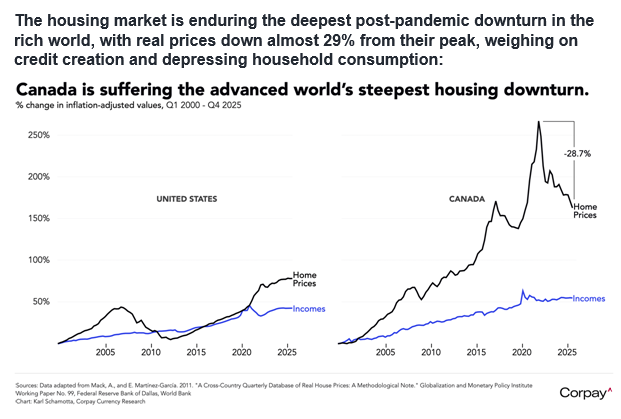
In case anyone still doubts that the bursting of Canada´s housing bubble still has a long way to go, our friends at Corpay put out this graph comparing Canada and the US. the normalization of house prices to incomes will take a few more years, and it´s been 4 years so far.
@PHfloor Canada did the opposite, relaxed the rules to allow zero down payment and 40 year amortization on the mortgage. banks were given massive liquidity.
it's in the book.