Super excited to share our two papers published in Nature today! 🧬 We use ancient genomics to explore how Germanic and Celtic languages spread across Europe. Here's a video of our findings, produced by Nicolas Delgado Clausen!
https://t.co/iJQeiwsauB
@pontus_skoglund We chose to delay publication of our paper by ~18 months to coincide with our companion Celtic paper. I hope this helps clarify the timeline. Twigstats looks very cool, I've been meaning to try it out!
@pontus_skoglund These dates, together with the received and accepted dates of the Nature papers, make it clear that the studies were conducted in parallel. We appreciate that the final publication dates give a different impression.
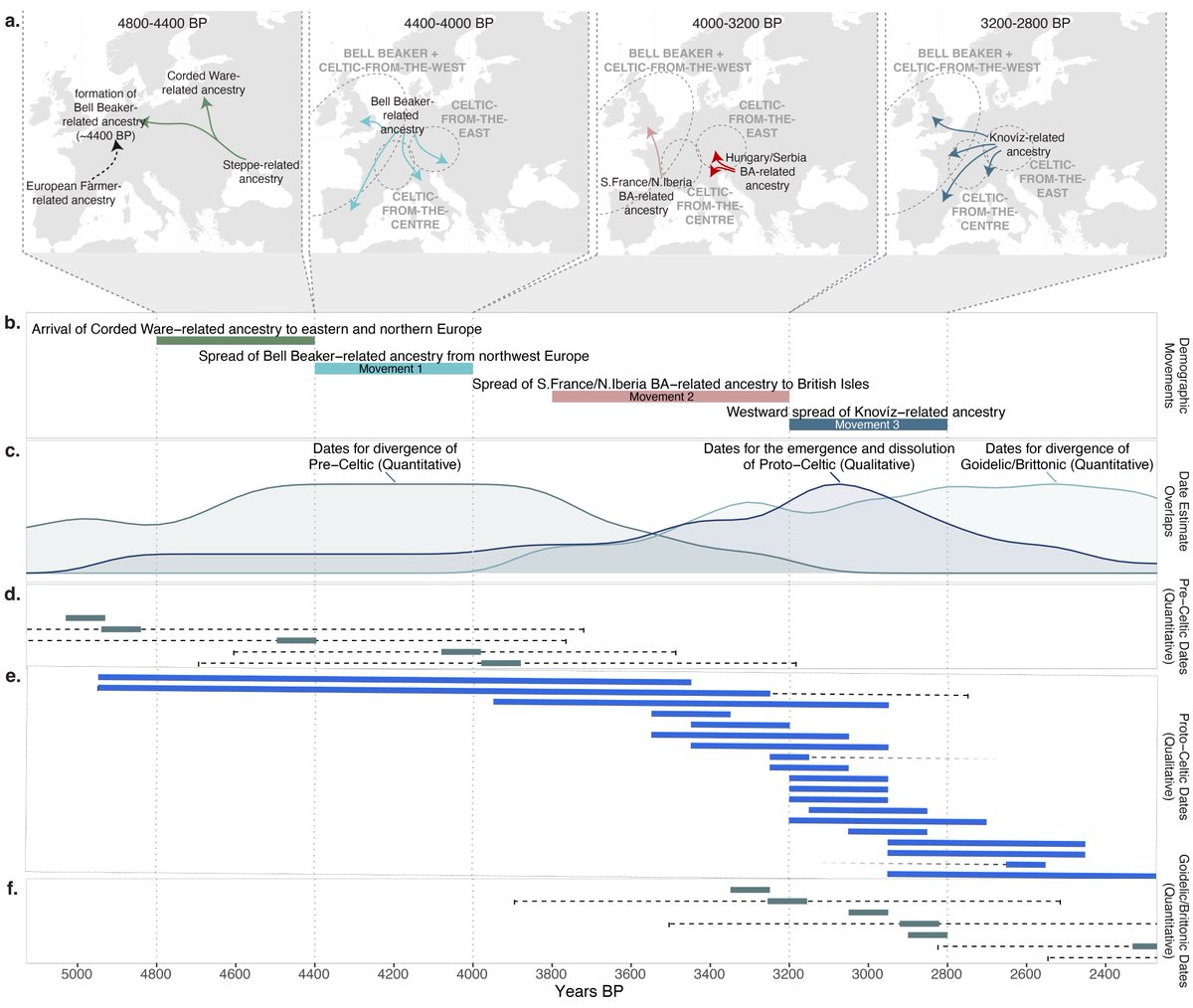
We found a movement from Central Europe ~3,000 years ago, spreading west into France, Britain, Ireland and Iberia. This provides a compelling explanation for the spread of Celtic languages, challenging theories of an Atlantic origin
Super excited to share our two papers published in Nature today! 🧬 We use ancient genomics to explore how Germanic and Celtic languages spread across Europe. Here's a video of our findings, produced by Nicolas Delgado Clausen!
https://t.co/iJQeiwsauB
Further west, Celtic languages survive mainly in Ireland, Wales, Scotland and Brittany. But where did they come from? For over a century, scholars have debated whether Celtic languages originated along Europe's Atlantic coast or farther east.
https://t.co/M4x3Pn4RED
Do you like riddles(and molecular biology)? Maybe you can help me solve this one.
We’ve found a short piece of DNA (plasmid) present in almost all plague samples from the Second Plague Pandemic (1338-1840), but absent in all earlier or later plague cases.
https://t.co/p1TncByDI5
Excited to share our preprint on the spread of megaliths in Neolithic Europe. Trade networks formed in the wake of migrations, and megaliths then spread within those networks. On their own, migration and cultural diffusion tell an incomplete story. https://t.co/f7q2HCgL0p
A little bit of reading material for your easter vacation: We found evidence of a population collapse in France 5,000 years ago in our new paper in Nature Evology and Evolution. Check it out!
https://t.co/3RSR6m9zOe
#NeolithicDecline#ancientDNA
Celtic languages are now limited to NW Europe, but they were once far more widespread. How did they spread? I'm excited to have contributed to this new ancient DNA study led by @hmcccoll exploring exactly that. 🧬 1/n
https://t.co/aYUqB6fLQr
Keen to work on the co-evolution of domesticates, humans and their pathogens? Come join us at Globe Institute, University of Copenhagen! We're hiring a postdoc in ancient genomics for a super cool project on Neolithic Sweden:
https://t.co/CJtFj7JpJ2
#AcademicJobs#AncientDNA
Our paper is finally out: Genetic and training adaptations in the Haenyeo divers of Jeju, Korea: Cell Reports
@ras_nielsen @andrewhvaughn https://t.co/JE7eTBhTGd
aDNA/aeDNA folks: tired of eyeballing hundreds of damage plots? I am excited to introduce AdDeam—a tool to rapidly generate damage profiles, cluster them, and spot outliers. https://t.co/O87oFP6iL6
Exploring the power of IBD, we took a fresh look at the Celtic linguistic dispersal. Following up on Patterson et al. 2022, we found not one, but two ancestry pulses into M/LBA Britain during the M/LBA: one from France/Iberia and another from C Europe.
https://t.co/bpLtKoTzDw