Super excited to share our two papers published in Nature today! 🧬 We use ancient genomics to explore how Germanic and Celtic languages spread across Europe. Here's a video of our findings, produced by Nicolas Delgado Clausen!
https://t.co/iJQeiwsauB
Happy to see my work with Regev Schweiger @Regevschweiger and Richard Durbin @richard_durbin now published in Genetics! Link to paper: https://t.co/eNazf4MMCB (open access). A thread on the main ideas....1/n
@petits_boules@hmcccoll If you read on, you'll see that's exactly what is argued in the paper :)
Some (most) ideas do clearly move without the movement of people though!
How megaliths spread along the Atlantic seaboard has long been debated: was it an idea that spread, or did people actually move and bring this technology with them?
A new preprint by @hmcccoll shows that neither explanation is exclusively right.
https://t.co/zrSiks51R6
So, some demic diffusion and some cultural diffusion. It seems like the Cardial-related ancestry formed the basis of long-distance trade networks, which later allowed a small number of seafaring people to spread the megalith building technology.
Great work @hmcccoll!
They found that megaliths were spread within regions of Cardial-related ancestry, but only in the British Isles/Ireland coinciding with the migration. Elsewhere megaliths diffused across groups whose long-distance trade networks formed in the wake of earlier population movements.
@Imirrr422294@IanBurkePerry@gregoryconnor11 Yep, the idea behind controlling for genetic relatedness is to discount the observed changes being driven by changes in ancestry. True selection should be independent of this. Changes via ancestry are also interesting but a separate (and less biologically interesting!) question
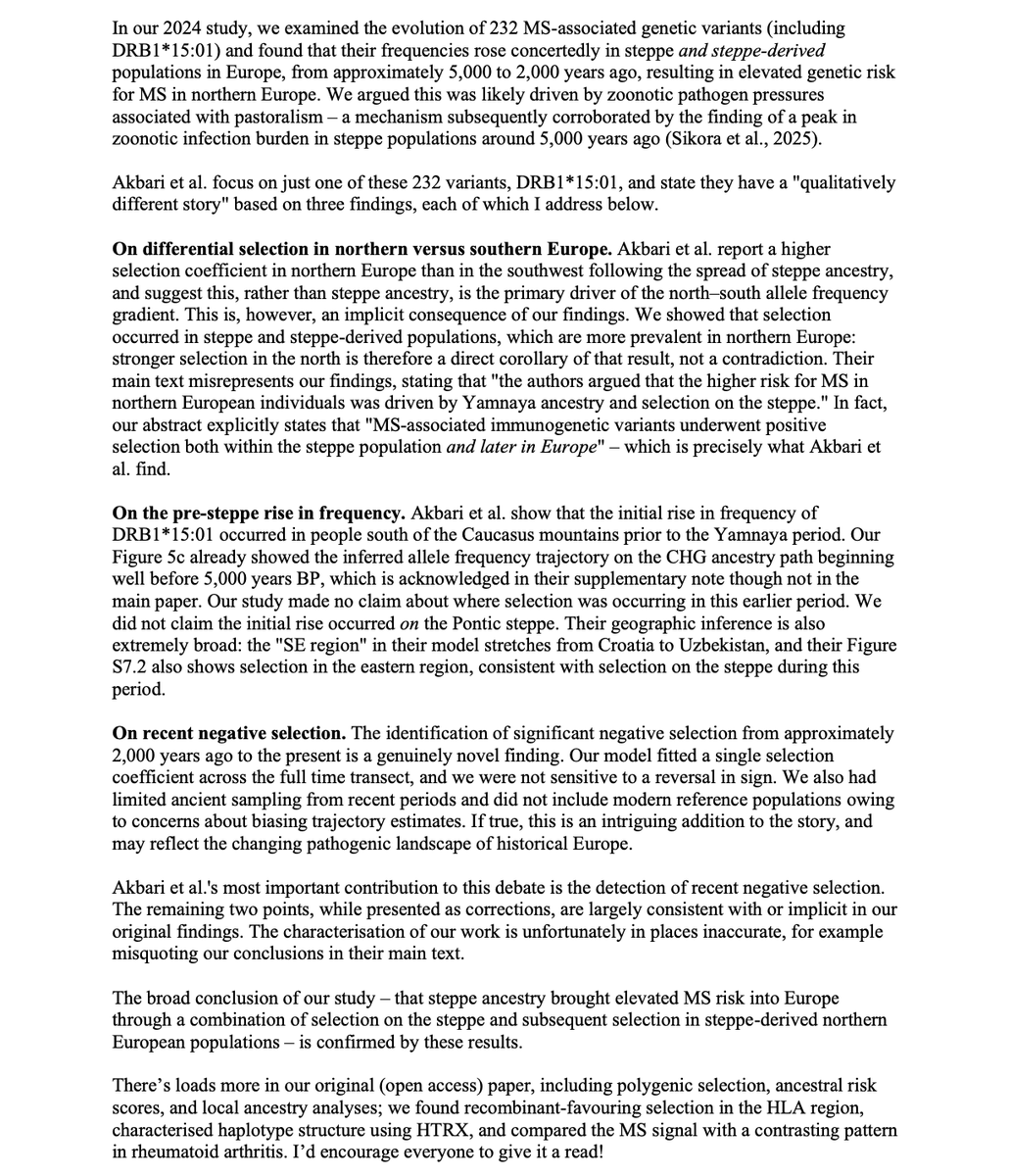
Great to see that Akbari et al devote part of their paper (and 1/8 supplementary notes!) to assess our 2024 findings regarding selection on DRB1*15:01. They largely confirm what we found, but this is not how their findings are presented. So, I thought I’d write a short rebuttal:
NEW Analysis of ancient DNA from monumental tombs in Neolithic northern Scotland suggests they were physical embodiments of prehistoric kinship, tracing lineages over centuries.
🆓 https://t.co/yZV2FRVfjJ
@cardiffuni@UniofNewcastle
@oldstiffcranky DRB1*15:01 binds a range of pathogens, any one of which could have driven its positive selection. We are just beginning to untangle all of this!
I wrote a short review article on the evolutionary origins of MS from an aDNA perspective. This link gives free access. My key points🧵:
https://t.co/Z8BVi8aw0O
@oldstiffcranky Yes, Bjornevik et al 2022. It's necessary but not sufficient, likely due to some molecular mimicry between an EBV transcription factor and CNS proteins which both bind DRB1*15:01. However, EBV isn't necessarily the reason DRB1*15:01 was selected in Steppe populations -