So let me start. DeFi is the future of the World Financial System. That's my belief, and this is why we are here.
This amount of absolutely preventable hacks we see in DeFi (with root causes attributable to CENTRALIZED points of failure) is enormous recently. This damages out industry, and I build for this industry. So I cannot remain silent.
Imagine an average grandma (mass adoption is here?) putting her life savings on Aave. And then BOOM, she cannot withdraw her funds on Monday. Aave (the biggest DeFi protocol btw) said it's operating as intended - just rsETH got exploited. rsETH said that all code is safu - just LayerZero bridge got hacked. LayerZero (the biggest bridge securing quarter of a trillion $) said that everything operating as intended. Yet, she cannot withdraw here funds. WTF? Are we industry of clowns?
But here's the thing. All issues like this should be prevented BEFORE they happen, not AFTER. Number of single points of failure should be reduced, not increased. When these points of failure are unavoidable - trust should be split. If there's a reliance on infrastructure - we should share best practices how to configure it. Not to mention that code should be very well checked - everyone gets that already.
We should probably come together and develop safety standards for DeFi. How to build safely, and how to verify safety. Probably everyone should bring their best practices, and the projects, auditors and risk assessment groups should know them. Maybe we need @ethereumfndn and @SolanaFndn bringing all the ecosystem projects to participate and come up with principles, rules and recommendations of safe building. And, perhaps, we can even learn something about protecting the few remaining centralized points of failure from traditional finance who have many more of those.
DeFi will win
Two years ago, I wrote this post on the possible areas that I see for ethereum + AI intersections: https://t.co/y8G3MD5APF
This is a topic that many people are excited about, but where I always worry that we think about the two from completely separate philosophical perspectives.
I am reminded of Toly's recent tweet that I should "work on AGI". I appreciate the compliment, for him to think that I am capable of contributing to such a lofty thing. However, I get this feeling that the frame of "work on AGI" itself contains an error: it is fundamentally undifferentiated, and has the connotation of "do the thing that, if you don't do it, someone else will do anyway two months later; the main difference is that you get to be the one at the top" (though this may not have been Toly's intention). It would be like describing Ethereum as "working in finance" or "working on computing".
To me, Ethereum, and my own view of how our civilization should do AGI, are precisely about choosing a positive direction rather than embracing undifferentiated acceleration of the arrow, and also I think it's actually important to integrate the crypto and AI perspectives.
I want an AI future where:
* We foster human freedom and empowerment (ie. we avoid both humans being relegated to retirement by AIs, and permanently stripped of power by human power structures that become impossible to surpass or escape)
* The world does not blow up (both "classic" superintelligent AI doom, and more chaotic scenarios from various forms of offense outpacing defense, cf. the four defense quadrants from the d/acc posts)
In the long term, this may involve crazy things like humans uploading or merging with AI, for those who want to be able to keep up with highly intelligent entities that can think a million times faster on silicon substrate. In the shorter term, it involves much more "ordinary" ideas, but still ideas that require deep rethinking compared to previous computing paradigms.
So now, my updated view, which definitely focuses on that shorter term, and where Ethereum plays an important role but is only one piece of a bigger puzzle:
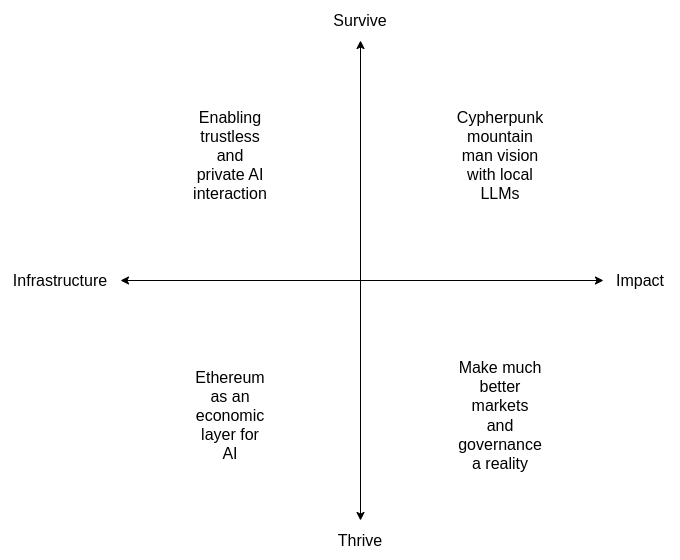
# Building tooling to make more trustless and/or private interaction with AIs possible.
This includes:
* Local LLM tooling
* ZK-payment for API calls (so you can call remote models without linking your identity from call to call)
* Ongoing work into cryptographic ways to improve AI privacy
* Client-side verification of cryptographic proofs, TEE attestations, and any other forms of server-side assurance
Basically, the kinds of things we might also build for non-LLM compute (see eg. my ethereum privacy roadmap from a year ago https://t.co/KdsQbpIkF9 ), but for LLM calls as the compute we are protecting.
# Ethereum as an economic layer for AI-related interactions
This includes:
* API calls
* Bots hiring bots
* Security deposits, potentially eventually more complicated contraptions like onchain dispute resolution
* ERC-8004, AI reputation ideas
The goal here is to enable AIs to interact economically, which makes viable more decentralized AI architectures (as opposed to non-economic coordination between AIs that are all designed and run by one organization "in-house"). Economies not for the sake of economies, but to enable more decentralized authority.
# Make the cypherpunk "mountain man" vision a reality
Basically, take the vision that cypherpunk radicals have always dreamed of (don't trust; verify everything), that has been nonviable in reality because humans are never actually going to verify all the code ourselves. Now, we can finally make that vision happen, with LLMs doing the hard parts.
This includes:
* Interacting with ethereum apps without needing third party UIs
* Having a local model propose transactions for you on its own
* Having a local model verify transactions created by dapp UIs
* Local smart contract auditing, and assistance interpreting the meaning of FV proofs provided by others
* Verifying trust models of applications and protocols
# Make much better markets and governance a reality
Prediction and decision markets, decentralized governance, quadratic voting, combinatorial auctions, universal barter economy, and all kinds of constructions are all beautiful in theory, but have been greatly hampered in reality by one big constraint: limits to human attention and decision-making power.
LLMs remove that limitation, and massively scale human judgement. Hence, we can revisit all of those ideas.
These are all things that Ethereum can help to make a reality. They are also ideas that are in the d/acc spirit: enabling decentralized cooperation, and improving defense. We can revisit the best ideas from 2014, and add on top many more new and better ones, and with AI (and ZK) we have a whole new set of tools to make them come to life.
We can describe the above as a 2x2 chart. There's a lot to build!
🚀Big news! @MistTrack_io MCP is now live for testing!
You can now use natural language in #Claude, #Cursor, and other MCP-supported clients to call #MistTrack’s on-chain analysis APIs — from address profiling & risk scoring to fund flow graphs.
🧐Smarter, faster, and easier blockchain investigations — powered by AI.
✍️In our latest post:
🔹What is MistTrack MCP
🔹How to use it
🔹Core features
🔹Real use case examples
https://t.co/Fvn2YZIuoI
👋Ready to explore the new AI paradigm for on-chain tracing? Start here:
https://t.co/UCDcC9Dt51
#Web3 #AI #BlockchainSecurity #MCP
There have been questions regarding Meteora and my involvement in $LIBRA, so I want to explain our role and share why we work with 3rd parties.
Meteora and I personally, have never received or managed any tokens on the side, do not receive knowledge or get involved with any offchain dealings, and we keep to the highest levels of confidentiality for any token launch happening on our platform.
To maintain the high levels of confidentiality, very few people in Meteora have access to any launch information. Often, the launch time is only known by me and the token/pool address is only given to me and an on-call engineer or two a few minutes before an actual launch, if at all.
Meteora’s DLMM and Dynamic AMM is a complex permissionless system with an incredible number of configuration options for teams looking to launch with it. There are various ways to lock liquidity, assign custody, design liquidity curves, and different ways to combat snipers including using our Alpha Vault. I often personally provide tech support for launches to help teams navigate the product. Mistakes can seriously impact a launch and it’s important to Meteora to help teams by configuring the product correctly.
We recognize that the complexity of the DLMM and the need to hand hold teams through its use is a problem. One mistake was not prioritizing a launch product so that teams would not need to rely on hand-holding to be successful.
When non-crypto natives (e.g. celebrities, politicians, etc.) want to launch a token, they typically need to hire a “deployer” and/or market-maker, which is a service we do not provide. These deployer teams are typically experts in using Meteora’s SDK or CLI and can design more sophisticated launches, as our tech allows for tons of customization. In the past, if a project did not have those resources, they would often ask me for deployer and/or market-making referrals.
Hayden Davis of Kelsier Ventures is one of the deployer/market makers that I have referred projects to over the past few months. There was nothing exclusive or unique about our relationship with Kelsier.
When we launched our new memecoin AMM platform in December 2024, I asked Hayden and Kelsier Ventures if they would be interested in launching a token on the M3M3 platform in order to provide an initial case study on how it worked. And, while they deployed and launched M3M3 on their own, post-launch we decided on a new set of tokenomics and facilitated a grant for the Meteora community as well as to establish a long-term foundation for M3M3.
After this successful, if somewhat challenging launch, they appeared to be trustworthy and I referred them to a handful of other projects that had inquired with us about deployer firms, which included the team behind $MELANIA. As with other projects, our role was limited to IT support and the tech we built for token launches. Like with any other unaffiliated token that lives on Meteora, we did not purchase, receive or manage any tokens on the side related to $MELANIA.
For $LIBRA, although we were made aware of the possibility of it several weeks ago by Hayden, we had no involvement in the project at all beyond providing IT support, including commenting on the liquidity curve and helping verify the token’s authenticity after the token was publicly launched.
Neither I nor the Meteora team compromised the $LIBRA launch by leaking information, nor did we purchase, receive, or manage any tokens.
I hope this clarifies what we do and how we have interacted with teams looking to launch major tokens on Meteora.
I’ll be here to answer any questions you have.
Today was the launch of the ambitious Viva la Libertad project to help private enterprises in Argentina, and the $LIBRA currency has been a success. We want to thank everyone for their trust and support.
To address all questions: we would like to clarify that this is a private enterprise project, President Milei was not and is not involved in the development of this project, as he has mentioned himself. This is an entirely private enterprise.
Thank you for being part of this great beginning!