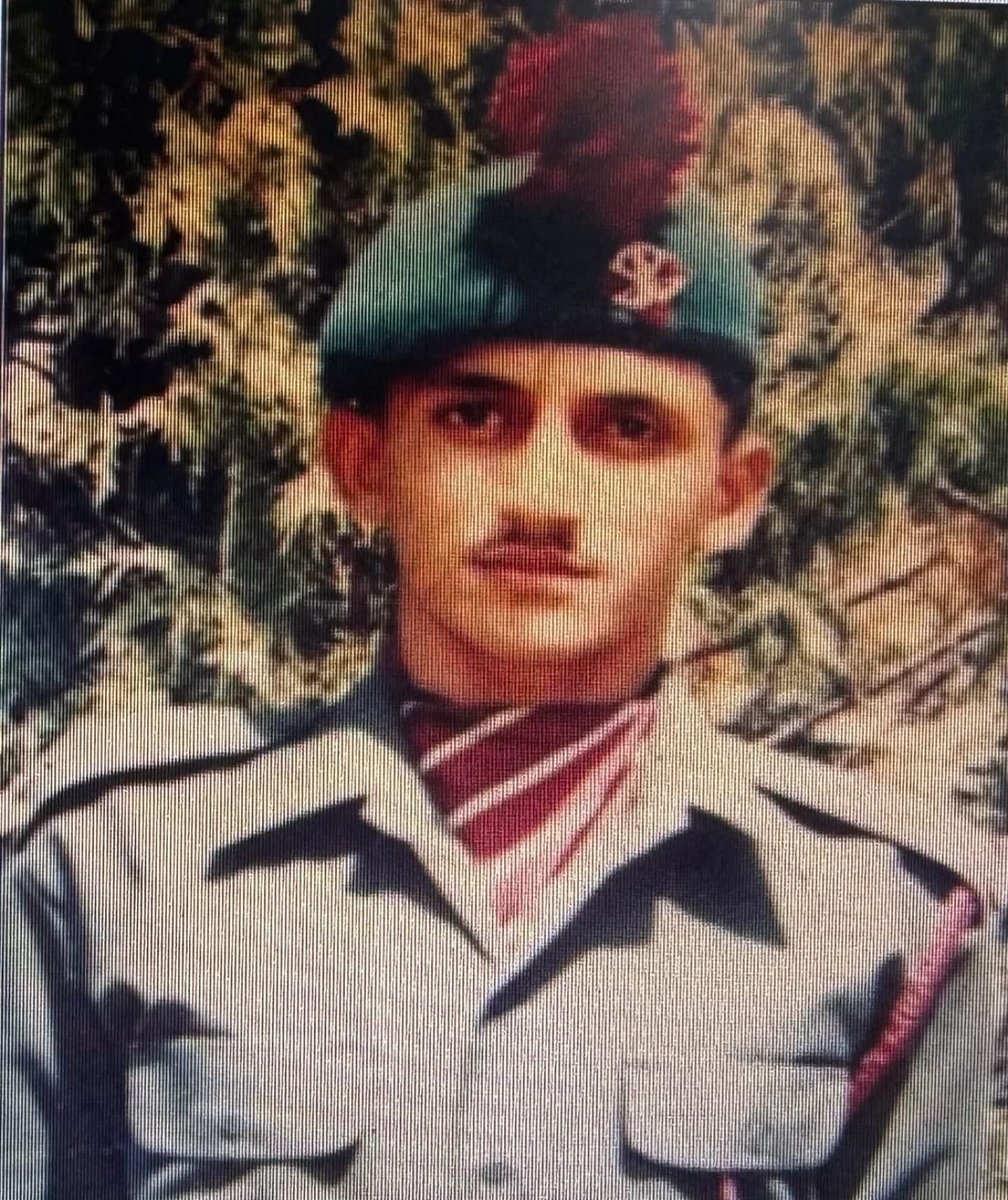
Meet Smt Manju Singh. Her son
CAPTAIN ANSHUMAN SINGH
Kirti Chakra
RMO 26 PUNJAB #IndianArmy
who cleared NIT, IIT, GMC, and NDA before joining AFMC Pune.
Sadly, we lost him #onthisday in 2023 while serving at #SiachenGlacier.
#FreedomisnotFree a few pay #CostofWar.
Wreath Laying Ceremony at the National War Memorial, New Delhi.
Smt. Dhanalakshmi Unnikrishnan, mother of Major Sandeep Unnikrishnan, Ashoka Chakra (P), paid floral tribute in his loving memory. Jai Hind 🇮🇳
#MajorSandeepUnnikrishnan@BravesBiharRegt@nsgblackcats
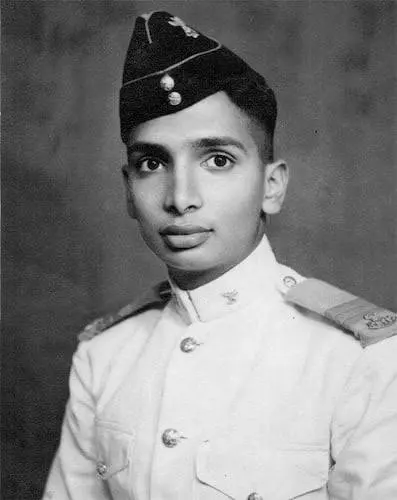
Commissioned on 5 Mar 1988
2nd LT RAJEEV SANDHU
7 ASSAM
immortalised fighting ltte on 19 July 1988.
Only four months in service.
His parents couldn’t see him last time as those days mortals remains were cremated in battlefield.
They have seen only this and later received MVC.
So … for bit of understanding of people who have very little idea of these concepts:
The book distributed by Steve Jobs at his funeral ‘Autobiography of a Yogi’ describes a being called ‘Mahaavatar Babaji’ who is known as the being (called a Siddha) living 1000’s of years who instructed the lineage of Lahiri Mahashaya and then finally Yogananda Paramhansa.
People think that this Mahavtar Babaji is ultimate!
🙏🏽👇🏻
This is not completely accurate.
The Nine Naths of the tradition, each of these Naths …. emanates many such Mahavtar Babaji type Siddhas and of course the proof of that concept sits in Alandi near Pune in Maharashtra in Jeeva Samadhi for the last 700+ years since 1294…
That Dnyaneshwar is a disciple of the disciple of Gahani Nath, one of the 9 who is accessible to humans (I mean only those who know… which is mostly Indians (Naths don’t distinguish between religions) and the few Westerners who come looking in India )…
For that one’s mind must first open a little and you need to do bit of sadhana which is difficult if you cannot even read or understand the language and the concepts (but this is not a barrier as so many Westerners have demonstrated by learning these things.).
Bit different concept of time and of what reality is and what you can do on earth (service mainly… but also some meditative spiritual practice).
🙏🏽🙏🏽
Mahadev.
Congratulations to Team @SkyrootA on the successful launch of Vikram-I - a landmark achievement for India's growing space ecosystem. This milestone reflects the ingenuity and technological excellence of our deeptech innovators.
The decision to open the space sector to private participation has unlocked new opportunities for India’s growing global competitiveness in SpaceTech, accelerating India's journey as a leading space-faring nation.
Wishing Skyroot, @PawanKChandana and @bharathdaka, and the entire Indian space community many more successes in the years ahead.
@isro
ORBIT ACHIEVED. 🚀
Vikram-1 Test Flight-1 has reached orbit. India's first privately developed orbital rocket has completed its final burn and injected its payloads into a ~450 km orbit, making India the third country in the world with private orbital launch capability.
History is made. 🇮🇳
#Vikram1 #JourneyToOrbit #SkyrootAerospace
Historic day. 🇮🇳 🇮🇳
Successful launch of #Vikram-1. Payload is in desired orbit.
It is India's first privately developed #rocket designed to place satellites into #orbit.
A technology demonstrator which will open path for government-led to industry-led space missions. Kudos to the young achievers.
An Indian company entering global space market. @SkyrootA@isro
As the monsoon swells the rivers, several parts of our national park become temporarily cut off, turning into isolated islands. During this challenging period, our frontline teams intensify surveillance through special boat patrols, ensuring continuous protection.
Ocean waves generate a natural form of pink noise that increases focus & calm.
During the Industrial Revolution, people began experiencing a new kind of ailment: neurasthenia, or chronic nervousness, brought on by the relentless pace of modern life.
Top physicians prescribed a single remedy: the sea cure.
It required leaving the noise of the city & spending time in coastal areas, not necessarily swimming, but simply sitting with the sound of the waves.
Sea waves are repetitive & rhythmic, unlike urban noise, which is chaotic & unpredictable. This rhythmic quality reduces cortisol levels, improves mood, & increases focus.
Nature's priceless gift.
Homage to
SEPOY HARI DARSHAN SINGH NEGI
19 MAHAR #IndianArmy
on his balidan diwas today.
Sepoy Hari Darshan Singh Negi was immortalized fighting terrorists in Jammu & Kashmir in 1999.
#FreedomisnotFree a few pay #CostofWar.
GOLD FOR INDIA! 🥇🇮🇳
Anand Singh brings home Gold with a superb throw of 80.57m in Men’s Javelin Throw at the Asian U23 Athletics Championships! 🔥
#IndianAthletics#AFI
🇮🇳 India Tops the World at the 56th International Physics Olympiad 2026!
🥇🥇🥇🥇🥇India's young physicists deliver an extraordinary performance at #IPhO2026 in Colombia. All five members of the Indian team win Gold Medals. 1/3
@PMOIndia@DrJitendraSingh@HBCSE_TIFR@TIFRScience
I taught JEE physics for years. That paper breaks strong kids in three hours.
This exam is five hours of theory and five hours of lab work, and these five did close to perfect scores on it.
Let me tell you what actually happened.
The International Physics Olympiad is the world championship of school physics. It was the 56th edition. Held in Bucaramanga, Colombia, from July 5 to 12.
381 students. More than 85 countries. Every one of them the best physics student their country could find.
India sent five kids.
All five came back with gold.
Their names are Kanishk Jain from Pune. Riddhesh Anant Bendale from Indore. Rishit Garg from Dwarka in Delhi. Shresth Suraiya from Mumbai. Svarit Joshi from Ahmedabad.
We know a hundred cricketers by their nickname and not one of these boys. :)
That clean sweep put India at joint World Number One. Tied with China, Russia, Kazakhstan, South Korea and Taiwan.
Those are countries that pour serious money and national pride into science education. We are standing level with them.
Now here is what the exam actually was.
Two papers. Each five hours long.
The theory paper had three problems. One on the thermodynamics of paramagnetic cooling. One on the photoionisation of ozone. One on the dynamics of electron positron pairs.
The experimental paper was another five hours in a lab, working through heat transfer and thermodynamic processes in fluids.
That means you get given equipment you have never seen, and you have to design your own experiment, take your own readings, handle the errors, and reach a real answer.
Not multiple choice. No shortcuts. No pattern recognition. You either understand physics or you sit there for five hours.
HBCSE says the Indian students were near perfect on theory and excellent on the practical too.
Now, this was India's 27th appearance at the IPhO.
Across all those years, about 44 percent of Indian students have won gold, 41 percent silver, 10 percent bronze.
In the last ten years, every single Indian student has come home with a medal. 62 percent gold, 38 percent silver.
Not one kid has gone and come back empty handed in a decade.
Five golds in one year has happened only twice. This year, and in 2018.
So who built this.
The programme is run by HBCSE, the Homi Bhabha Centre for Science Education. It sits under TIFR, which sits under the Department of Atomic Energy.
They run the whole funnel. A national exam, then a national olympiad, then a brutal selection and training camp, and out of everyone in the country, five kids get on a plane.
The team was led by Professor Anwesh Mazumdar of HBCSE-TIFR and Dr Leena Joshi from St Xavier's College, Mumbai.
The scientific observers were Professor Ananda Dasgupta from IISER Kolkata and Nisha Kelkar from Gogate-Joglekar College in Ratnagiri.
Yes. Ratnagiri. A college in a small coastal town in Maharashtra.
This is public education doing something the private coaching industry could never do on its own.
The coaching industry is very good at one thing. Teaching you to solve a known problem fast.
That is what JEE and NEET reward, and I say that with love because I was part of that world.
But an olympiad paper does not have a known type. There is no shortcut chapter. There is no formula sheet that saves you. You have to sit with a problem you have never seen and think.
That is a completely different muscle. And a government funded centre has been quietly building it in Indian teenagers for 27 years.
So yes, be proud. Loudly.
HBCSE also shared that around 64 percent of India's olympiad medallists go on to do a PhD.
But only about 32 percent of medallists end up settling in India.
I do not say that to spoil the moment. These kids owe the country nothing. They earned every option they have.
But it should tell us something. We are excellent at finding this talent. We are excellent at training it. We are still not great at giving it somewhere worth staying.
Congratulations Kanishk, Riddhesh, Rishit, Shresth and Svarit. This is one of the best things an Indian did this year and most of the country will never hear about it.
Next in who after the Ramanujan series?
At a tender age of 16, a brilliant but completely unguided boy from Tamil Nadu joined the National Defence Academy & was commissioned into the Indian Navy's electrical branch . He did not have the luxury of a quiet university setting; he was trained in practical skills to maintain weapons systems on warships.
But Arogyaswami Paulraj possessed an insatiable, self-taught obsession with the advanced mathematics of signal processing, control theory & information theory. He studied advanced matrices & random variables by lamplight on naval ships.
By the late 1970s, India faced a serious strategic challenge. After the 1971 Indo-Pak War exposed weaknesses in imported sonars, the Navy needed an advanced anti-submarine warfare system but was blocked by international export restrictions. The Navy turned to Paulraj, then a rising officer with a PhD from IIT Delhi (earned while still in service). He was tasked with leading a major indigenous project to develop a world-class hull-mounted panoramic sonar from scratch.
Operating under intense resource scarcity, Paulraj’s mathematical genius took over. He designed complex signal-processing algos that could filter the chaotic, deafening acoustic noise of the ocean to pinpoint enemy submarines. The resulting system, APSOH (Advanced Panoramic Sonar Hull), inducted in 1983, completely stunned global military observers. It did not just work, it outperformed contemporary Western systems.
After setting up major defense labs in India, Paulraj retired from active naval service & arrived at Stanford University in 1991 as a research associate. This is where the story shifts from military history to modern legend. While working on signal separation experiments for airborne military reconnaissance, Paulraj noticed a strange, fleeting physical phenomenon.
When a radio signal is transmitted in a crowded area (like a city with buildings), it bounces off walls & scatters into 1000s of chaotic, distorted paths. Engineers treated this scattering as a nightmare, multipath interference that corrupted data.
Paulraj had a paradigm-shifting realization rooted in multi-variable calculus & spatial matrices: What if the scattering was not a bug, but a feature?
He realized that if we used multiple antennas at the transmitter & multiple antennas at the receiver, we could use advanced matrix mathematics to isolate those scattered paths & stream parallel, independent channels of data over the exact same frequency, at the exact same time.
He called it MIMO (Multiple Input, Multiple Output).
When he 1st proposed it, the academic world mocked him. Prominent profs & industry skeptics told him it violated the laws of physics & information theory. They claimed it was mathematically impossible to multiply data speeds w/o expanding bandwidth.
Paulraj did no back down. He built his own prototype, founded a startup & proved the mathematics in real-world silicon. He designed the microscopic architecture, the microchip algos that allowed small devices to execute these hyper-complex spatial matrix calculations in fractions of a microsecond.
If we look at the device we are using to read this right now, look at the top corners of our screen. We cannot see them, but embedded inside the frame of our phone are multiple microscopic antennas operating on Paulraj’s exact MIMO-OFDMA mathematics.
Every single modern 4G network, 5G network & high-speed Wi-Fi router on Earth is built entirely on the mathematical foundation invented by the self-taught Indian Navy officer who packed his bags for Stanford. He did not just solve a math problem; he built the invisible highway that carries nearly 100% of the world's mobile data traffic today.
It got my attention after long because a very prominent NGO felicitated our teams in capital city yesterday for this epic operation. Field teams went to receive the honour.
So True ! Was in NDA when Sub Maj Guman Singh and Sub Maj Darbara Singh were there ! Their voice on the Drill Square still rings in my ears…been about 46 years !
@ANI Our soldiers, saving lives everywhere they go. Kudos to Maj Gen Patra and his driver. @PMOIndia@HMOIndia plz make knowledge of BLS compulsory in Colleges atleast.
#WATCH | Uttarakhand: A swift and timely intervention by an Indian Army Medical Officer helped save the life of a road accident victim on the Banbasa–Champawat road near Sukhidhang on 8 July 26.
At approximately 11:05 a.m., Major General V. K. Patra of the Indian Army was travelling from Bareilly to Pithoragarh when he noticed a group of people gathered around a motorcyclist lying motionless on the road, about 2 km before the Chalthi turn near Sukhidhang. Bystanders informed him that the victim had succumbed to his injuries.
Drawing upon his medical expertise, Major General Patra immediately examined the victim and found him to be unresponsive, with no palpable pulse and no spontaneous breathing. Recognising the situation as a cardiac arrest, he promptly initiated Basic Life Support (BLS) in accordance with established resuscitation protocols. He instructed his co-driver, an Army soldier, to assist by providing rescue breaths while he continued high-quality chest compressions.
After approximately two minute of continuous cardiopulmonary resuscitation (CPR), the victim regained spontaneous circulation and breathing. Suspecting an associated head injury, Major General Patra carefully placed the patient in the recovery position to maintain a patent airway and minimise the risk of aspiration in the event of vomiting.
Appreciating the seriousness of the injuries, Major General Patra simultaneously coordinated for an Army ambulance from Banbasa Cantonment. An Army Medical Officer and medical team arrived promptly, and the victim was stabilised and evacuated to the nearest Primary Health Centre for further management.
Meanwhile, personnel of Dial-112 from Chalthi Police Outpost reached the scene and contacted the victim’s family using his mobile phone. The injured person was identified as Laxman Singh, son of Bishan Singh, a resident of Budhabagh, Chakarpur, Khatima, aged about 40 years, who was travelling with relatives to Lohaghat for worship when the accident occurred.
The incident highlights the critical importance of immediate bystander intervention and the lifesaving value of Basic Life Support and CPR during the golden minutes following cardiac arrest. It also reflects the unwavering commitment of the Indian Army and its medical fraternity to preserving life—not only on the battlefield but also in civil emergencies—demonstrating that every trained soldier and military medical professional can make the difference between life and death.
(Video: Indian Army official)
Basically the only civilisation which actually gives them a space in their geographical land is the Indian civilisation. (India, Nepal and maybe part of Tibet).
These Nine are called the Nine Naths (each complete master of a power of the Universe).
In ancient times they were the Nava Narayana!
These Nine Naths are directly called upon only by the Indians.
A disciple of a disciple of the Nine Naths (Dnyaneshwar) is still sitting under the ground in Alandi !
They are the reason why the Indian civilisation is becoming known again.
Only in India are they directly worshipped.