Folks! I have some great news. We’ve just received distribution approval from the market authority for my secondary fund focused on small transactions. We’re officially ready to go!
I’m very excited to start fundraising in September, with the fund launch to follow in early October. We will have very attractive terms for early closers.
I’ve built this strategy over the last few years as an institutional investor around a simple conviction: some of the most attractive opportunities in secondaries are found in transactions that are too small and subscale for the largest or more established players.
Stay tuned!
I’ve seen a lot of PE secondaries deal flow lately. There is a lot of junk out there that I wouldn't even consider at a high discount because many are just coin flips.
👉 Hard truth: a sizeable portion of deals done between 2018–2021 that haven’t already exited look quite poor. Even some of the top-performing GPs are facing setbacks; it seems no one is immune. Expect the number of zombie assets and zombie GPs to keep increasing. The dispersion is massive.
Many deals were bought at extremely high multiples, financed for a different rate environment, and hit by various macro shocks such as COVID, wars, inflation, etc.
AI is hitting Lower Mid-Market Private Equity faster than I expected.
Yesterday I attended the AGM of one of our LMM funds. Nearly every portco had rolled out AI initiatives of varying complexity, some early-stage, some more advanced. But across the board: real productivity gains and real P&L impact, already.
One example stood out. A specialised luxury consulting firm (50 FTEs) implemented AI primarily for document drafting, PPT generation, and similar tasks. The productivity gains allowed them to compete in larger tenders they would never have attempted before. Simply because they previously lacked the headcount to respond competitively.
Their CEO : “Thanks to AI, we now do at 50 FTEs what would have required 150 FTEs three years ago.”
But the real insight is why they’re winning against much larger firms.
Their clients don’t want to pay premium fees for armies of juniors producing insipid, templated insights. They want senior expertise. That’s what they’re buying.
Most of the actual document drafting is junior work. AI now does it faster and cheaper. This firm runs an almost entirely senior team with genuine industry expertise. AI handles the rest.
Small, nimble companies are taking market share from bloated incumbents and this is just the beginning
I had a meeting with a Top 5% European lower mid-market GP today, and one of the partners shared is thought about Software Investing 👇
« Software is not 'dead' because of AI, but you now have to be much more disciplined in what you back. The market reaction has been partly justified, but the idea that all software companies will be disrupted is intellectually lazy. Instead, there is a clear split between fragile and highly defensible software businesses.
The types of software we like have common characteristics
1. Backbone systems: software that sits at the core of a client’s operations and cannot be removed without breaking the business (e.g., accounting or ERP systems).
2. Ownership of proprietary data: the software generates and controls the underlying data, rather than just layering on top of existing datasets.
3. Strong distribution moat: customer bases built over many years through direct sales and deep integration, not easily replicated by a new AI-native entrant.
4. Regulatory barriers: software operating in regulated environments (e.g., certified platforms) is far harder to replace quickly.
5. Low tolerance for error: when mistakes have financial, legal, or operational consequences, clients are reluctant to switch to less proven AI-driven tools.
6. High technical depth: complex products with large codebases are more defensible than lightweight tools that can be rebuilt easily with vibecoding.
Bottom line: we remain positive on software, especially vertical, mission-critical, and regulated solutions. The current environment as potentially attractive for investing, as valuations may be over-correcting due to generalized fears around AI. »
I am computing some stats on our secondary track record, and I found that on a time-series basis, our weighted-average DPI after 18 months is 0.46x, which I think is quite good for buyout exposure.
This is what secondary is meant for: early cash flows
The market is so bad that they are organizing a private equity Mass in Paris 🤣
« Good Lord, offer us crystallized carried on unrealized gains, forgive us our 2% management fees, keep us away from adjusted EBITDA, and deliver us from add-backs. Amen.”
🚨As we prepare the launch of our Private Equity Secondaries fund dedicated to small deals (target Sept 2026) and given the current prolific deal flow, I’m looking for a partner able to provide ~€10 to 15m of warehousing capacity to seed initial transactions.
These deals would be transferred into the fund at launch (avoiding a blind pool for incoming investors and making it more appealing).
Economics are negotiable but ideally: pre-agreed yield and exit through inflows or option to convert into the fund with no fees and no carry.
DMs open, feel free to reach out
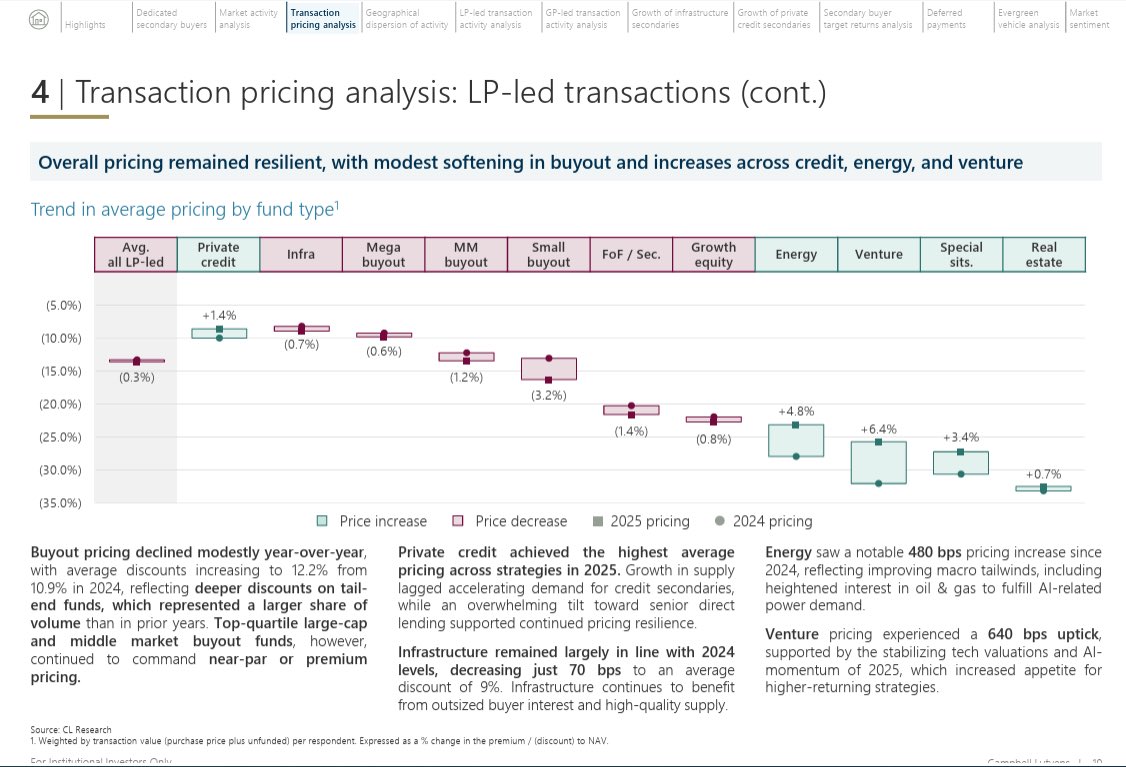
Another good report from Campbell Lutyens on secondaries. Some stats that caught my attention 👇
1. Average pricing and size by underlying strategy
2. Trend in pricing by underlying strategy
3. Evergreen still overpaying 330bps on average vs traditional closed funds
4. GP-led activity by sector and valuations
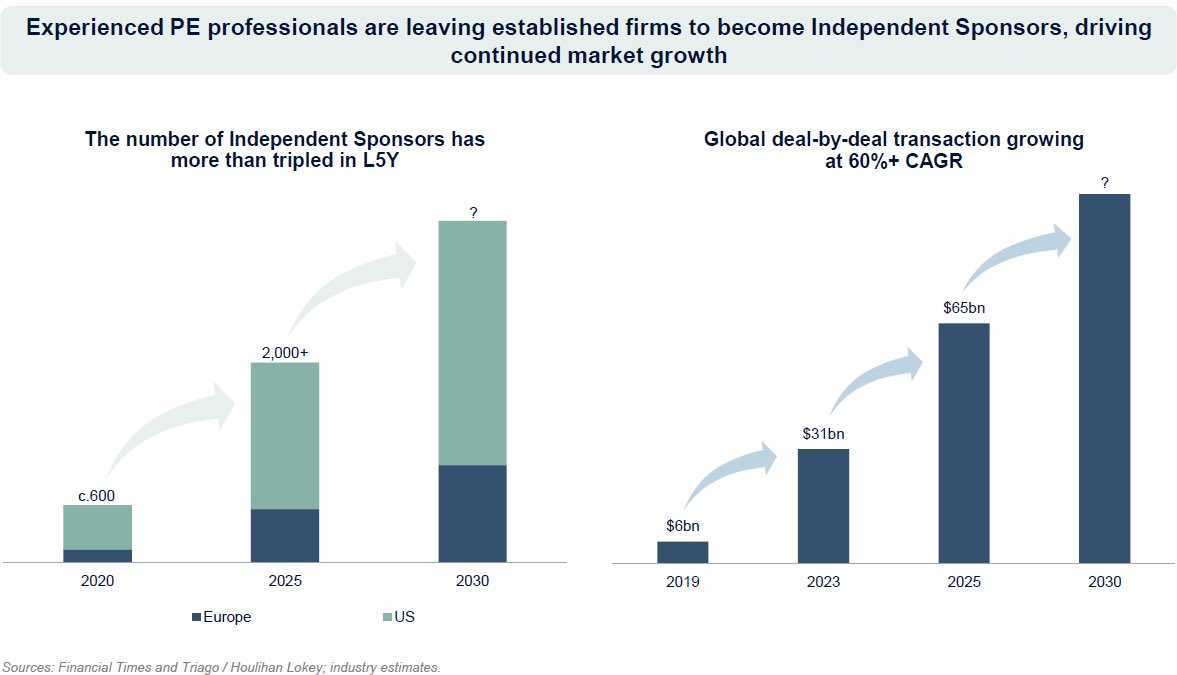
The independent sponsor model is gaining traction, with deal value increasing tenfold over the last 7 years.
The current state of the PE market is prone to the formation of this type of structure, and I believe we will see more and more going forward
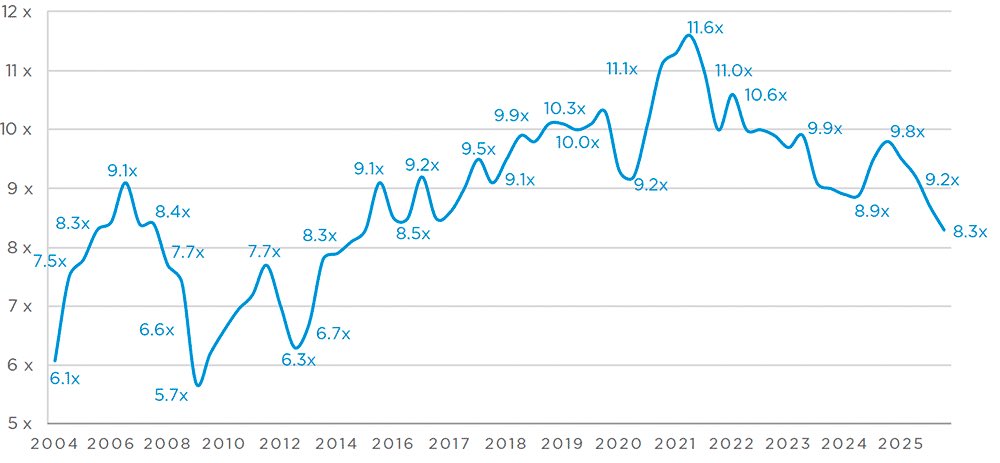
Private Equity - Valuations for European mid-market deals continue to decline, reaching levels not seen since 2015.
1. Argos Index fell to 8.3x EV/EBITDA in Q4 2025, down from 9.8x at the same time last year.
2. Only 7% of deals are now closed above 15x EBITDA, a record low
3. Mid Market M&A accelerated at year's end, supported by lower valuations and better alignment between buyers and sellers expectations
It's happening! In a few months, I will go on the other side of the fence after a decade as an LP.
With a bit of structuring and time to clear all the regulatory hurdles, our fund dedicated to small secondaries should be ready in Q3.
Had an interesting conversation with a very successful sponsor on how to pay low multiples at entry:
“There is no magic you have to go in places most investors deliberately avoid. The first real driver of value is how you enter. Buying something “cheap” is not about luck; it’s about accepting complexity that others can’t or won’t underwrite. That complexity can be governance deadlock, a messy carve-out, a loss-making division, a stigma around the sector, or a management transition. The discount is not upside it is a protection. That protection will become upside only if you are able to fix the reasons the asset was cheap in the first place”
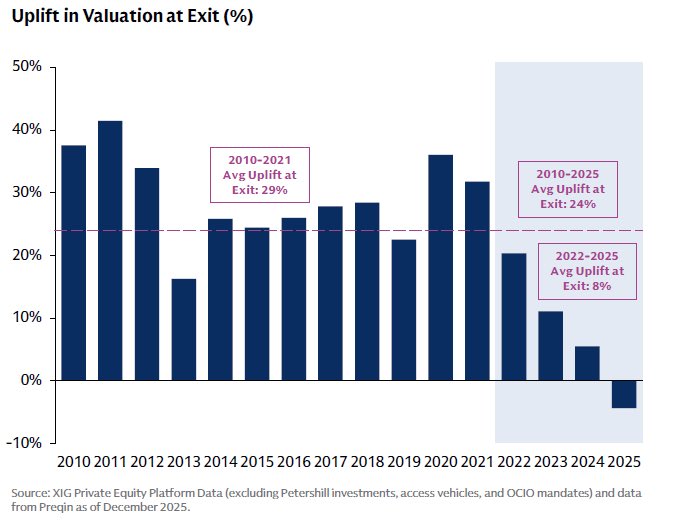
Interesting data on PE from Goldman Sachs noting an average negative valuation uplift at exit for deals in 2025 (average of 1, 3 and 5 quarter valuation prior to exit). I had somewhat more positive stats from Stepstone, but I can’t say I am surprised.
I am in touch with the team running an electronic secondary platform that is currently integrating with iCapital and Private Bank platforms to facilitate liquidity offerings to their clients.
It appears that the retail/wealth management crowds require earlier liquidity than anticipated.
The Venezuela thing reminds me of a story.
In 2015, I briefly worked at the FX treasury desk of a large pharmaceutical company, which had cash trapped in Venezuela, equivalent to $200 million in local currency. The currency wasn’t exchangeable, and you couldn’t repatriate it. But the Venezuelan government offered a solution for foreign companies. You could exchange your Bolivars to buy a primary bond issuance of PDVSA, denominated in USD, at a set, rigged exchange rate, of course. PDVSA, the local oil company, was in default, and the bonds on the secondary market were trading at 25 cents on the dollar. However, by owning the bonds, you could then sell them to get US dollars back.
So the only way to get cash back was to take a 75% hit on it.
Pure organised racketeering