When you feel the urge to isolate, the most reliable way forward is to do the opposite.
In this week’s episode of ‘Office Hours’, I explore why loneliness has become so widespread and how it shows up in our relationships. I talk about the difference between being known and being understood, why feeling understood matters so much for happiness, and how modern habits and technologies can make it easier to stay in touch while avoiding real connection.
Watch the full episode here: https://t.co/DKnJVmnJVF
To lead is not always to direct–at times, it is simply to hold open the space where something meaningful can take root.
In recent years, I’ve spent a great deal of time thinking about what causes people to burn out.
Many of the people I speak with, the executives, educators, and caregivers, aren’t exhausted from laziness or lack of purpose. They are exhausted from living in systems where every moment is spoken for.
Burnout is rarely about how much we’re doing and more often about what we no longer have space to notice.
In behavioral science, we call this ‘role strain’.
The brain can sustain effort, but it cannot sustain constant interruption, as we aren’t wired to live at full speed with no room to reflect. And yet, so many professionals are asked to do just that, to treat time as infinite and attention as disposable.
In my teaching, I’ve found that the most useful question isn’t “How can I do more?”
It is: “What am I willing to let go of?
And if leadership means anything at all, perhaps it means to resist the instinct to fill every silence.
Knowledge is like an ocean, vast and infinite. The further you venture, the deeper you realize it goes. Yet, if you only stand at the shore, you may falsely believe you've seen its entirety.
Sometimes it feels like we are just trying to get through the day.
Finish the quarter or hit the next goal.
Then, only then, you finally feel peace. Or joy. Or purpose.
You’re not alone. I’ve lived that way too.
A few years ago, my wife, Ester, and I walked 100 miles across Spain on the Camino de Santiago.
It sounds romantic.
But really, it’s 12 days of aching feet, endless farmland, and your own thoughts.
At first, I was impatient. Still scanning for email pings that weren’t coming.
But on day 4, we noticed a bright blue flower on the side of the road — a passionflower. It stopped us in our tracks. We sat. We looked. And for a few minutes, we were just there — not striving, not analyzing, not achieving. Just being.
That tiny moment did something to me.
I realized how much I’d trained my brain to skip over beauty in search of progress. And I started asking a question I hadn’t considered in years:
“What if this quiet moment is the part that actually matters?”
Later, I wrote this down in my journal:
Fulfillment cannot come when the present moment is merely a struggle to bear in service of the future.
Since then, I’ve seen this in CEOs, students, and myself:
We treat life like a tunnel. Push through this week, this launch, this quarter — and then we’ll live.
But the walking is life.
And the moment you’re in — even if it’s unglamorous or slow — might be the most important one.
So here’s the question I’ve been sitting with ever since that flower on the trail:
What are you rushing past that’s asking you to stop and see it?
Reinvention at 45 isn’t weak. You're supposed to change; that's a normal and healthy thing.
Many professionals fear that their best years are behind them by midlife. They feel their edge softening, their energy shifting, their ambitions changing shape.
But research on intelligence over a person's life offers a different—and more hopeful—story.
Fluid intelligence (the ability to solve novel problems), peaks in our 30s and then declines. But crystallized intelligence (the ability to synthesize knowledge, teach, and understand complex ideas) rises with age.
That’s why many people, especially men who have spent decades climbing, begin to feel unsatisfied around midlife. They’re still chasing fluid rewards, even as their gifts have evolved.
See this transition as moving from the first curve to the second. And following your rhumb line, which is the true course of meaning in your life, guided not by comparison or ego, but by wisdom.
I’ve had four completely different careers. Every decade, I take it down to the studs and start again, and that reinvention has brought me closer each time to who I truly am and what I’m really here to do.
My burnout taught me a valuable lesson about self-identity: You are a person doing a job, not a job pretending to be a person.
For a long time, I didn’t know the difference. Like many professionals, I let my role quietly become my identity. Work wasn’t just something I did; it was who I was, and when it started to unravel, so did I. That’s what made the burnout so disorienting.
When your identity is fused with your output, any threat to your job feels like a threat to your worth—psychologists refer to this as “role fusion.”
Long before modern psychology, the Roman emperor Marcus Aurelius wrote: “You are a soul carrying a body, not a body carrying a soul.” That line returned to me when I needed it.
Here are three things to remember:
1. Your job is what you do.
2. Your soul is who you are.
3. And those two things must remain separate, if you want to stay whole.
I still care deeply about my work, but I no longer need it to tell me who I am. And ironically, that’s made the work better, not worse.
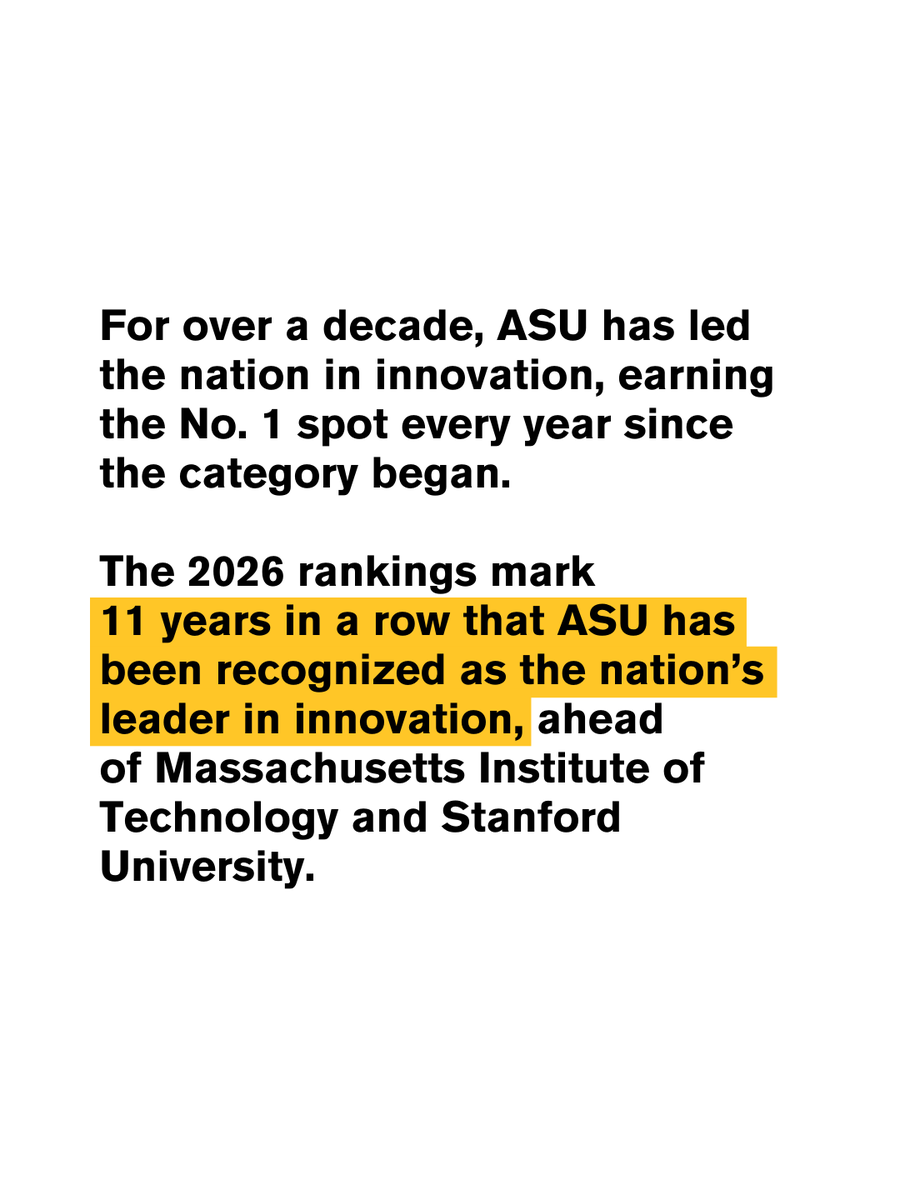
For the 11th year in a row, ASU is ranked America’s most innovative university by @usnews.
Innovation at ASU means advancing student success, meaningful research and social impact. My thanks to our ASU community and partners for your commitment to perpetual innovation.
Here are 5 signs of a dark triad personality type at work:
• They exaggerate their worth
• They don’t trust others
• They act impulsively and disrespectfully
• They break rules as if they’re above them
• They lie
Seeing these patterns is your reminder not to get pulled in.
I recorded a 45-minute in-depth episode on my show named 'The Sociopaths Among Us: How to Spot (and Avoid) a Dark Triad.'
Available on YouTube here: https://t.co/cReeiYVDxU
Today, my new show, “Office Hours” went live!
The first episode draws from my new book, “The Happiness Files,” a collection of essays from my ‘How to Build a Life’ column in The Atlantic. But more importantly, it’s grounded in science, drawing on a 2020 study where top researchers ranked the most practical and effective ways to get happier.
I discuss the top 5 research-backed ways to improve your well-being, why investing in your close relationships is the single most powerful thing you can do to be happier, how physical exercise reduces unhappiness (and why that matters more than you think), how to move on from heartbreak, and much more.
I hope you’ll tune in, watch or listen, and be part of the conversation.
YouTube: https://t.co/r1ERhANca0
Spotify: https://t.co/RUA8LbCD7Z
Apple: https://t.co/aTyveWZM0h
🔥 BRACE YOURSELF, PHOENIX 🔥
Records will likely be shattered for the next couple of days 🌡️
117° Wednesday
118° Thursday
Still stuck in the 90s at night.
The last audition I won, I was one of 310 candidates. This is gladiator competition where only the most dedicated competitors have a chance to succeed. If my attempts to articulate the mindset required to compete at this level are "embarrassing" you can always unfollow.
Your life is the most important management task you will ever undertake. It is, in fact, like a start-up, where you are the founder, entrepreneur, and chief executive. And if you treat your life the way a great entrepreneur treats an exciting start-up enterprise, your life will be happier, more meaningful, and more successful than it otherwise would be.
Once you have a firm foundation on how to manage yourself, you can use this to build a career at the center of your start-up life. The key insight behind a career that consistently raises your well-being (besides not letting it take over your entire life) is progress.
Humans get satisfaction not from arriving at a destination, but rather, from making tangible progress toward it. Indeed, one of the great errors people make in their careers is assuming that hitting a particular goal—a sum of money, a particular title, retirement—will give them the happiness they seek. The right approach is to set up a work life in which you create more and more value for yourself and others.
You can find a deeper exploration of this in my new book, The Happiness Files, available for pre-order now.