Given a request, AI systems generate long-form reports. Report evaluation relies on nuggets: essential & granular facts. Prior work on nugget generation treats them as short statements. Our #ICTIR2026 oral proposes DoGMaTiQ, an automated pipeline for Q&A nuggets.
1/6🧵
Do you work across computational methods, social sciences, and the humanities? Submit to Text as Data 2026!
📄 One-page submissions
🔓 Non-archival
⏰ Due August 1
📍 October 5 @UCBerkeley
https://t.co/pdAUJTuAhp
Really cool initiative!
I am hopeful that it will encourage submissions with lots of thoughtful human effort, since I dont find LLMs alone particularly good at teaching
As another gut punch, our COLM paper with high enough scores (or so I thought) got rejected for being too HCI-y 😅 Another chance to practice persistence!
But this paper is on arXiv, so you can judge it for yourself 😉🧛 (thread coming soon)
https://t.co/D5A7FT2ceQ
Anyone at ICML (or in Seoul) want to play against an AI in visual quiz bowl at our workshop on the 10th, lunchtime? We have AI opponents and teammates. Reply here or send me an e-mail ([email protected]), subject "EMMQA Expo". Leads appreciated!
https://t.co/a89NlZNWwR
destiny🕺and yes i'm heading to #ICML2026 in Seoul to present two posters! would love to chat about:
• making good evals for non-verifiable tasks
• scalable data synth
• long-horizon agentic training
DM if wanna get ☕️ or just hang :)
I'm in San Diego for #ACL2026 🌴! Excited to chat about long-context evaluation and narrative generation/analysis.
I am also looking for postdoc and research scientist opportunities starting in 2027. Would love to connect if you know of any openings!
📍 Presenting this on July 5 at 11:00 AM in Poster Session A at #acl2026nlp.
📜: https://t.co/PsnVk1Cygd
Come chat about when humans should let AI take the wheel, when they should push back, and what live human-AI collaboration reveals that static benchmarks miss.
🧵 Trusting AI is not one decision.
In our ACL 2026 paper, expert trivia players had to decide when to let AI answer, when to ignore it, and when to change their minds because of it.
The main failure mode was not blind trust.
Excited to present our work on "sharpness-aware pretraining" at ICML'26 in Seoul 🇰🇷!
Poster #2810 | July 7, 2:00-3:45 PM | Hall A
Project: https://t.co/4V117ww5gG
Come say hi if you're interested in efficient adaptation, agent memory, or have Seoul recommendations! 😄
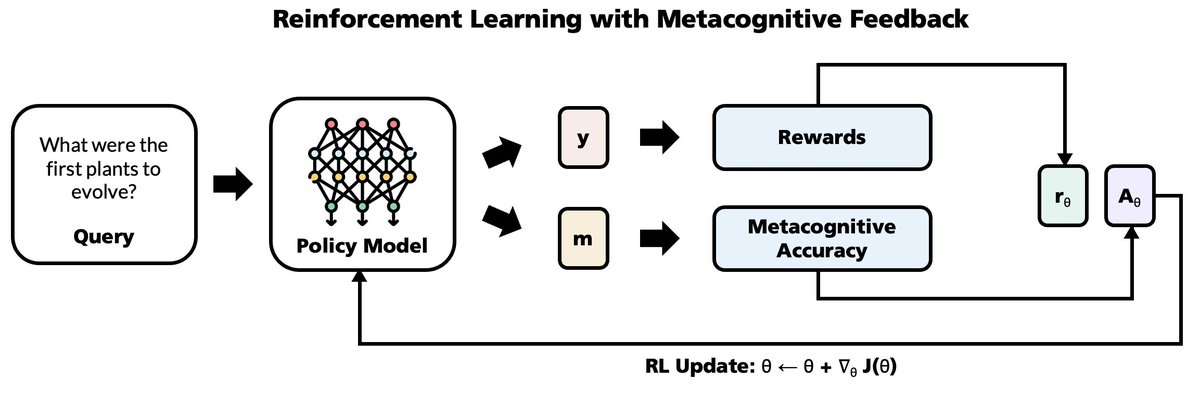
🔥 New paper alert!! Reinforcement Learning with Metacognitive Feedback Elicits Faithful Uncertainty Expression in LLMs 🔥
Can a model that learns to 𝘫𝘶𝘥𝘨𝘦 𝘪𝘵𝘴𝘦𝘭𝘧 get even better at tasks—and learn to be honest about what it doesn't know? Turns out: yes🤯
Details🧵👇
I'll be presenting three posters at ACL next week! 😎🏖️
Reach out if you wanna chat about evals, human feedback, personalization, and anything in between!
TL;DR of our papers 👇🧵
As my time in Pittsburgh comes to an end...
I'm excited to share that I will be joining UIUC as an Assistant Professor in fall 2027! I will recruit PhD students in both ECE and CS.
I’m looking for students and postdocs who are excited to continue building towards collaborative AI systems that learn and adapt through interaction.
I posted this when it came out, but it didn't have a nice online readable form (only a PDF). If this sounds fun to you can get in on the action in person (DC area) or online *THIS WEEKEND* (1/4)
📢Call for abstract submissions: 2026 Workshop on Human-AI Complementarity for Decision Making at CMU
This year's theme: Dynamic Human-AI Alignment. How do we design AI systems that don't just emulate static human preferences, but actively and effectively coordinate with humans over time?
📅Workshop Dates: September 24-25, 2026
🗺️Workshop Location: Pittsburgh, PA, USA
⌛️ Application Deadline: Friday, July 17, 2026
Funding for travel/lodging available to support speakers + student presenters.
"AI may have the answers, but mathematics has the questions."
With all the recent excitement around AI for math, many start to wonder: can mathematics be automated? And what does it mean to learn and understand math?
For EP5, we're thrilled to talk with Prof. Jeremy Avigad, philosopher & mathematician @CarnegieMellon and one of the early forces behind 3w. This episode features rich technical discussions on AI & mathematics, as well as many touching moments where Jeremy shares his vision for the future of mathematicians, math education, and mathematics itself.
Outline:
0:00 - Teaser
1:04 - Monologue
2:50 - The Historical Landscape of AI for Mathematics
7:28 - Formalization and Computer-Aided Proof
11:56 - The Birth of the Lean Project
21:21 - Lean Blueprint, Model Training with Lean, Using Lean in Agentic Systems
29:48 - Making AI Actually Useful for Mathematicians
32:46 - How AI is Changing Mathematics
36:29 - "It's Our Mathematics, and Us Doing Mathematics"
43:04 - The Verification Gap in Human-AI Collaboration
47:46 - The Future of Math Education
52:23 - Capital, Startups, and the Mathematicians' Ecosystem
1:01:08 - Predictions