14+ minutes on hold with United Airlines. 90 seconds of my time.
Week 2 of building https://t.co/IPneLorjIR in public.
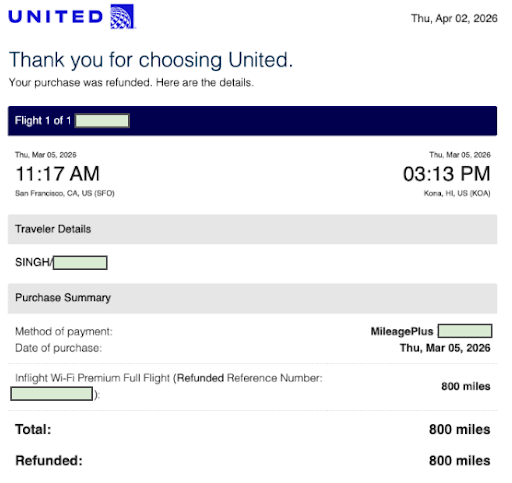
After a March family trip to Hawaii, I realized I forgot to request a refund for the non-functional Wi-Fi on our United flight. A month passed. Trying online failed, which meant calling, which meant hold music, which meant it would sit on my to-do list for another month.
Instead, I texted Sara (my personal agent from AskRanger): "Call United and get a refund for wifi that didn't work on flight UA694."
Sara called United. Navigated the automated phone menu. Waited on hold for 14+ minutes. Got a rep on the line and explained the situation. The rep needed my MileagePlus number to verify my identity. Sara texted me: "They need to verify your identity - want me to patch you in? Text JOIN or tell me what to say."
I replied JOIN. Sara connected me directly to the rep and dropped off the line. I confirmed my info, and the refund was approved. A full credit of 800 miles back the next day. My total time: 90 seconds. Sara handled the 14+ minutes of hold music I was happy to miss.
Thank you to our early users and everyone on the waitlist - we're opening more spots as we harden the product. Still in private beta. Text GO to (510) RANGER1 or DM me for an invite code.
it's ironic that the first autonomous AI attack was done by a close weight model defended by an open weight model, where everyone was expecting the opposite
For my first post, I’m sharing a letter @NVIDIA signed on why open models matter.
AI will transform every industry, power every company, and be built by every country.
Open models strengthen safety and cybersecurity, accelerate innovation and diffusion, and enable sovereignty.
The world needs both frontier closed models and frontier open models.
https://t.co/AUKzoQ5Ikb
At the robotics team in @huggingface, we take cyber security very seriously. So we have deployed a physical guard rail to all our robots to prevent further AI security threats from @OpenAI to affect our devices.
So proud of our security team! They caught, contained & publicly disclosed an attack unlike anything we've seen before, and did it at record speed.
Also massively grateful to @Zai_org: they shared GLM5.2 as open weights (for free!) with the world and it became a key part of our defense.
This is day one for cybersecurity in the age of agents & we're all learning that secrecy is not the answer & that all defenders (not just a few selected ones) everywhere need more powerful models without restrictions, especially open ones!
Today, we are introducing Inkling.
Inkling reasons efficiently across text, image, and audio modalities. We are making the full weights available.
https://t.co/Ghebq5mG30
Available today for fine-tuning on Tinker. Play with it in the Inkling Playground. 🧵
We can use videos from the internet to teach robots!
Do as I Do, from
@bhawna_paliwal_ , @HarithejaE , and Willian Liang at UC Berkeley — advised by @pabbeel, @notmahi, and @JitendraMalikCV, used an algorithm that reconstructs hand-object interactions from monocular RGB video and retargets them into real, executable trajectories for multi-fingered dexterous hands. Just using "low quality" video footage of humans doing tasks. No sensors.
The Sharpa Wave robot hand being anthropomorphic, it matches human kinematics. Not only that works, but at fast speed, too!
Congrats to the team, that's super exciting!
Project: https://t.co/khlcaUYCEp
#Robotics #SharpaWave #Sharpa #EmbodiedAI #DexterousManipulation #RobotLearning
This is great advice and makes sense for founders with resources.
For a 2–5 person startup, I'd argue the best GTM strategy is often just: launch, talk to users, listen obsessively, and iterate until something clicks.
really like how @samdblond basically walked through monaco’s gtm + launch playbook for free
if you’re launching soon or trying to fix gtm, this is one of the better deep dives to learn from
1/ go from zero to 100 (not 0 → 30 → 60)
>they stayed in real stealth for ~a year (site said “coming soon,” linkedins said “company in stealth”)
>then they stacked everything on one day: launch video, fundraise announcement, outbound waves, etc.
>the goal was to go from “no one has heard of us” to “i’m seeing this everywhere” in a few days.
2/ favor a “big bang” over a slow, leaky launch
>if you drip small announcements for months, people acclimate and tune out. you lose the “this came out of nowhere and is suddenly everywhere” effect.
>a concentrated launch creates a step‑change in awareness and a steeper early growth curve.
3/ treat launch distribution as a real project
>make a genuinely good product video that shows the product clearly.
>build a simple distribution spreadsheet with 4 tabs: employees, investors, friends of the firm, customers.
>coordinate outreach the day before and the day of launch across all 4 groups.
>content matters, but distribution is equally important.
4/ design the distribution spreadsheet to extend your reach
>ask every employee for “3–5 most influential people” in their network (by relationship or following).
>add those names to your “friends of the firm” list.
>give each group specific instructions and assets (copy, video link, timing) so you’re not relying on people to improvise.
5/ plan 2–3 simple stunts or campaigns ahead of launch
>~45 days before launch, form a small launch committee (around 5 people).
>weekend homework: each person brings 2–3 ideas that are creative but within budget.
>whiteboard everything, then pick the 3–4 best ideas you can realistically execute.
>bias toward ideas that feel a bit unusual but are operationally doable for your team.
6/ treat “launch” as a repeatable motion, not a one‑time event
>each milestone is its own launch with distinct content and distribution:
>beta → public → GA
>fundraises: seed, A, B, etc.
>every one of these is another chance to build momentum and rerun the playbook with a new angle and a slightly different audience.
7/ for budget‑constrained teams, favor creative over paid
>assume billboards and big paid campaigns are off the table.
>every month, force at least one creative idea, even if it’s small.
>prefer things that are operationally hard but cheap over things that are easy but ad‑platform expensive.
>a small in‑office comedy show or sending $100 poker sets to 100 ideal customers can beat tens of thousands in google/linkedin ads.
Spotted an autonomous delivery robot in downtown Philly last night.
What’s interesting isn’t the robot. It’s that nobody seemed to care.
The moment a technology becomes boring is usually when it starts scaling. 🤖📦