Gemini Robotics 2 is here, with our new suite of models, robots can now reason through every movement to manage tasks that weren’t possible before, like tying delicate knots - and even team up to solve complex workflows. Huge congrats to the robotics team on this great milestone!
derek thompsons recent article inspired me to read more about alcohol
im shocked by the est impact vs current narrative
for instance, 7-14 drinks per wk reduces life expectancy by only 6 mos (!!)
moreover, the negative effect is possibly offset by gains from deeper friendships
Satya Nadella just posted something that every enterprise board should read before their next AI contract renewal.
He calls it the Reverse Information Paradox and once you see it, you can't unsee it.
Kenneth Arrow's 1962 paradox was the seller's problem: to sell information, you have to reveal it, which means you've already given it away for free. The seller bore the risk.
Nadella says AI flips this entirely. Now the buyer bears the risk.
Every time your team prompts a model, corrects it, or tunes it to your workflow, you are feeding it the exact knowledge that makes your company hard to compete against. The model learns what you measure, where your processes break, and how your organization defines "good." That distilled institutional knowledge compounds inside the vendor's system. Trace by trace. Correction by correction. Eval by eval.
You paid for intelligence with money. Then you paid again with something no competitor could ever buy off a shelf.
The asymmetry is what makes this serious. The vendor learns more about your business the better you use their product. You learn almost nothing about what they're retaining in return. And because the leakage happens at the level of model exhaust, not data exports, most enterprise legal and security teams aren't even looking at the right layer.
Nadella's framework for what enterprises must demand is precise. Control over your evals, because evals define what "good" looks like inside your organization. Ownership of your traces, corrections, and institutional memory. The ability to fine-tune models inside your own tenant boundary without exposing that knowledge outside it. And an orchestration layer decoupled from any single vendor, so that if one model is repriced, deprecated, or restricted, your 18 months of corrections don't disappear with it.
The last point is the one most enterprises skip entirely.
One thing worth noting: Nadella is not a disinterested observer here. A Microsoft CEO arguing that enterprises should keep their learning loops inside a tenant boundary is, not coincidentally, an argument that cuts against OpenAI-style value capture at the model layer, which is striking given Microsoft's own substantial OpenAI stake. The argument is strategically useful to Microsoft whether or not it is true. Read it with that in mind.
But the core observation holds regardless of who is making it. In the cloud era, enterprises fought to own their data. The battle in the AI era is to own the mechanism through which your organization learns. Those are not the same fight. And the contracts most enterprises signed in 2023 and 2024 were written for the first one.
U.S. based humanoid robotics company @1x_tech has just unveiled their new tendon-driven robot hands with 25 degrees of freedom (DOF).
• Made in USA
• Tendon Drive Ratio: 5:1–15:1
• Wrist Dexterity: 3 DOF
• Backdrivability: Fully backdrivable
• Tactile Sensing: Pressure + location + slip
• Finger Force: Up to 45 N
• Wrist Torque: 17.75 Nm
• Position Accuracy: ±0.2 mm
• Waterproof Rating: IP68
• Reliability: >2 million cycles
"These hands are designed to do something fundamental: remove the hardware ceiling on what humanoid robots can actually do, and make data the only barrier to capabilities. By matching or surpassing human hands across the dimensions that matter, they ensure our AI models are no longer limited by dexterity. NEO can now perform virtually any task a human can do with their hands– with the precision, adaptability, and gentleness required for real-world environments."
After 25 years of brave & brilliant work by hundreds of scientists in my lab to understand then safely reverse aging for the first time, it was moving to witness the first human dose being delivered 🥹 https://t.co/veQsyUEORz
Fra første dag i Native har vi blitt rådet til å dra fra Norge.
Møtte også Sebastian i går. Han er 18 år og tar med seg selskapet med 30 ansatte.
Her i Norge stikker man så fort man får en idé, mens i Sverige drømmer alle om å bli Anton Osika.
Anton Osika startet Lovable i Stockholm for litt over to år siden. Nå er selskapet verdt over 67 milliarder kroner, og han nekter å flytte til Silicon Valley, for han skal bygge fra hjemlandet.
De jævla svenskene er irriterende flinke på å investere tilbake i sine egne oppstartsselskaper. Folk fra Spotify, Klarna og tech-miljøet putter penger, erfaring og nettverk rett inn i neste generasjons selskaper.
Derfor suger Stockholm til seg talenter, investorer og gründere.
Hva skal til for at vi får til det samme i Norge?
We just launched @gymfluence_ai
Built for nutrition, lifestyle, and fat-loss coaches.
The thesis is simple:
People do not fail because they need another plan.
They fail because follow-through breaks down.
Gymfluence helps coaches see adherence, detect drift, and support clients before progress breaks down.
https://t.co/eiVa4QU1zs
Introducing GPT-5.5
A new class of intelligence for real work and powering agents, built to understand complex goals, use tools, check its work, and carry more tasks through to completion. It marks a new way of getting computer work done.
Now available in ChatGPT and Codex.
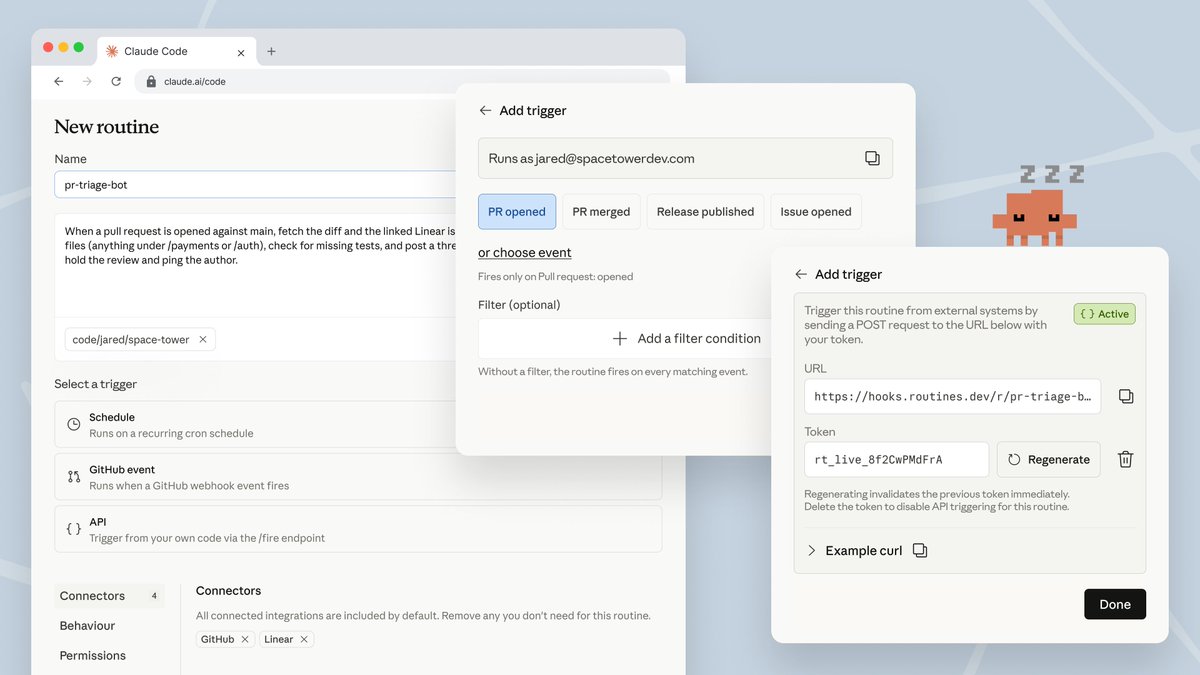
Now in research preview: routines in Claude Code.
Configure a routine once (a prompt, a repo, and your connectors), and it can run on a schedule, from an API call, or in response to an event.
Routines run on our web infrastructure, so you don't have to keep your laptop open.
🚨SOMEONE REINVENTED HOW TEXT RENDERS ON THE WEB AND ITS ABSOLUTELY INSANE.
the goated dev behind react, reasonML, and midjourney’s frontend, just dropped Pretext. a tiny typescript library that measures and lays out text 500x faster than the DOM.
he trained models against real browser rendering for weeks until the output matched safari, chrome, and firefox exactly.
the demos are insane!! hundreds of thousands of text boxes at 120fps. magazine layouts and chat bubbles that actually wrap right.
engineers from Vercel, Remix, Figma, and shadcn all cosigned. this is the kind of open source that makes you want to be a better dev.
here are some cool demos in the past 24hrs👇
🇳🇴 «NÅ ER DET NOK - LANDSDEKKENDE DEMONSTRASJON - 8.MAI» 🇳🇴
Regjeringen har kjørt Norge inn i en vegg med høye priser, sviktende velferd og globalistisk dritt som rammer vanlige folk hardest.
Fredag 8. mai kl. 13:00 er det landsdekkende demonstrasjon!
• Oslo: Eidsvolls plass
• Bergen: Torgallmenningen
• Stavanger: Domkirkeplassen
• Trondheim: Torvet
Ta med flagg, stemme og kompisene dine. Dette er dagen vi viser at vi ikke finner oss i mer jævla svik mot eget folk og fedreland.
Del, møt opp og la de høre oss! 🔥
Det kommer mer info fortløpende. Ta gjerne kontakt på pm om noen ønsker å være med å organisere i Tromsø, Bodø, Ålesund og Kristiansand.
Vi må stå sammen i dette så all hjelp tas i mot. ☺️
NOK ER NOK - HÅPER VI SEES 🇳🇴🇳🇴🇳🇴
#8Mai #RegjeringenUt #NorgeFørst
David Sinclair says we’ll find out this year whether aging is reversible.
His lab reversed biological age in animals by 75% in six weeks. The FDA has cleared the first human trial.
Aging may be information loss.
Information can be restored.
Peter Steinberger just proved his own point in real time.
He built PSPDFKit in Austria, bootstrapped it for 13 years, exited to Insight Partners, then created OpenClaw, which became the fastest-growing GitHub project in history. Two days ago, he joined OpenAI and left Vienna for San Francisco.
The Draghi Report quantified this exact dynamic last year: zero EU companies founded in the last 50 years have reached €100B in market cap. The US created every single trillion-dollar company in that same window. Combined market value of US companies in the global top 100 was 2.6x Europe’s in 2015. By Q1 2025, that ratio hit 7.6x. Today it’s approaching 9x.
There are only 13 EU-founded companies under 50 years old worth more than $10B. Their combined market cap is $400B. The comparable US cohort is worth $30 trillion. That’s a 70x gap.
And the gap is self-reinforcing. Europe’s labor regulations don’t just slow companies down. They change which companies get built. When you can’t scale a team fast, pivot hard, or compensate for intensity, you select for industries where that doesn’t matter: luxury goods, pharma, industrials. LVMH, Hermès, Novartis, Siemens. Safe bets, slow compounders. The entire EU has 18 companies in the global top 100. The US has 62.
The tell is what Steinberger did with the choice. He had every reason to build OpenClaw into a standalone company in Europe. Investors would have funded it. Instead he looked at the regulatory environment, the cultural friction he describes in this thread, and picked the fastest path to impact: leave.
Every founder doing this math reaches the same conclusion. And each one who leaves makes the math worse for the next one.
🇪🇺 @steipete on why Europe was unable to retain him as talent:
"In the US, most people are enthusiastic.
In Europe, I get insulted, people scream REGULATION and RESPONSIBILITY.
And if I really build a company here, then I get to struggle with things like investment protection laws, employee rights, and paralyzing labor regulations.
At OpenAI, most people work 6-7 days a week and get paid accordingly.
In Europe, that's illegal."
Most people who say “AI will replace SaaS” have not replaced a single system in reality.
They are vibe coders, solopreneurs, and self-proclaimed experts talking theory.
We have done real replacements at Voi, at scale, on a modern tech and data stack, with elite engineering resources.
Here is the truth.
Critical systems like ERP and CRM are not getting ripped out in established companies. Forget it.
You do not replace NetSuite, or Salesforce, lightly. Over years, millions of micro-improvements become embedded in finance, reporting, compliance, and operations. The data is too critical. The operational risk is too high.
Net-new companies can go AI-native ERP from day one. Incumbents will not gamble their backbone.
Mid- and long-tail SaaS is different.
Narrow tools with limited surface area and clear workflows can be replaced.
But even there, it is not about writing a prompt and deleting a subscription.
You must own lifecycle management: integrations, permissions, data models, edge cases, upgrades, monitoring, and governance.
That requires real engineering resources.
Saving money on SaaS licenses is a nice headline. It is not the frontier.
The frontier is replacing human labor.
Cross-functional workflows: reporting, validation, translations, parsing, reconciliation, planning, coordination, and decision support.
You do not just swap software. You redesign work.
We are now building customized, enterprise-grade software that replaces manual white-collar work, then standardizing the components so evolution and maintenance become automated.
The real TAM is not SaaS spend.
It is white-collar time spent on tasks computers are better at.
That is where this goes.