ICU Stories:
An 80 yo woman is about to go home when she suddenly develops profound shock
SBP: 40s–50s mmHg
Cold. Clammy. Diaphoretic. Weak
The ECG is interpreted as:
“Anterolateral and septal infarct”
iv fluids + norepinephrine aren't working...
What would you do next?
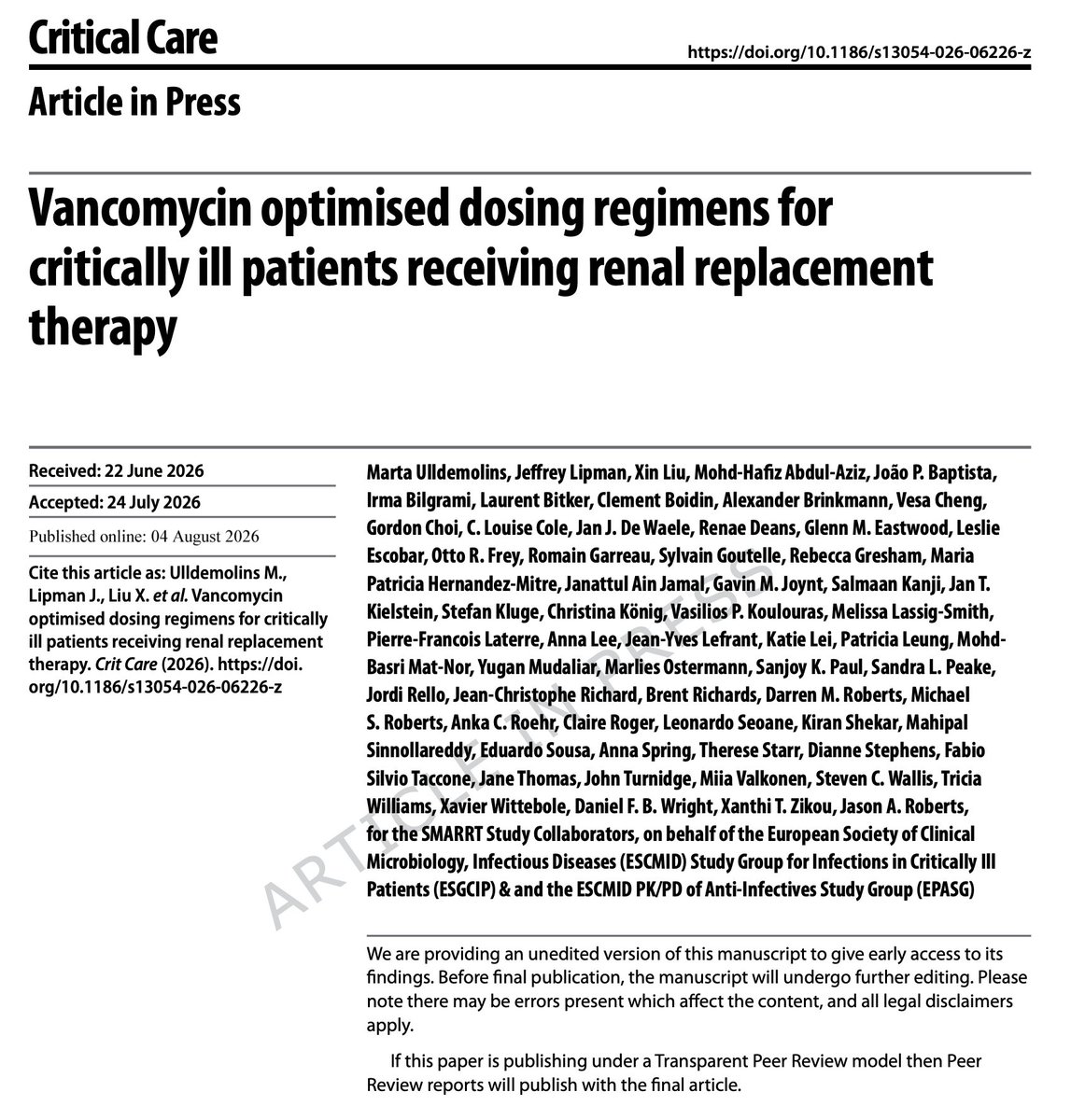
If you use vancomycin in patients requiring renal replacement therapy (RRT), you have to read this study 👇
Actual body weight and RRT intensity and duration are the main determinants of vancomycin dosing requirements in critically ill patients treated with RRT
I am biased here because I always use a *large* loading dose of vancomycin (when I use vanco instead of linezolid or daptomycin!) but I have not been able to use continuous vancomycin infusion (rare practice in US hospitals but fairly common in other countries)
Kudos to the authors!
One of my ICU rules:
Venous access saves lives. Arterial line gives data
I have never seen a patient die because an arterial catheter wasn't placed promptly. I have seen plenty of patients getting hurt (or die) because reliable venous access came too late (or never)
Place the venous catheter first. Sweat about the arterial line later
And yes. I place a lot of arterial lines and I was not pleased with how many people interpreted the EVERDAC trial
(NEJM 2025; 393: 1875-88 -
DOI: 10.1056/NEJMoa2502136)
Atrial fibrillation secret:
When a patient presents to the ED, ICU, or wards with new-onset atrial fibrillation -and we do not know their systolic function- it is worth taking a quick look at the heart before reflexively reaching for diltiazem or metoprolol. We do not always need a formal echo before acting. But if bedside US is available, even a brief POCUS assessment can change the entire plan.
I know this is not always feasible in real time. But every year, I see a few patients who crash -or even arrest- after AV nodal blockers are given, only for POCUS afterward to reveal an ejection fraction of 10-20%.
The point is simple: not every patient with rapid atrial fibrillation has a ventricle that can tolerate negative inotropy.
Let’s try to make the “diltiazem death challenge” a thing of the past.
all hypoglycemia isn't the same
starvation-induced hypoglycemia causes elevation of ketones, which may provide an alternative energy source for the brain (making this less neurotoxic)
insulin-induced hypoglycemia knocks down BOTH glucose AND ketone levels = more neurotoxic