I’m going to spend the next 120 days learning AI from the foundations up.
Not because I have never touched the stack. Because I touched the wrong end first.
I was inside a coding-agent codebase Pi. Message model, loop, session, tools, harness. I could point at the layers. I could not say, without waving my hands, why a vector has a shape, why a gradient moves a loss, why a prior belongs in a decision. An agent is a protocol moving state through time. I was reading the protocol and skipping the language state is written in.
So the direction is incremental on purpose.
Linear algebra.
Calculus and a little optimization.
Probability and statistics.
Classical ML, implemented, not watched.
The transformer I have already wired once — as attention, not as a product.
Then search, uncertainty, and back to the loop.
Math until the model is not magic.
Systems until the agent is not a demo.
Public notes. India. Attention, wired by hand.
“From scratch” here does not mean beginner content. It means I will not post a concept I cannot compress: one picture, a few lines of code, one sentence for why a training step or an agent turn cares.
I am not building another wrapper. I want to close the repo one day and rebuild the harness because the math and the ML underneath it are inevitable, not borrowed.
Day 7 / 120 — Learning AI from scratch.
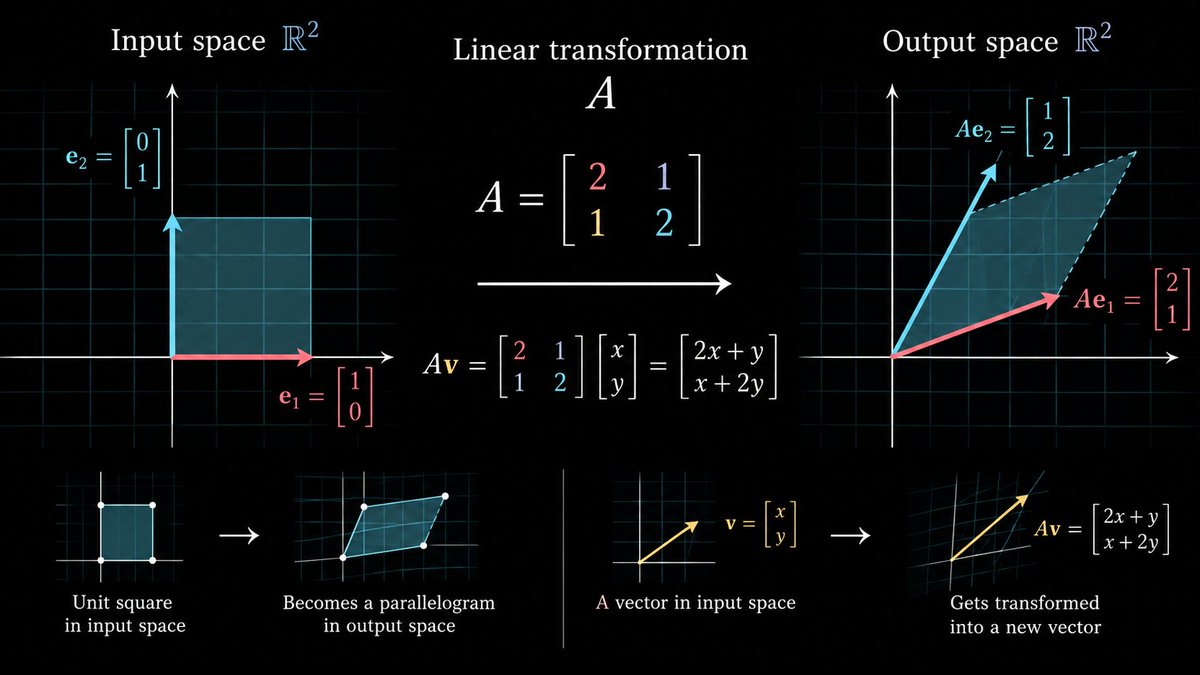
Most vectors change direction when a matrix transforms them. these are eigenvectors. The scaling factors are eigenvalues.
Today: eigenvalues → eigenvectors → diagonalization → symmetric matrices → spectral theorem.
Day 6 / 120 of learning AI from scratch >
Today: LU Decomposition, Determinants & Matrix Transformations.
→ LU decomposition : breaking a matrix into simpler pieces
→ determinants : what does a matrix tell us about space?
→ vector and matrix transformations
trying what?
Day 5 / 120 of learning AI from scratch >
Today: Orthogonality & Projections.
→ orthogonal vectors — when directions don't interfere
→ orthogonal subspaces
→ projections — finding the closest point in a subspace
→ least squares — what happens when Ax = b has no exact solution
→ Gram-Schmidt → QR decomposition
Trying to understand not just the formulas, but why these ideas matter in ML.
video #1🎥
Topic : Rank, Nullity & Consistency
because the number of equations doesn't tell you how much independent information a system actually has.
Day 4/120 - Learning AI from scratch.
Most people meet Linear Algebra as a bunch of matrices and equations.
I'm trying to understand why it's one of the foundations of AI/ML.
In this video:
→ What Linear Algebra actually is
→ Why it matters
→ Where matrices show up in ML
Learning → understanding → explaining → building. 🧠
🎥👇
Day 3 / 120 of learning AI from scratch >
Linear Algebra so far:
vectors → vector spaces → subspaces → linear combinations → span → dependence / independence → basis → dimension → column / row space → rank.
Alongside the coursework, I've also been using @3blue1brown's visual explanations to build intuition around what matrices actually do — transformations, vectors, and how the pieces connect.
The more I learn, the less Linear Algebra feels like a collection of formulas.
Tomorrow, I'll try to put the whole picture together in one video.
ML math until it feels inevitable.
Public notes. Incremental.
@3blue1brown
Day 3 / 120 of learning AI from scratch >
dependence / independence → what information is actually new
→ basis → the smallest set that can still reach the space
→ dimension → how many independent directions exist
→ column / row space → what the matrix can reach from two views
→ rank → how much independent information it actually carries
A matrix can hold many numbers without holding many independent facts.
An agent is still a protocol over state.
Today I learned how to distinguish state from redundancy.
Public notes. Incremental.
Day 2 / 120 of learning AI from scratch
> vector spaces as the legal set of states
> subspaces — what you can stay inside
> linear combinations and span
> why “new vector” is often just a mix of old ones
> started dependence / independence
> mapped span → what a model can reach
> mapped rank → how many facts the system actually holds
An agent is still a protocol over state.
Today the state got a space, not just a shape.
Public notes. Incremental.
Day 1 / 120.
Today I started linear algebra — matrices and vectors — as the first layer of learning AI from the foundations up.
I paused the agent repo on purpose. An agent is a protocol over state. I want the language that state is written in before I go back to the loop.
Incremental from here. Public notes. No streak-for-its-own-sake.