@RuxandraTeslo When you get the chance to visit Yale, plan to spend an hour at the Beinecke library. It's a masterpiece of american architecture and the affect the marble has is jaw dropping.
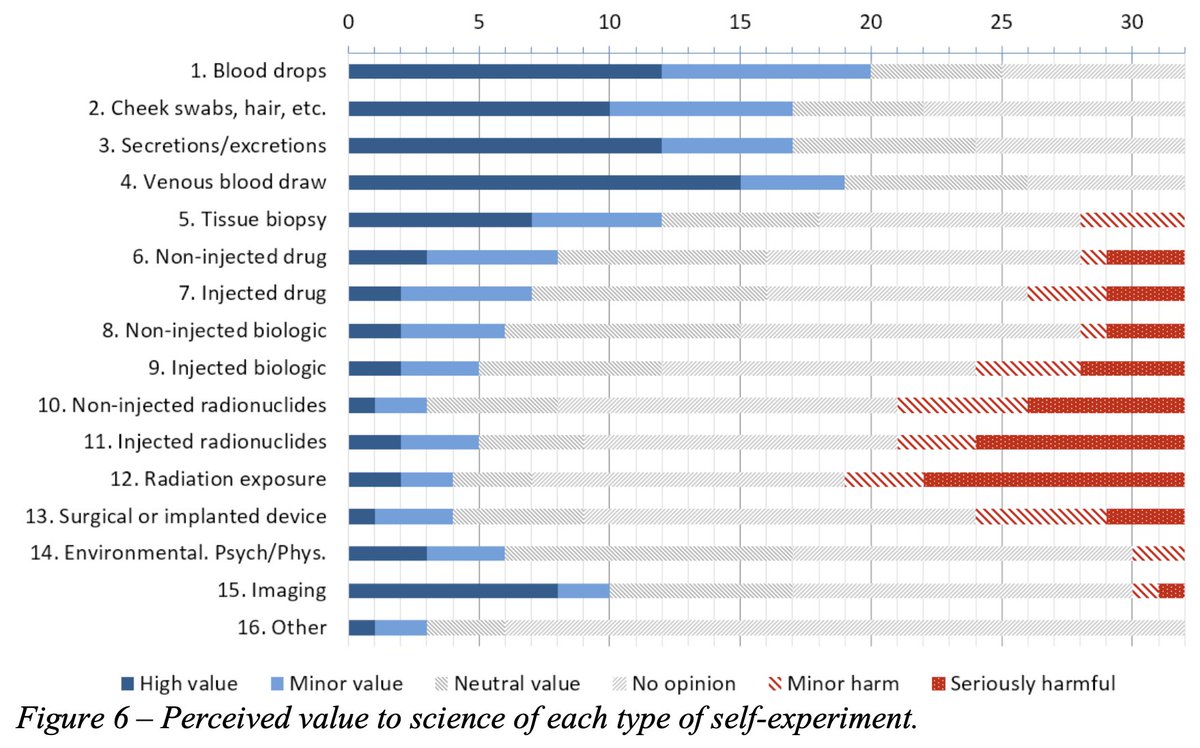
This paper is a goldmine on scientific self-experimentation.
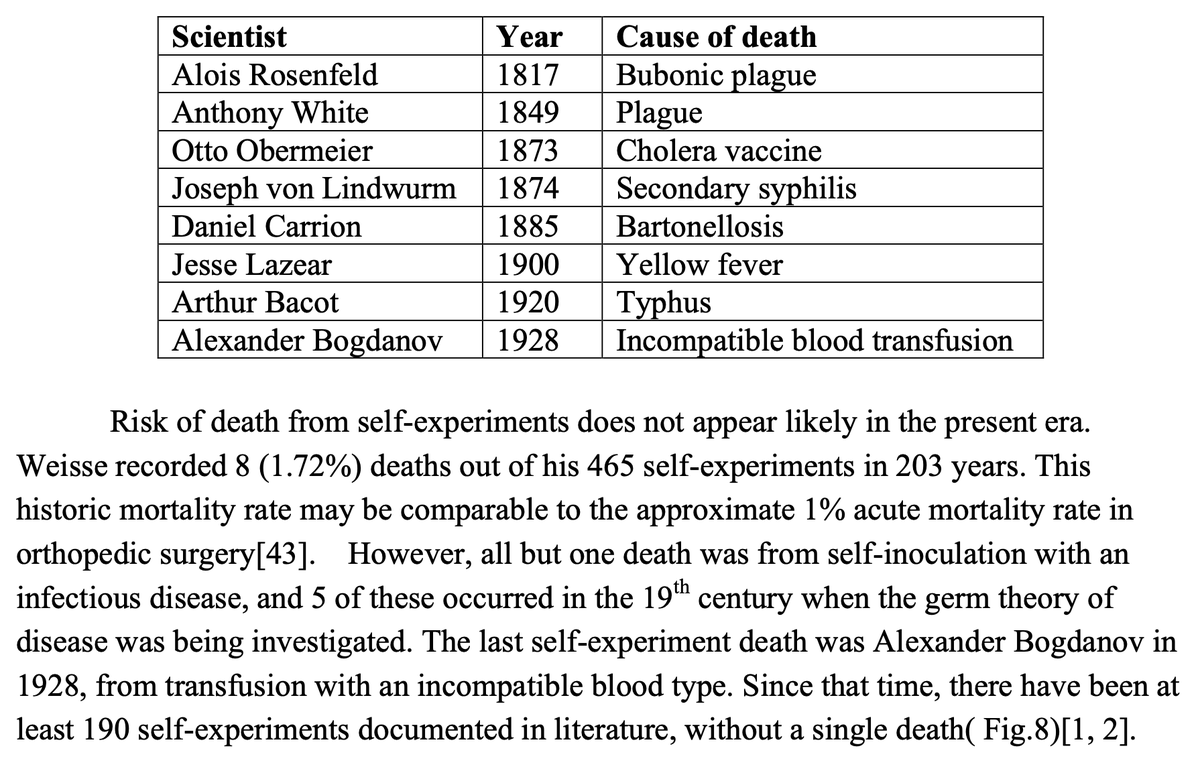
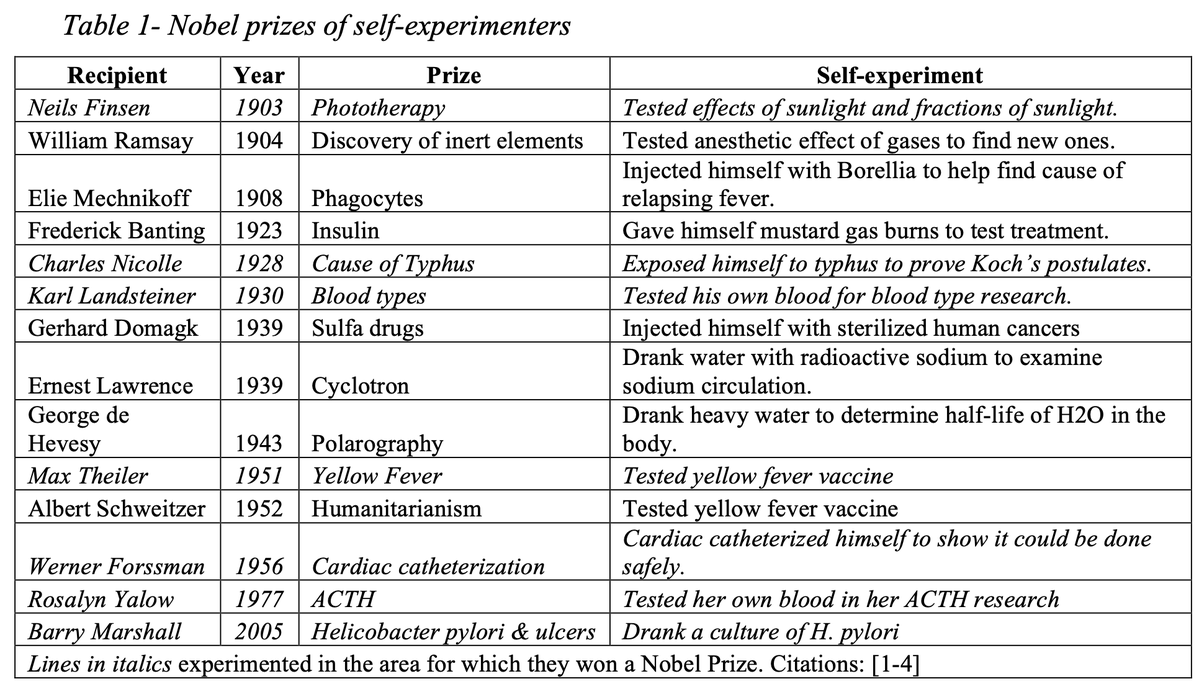
-14 Nobel Prizes have gone to self-experimenters.
- Of 465 scientific self-experiments documented over a 203-year period, there have been 8 deaths.
- The most recent recorded death from a self-experiment was in 1928, when Alexander Bogdanov injected himself with an incompatible blood type.
- Many universities say that self-experimentation would require IRB approval because it violates "ethical norms for medical research," which is not true; the Nuremberg Principles make an explicit exception for people experimenting on themselves, and the Declaration of Helsinki just says the subject must consent. Also, "there is no law nor regulation identified that requires investigators experimenting on themselves to consult an ethics committee."
- There are lots of recent self-experiments; "In 2014, Philip Kennedy had electrodes implanted into his speech center to further his research on direct brain interfaces. In 2016, Alex Zhavoronkov self tested drugs which his software algorithms identified as likely candidates."
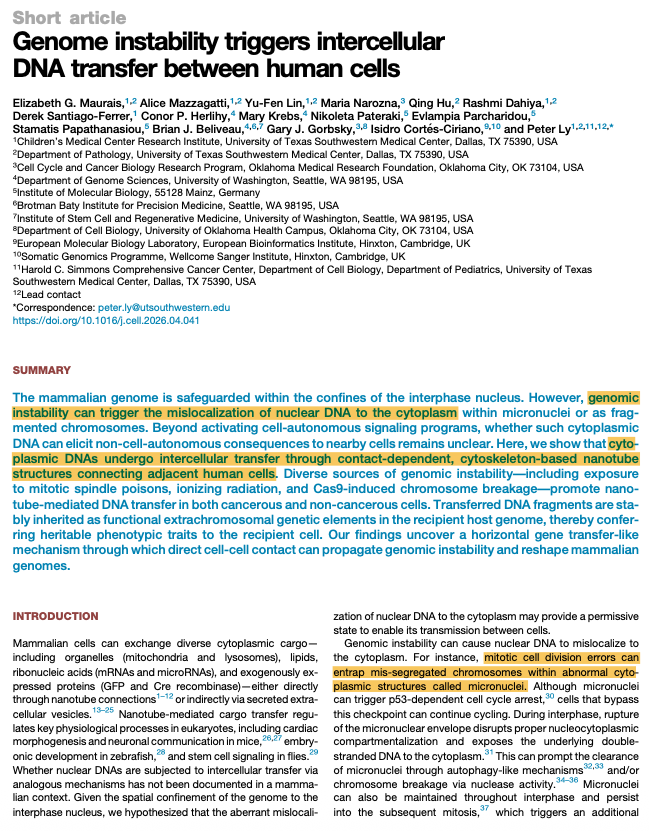
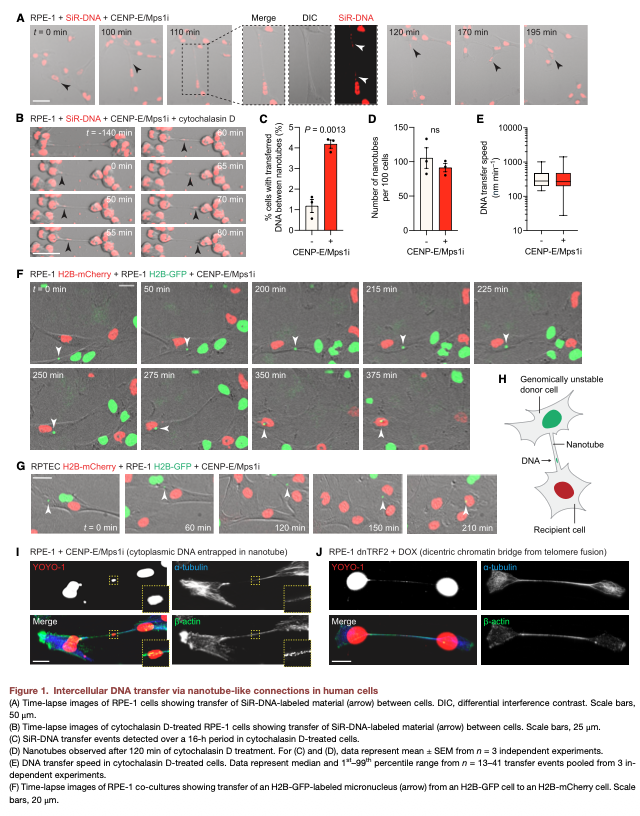
My favorite paper this week: Human cells with damaged genomes (from cancer, radiation, or even CRISPR editing) grow tube-like bridges to their neighbors and send them broken chromosomes. The transferred DNA sticks around in the receiving cell and remains functional.
This paper is really cool, and hints at *so many* interesting questions, but it’s important to caveat that it isn’t the first time people have seen DNA moving between human cells! There’s a 2013 paper (Jin Cai et al.) that shows extracellular vesicles (membrane-enclosed bubbles that bleb off cell membranes) can also carry DNA between cells. A similar thing happens with “apoptotic bodies.” Basically, when a cell dies, pieces of that cell will form into little spheres, some of which contain DNA. These “apoptotic bodies” are then engulfed by neighboring cells, which take up their DNA and (sometimes) incorporate the sequences into their own genomes. (See the Holmgren et al. paper from 1999.)
People had even shown that nanotubes can swap DNA between cells! They hadn’t seen this with nuclear DNA, though; mostly mitochondrial DNA and various RNAs. This paper, then, is extremely original and exciting, yet sits within a rich subfield of cell-cell DNA transfers.
The experiment was extremely simple. The researchers grew two types of human cells together in a dish. They tagged the histones in each cell type with a different fluorescent color; one green and the other red. Next, they exposed the cells to drugs that interfere with mitosis and recorded time-lapse videos. In one of these videos, they literally watched as DNA tagged with one color moved — through the thin nanotubes — into a cell with the other color. This happened not only with mitosis-blocking drugs, but also with CRISPR-induced chromosome breaks and radiation. The transferred DNA remained functional, too; they were transcribed into RNA and translated into protein.
(Sidebar: It seems like this whole discovery was an accident. The group behind this paper had previously studied what happens to nuclear DNA when chromosomes break using exactly the same techniques and drugs. But it seems like they never expected to see this transfer happen between cells. They write in the paper: “Surprisingly, using live-cell imaging to monitor cytoplasmic DNA labeled with a double-stranded DNA-specific fluorescent dye, we observed the apparent transfer of DNA from the cytoplasm of donor cells to neighboring recipient cells.”)
It’s not clear to me how important this might prove for, say, cancer. But the authors point at some intriguing ideas. Maybe the transfer of DNA between cells “mimics” some of the genome architectures we see in cancer cells, for example. Perhaps “DNA transfer could generate genomic alterations in recipient cells that resemble whole-chromosome gains or non-tandem duplications, challenging the assumption that these changes originate exclusively from cell-autonomous mitotic defects.”
The researchers also speculate that DNA transfers could “potentially enable genomically unstable cancer cells to disseminate oncogenic alleles, deleterious mutations, and/or regulatory elements to neighboring non-cancerous cells.” If this turns out to be true, nanotubes could be a useful target for cancer therapies.
Anyway, I love papers like this, where it feels like a whole swath of questions suddenly arises from beneath your feet. There is so much work to be done, and biology goes ever deeper.
Al Roth on Why People Should Be Free to Sell Their Kidneys. (Any "yuk" reaction should be weighed against the hundreds of thousands of lives that could be saved, just as in the past we overcame our "yuk" reactions to blood transfusions, life insurance, organ transplants, IVF, and other innovations with massive benefits and no tangible costs.) https://t.co/2OpaXLeRWf
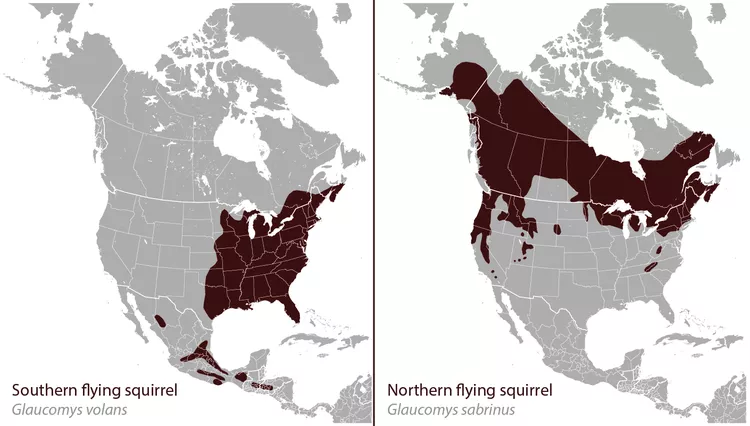
It turns out that flying squirrels live in most of the continental US, but you almost never see them because they are 100% nocturnal.
I learned this recently because as I knocked down a dead tree in my backyard a family of squirrels flew out and I thought I was going insane.
Could you help me collect data?
It's a fun game that takes only a few minutes, but it will really help my colleagues and I to better understand human beauty preferences.
Please share to help increase sample size; I'm grateful for your support for science.
Underrated Ideas in Biotech (Part I)
My list of writing ideas is growing far faster than I can possibly publish. So here are some "half-baked" ideas in biology that I hope others will pick up and run with.
In this first blog, I share three ideas:
1. Hyperspectral Biology — It is possible to see microbes from outer space. (That sentence sounds ridiculous, but it's true.) We can now build planetary-scale networks that would enable us to engineer microbes that sense pathogens, or act as early warning systems for other threats, and monitor using satellites.
2. Biology for Beauty — Nature is often described as the most beautiful thing on Earth, far exceeding artistic works from Monet and Picasso. Yosemite and the Grand Canyon feel as if they were sculpted by the hands of God; all other art is unmistakably the work of humans. Why aren't there entire companies that (like Tiffany or Cartier) aim to make eternal art using biology?
3. Mapping the Air — Microbes can travel thousands of miles, traversing continents by riding on dust motes carried by atmospheric winds. Sand from the Sahara desert travels all the way to New York City, carrying pathogens with it. We have barely begun to study the microbes hitching rides on these atmospheric winds.
On a related note: There is a growing field of AirDNA. Every time you breathe, saliva droplets are released into the air. These droplets contain DNA, which can be captured and sequenced. After the DNA settles onto the ground after about 24 hours, it gets wrapped into dust, and sits there for years.
It is feasible to take the dust from a room and build a genomic record of everyone who has ever entered it. In 2023, researchers at MIT also engineered living cells to take up and permanently record DNA from their surroundings. The bacteria were sensitive enough to distinguish between two sequences differing by a single nucleotide at exceptionally low concentrations — about 4.6 femtomolar.
These “sentinel” cells can be used to figure out what a person looks like, solely by storing the trace amounts of DNA they leave behind in a room.
Many facial features are influenced by single-nucleotide polymorphisms (SNPs), or single-letter variants in the genome that correlate with things like nose width and eye spacing. The MIT team engineered cells to detect five facial SNPs and showed each could be detected independently. Sprayed onto a surface, these cells would capture SNPs and, once sequenced later, reveal who passed through.
This is not science fiction. The authors say it directly in the paper: “we demonstrated sentinel cells on a set of five human SNPs associated with human facial features. One could record this information in a single cell or consortium, recover the DNA, and use artificial intelligence to rebuild the predicted face.”
Much more: https://t.co/NrIEDC8UGr