Are we ready, Brazil? 🇧🇷
In 24 hrs, we're going to launch the only audited Brazilian stablecoin! Spearheaded by @BRLAdigital, it aims to spearhead the transformation of Brazil’s financial infra 🔥
Onboarding Brazil to @Polkadot. Are you ready for some Samba? 🕺💃
@BRLAdigital @ @WebSummitRio 2024! 🚀
[PT] Nosso time estará no Web Summit Rio 2024, um dos maiores eventos de tecnologia do mundo!
Venha nós visitar no estande A501 na Terça-Feira, dia 16 ou procure nosso time nos demais dias.
[PT] O $BRLA foi verificado no PolygonScan! ✅
Após uma diligência extensa, o PolygonScan finalmente verificou a reputação da nossa stablecoin.
Esse selo está alinhado com o nosso compromisso com a transparência na @BRLAdigital, trazendoconfiança para nossos stakeholders.
Diving into Brazil's financial revolution with DREX, as discussed by Fabio Araujo on a podcast hosted by @AaronWStanley at @BrazilCrypto_. Here's how DREX is setting a new standard for digital currencies and financial inclusion. A thread 🧵
🚀 Diving into the essence of startup success, I've unpacked insights from @pmarca's brilliant piece on @a16z's blog. A thread on navigating the startup odyssey. 👇
Delving into "The Guide to Create a Sales Machine for GTM" by Vitor Pijaro and @astellainvest. Unearth insights from Chapter 2 (Part 2)!
Chapter 2: Foundation to Build the Sales Machine
Tech
The Sales tech stack plays a dual role:
1️⃣ Ensure adherence to the sales process.
2️⃣ Minimize sales team overhead, allowing more time for productive selling.
In the early stages, simplicity rules. Focus on Product-Market Fit (PMF) over scaling; tools like spreadsheets and Notion make effective starter CRMs. As you progress, seek tools for increased efficiency, effectiveness, and enhanced client experiences.
Content
Effective communication is crucial. Sales and Marketing (S&M) teams must share a common language for engaging potential clients and boosting success rates.
Leverage an Impact-based framework:
Roles and Responsibilities
Acquisition:
1. SDR: Qualify inbound leads.
2. BDR: Pursue outbound leads (sometimes overlapping with SDR).
3. Account Executive: Execute effective sales.
4. Sales Engineer: Understand technical viability.
Expansion:
1. ONB (Onboarding): Implement the "go live."
2. CS (Customer Success): Ensure clients derive value.
3. AM (Account Manager): Identify new opportunities.
A well-machined POD is one where we know the time required to achieve 80% of its goal, ensuring a balanced equation. The key efficiency benchmark asserts that each POD must generate a minimum of 2.5x annualized revenue compared to its total cost (fixed salary + variable) 📈
I've delved into "The Guide to Create a Sales Machine for GTM" by Vitor Pijaro and @astellainvest. Check out the key insights from Chapter 2 (Part 1)!
Chapter 2: Foundation to Build the Sales Machine
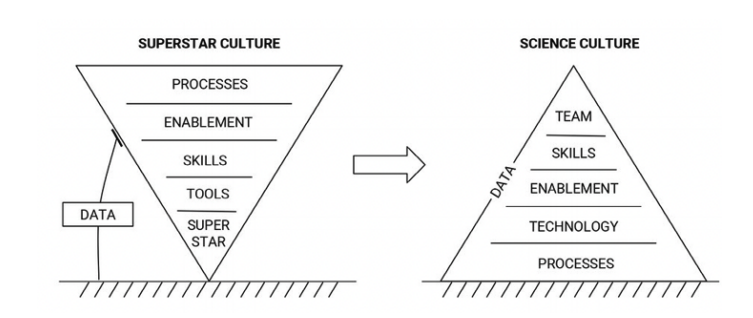
Certain sales philosophies can hinder change and work against creating a sales machine, such as ABC (always be closing), leading to "selling hairbrush to balds" or valuing relationships over disciplined systems and methods.
This lack of investment in discipline creates instability in the sales machine. The necessary changes are exemplified below:
Process: Enables every stage to work uniformly, leveraging past lessons to enhance future movements.
Tech: Optimizes activities, aids in process adherence, and guides the team based on insights for better client interactions.
Enablement: Establishes frameworks to maintain a clear and consistent message throughout the client's journey.
Skills: Coaching is crucial; 10% from lessons, 20% from feedback, and 70% learned by doing. Team preparation is vital.
Data: Quantifies all aspects to expedite learning, reduce investment needs, and increase returns.
Process
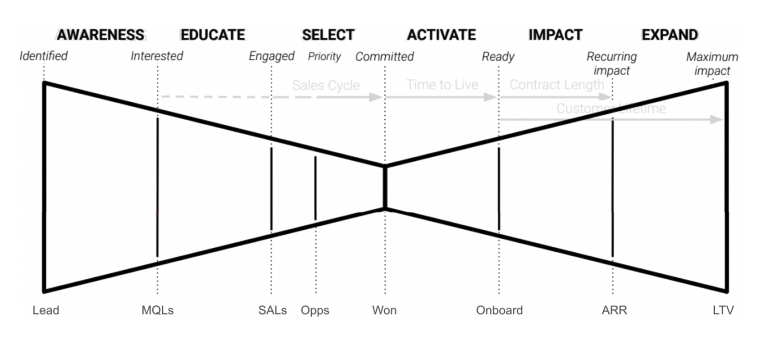
Scaling what already works involves diagnosing what's effective and identifying areas for improvement. The Bow-tie model is a well-known approach:
Left side represents Acquisition:
Discovery: Identify client pain points and find potential clients with those issues. Define your Ideal Customer Profile (ICP).
Education: Buyers seek to understand your problem-solving capabilities. Verify if the ICP was right; is this a genuine opportunity?
Selection: With various options, explain why your company has the best impact. Demonstrate how you can maximize your ticket.
Right side represents Expansion:
Activation: Customizations, deployments, and integration phase.
Impact: Deliver as promised or better. High Value Perception is the goal.
Growth: Explore additional ways to serve the client and generate more value in the partnership.
Stay tuned for Part 2 where we explore other elements!
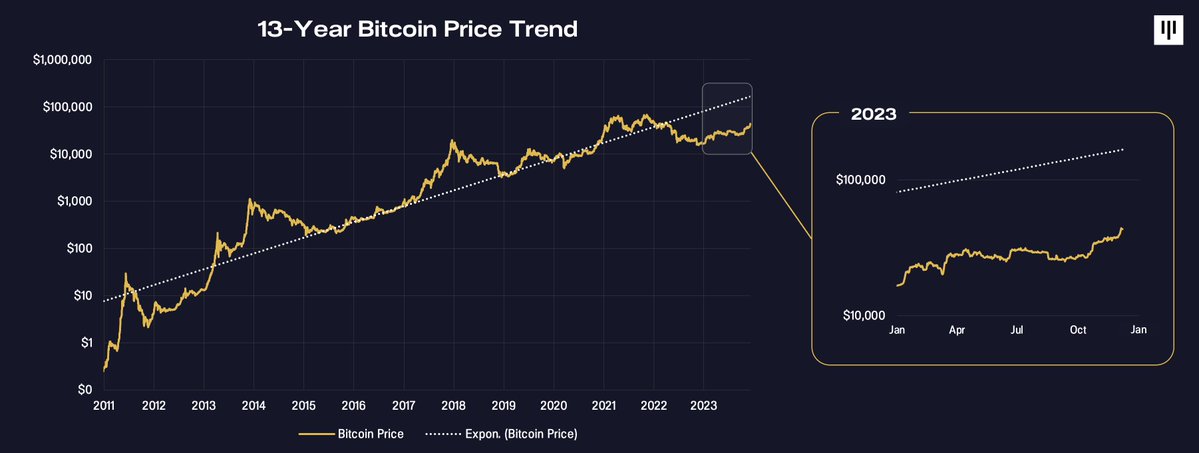
Unlocking insights from @PanteraCapital's YE23 letter: a bullish outlook ahead! From institutional adoption to regulatory wins and on-chain growth, it's shaping up to be an exciting year. Plus, a deep dive into Bitcoin's 13-year trend analysis. 🚀
Reasons to be Bullish! 🐂
Institutional Adoption:
Imminent approval of Bitcoin ETFs by major traditional finance players like BlackRock and Fidelity signals accelerated institutional adoption (Now Approved!). This echoes the introduction of the first international gold ETF in 2003, opening doors for traditional capital into the realm of "digital gold."
Regulatory Standards:
Court victories for Ripple's XRP and Grayscale's Bitcoin ETF application instill confidence in the fairness of the U.S. court system, indicating a positive regulatory landscape. This fosters onshore innovation within the blockchain industry.
On-Chain Growth:
The blockchain industry's shift from "dial-up" to "broadband" is evident in the growth of Ethereum layer 2s and hyperscale blockchains. Arbitrum, driving nearly 100% of transaction growth in the Ethereum ecosystem, reflects this transformative moment.
Market Cap Surge:
Noteworthy market rebound since the year's beginning, with Bitcoin's yearly low at $16,680 on January 2nd. The overall market capitalization of cryptocurrencies has doubled, surging from $0.8tn to $1.6tn.
Binance Settlement:
The likely resolution of the Binance settlement marks a pivotal moment, signaling the conclusion of significant events and clearing the path for positive developments within the blockchain industry. The market is now poised to move forward.
Let's end with the 13-Year Trend Analysis they made!
I just watched @waseem from @PilotHQ share insights in @a16z 's 'My First Sixteen' series. Here are the main lessons:
Their MVP began with hands-on QuickBooks accounting, identifying pain points, and coding solutions for efficiency. A tight-knit team of 3 co-founders and 2 engineers laid the foundation.
Recognizing the universal need for accounting, they targeted early-stage tech startups. The unique proposition? 'For startups, by startups.' Waseem, having been through the startup grind, understood the challenges faced by founders without a CFO.
They embraced an open-minded approach to their startup clientele, drawing in those dissatisfied with existing providers. Trust-building was a priority, facilitated through investor intros and their expanding network. Feedback collection wasn't limited to emails; they actively sought opinions and potential users through client interactions.
In the early days, their pricing strategy leaned on the idea that technology would make them more cost-effective. However, a pivotal shift occurred, and they pivoted to providing the best solution at a fair price. Today, their pricing is 10x higher than day one, emphasizing the value they bring.
A notable decision was to avoid solo entrepreneurs and very small businesses, maintaining a rule of thumb that customers shouldn't spend more than 1.5% of total expenses on accounting.
Founder-led sales played a crucial role. Even when uncomfortable, Waseem, with a technical background, preferred training generalists over hiring pre-formatted sales personnel. The first sales hire was made at 60 customers, and the second at 240.
An insightful takeaway: imperfection is the path to improvement. Whether in the deck, product, or sales pitch, Pilot emphasized the importance of getting feedback from the world. Founders must step into the discomfort of acquiring customers themselves, as it's the only way to truly understand the market's needs.
Just watched "Competing in a Crowd of Incumbents" with @immad from @mercury, part of @a16z series: My First Sixteen. Key lessons:
https://t.co/ZyeaPdmNGA
Mercury wanted to be the primary bank for its customers and began with Early-Stage Startups as the Ideal Customer Profile (ICP), setting a fairly high product standard.
The Mercury MVP was robust due to this vision of banking as highly competitive. Customers already had alternatives, unlike an Airbnb-like situation.
Immad believes in having a lean team before Product-Market Fit (PMF), fewer than 10 people.
Growth Trajectory:
Over 18 months, he spoke with 100 startup founders - they weren't very excited. Learning without a live product is challenging.
Mercury falls into the "vitamin" startup category. For such companies, it's difficult to generate excitement without people seeing the product because they always view it through the lens of alternatives.
Easy onboarding, a great landing page, and a highly connected community (where each founder has 20 founders as friends) were powerful for them.
The first hire should not be a head of sales; you should hire some salespeople, test if the process is repeatable and adds value, and maybe those individuals can become managers as things progress. They hired a VP of Revenues and a VP of Marketing after 4+ years.
Taking something from zero to one is not about hiring the best manager; it should be founder-led with the help of mentors. Bring in leadership later.
Pricing is peculiar for fintechs: for the revenues they make, how much do they pass on to people? Mercury doesn't aim for the best pricing but rather a really good deal.
You have to build something that creates demand from clients who are coming to you to build big companies. You cannot rely only on convincing/forcing one client at a time.
The best sales path for day zero would not be the best for 1M+ ARR and for 10M+ ARR.
The one piece of advice for founders: Think about sales as a numbers game - how many people you talk to, how many you convert, how many talks you need to do. Not as an emotional game. Run a process and a pipeline to be successful.
$BRLA: A primeira stablecoin do BRL auditada do mundo
Na BRLA Digital, vemos a construção de confiança como um pilar de fundação do nosso crescimento.
https://t.co/28OCAb4BTC
Unpacking @pmarca's Archives Part 2: When VCs say "no"
Lesson 1: Treat each 'No' as a pivot point. Accumulate 5-10 'No's, it's a cue to recalibrate your strategy. Politely accept it - VCs often keep doors ajar for future engagements, so do you want this.
Understanding Startup Risks:
Founders Risk: Ensure a dynamic blend of skills in your founding team - ideally, a business visionary and a tech maestro. Consider role adjustments for a more robust synergy.
Market Risk: Don’t just assume demand; validate it practically. Secure paying customers to prove not just interest, but actual market viability.
Competition Risk: Never claim a lack of competitors. It signals either naivete or significant market risks. Understand your competitors, learn from them.
Timing Risk: Justify why now is the opportune moment. Timing can be a decisive factor in your startup’s trajectory.
Financing Risk: Be precise about your funding needs. Understand the number of funding rounds required and evaluate if it’s feasible to secure them.
Marketing Risk: Scrutinize the cost of marketing. Ensure that your customer acquisition economics align for scalable growth.
Distribution Risk: If success hinges on a distribution partner, meticulously outline your strategy to secure one.
Technology Risk: Address the feasibility of building your product. Develop an MVP to tangibly reduce tech and product risks.
Product Risk: Gauge your team's capabilities in building the envisioned product. A competent team is pivotal to success.
Hiring Risk: Assess the positions crucial for execution. Evaluate your team's prowess in attracting and retaining top-tier talent.
Tailored Risk Mitigation: Address specific risks within your market. Tailor your approach to mitigate challenges unique to your industry.
Remember, while securing a 'Yes' is a pivotal milestone, maintain flexibility until the funds are securely in your company's coffers.
A BRLA Digital e @usePicnicBR criaram um incentivo para aumentar a liquidez da pool de BRLA-USDC 💰
Vamos distribuir R$4,5 mil ao longo de 6 semanas, que deve gerar um APY muito interessante (veja foto).
Esse incentivo é adicional ao retorno da pool, que já está muito bom.
- vender 2k USDC por BRLA = 9911 BRLA
- sacar para conta
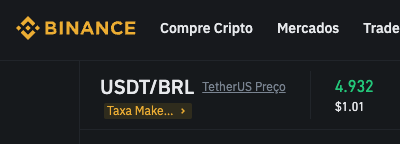
- comprar USDT na binance = 2009 USDT
pnl = 8 dol (com tx de saque)
rola de fazer em 5 min. vale o trabalho?
40 reais em 5 min arbitrando a pool de BRLA <> USDC
Vale a pena ficar de olho, tá rolando oportunidade assim 2-3x por dia: https://t.co/zqtOGD9pMq
Just tuned in to @BrazilCrypto_ Podcast featuring Thomas from @Credix_finance, and there's some fascinating stuff:
Credix, a decentralized credit marketplace on @solana, has deployed over U$45M in investments across Latin America since last year. Now, they've raised U$60M in credit facility to further boost capital in the region.
With U$40M in AuM/TVL today, Credix collaborates with local originating platforms, acting as a potential lender for over 10K SMEs indirectly connected through these platforms.
Why Latin America?
It started with their first client in Brazil. Recognizing a vast market opportunity with significant access barriers, Credix focused on building the best credit marketplace to attract institutional capital at scale.
Business Case: Clave, a Colombian fintech platform in agriculture, partnered with Credix, gaining access to over U$5M, facilitating scale.
Investors enjoy a comprehensive data dashboard - digital, transparent, and efficient capital deployment infrastructure, 10x better operationally. Credix believes in blockchain as the best tech stack for the future of finance infrastructure.
On @solana: Impressed with the ecosystem, they see Solana's frictionless and ultra-scalable nature as the future of finance. The Solana team's support adds to the platform's potential.
Congrats @AaronWStanley for making such great content available 🙌
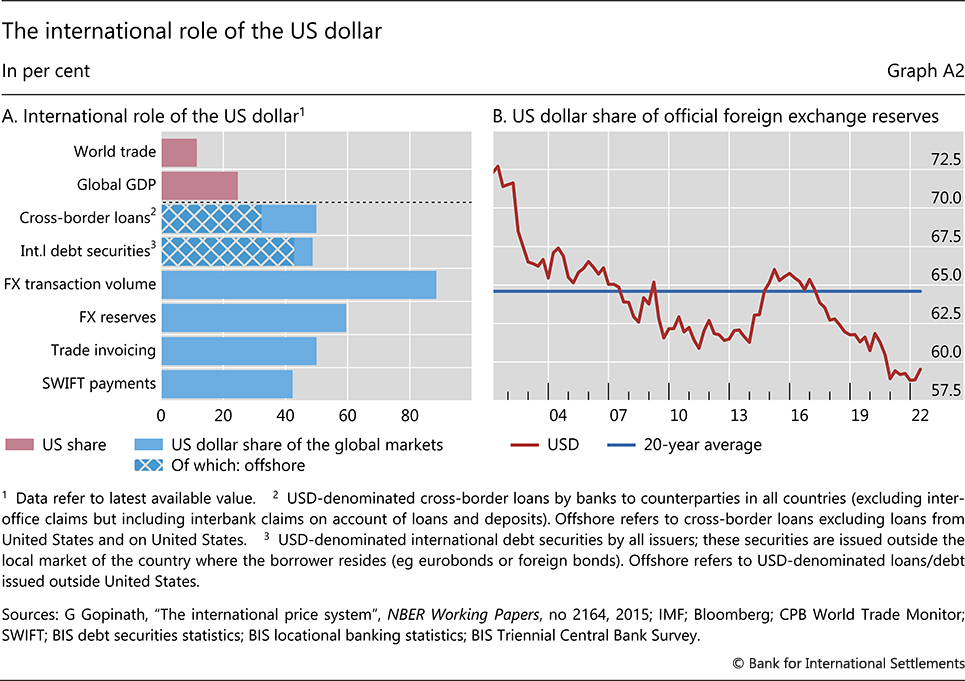
Diving into the insightful piece by the @avax team on "The Tangible Benefits of Bringing Non-USD Stablecoins and FX On-chain," let's break it down here
USD Dominance in Global Finance
The United States dollar (USD) maintains its prominence as the world’s principal reserve currency, constituting 60% of foreign exchange reserves globally. It also commands a significant share in SWIFT payments (40%) and FX transaction volume (85%).
On-Chain Dominance
When it comes to on-chain dynamics, USD stablecoins emerge as dominant players, boasting a staggering 99.66% market share in terms of market capitalization ($125B) and over 99.97% in daily trading volume ($30-40B). In contrast, non-USD stablecoins are virtually nonexistent in this space.
Growth Potential for Non-USD Stablecoins
Considering the potential alignment of on-chain finance with traditional finance, there's a significant growth prospect for non-USD stablecoins. This could potentially lead to a market capitalization of around $50B and daily trading volumes of approximately $20B.
On-Chain FX Trading
The expansion of non-USD stablecoin issuance on-chain brings forth the prospect of creating alternative foreign exchange (FX) markets. This shift holds the promise of better uptime, reduced transaction fees, and the introduction of atomic trade finality and settlement. Key advantages include 24/7 trading, cost-effectiveness (especially for retail and small businesses), broader accessibility, composability, instant transaction finality, and less operational intensity.
To Learn more, search the paper below:
Remittances and Cross-Border Payments
The development of alternative, liquid FX markets on-chain represents the initial step towards a broader vision in the global utility and payments landscape. The complexities and high costs traditionally associated with remittances and cross-border payments, attributed to legacy banking infrastructure and intermediaries, could be addressed through the efficiencies of on-chain alternatives. In 2022, countries received over $831 billion in combined remittance inflows, with on-chain alternatives presenting a tangible opportunity for enhanced efficiency, cost-effectiveness, and transparency.
Derivatives Markets
In addition to facilitating spot transactions, robust on-chain FX markets could catalyze the creation of derivatives markets for macro directional trading and hedging purposes. Protocols like Hubble and GMX offer the potential for perpetual futures, tracking underlying currency prices and enabling leveraged trading strategies. The profits generated from trading and market-making activities can be redistributed to liquidity providers, opening up additional opportunities for earning yield on on-chain currency deposits. While work remains in these areas, on-chain protocols hold the potential to reshape traditional currency derivatives markets.





![aveniaio's tweet photo. @BRLAdigital @ @WebSummitRio 2024! 🚀
[PT] Nosso time estará no Web Summit Rio 2024, um dos maiores eventos de tecnologia do mundo!
Venha nós visitar no estande A501 na Terça-Feira, dia 16 ou procure nosso time nos demais dias. https://t.co/OkwrXKaFsC](https://pbs.twimg.com/media/GK6bxT6bYAAg_tk.jpg)
![aveniaio's tweet photo. [PT] O $BRLA foi verificado no PolygonScan! ✅
Após uma diligência extensa, o PolygonScan finalmente verificou a reputação da nossa stablecoin.
Esse selo está alinhado com o nosso compromisso com a transparência na @BRLAdigital, trazendoconfiança para nossos stakeholders. https://t.co/3QsqdOmTwi](https://pbs.twimg.com/media/GJCkUh4XQAAyDw1.png)