T3 Code founder shared an 11-page PDF with his personal setup for a multi-agentic team.
Fable 5.2 leads → Opus 5.5 builds. → Gemini 4 Neon docs → Grok Bot feeds them work 24/7
how:
→ Grok Bot files tasks into T3 Code over MCP
→ Fable 5.2 writes the spec and splits the work
→ Opus 5.5 builders run in parallel, one worktree each
→ a different model family reviews every diff before you see it
save the pdf, here's the guide:
• step 0 → what it is:
T3 Code = open-source control plane for coding agents. free, runs on your machines, uses your own Claude, ChatGPT and Google subscriptions
Grok Bot = always-on agent with its own cloud computer. the only member that never sleeps
• step 1 → the five seats:
- Grok Bot → dispatcher, writes briefs, never merges
- Fable 5.2 → lead, SPEC.md + the hardest slice
- Opus 5.5 ×2 → builders, one slice each
- GPT-6.2 Astra → playtester, read-only
- Gemini 4 Neon → docs, changelog, UI copy
• step 2 → one charter, one brief:
TEAM.md in the repo root, every agent reads it first
every handoff = 7 fields: goal, context, done when, do not, return. "done when" must be a command, not an opinion
• step 3 → let the lead delegate:
Fable 5.2 on High, not max. it starts builders with delegate_task, each in its own worktree on its own branch
• step 4 → cross-family review:
Astra tries to break every diff. max 3 rounds, then a human
in one public pipeline Astra rejected 417 of 1,287 Opus additions. same-family review would have shipped them
• step 5 → go 24/7:
npx t3 connect on every machine → Copy MCP URL → paste into Grok Bot with OAuth
it watches GitHub, Slack and X, deduplicates, and launches threads while you sleep
what to expect:
- one feature ≈ $12.75 at API prices, the lead is 25% of it
- 28 PRs merged in one night (Theo, only because his systems verify them)
- control everything from your phone
- T3 Code: $0. you pay for your own subs
honest take:
the model is not the bottleneck anymore. verification is. bad briefs still give bad PRs, and green checks only mean something if your tests do
Save it so you don't lose it.
then read the full guide on building AI agent teams in T3 Code in the article below ↓
holy sh*t. Official Anthropic tip for Claude Code: stop burning Opus 5.5 context on tasks Haiku 5.5 can swarm, while Sonnet 5.5 builds
put the architect on call with /advisor
claude --advisor opus --subagents haiku
Sonnet 5.5 drives the primary session on high effort, writing diffs and running test suites
Haiku 5.5 subagents swarm the repo in parallel at 340 tok/s, handling file discovery and spec docs lookup
Opus 5.5 stays on call in the background as the advisor, only stepping in at three critical moments:
→ before a plan locks: does the implementation plan miss auth invariants or schema contracts?
→ when a test breaks twice: are we fixing the root cause or falling into a recursive rabbit hole?
→ before calling done: did the full diff introduce hidden regressions or break pre-flight rules?
Opus 5.5 reviews. Sonnet 5.5 builds. Haiku 5.5 swarms
Jev engineering runs the identical pattern one layer down: mechanical decisions that need no reasoning (which file to open, which tool to invoke, retry or abort) execute in 16ms, so the frontier models only wake up when execution paths actually diverge
Plan on high. Delegate on medium. Keep Opus on call.
- the full advisor setup
> Opus 5.5 on call reads full session history and catches deep architectural traps
> Sonnet 5.5 lead drives edits, writes core logic, and executes test harnesses
> Haiku 5.5 subagents swarm AST parsing, grep scans, and API docs in parallel
> JEV micro-fork layer resolves 1,500+ mechanical routing branches in under 16ms
> advisor stays completely silent on routine bash execution to protect context
paste the setup and this prompt into Claude Code below:
"Configure my Claude Code workspace for hierarchical advisor orchestration:
1. Audit ~/.claude/settings.json and project config for model roles fitting lead, subagents, and advisor:
> Pin main session model: sonnet with effortLevel: high for primary execution
> Pin subagents model: haiku with effortLevel: medium for parallel file discovery and docs retrieval
> Pin advisor model: opus on call for strategic review
2. Enable the advisor tool in ~/.claude/settings.json:
> Set advisorModel to claude-opus-5-5
> Enable subagent parallel dispatcher pool (3x workers)
3. Configure automatic advisor consultation checkpoints in ~/.claude/CLAUDE.md:
> Consult /advisor opus before finalizing multi-file architecture plans
> Automatically summon /advisor opus when the same test or compiler error fails twice
> Enforce advisor diff contract audit before declaring tasks complete or staging git commits
4. Constrain subagent scopes:
> Haiku subagents return structured AST summaries and docs snippets only without modifying main session context
Show every configuration diff first. Do not apply edits until confirmed"
↳
https://t.co/gvAWk6KbDn
Introducing AgentCraft: a multi-agent harness that runs inside Minecraft ⛏️
A team of Claude agents plans, builds in real worktrees, and walks over when they need you.
Andrej Karpathy just explained the 5 shifts turning LLMs into agentic systems.
00:00 - Memory turns chat into personal AI
06:41 - Multimodal AI reads the world
16:58 - Thinking models solve harder tasks
24:51 - Search makes LLMs live
30:58 - Tools turn LLMs into workers
Most people are still treating LLMs like chatbots.
Karpathy is showing the full stack:
Memory → Vision → Reasoning → Search → Tools
Prompting is the old workflow.
Agentic systems are the new one.
This 40-minute talk is worth more than most paid AI agent courses.
Bookmark and watch it before everyone catches up.
Then read how to turn LLMs into self-improving agent loops below
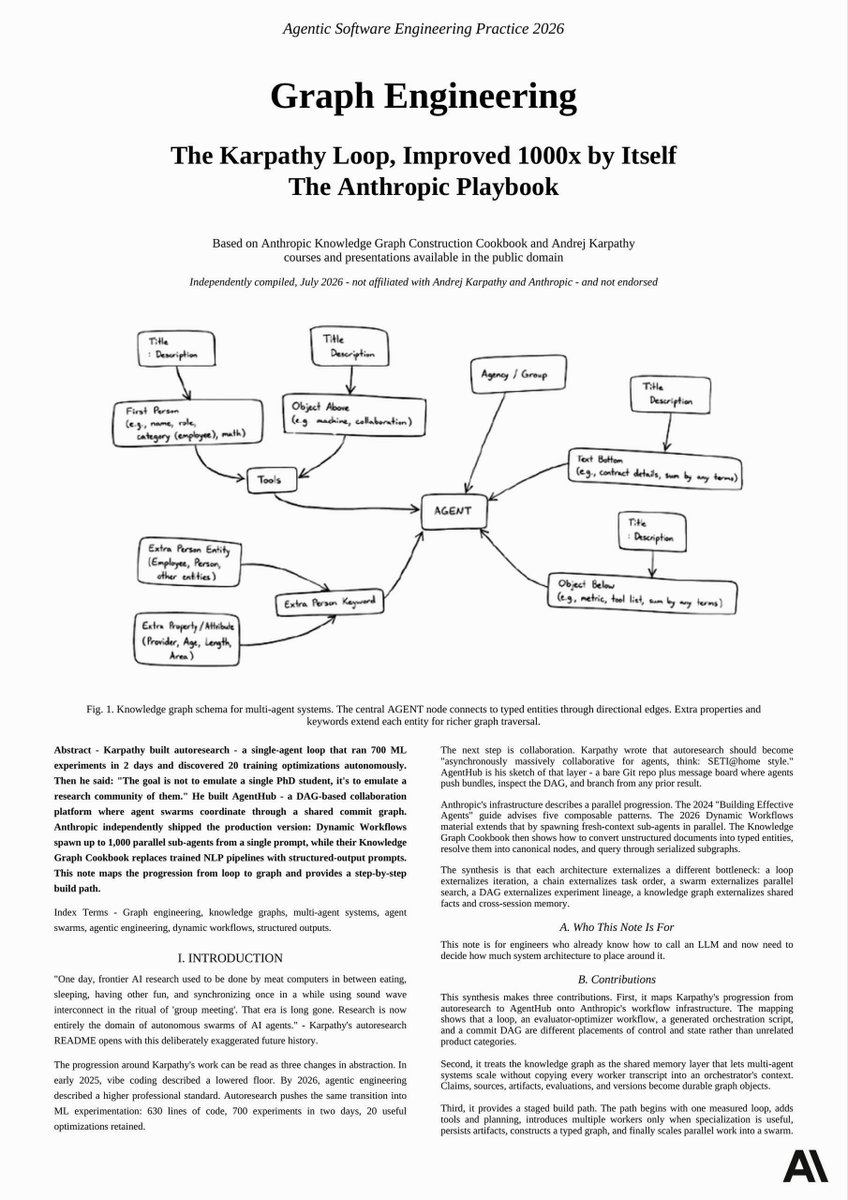
Two Anthropic seniors just made Karpathy's loop 1000x better with "Graph Engineering" - dropped 11-page PDF
the shift: the agentic systems got 1000x better the moment you wired agents into a graph
here's the playbook in 6 steps:
step 1 → build one loop: generate, critique, revise - one self-review cycle beats a smarter model with none
step 2 → add tools: search, code execution, database - thinking without tools is hallucinating
step 3 → go parallel: spin up agents in separate worktrees - same repo, different branches, no conflicts
step 4 → add a graph: agents write findings as typed nodes and edges - not transcripts - every claim keeps its source
step 5 → ground your evaluator: it checks claims against graph edges, not vibes - "Triple not found" beats "seems off"
step 6 → the graph survives every session - your agents stop rebuilding context from scratch
the result: Karpathy ran 1 agent in 1 direction - this system runs 1,000 with shared memory - same model, it's the architecture
read this 11-page PDF and paste it into your Claude - you won't regret it
bookmark - then read the article on building graphs from scratch ↓
Andrej Karpathy: "90% of your AI coding bill is paying for context you didn't need to send"
Here are 10 things senior AI engineers stopped wasting tokens on:
1. Auto-context loading 50 files for a 30-line fix: $1.20/turn for tokens you'll never read. 80% input waste, every session
2. Running Opus on lint, format, and rename tasks: $0.60 for what Haiku nails at $0.02. 30x overpay on the cleanup tier
3. Tool call loops that re-send the full repo on every retry: 5x context cost per agentic flow. fixing these alone cuts 30-50% of bills
4. Sonnet as the default model: Kimi 2.6 matches its quality on most coding tasks at 1/6 the cost. defaulting to Sonnet in 2026 is leaving 60-70% on the table
5. Streaming responses on stable-prefix workflows: kills your prompt cache. you pay 10x for tokens that should have cost cents
6. "Just in case" file includes: 80,000-token prompts that should be 3,000. context bloat is the silent budget killer
7. Per-session knowledge rebuilding: 10 min writing a SKILL.md once vs paying agents to re-figure out your environment every run. $4 vs $0.30 per execution
8. Single-model setups: premium tier on every task is the most expensive mistake in AI coding right now
9. Asking 10 small questions one at a time: 10 separate input prefix charges vs one batched call. 70-90% savings on routine workflows
10. Buying Claude Pro + ChatGPT Plus + Cursor Pro: you seriously use one. the other two are habit, not utility
what actually compounds instead:
- context discipline (grep before fetching, always)
- prompt caching on every stable prefix
- multi-model routing (Kimi 2.6 default, Opus for the 10%)
- graduated skills via SKILL.md files
- profiling tool calls before optimizing prompts
- the routing mindset (right model for right task)
in 12 months, the gap between developers shipping on $200/month and $4,000/month budgets won't be skill
it'll be how well they route
study this.
Ruflo - 클로드 코드를 위한 멀티 에이전트 AI 오케스트레이션 플랫폼
- 클로드 코드에 100개 이상의 특화 에이전트를 조율하는 능력을 부여하는 플랫폼으로, 기존 Claude Flow에서 리브랜딩
- `npx ruvflo init` 한 줄이면 에이전트가 스웜으로 자기 조직화하고, 작업…
https://t.co/NGisIljcjX
터미널폰 – 명령줄에서 사용하는 종단간 암호화 워키토키
- Tor 네트워크를 통해 음성과 텍스트를 익명·종단간 암호화(E2EE) 방식으로 주고받는 Bash 기반 워키토키형 통신 도구
- 서버, 계정, 전화번호 없이 `.onion` 주소만으로 상대와 직접 연결하며, 음성 메시지를…
https://t.co/3KSiT7GXvS
Cloudflare, AI로 Next.js를 1주일 만에 Vite로 재구현한 vinext 공개
Cloudflare의 한 엔지니어가 AI(Claude)의 도움을 받아, 복잡한 Next.js 인프라를 Vite 기반으로 완전히 새로 작성한 프로젝트 'vinext(vee-next)' 를 공개. 기존 Next.js의 고질적인 배포 및 빌드 문…
https://t.co/GvbDMg9Gxx
AI 코딩 에이전트(Codex, Claude Code)를 직접 쓰는 대신, 상위 오케스트레이터(OpenClaw의 "Zoe")가 여러 에이전트를 관리하는 2계층 시스템을 구축에 관한 아티클입니다.
너무 좋은 글이네요.
----------------------------------------------------------
요약
왜 오케스트레이터가 필요한가?
: 컨텍스트 윈도우는 한정적이라 코드와 비즈니스 맥락을 동시에 넣을 수 없습니다. 그래서 오케스트레이터(Zoe)는 고객 데이터·회의록·과거 의사결정 등 비즈니스 컨텍스트를 담당하고, 코딩 에이전트에게는 코드에 집중할 수 있는 정밀한 프롬프트만 전달합니다.
작동 방식 (8단계)
: 고객 요청 → Zoe와 스코핑 → git worktree + tmux로 에이전트 스폰 → 크론잡이 10분마다 상태 모니터링 → 에이전트가 PR 생성 → Codex·Claude·Gemini 3개 모델이 자동 코드리뷰 → CI/테스트 통과 → 텔레그램 알림 후 사람이 최종 머지
핵심 차별점
: 에이전트가 실패하면 같은 프롬프트로 재시도하는 게 아니라, Zoe가 실패 원인을 비즈니스 맥락과 함께 분석해서 더 나은 프롬프트로 재스폰합니다. 성공 패턴도 학습해 시간이 갈수록 프롬프트 품질이 올라갑니다.
실적
: 하루 평균 커밋 50개, 최대 94개. 에디터를 열지 않고도 고객 요청을 당일 배포. 비용은 월 ~$190 수준. 실제 B2B SaaS(에이전틱 PR 서비스)를 이 시스템으로 혼자 운영 중입니다.
Kimi Claw - OpenClaw를 클라우드에 원클릭 배포해서 사용하기
- OpenClaw를 Kimi 플랫폼을 통해 클라우드에 원클릭으로 몇 초안에 배포 가능
- 복잡한 설정 없이 24시간 온라인 상태로 유지되며, 즉시 사용 가능한 형태로 제공됨
- Kimi K2.5 Thinking이 적용되어…
https://t.co/6zxfavsXvw
agent-of-empires - tmux와 git Worktree를 활용한 AI 코딩 에이전트 터미널 세션 관리자
- AI 코딩 에이전트의 병렬 실행과 세션 관리를 위해 개발
- Claude Code, OpenCode, Codex CLI, Gemini CLI 등 주요 AI 코딩 도구를 통합 지원
- Linux와 macOS에서 동작하며…
https://t.co/yPhh6LCDDD