Here's part 1 (of 5) of my short course on efficient LLM inference that I taught at Columbia University. Slides are heavily updated from two weeks ago.
https://t.co/WVCf7mUdkY
I'm actually quite bullish on memory models.
Memory can mean many things:
- In context learning
- Generative replay w/ distillation
- Actual writing to memory in the architecture like the Kanerva Machine <-- 🧵
FlexAvatar Code Release 📢📢
Now you can create your own 3D head avatars from any portrait image!
Code for custom avatar creation, rendering and interactive GUI available at:
👉 https://t.co/m3mLgd3qxA
🖥️ Best Local LLMs for Consumer GPUs — llama.cpp Guide (June 2026)
What I actually run on consumer hardware right now. Every model below runs via llama.cpp with a simple one-liner — no Docker, no Python env, no cloud.
━━━ 8-16GB VRAM ━━━
🔹 Gemma 4-12B (Google)
• Smartest model in this size class — competes with stuff 2× bigger
• Unsloth's MTP GGUFs: 162 tok/s vs 52 tok/s normal (3× speedup)
• Minimum 8GB VRAM recommended for Q4_K_M quant
• GGUF → https://t.co/VWp818MB3D
🔹 LFM2.5-8B-A1B (LiquidAI)
• Hybrid MoE, only 1B active params — absurdly fast for its size
• Perfect for 8-12GB cards, MacBooks, or anyone on a tight budget
• GGUF → https://t.co/ZbOs4mXJDq
━━━ 16-32GB VRAM ━━━
🔹 Qwen3.6-27B (Qwen)
• Scored 1.00 on tool-efficiency benchmarks — best local agent available
• 40 deterministic tasks, 32k/128k context needle tests — all passed
• GGUF → https://t.co/n7K3sPvliE
• MTP version (faster) → https://t.co/gwdfnJTzcy
🔹 Qwopus3.6-27B-v2 (Jackrong)
• Best quantization of Qwen3.6-27B — topped 5 agent & coding benchmarks (1200 samples)
• If you're running Q4, this is the one to grab
• GGUF → https://t.co/tV1DFqXnOD
• MTP version → https://t.co/PMqz7V5ewv
🔹 Gemma 4-31B QAT (Google/Unsloth)
• QAT variant with MTP draft head: 76-125 tok/s (1.67× speedup)
• Excellent for multi-agent / subagent workflows
• GGUF → https://t.co/FgVsUX0YOB
🔹 Nex-N2-Mini (Nex AGI)
• Post-train of Qwen3.5-35B-A3B — MoE with only 3B active params
• Fits on 16GB+ VRAM, overflow loads from system RAM
• Adaptive thinking saves ~20% tokens with no quality loss
• For deep multi-step reasoning, nothing in this size comes close
• GGUF → https://t.co/oyC522a8Eh
━━━ Quick Picks ━━━
• 16GB all-rounder → Gemma 4-12B with MTP GGUFs
• 32GB all-rounder → Qwen3.6-27B / Qwopus-v2
• Agents & tool use → Qwen3.6-27B or Qwopus Q4
• Deep reasoning → Nex-N2-Mini (MoE, fits 16GB+)
• Tight budget → LFM2.5-8B-A1B
• Cheapest full build: 1× used RTX 3090 (24GB) + rest of PC ≈ $1000-1500
━━━ Setup on Windows ━━━
1. Download llama.cpp → https://t.co/et0J7Swua7 (latest .zip)
2. Extract to any folder (e.g. C:\llama.cpp)
3. Download a .gguf from the links above (Q4_K_M or Q5_K_M for best quality/speed balance)
4. Run one of the commands below depending on your hardware
━━━ Launch Commands ━━━
SINGLE GPU — Standard model (no MTP):
llama-server.exe ^
-m C:\models\Qwen3.6-27B-Q5_K_M.gguf ^
--ctx-size 180000 ^
--flash-attn on ^
--cache-type-k q4_0 ^
--cache-type-v q4_0 ^
--batch-size 1024 --ubatch-size 512 ^
-ngl 100 ^
-np 1 ^
--port 8080 ^
--jinja
SINGLE GPU — MTP model (faster inference):
llama-server.exe ^
-m C:\models\Qwen3.6-27B-MTP-Q5_K_M.gguf ^
--ctx-size 180000 ^
--flash-attn on ^
--cache-type-k q4_0 ^
--cache-type-v q4_0 ^
--batch-size 1024 --ubatch-size 512 ^
--spec-type draft-mtp ^
--spec-draft-n-max 3 ^
-ngl 100 ^
-np 1 ^
--port 8080 ^
--jinja
DUAL GPU — Split across two cards:
llama-server.exe ^
-m C:\models\Qwen3.6-27B-Q5_K_M.gguf ^
--ctx-size 180000 ^
--flash-attn on ^
--cache-type-k q4_0 ^
--cache-type-v q4_0 ^
--batch-size 1024 --ubatch-size 512 ^
-ngl 100 ^
--tensor-split 0.55,0.45 ^
--main-gpu 0 ^
-np 1 ^
--port 8080 ^
--jinja
DUAL GPU + MTP + Vision (multimodal):
llama-server.exe ^
-m C:\models\Qwen3.6-27B-MTP-Q5_K_M.gguf ^
--ctx-size 180000 ^
--flash-attn on ^
--cache-type-k q4_0 ^
--cache-type-v q4_0 ^
--batch-size 1024 --ubatch-size 512 ^
--spec-type draft-mtp ^
--spec-draft-n-max 3 ^
-ngl 100 ^
--tensor-split 0.60,0.40 ^
--main-gpu 0 ^
-np 1 ^
--port 8080 ^
--jinja ^
--mmproj C:\models\mmproj-F16.gguf
━━━ Parameter Breakdown ━━━
-m <path>
Path to your .gguf model file. Change this to wherever you downloaded it.
--ctx-size 180000
Context window in tokens. 180k = huge context for long conversations or big codebases.
Reduce to 32768 or 65536 if you don't need long context — uses less VRAM.
--flash-attn on
Flash Attention — dramatically speeds up inference and reduces VRAM usage.
Works on RTX 30xx/40xx/50xx. Always enable this.
--cache-type-k q4_0 / --cache-type-v q4_0
Quantizes the KV cache (key/value attention cache) to 4-bit.
This is what makes 180k context fit in VRAM. Without it, huge contexts eat all your memory.
Quality impact is minimal — this is a free performance win.
--batch-size 1024 / --ubatch-size 512
batch-size = how many tokens are processed in one forward pass (throughput).
ubatch-size = micro-batch actually sent to the GPU per step.
Higher = faster prompt processing but needs more VRAM.
If you run out of VRAM, lower these (e.g. 512/256).
-ngl 100
Number of layers to offload to GPU. 100 = all layers on GPU (full offload).
This is what you want if the model fits in your VRAM.
If it doesn't fit, reduce this (e.g. -ngl 40) — remaining layers run on CPU/RAM.
--tensor-split 0.55,0.45
How to split model layers across multiple GPUs. Values are ratios.
0.55,0.45 = GPU 0 gets 55% of layers, GPU 1 gets 45%.
Adjust based on your VRAM — give more to the card with more memory.
Example: 0.70,0.30 for a 24GB + 12GB setup.
Not needed for single GPU setups.
--main-gpu 0
Which GPU handles the batch computation (the "orchestrator").
Set to 0 (your primary GPU). The other GPU(s) handle their assigned layers.
Minor performance impact — usually just leave it at 0.
-np 1
Number of parallel slots (concurrent requests). 1 = one user at a time.
Increase to 2-4 if you want multiple clients connected simultaneously.
Each extra slot uses additional VRAM for its own KV cache.
--port 8080
Which port the server listens on. Change if port 8080 is busy.
--jinja
Enables Jinja2 template processing — required for proper chat formatting.
Most modern models expect this. Always include it.
--spec-type draft-mtp
Enables Multi-Token Prediction (MTP) speculative decoding.
Only works with MTP GGUF models (downloaded separately).
The model predicts multiple tokens at once and verifies them — big speed boost.
--spec-draft-n-max 3
How many tokens the MTP draft head proposes per step.
3 is a good default. Higher = potentially faster but more VRAM and may reduce quality.
--mmproj <path>
Path to the multimodal projector file (for vision models).
Enables image understanding — paste screenshots into the web chat.
Only needed if you want vision capabilities. Omit for text-only use.
━━━ Your Hardware → Your Command ━━━
Single GPU (8-24GB VRAM):
Use the "Single GPU" command. Change -m to your model path.
8GB card → Gemma 4-12B Q4 or LFM2.5-8B
12GB card → Gemma 4-12B Q5/Q6
16GB card → Gemma 4-31B QAT Q4 or Nex-N2-Mini
24GB card → Qwen3.6-27B Q4/Q5, Qwopus-v2, Gemma 4-31B QAT Q5/Q6
Dual GPU:
Use the "Dual GPU" command. Adjust --tensor-split based on your VRAM ratio.
24GB + 24GB → --tensor-split 0.50,0.50
24GB + 12GB → --tensor-split 0.70,0.30
24GB + 8GB → --tensor-split 0.75,0.25
Want speed? Use MTP versions of models with the "MTP" commands.
Want vision? Add --mmproj with the projector file from the model's HuggingFace repo.
5. Once running, you get:
• Web chat UI → http://localhost:8080
• OpenAI-compatible API → http://localhost:8080/v1
• Playground → http://localhost:8080/playground
━━━ Why /v1 API Is the Killer Feature ━━━
One local endpoint replaces your entire cloud API bill. The /v1 endpoint is drop-in OpenAI-spec compatible — every tool that speaks OpenAI just works. No custom code, no glue layer.
Works out of the box with:
• IDEs: Cursor, Continue, Windsurf, Cline, Roo Code
• CLI tools: aider, Open Interpreter, OpenCode
• Frameworks: LangChain, LlamaIndex, LiteLLM
• Any OpenAI SDK (Python, Node, Go, Rust)
Why this beats cloud APIs:
• 100% private — code never leaves your machine
• $0 per token — no rate limits, no quotas, no surprise bills
• Works fully offline
• Zero telemetry, no training on your data
• Swap models by dropping in a different .gguf — no app changes needed
• Run 32k–128k context windows without burning money
Good combos:
• Cursor + Qwopus-v2 → near-frontier quality, zero API cost
• Continue + Qwen3.6-27B → best local coding agent
• aider + Gemma 4-12B MTP → 162 tok/s, feels instant
• OpenCode + Nex-N2-Mini → deep reasoning on 16GB
Set any OpenAI-compatible client to your local endpoint:
set OPENAI_API_KEY=sk-dummy (any non-empty string works)
set OPENAI_BASE_URL=http://localhost:8080/v1
# every OpenAI-compatible tool now hits your local GPU
Shoutouts: @0xSero@rS_alonewolf@witcheer@UnslothAI@LottoLabs
Zang et al., "World Tracing: Generative Pixel-Aligned Geometry Beyond the Visible"
A Diffusion Transformer that estimates multiple layers of depth to further estimate occluded parts as well.
Announcing the First Geometric Intelligence Workshop at @eccvconf : https://t.co/sCUCzCmfUl. Our aim is to position geometry as a means to transform vision models from spatial structures to the realm of science, in order to advance reasoning and discovery. Submissions by Jul 13.
Excited to finally introduce Topological Neural Operators (TNOs) [https://t.co/V0yJbo9lIf], lifting operator learning to topological domains (cell complexes), where pyhsical quantitites live on their natural supports and interact via the language of Discrete Exterior Calculus. 🧵
For over a decade, we’ve accepted that end-to-end backprop is the only way to train deep networks. But holding the entire network in memory all at once is why AI training is hitting a resource wall.
We found a new way to break the network into blocks and train them independently. The trick? Treating the network’s forward pass like a diffusion model denoising a signal.
This reinterpretation slashes the memory needed to train deep models. In our #ICLR2026 paper (https://t.co/PK5h0mqQSo), we matched end-to-end performance across ViTs, DiTs, and LLMs. We did this while training just one isolated block at a time.
#CVPR2026 Can frontier LLMs write PhD-level 3D vision code?
We introduce GeoCodeBench, a benchmark that asks models to read real 3D geometric vision papers and implement core functions.
Best result so far: GPT-5 reaches only 36.6%.
This suggests that scientific coding in 3D vision remains far from solved.
Paper: https://t.co/tgl2LxNmFL
Project: https://t.co/GAm2ajFlAt
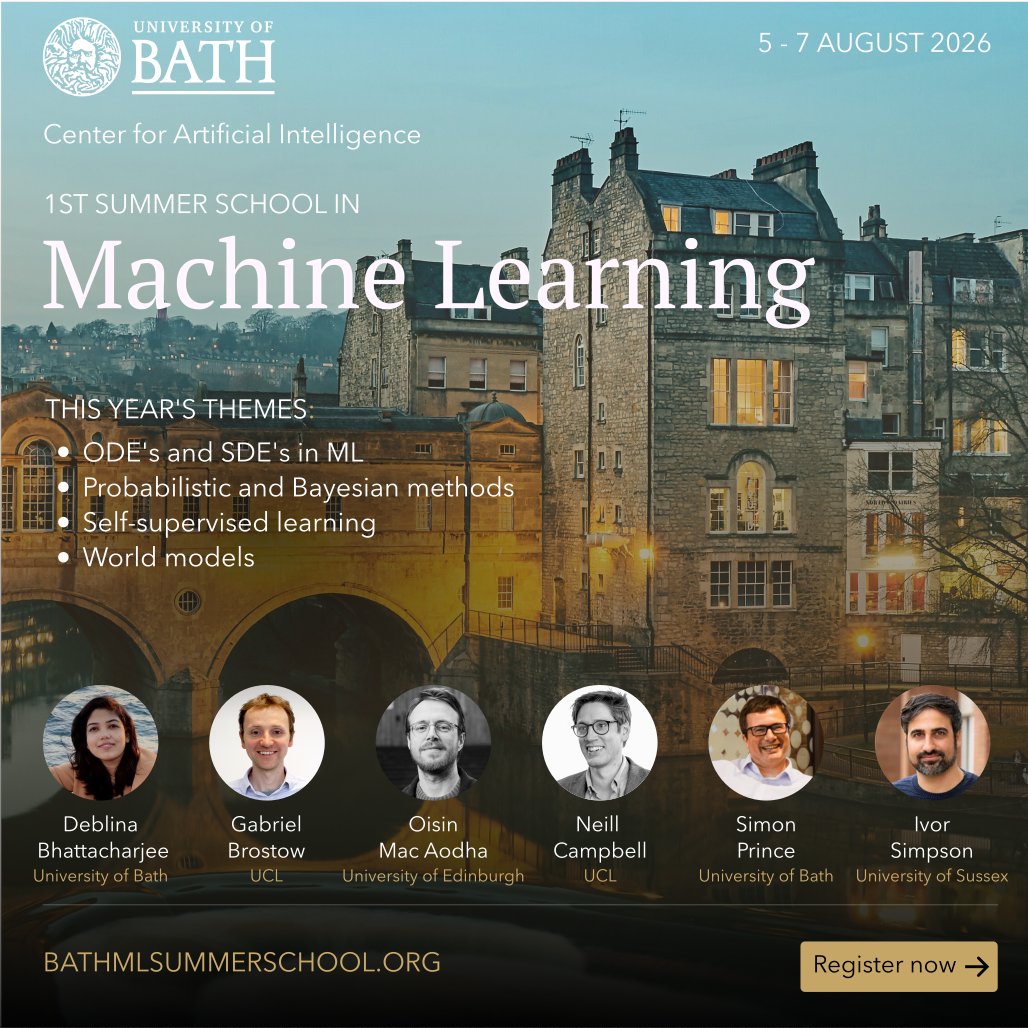
🎓Announcing the 1st Bath Summer School in Machine Learning
📅 5–7 August 2026 | 📌 University of Bath
Topics: ODEs/SDEs, Bayesian methods, Self-Supervised Learning, World Models
Open to PhDs, postdocs & staff at EU/UK universities
https://t.co/mRC8nNWXYY
Introducing Flux Matching, a generative modeling paradigm that generalizes diffusion models to vector fields that need not be the score function.
Enables structural priors in the dynamics, faster sampling, interpretable generation, and more!
w/ @StefanoErmon@Xiaojie_Qiu 🧵⤵️
There are 2 weeks left to submit your method to the NeRSemble 3D Head Avatar benchmark! Deadline May 26th.
🏆The winners of the workshop challenges get a GPU prize and an oral presentation slot at our @CVPR workshop.
👉https://t.co/5jCMaf3iMu
#CVPRWorkshop#CVPR2026
Could your HMR prediction do with a bit of refinement? Try Anny-Fit – a new framework for all-ages that improves existing models & also generates pseudo GT for in the wild images🔥!
📄Anny-Fit Code & Paper: https://t.co/UAlpnShnhL
➡️Anny Apache 2.0: https://t.co/bOe3qGbpF7
#CVPR2026 #3DVision
Large foundation models have made enormous progress in modeling language, images, and video. These systems can generate highly realistic outputs and capture complex statistical structure in data. However, they still operate on projections of the world, text sequences and 2D pixel grids, rather than the world itself.
The real world is not a sequence of text tokens or frames; the real world is inherently anchored in 3D metric space, and dynamics across time. Objects occupy space and persist over time. They interact according to physical laws. Any model that aims to support real-world intelligence, e.g., for robotics, simulation, design, or spatial computing, must capture this structure.
This is where current approaches fall short. While most video models can generate visually plausible frames, they often lack a consistent notion of the underlying scene due to limited context windows. As a result, geometry drifts, scale is ambiguous, objects appear and disappear, and interactions are not physically grounded. The model produces superficial appearance without a persistent world representation.
For many downstream applications, this is not enough.
The first step toward addressing this is modeling 3D space and keeping it consistent. A model should recover a coherent spatial representation of the scene, including layout, geometry, and scale. This not only allows the environment to be rendered from new viewpoints but also, more critically, reasoned about in metric space. If a model cannot produce a stable 3D representation, it is not grounded in the physical world, and it will fail to model the world due to its inefficient contextual memory.
However, 3D is only the beginning.
A truly useful world model must also be temporally and physically consistent. It should not only reconstruct a scene, but also simulate it, predicting how it evolves, how objects interact, and what happens under intervention. Eventually this requires moving beyond static representations toward models that capture dynamics and causality.
I believe that generative approaches are highly compelling in this context, as they can be trained on large-scale data in a self-supervised fashion. In particular, comprehensive 3D world modeling is a highly-promising path forward, since richer environmental representations directly enable deeper and more effective learning of physical reality. Crucially, such generation enforces consistency: for instance, to generate a scene across viewpoints, a model must implicitly recover its underlying 3D structure. To generate it over time, it must capture its dynamics. This forces the model to internalize the latent state of the world, including geometry, scale, materials, motion, and physical behavior.
This also highlights a limitation of purely abstract representations. High-level embeddings or action-centric models can be effective for specific tasks, but without the ability to model and simulate the world, they will eventually remain incomplete. They compress observations, but do not fully model the underlying process that generates them.
The next generation of AI systems should therefore move beyond text and pixels, and toward physically-grounded world models: models that represent space, maintain consistency over time, and enable simulation and interaction.
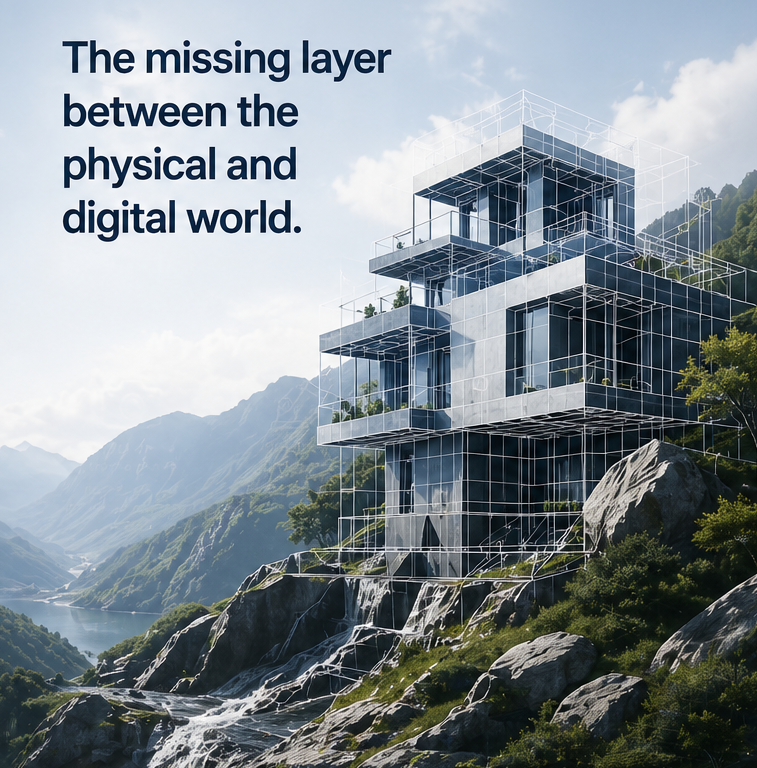
This is the missing layer between the physical and digital world, which will ultimately enable AI systems not just to observe the world, but to understand and operate within it.
📢Pixel3DMM: Versatile Screen-Space Priors for Single-Image 3D Face Reconstruction📢
-> highly accurate face reconstruction by training powerful VITs via surface normals and UV-coordinates estimation.
The geometric cues from our 2D foundation model backbone constrain the 3DMM parameters, which allows us to achieve remarkable reconstruction accuracy - works for both single image and videos!
In addition, we introduce a new 3D face reconstruction benchmark that evaluates both neutral and posed face geometry.
🌍 https://t.co/2UBeLPeXEa
📷 https://t.co/pa1DgRgfcN
Great work by @SGiebenhain@TobiasKirschst1@martin_ruenz@LourdesAgapito
📢Face Anything: 4D Face Reconstruction from Any Image Sequence
Transformer model for 4D face reconstruction and dense tracking:
- predict canonical facial coordinates per pixel
- tracking as reconstruction in canonical space
- geometry + correspondences in one forward pass
Key idea: a shared canonical space across frames
- correspondences as nearest neighbors
- no motion or deformation estimation
Stable geometry and tracking, even under large expressions and viewpoint changes - check out our results!
🌐 https://t.co/VRF2UFYo6Y
▶️ https://t.co/qMv8IKpy6R
Great work by @UmutKocasa4344, @SGiebenhain, @richard_o_shaw
I really enjoyed this talk on diffusion models for image and video generation by @sedielem!
It gives a great overview of the components necessary to build SOTA GenMedia models:
https://t.co/9kQzZrDrsg
Spark 2.0 is here! 🚀
We’re redefining what’s possible on the web with a streamable LoD system for 3D Gaussian Splatting.
Built on Three.js, you can now stream massive 100M+ splat worlds to any device from mobile to VR using WebGL2. All open-source.
Dive into the tech 👇
I’ve uploaded a new paper on arXiv (co-authored by @rasbt):
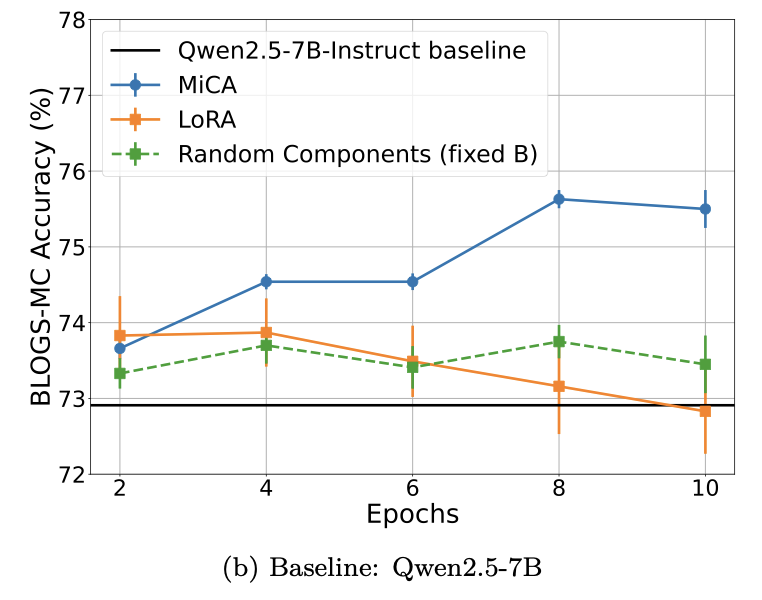
MiCA Learns More Knowledge Than LoRA and Full Fine-Tuning
In Parameter-Efficient Fine-Tuning, a key question may not just be how low-rank the update is, but *which* subspace we adapt.








![tolga_birdal's tweet photo. Excited to finally introduce Topological Neural Operators (TNOs) [https://t.co/V0yJbo9lIf], lifting operator learning to topological domains (cell complexes), where pyhsical quantitites live on their natural supports and interact via the language of Discrete Exterior Calculus. 🧵 https://t.co/OOm1bcZ0Gd](https://pbs.twimg.com/media/HKe4QWpX0AAqvZY.jpg)