We do the work, you make the call. CEO @impliedinsights, building the AI-native research platform for equity investors. Prev: PM @ Balyasny; Citadel, Goldman.
There are only 3 buckets of value that matter for AI implementations.
Time/cost savings: Is AI going to replace the work humans do, cheaper or faster?
Revenue uplift: Is AI going to increase the amount of money I make, after accounting for token spend?
Risk reduction: Will I be more accurate as a result of AI doing, or checking, the work my team does?
It's incredibly important to walk teams through this value capture exercise, allowing both sides to mutually agree on priorities, KPIs, and definition of success.
The reason why AI keeps failing is because giving everyone in the org access to Claude Code and burning through $10M in tokens in 3 months feels productive until you realize there was no time/cost saving, no revenue uplift, and no risk reduction.
Implied has always been easier to show than explain.
I often describe it as the operating system for investment research, and I get asked a lot what that actually means. There’s a long answer involving features and infrastructure. But what matters is the completely different experience they create together.
Over the next few weeks, we’ll share a series of product videos showing how bringing these capabilities together in one system can transform nearly every part of the research workflow.
And since we’re in the thick of earnings season, that’s where we’ll start. If there’s a workflow you’d like us to cover, send it my way!
Ex-Balyasny PM Ying Hua (@huaxying) on why automation will increase demand for hedge fund talent, the quant/fundamental convergence, & why quant is blackjack but fundamental is poker.
Ying Hua (PM @ Balyasny — built & led a quantamental team covering US insurance, capital markets & fintech | ~5 yrs @ Citadel running a long/short insurance book | Equity research @ Goldman Sachs | MS in Data Science @ UC Berkeley | Now founder & CEO of Implied @impliedinsights)
"One of the best-kept secrets: fundamental investors are not good at sizing. Quant funds are really good at sizing."
We cover:
- The only real line between quant and fundamental: historical pattern matching vs. "how is this time different" — and the alpha neither group is looking at
- Why she rebuilt her process so every model updated within 2 minutes of a print
- Scraping highway patrol data from 15 states to track auto insurance losses live, every single day
- The Malibu wildfire: mapping burned mansions from celebrity tweets to estimate losses before any industry consultant published a number
- Her automation math: data gathering ~100% automatable, processing ~80%, judgment still 100% human
- AI is quant for words — next-token prediction is pattern matching, which makes this just the next automation wave after quant and indexing
- The proof differentiated views pay more: insurance stocks moved 2-3% on earnings in 2010; by the time she left, 15-20% intraday
- Why "hook Claude Code up to data and let it rip" fails: BloombergGPT losing to a smaller open-source model, & why horizontal models are college grads
- Quant is blackjack with card counting; multi-manager investing is poker — your hand, others' perception of it, your seat, everyone's stack
- Most PMs are playing the wrong game: the positioning game hiding inside "fundamental" sectors with no new money coming in
- Her hiring bar at BAM: every fundamental analyst learns Python — and the one skill she says can't be trained
- The only two truly meritocratic jobs: hedge fund PM & sales
Highlights:
(00:00) Intro
(00:40) How a quantamental PM actually puts on a position
(02:05) The only real line between quant and fundamental
(04:45) Why quantamental lowers the burden on your brain
(06:40) Scraping 15 states of highway patrol data to nowcast insurance losses
(09:25) The Malibu wildfire: estimating losses from celebrity tweets
(11:55) How much of fundamental investing can be automated
(13:45) Quantifying intuition: when a CFO's filler words jump 8% to 20%
(16:25) The contrarian case: automation expands demand for talent
(18:15) Earnings vol exploded — differentiated views pay more
(20:25) Why Claude Code can't run your book
(23:40) Horizontal models are college grads with no domain knowledge
(30:50) Why chat is the wrong interface for investors
(36:20) Will AI make markets more or less efficient?
(39:10) Two things every fundamental PM should do today
(41:50) The moat that expands: talent, redefined
(45:50) Sometimes the game is positioning, not fundamentals
(48:25) Blackjack vs. poker vs. surfing: matching the game to your horizon
(52:00) Should young analysts chase the hottest sector?
(57:55) Munger vs. Musk: two philosophies of wealth
(1:01:05) Self-awareness in investing is bimodal
(1:07:05) The only two truly meritocratic jobs: hedge funds & sales
(1:08:50) The one skill for every regime: reconstruct the narrative
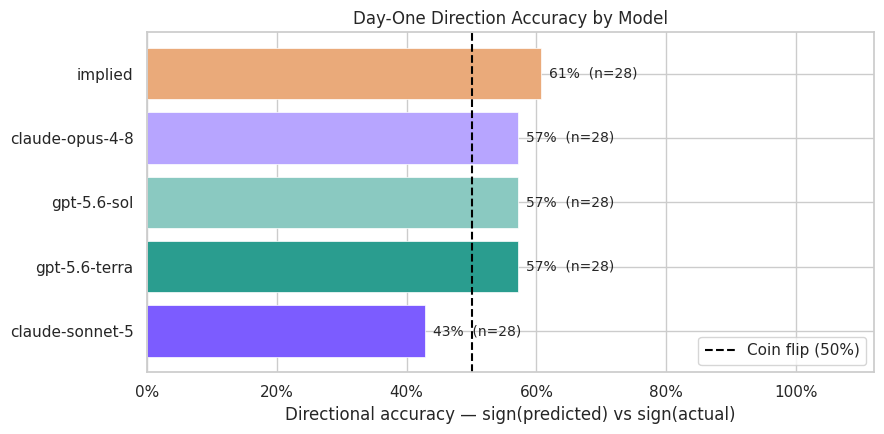
Week 1 results from our live AI earnings prediction experiment are in. It’s a small sample, but Implied is off to an encouraging start. We’re publishing every prediction and grade. Follow along as the experiment continues through earnings season!
I see what you mean, and we’ve thought about it. The challenge is that MSE measures forecast distance rather than portfolio outcome: actual +5%/predicted +2% and actual +1%/predicted −2% have the same squared error, but one forecast is clearly better than the other. A true Sharpe-like score would require translating forecasts into positions, which introduces assumptions about sizing, strategy, and portfolio construction that we’d prefer not to impose for now
That’s a fair question. Sharpe and information ratios are useful, but they also depend on portfolio-construction choices such as position sizing, turnover, trading costs/slippage, risk constraints, and benchmark selection. For now, we’re testing a narrower question: can Implied accurately predict company fundamentals and the market’s reaction?
Can AI be more than just an efficiency tool?
Super excited to run an experiment during this earnings season. Having lived through many earnings, I know how hard this task is. The outcome will be interesting, but the bigger question is whether the system can learn from its misses and improve over time.
We’ll share what works, what doesn’t, and what we learn along the way. Follow along if you’re curious!
Ken Griffin says short-term alpha from calling the quarter with alt data is dying, and the next era of stock-picking belongs to those with a long-term horizon.
"I think there'll be more focus and emphasis on those who have really good vision about what companies are actually creating transformative products that will change society. The market will reward that far more intensely in the future than will a company beat this quarter's earnings or not.
I think the question of will a company beat this quarter's earnings has gotten far more difficult over the last 10 years because, for example, the rise of alternative data. I have access to the credit cards of millions of Americans. What are they spending money on? What's that mean for Starbucks revenues this quarter? What's it mean for McDonald's this quarter?
This is a decade-old transformation, but the here and now is just becoming far more transparent, far more readily understood and triaged by the combination of really bright people and really good AI technology. Where this will leave us is those who are able to see what is unfolding over years to come will be in a very valued position on a relative basis."
Ken Griffin says short-term alpha from calling the quarter with alt data is dying, and the next era of stock-picking belongs to those with a long-term horizon.
"I think there'll be more focus and emphasis on those who have really good vision about what companies are actually creating transformative products that will change society. The market will reward that far more intensely in the future than will a company beat this quarter's earnings or not.
I think the question of will a company beat this quarter's earnings has gotten far more difficult over the last 10 years because, for example, the rise of alternative data. I have access to the credit cards of millions of Americans. What are they spending money on? What's that mean for Starbucks revenues this quarter? What's it mean for McDonald's this quarter?
This is a decade-old transformation, but the here and now is just becoming far more transparent, far more readily understood and triaged by the combination of really bright people and really good AI technology. Where this will leave us is those who are able to see what is unfolding over years to come will be in a very valued position on a relative basis."
@firesidealpha Feels like both are true right now: alpha in alt data has compressed, while 1-day post-earnings moves have actually been getting larger. To me, that suggests there’s still plenty of alpha around earnings, it just isn’t purely driven by alt data anymore. The game has gotten harder
@FundamentEdge We will be running something similar on our end, would love to compare notes. We think there are some other knowledge piece we can feed the agent to get better results (e.g. readthroughs, etc) but will be interesting to see!
How much of the investment research process can actually be accelerated?
I've been obsessing over that question since my early days on the buyside. I taught myself Python (via good old Stack Overflow) and started rebuilding our stack piece by piece. By the time I was running a quantamental book at Balyasny, model updates ran in 2 minutes instead of 40 (all pre-AI, no vendors), alt data processed itself in the background, and positioning analysis ran automatically every morning.
But that was the ceiling of that approach. I was making individual pieces faster while the process itself stayed fragmented across half a dozen interfaces. A few months after GPT-4 came out, I finally saw the real unlock: you can rethink the research process from scratch instead of just speeding up the parts.
So I started Implied.
We never believed a chatbot alone was the answer. We built a platform that carries the entire workflow end to end, and on top of it, an agent that understands ticker-level context, learns from the newest information, and acts proactively for you.
Every fund has a chatbot. Most investors tell us their process doesn't feel much faster. The time AI saves on search gets spent stitching everything else together across an already fragmented stack.
The mistake is treating AI as one more tool. We believe it's the first real opportunity to rethink the research process from scratch, and we've spent the last two and a half years building exactly that: one system for the entire workflow, run by an agent that knows your names, learns from live information, and works ahead of you.
There's a lot to build, and a race to build it. The first funds to get there lock in a multi-year lead. So what does it take? Not to deploy a chatbot, but to actually build an AI-native research platform? We just published our first post on exactly that. Link in the reply.