PhD candidate @CMU_ECE, @ICL_at_CMU, @CMU_Robotics | alum @mldcmu @cmu_SCS @sjtu1896 | Safety and robustness in ML, control, robotics. Opinions are my own
We are excited to announce the 2026 cohort of RSS Pioneers! This year’s cohort brings together an outstanding group of early-career researchers whose work spans the breadth of robotics. A heartfelt thank you to all the organizers who made this year’s program possible.
Can task structure emerge directly from robot demonstrations?
We introduce ENAP: a bi-level neuro-symbolic policy that learns an interpretable automaton from visuomotor trajectories and uses it to guide continuous control.
Instead of treating long-horizon manipulation as a pure black box, ENAP recovers task phases, branching behaviors, and recovery loops directly from data.
Project page: https://t.co/ZTDOiNM97N
Paper: https://t.co/mwpX9FAicn
📢 Workshop on Foundation Models for Control (FM4Control) — Bridging Language, Vision & Control.
🌐 Details: https://t.co/jeiTI9GWh4
🎙️ Speakers: Chuchu Fan (MIT), Chen Tang (UCLA), Ziran Wang (Purdue), Neel P. Bhatt (UT Austin), Yorie Nakahira (CMU).
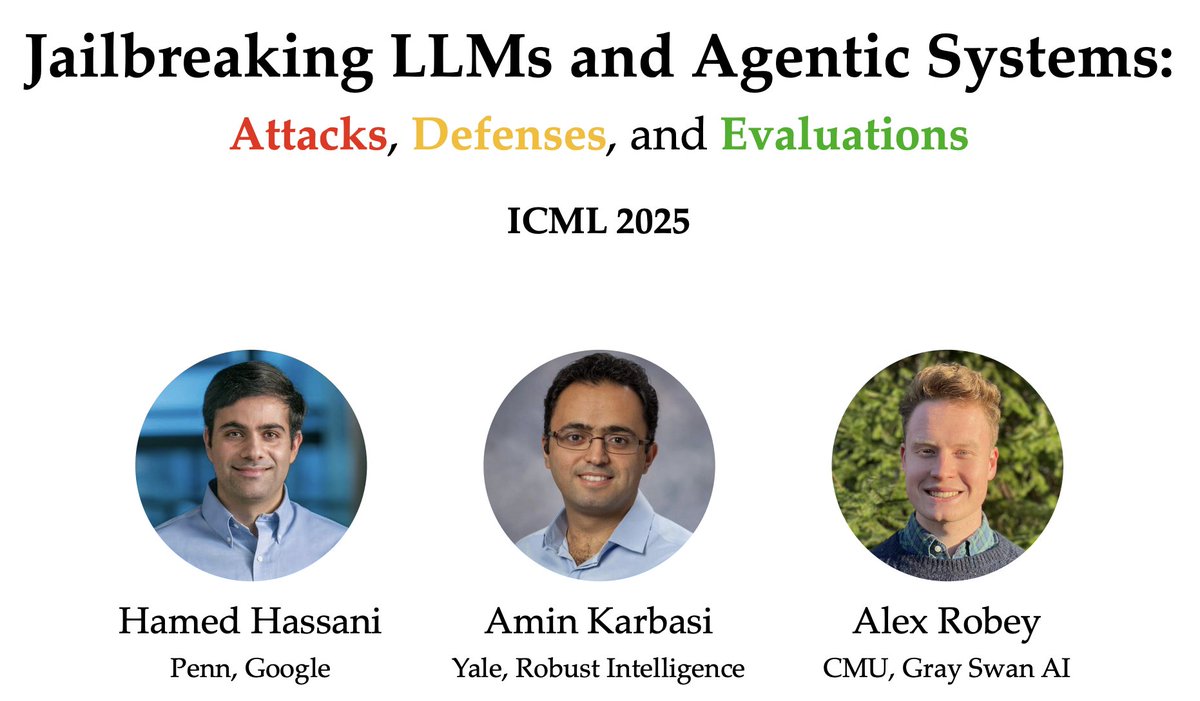
If you are interested in safety/security jailbreaking of LLMs, defenses against them, and how the safety issues become more complicated when we design agentic workflows, this tutorial by @HamedSHassani, @aminkarbasi, @AlexRobey23 is highly recommended
Smarter sensing, not more sensors🤗
How can robots see better with fewer sensors? Track 3 of #RoboSense2025 explores Sensor Placement — evaluating how 3D perception models adapt under reduced or shifted LiDAR configurations.
👉 Register: https://t.co/QOauqy5JRk
👉 Toolkit: https://t.co/8FeFIwoAUn
🎉 Excited to announce that 𝗧𝗵𝗲 𝗥𝗼𝗯𝗼𝗦𝗲𝗻𝘀𝗲 𝗖𝗵𝗮𝗹𝗹𝗲𝗻𝗴𝗲 is officially launching this June!
🌐 𝗪𝗲𝗯𝘀𝗶𝘁𝗲: https://t.co/QOauqy5JRk
💰 𝗧𝗼𝘁𝗮𝗹 𝗣𝗿𝗶𝘇𝗲 𝗣𝗼𝗼𝗹: 10,000 USD
We're organizing a global competition focused on 𝗿𝗼𝗯𝘂𝘀𝘁, 𝘀𝗮𝗳𝗲, 𝗮𝗻𝗱 𝗴𝗲𝗻𝗲𝗿𝗮𝗹𝗶𝘇𝗮𝗯𝗹𝗲 𝗿𝗼𝗯𝗼𝘁 𝗽𝗲𝗿𝗰𝗲𝗽𝘁𝗶𝗼𝗻 𝗮𝗻𝗱 𝗻𝗮𝘃𝗶𝗴𝗮𝘁𝗶𝗼𝗻 under real-world conditions — including social dynamics, cross-modality, and out-of-distribution shifts.
🧠 The challenge features 𝗳𝗶𝘃𝗲 𝗲𝘅𝗰𝗶𝘁𝗶𝗻𝗴 𝘁𝗿𝗮𝗰𝗸𝘀:
1️⃣ Driving with Language
2️⃣ Social Navigation
3️⃣ Sensor Placement
4️⃣ Cross-Modal Drone Navigation
5️⃣ Cross-Platform 3D Object Detection
�� Important Dates (AoE):
🔹 June 15 – Challenge Begins
🔹 August 15 – Phase 1 Deadline
🔹 September 15 – Phase 2 Deadline
🔹 October 19 – Award Ceremony at IROS 2025, Hangzhou
📩 𝗘𝗺𝗮𝗶𝗹: [email protected]
We welcome researchers and students working in 𝗿𝗼𝗯𝗼𝘁𝗶𝗰𝘀, 𝗻𝗮𝘃𝗶𝗴𝗮𝘁𝗶𝗼𝗻, 𝟯𝗗 𝘃𝗶𝘀𝗶𝗼𝗻, 𝗿𝗲𝗶𝗻𝗳𝗼𝗿𝗰𝗲𝗺𝗲𝗻𝘁 𝗹𝗲𝗮𝗿𝗻𝗶𝗻𝗴, 𝗮𝗻𝗱 𝗺𝘂𝗹𝘁𝗶-𝗺𝗼𝗱𝗮𝗹 𝗽𝗲𝗿𝗰𝗲𝗽𝘁𝗶𝗼𝗻 to join us!
Let’s push the boundary of robot autonomy — and make intelligent systems that navigate the human world safely and naturally.
#RoboSense2025 #IROS2025 #Robotics #SocialNavigation #RobotLearning #AIChallenge
Just as humans transitioned from understanding nature to controlling it, can we move beyond just solving PDEs to actually controlling them safely?🤔
#L4DC2025 "Safe PDE Boundary Control with Neural Operators", control one boundary to keep the other end safe with unknown physics
💡Core idea: We map boundary controls to outputs using neural operators, then apply safety filtering with quadratic programming. This bypasses the underlying PDE dynamics while ensuring the output boundary stays within safe constraints!
There’s a shocking amount of useless rebranding in AI Safety.
E.g., I have trouble understanding how “AI Control” is anything other than a new word for oversight and deployment monitoring — which has been a part of the broader agenda for a while.
Ideal AI safety comes with AI robustness: Real-time error correction (e.g. online safety filter) results in a resilient AI system without compromising AI helpfulness due to safety alignment.
I’ve always championed AI robustness over strict AI alignment. Robustness means building systems that can handle unexpected behaviors—adapting quickly without stifling innovation. (1/8)
Read more: https://t.co/s3X50MCK2a
Check out our latest work on #robotics safety, where we propose a CBF-derived safety filter, which can handle hundreds of simultaneous constraints while retaining real-time control rates.
Great work by @danielpmorton@StanfordEng
🚀 Excited to share our #ICLR2025 work on planning with neural dynamics models!
While our lab has developed diverse neural dynamics models for manipulating rigid, deformable, and granular objects, having the model alone doesn’t solve the problem—planning with it remains a challenge.
💡 Enter BaB-ND, led by @Keyi_Shen_ and Jiangwei! We propose a scalable, GPU-accelerated branch-and-bound algorithm, inspired by neural network verification, to enable effective planning for diverse objects modeled with neural dynamics.
🔗 Project page (open-source + detailed docs!): https://t.co/J1yesyun8X
🎥 Watch the video to see T being pushed around obstacles, and check out Keyi’s thread for more details!
Our defense ensures invariant safety of LLMs, filtering harmful queries at each turn before they escalate along the context.
Thanks to my amazing collaborators @AlexRobey23@ChangliuL for making this possible! 🚀
💻 Code: https://t.co/7TCzgiSMJO
#AISafety#SafeControl#LLMs
🔐 Can we ensure AI safety through the lens of safe control?
💥 We model the multi-turn LLM conversation as a neural dialogue dynamical system and introduce a Neural Barrier Function (NBF) to safely steer LLMs against multi-turn jailbreaks.
arxiv: https://t.co/2MK8FT2fcA
For the robust perception in autonomous driving, how about enhancing ood robustness under corruptions through optimizing sensor placement?
Check out our LiDAR placement work as #NeurIPS2024 Spotlight!
Is Your LiDAR Placement Optimized for 3D Scene Understanding? #NeurIPS2024 Spotlight
- Paper: https://t.co/RLqtO6WAlK
- Code: https://t.co/GRln8AHiEN
We present Place3D, a full-cycle pipeline for LiDAR placement optimization, data generation, and downstream evaluations.
I was always wondering how safety would be like for humanoids, until SPARK shows me with safe set algorithm: Provable safe controller can really guarantee safety in real-world robots. Congrats to the team @ICL_at_CMU led by Yifan!
[1/4] 🌟Sneak Peek: SPARK in Action! 🦾
Previewing Safe Protective & Assistive Robot Kit (SPARK)—a modular toolbox designed to enhance safety in humanoid autonomy and teleoperation.
Safety isn't just a feature—it's the foundation for humanoids to truly integrate into human life. SPARK filters risky actions, ensuring humanoids can achieve their objectives securely across tasks—from lab experiments to real-world deployments. With SPARK, you can innovate fearlessly, knowing safety is always guaranteed.
Powered by Safe Set Algorithm (SSA), SPARK is built to:
✅ Configure safety behaviors with ease
⚖️ Balance safety and performance
🤖 Integrate with Unitree G1 + Apple Vision Pro
🔧 Support customization for other systems
Stay tuned for the full release in a few weeks 🚀
Please see our website for the paper and more details!
🌐 Website: https://t.co/1e879HhH4C
@ICL_at_CMU@CMU_Robotics@CarnegieMellon@UnitreeRobotics
#Robotics #HumanoidSafety #AIInnovation
Tired of making robot demos? Try something with math for robot learning! #CoRL2024
We introduce a verification method to give symbolic bounds through Lie derivatives in neural CBFs, turning black-box neural networks into verified real barrier functions for robot safety! (1/2)