Professional Engineer|Co-founder|Volunteer|Avid Runner. Deeply care about Human Rights, Equality & Justice. Tweets are my personal views. RT is not endorsements
Ethiopia’s prime minister says the next election will be the most open and democratic in the country’s history. In reality it will be a sham. Discover the full story: register to read for free https://t.co/tuiCbgfPOU
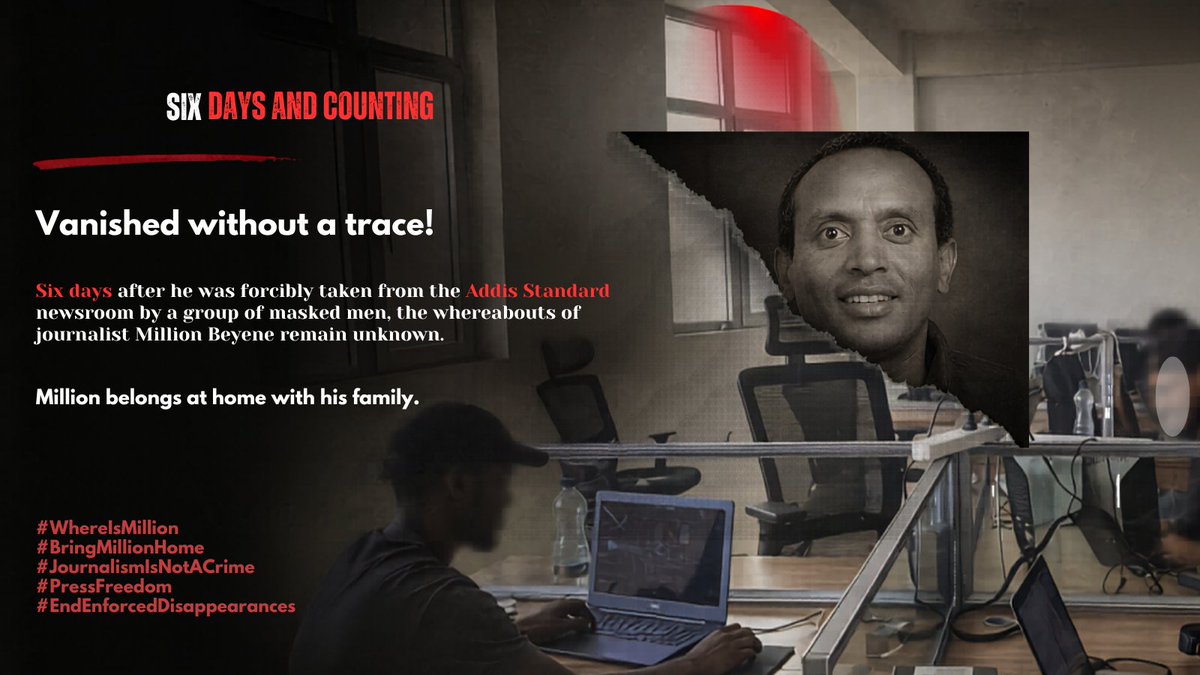
Vanished without a trace!
Six days after he was forcibly taken from the Addis Standard newsroom by a group of masked men, the whereabouts and conditions of journalist Million Beyene remain unknown.
Million belongs at home with his family.
#WhereIsMillion? #BringMillionHome #JournalismIsNotACrime #PressFreedom #EndEnforcedDisappearances
“I’ve congratulated the victorious party.” After 16 years as prime minister, Hungary’s Viktor Orban conceded defeat to opposition leader Peter Magyar and his Tisza party.
#Coming_UP: The Standard Signal | Ep.15: Ethiopia Under Pressure: Fuel Crisis, Global & Regional Instability, a Fragile Election | Jawar Mohammed
Ethiopia faces a fuel crisis, corruption, fertilizer shortage risks, election uncertainty, global and regional instability, all at once.
In this Episode of The Standard Signal, Jawar Mohammed discusses these growing challenges, from global and regional tensions to domestic instability, corruption and Ethiopia’s fragile election.
The discussion examines how Ethiopia is struggling to navigate these overlapping internal and external crises.
Watch the full conversation on Addis Standard.
Premiers at: 7:30 PM EAT tonight.
Subscribe to watch: https://t.co/qfumw5fsAf
#AddisStandard #TheStandardSignal #Ethiopia #JawarMohammed #EthiopiaPolitics #Corruption #FuelCrisis #HornOfAfrica #Tigray #Amhara #Oromia #EthiopiaElection #AfricaPolitics #EthiopiaNews #AfricanPolitics #Geopolitics
New investigation out tomorrow documents sexual violence, summary killings, and displacement in Ethiopia’s Oromia region.
These are not isolated abuses; they are war crimes that demand justice.
#Ethiopia revokes Addis Standard’s license amid escalating crackdown on independent media
https://t.co/McVs8ps3to
CPJ calls on Ethiopian authorities to immediately restore the registration of independent outlet @addisstandard after the Ethiopian Media Authority (@EthMediaAuth) revoked its online media registration certificate effective February 24.
𝐄𝐱𝐩𝐥𝐚𝐢𝐧𝐞𝐫 𝐟𝐫𝐨𝐦 #𝐀𝐝𝐝𝐢𝐬_𝐒𝐭𝐚𝐧𝐝𝐚𝐫𝐝 𝐍𝐞𝐰𝐬𝐫𝐨𝐨𝐦:
As of 24 February, Addis Standard has not received any formal written notice, legally mandated opportunity to respond, or reasoned decision preceding the #Ethiopian Media Authority’s public claim, made via social media, that our online media registration was revoked.
Ethiopian media law is clear: suspension or revocation of a media license must follow a defined process, including written notice, a 14-working-day right of response, a reasoned decision, and access to appeal before the Authority’s Board of Directors.
None of these mandatory steps have been observed. Addis Standard remains fully operational and continues its public-interest journalism in good faith, while its publisher, #JAKENN Publishing PLC, pursues clarification and rectification through lawful channels. This matter goes beyond one newsroom, it concerns whether media regulation in Ethiopia is governed by law, due process, and institutional accountability.
Read the explainer: https://t.co/9ZxtjK0cgq
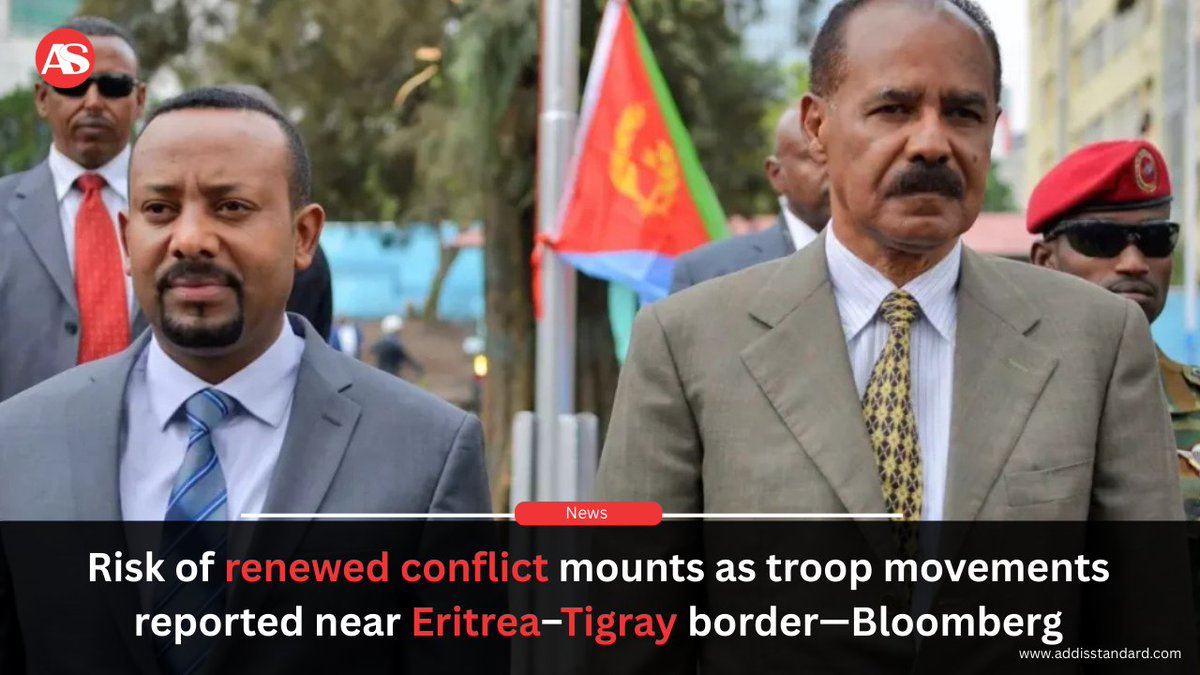
News: Risk of renewed conflict mounts as troop movements reported near #Eritrea– #Tigray border—Bloomberg
Addis Abeba—Ethiopia and Eritrea are deploying troops and military equipment near the northern Tigray region, raising the risk of renewed conflict in the Horn of Africa, Bloomberg reported, citing regional diplomats.
Sources familiar with the matter told Bloomberg that Ethiopian troops and equipment have been moved northward, including through Bahir Dar, while Eritrean forces have also deployed to areas inside Tigray.
Prime Minister Abiy Ahmed this week reiterated Ethiopia’s longstanding ambition to secure access to the Red Sea, describing maritime access as key to overcoming logistical constraints on economic growth. Eritrea dismissed what it characterized as threats of war. Information Minister Yemane Gebremeskel told Bloomberg that claims justifying conflict to obtain “sovereign access to the sea” lack international support.
Eritrean state television also broadcast a naval parade in Massawa last week, marking the anniversary of the city’s capture in 1990.
https://t.co/7ypsPwQxjd
No More War
I opposed the war in Oromia and did everything within my reach to prevent it and later to end it before further deterioration. I opposed the war in Tigray and spoke out loudly to prevent its outbreak. I opposed the conflict in Amhara before it broke out, and I warned at the time that rushing to coercively disarm the regional special forces and Fano without sufficient reassurance would lead to conflict. And now, the devastating cost continues. Today, I stand firmly against the dangerous push toward another war in the North, and I raise my voice once again in warning.
That position is fully consistent with the principle that even after immense destruction, a political settlement remains the only serious path out of war. The price of these wars is not paid by those who start them. It is paid by ordinary families through death, displacement, fear, imprisonment, hunger, and lost futures.
My position has been consistent, not because I reject all war, but because I reject senseless war. That principle remains true for Ethiopia today. War must serve the survival and security of the people, not the political survival of those in power. The conflicts Abiy Ahmed keeps dragging Ethiopia into do not meet that standard. They do not advance our national interest. They do not strengthen our security. They do not serve Ethiopia. They only deepen its wounds.
Instead, they have done the opposite. They have deepened internal divisions, weakened national cohesion, and damaged Ethiopia’s standing abroad. They have strained relations with neighbours and widened the gap between Ethiopia and the broader international community. At home, they have drained public resources, militarized politics, and weakened institutions that should be addressing the country’s urgent problems.
The damage is not only political and diplomatic; it is also economic, and ordinary people bear it every day. Families are struggling with rising prices, unemployment, shrinking livelihoods, and deepening poverty. Young people are losing hope and leaving in large numbers, not because they do not love their country, but because their country is not giving them a future. While citizens carry this burden, the government continues to invest in confrontation rather than recovery. This is not leadership. It is a path to national exhaustion.
For that reason, another war will not solve Ethiopia’s crisis. It will deepen it. A country divided at home, economically strained, and distrusted abroad cannot be secure. And a new war in the North will not remain contained within Ethiopia. It will push instability further across the Horn of Africa.
As I have stated repeatedly in my written analyses, statements, and interviews, this remains my consistent position. Ethiopia does not need another war. The country needs restraint, serious political dialogue, and a negotiated settlement before it is pushed into further destruction.
Let this be clearly recorded. Another war will not serve any good purpose for Ethiopia. I call on all those with influence to act now and stop it before it starts. Those of us who believe dialogue and accommodation are the only viable path forward stand ready to offer our full support, provided it is pursued in good faith
The absence of permanent African seats on the Security Council is indefensible.
The Security Council must reflect today’s world. This is 2026 — not 1946.
Whenever decisions about Africa and the world are on the table, Africa must be at the table.
🚨The UAE is reportedly funding an RSF training camp in Ethiopia.
External support like this only fuels Sudan's brutal conflict. And it's why @RepGregoryMeeks will continue holding all major US arms sales to UAE & any country supporting the RSF or other combatants in this war.
Really? Aren’t you doing the very thing you’re accusing him of?
Is this an admission of involvement in the genocide in Sudan 🇸🇩? And this is an advisor to the Prime Minister of #Ethiopia
Congratulations, brother @Jawar_Mohammed Your persistent conflation of personal opposition to the Prime Minister with a coherent critique of Ethiopia’s long-term strategic interests is remarkable. Disliking the ruling party does not free you from having to distinguish between regime politics and state/national interests.
Over the past few days, you — once an ally of the Prime Minister but now a vocal critic — have repeatedly attacked Ethiopia for seeking to protect its strategic interests in the context of the Sudanese conflict. Some of the reports you circulate or the ideas you share may be factually accurate in isolation. Yet, you present them without reference to the broader strategic context shaping Ethiopia’s calculations. Facts, detached from structure and strategy, can easily be marshaled into a misleading narrative.
Do you genuinely believe Ethiopia should behave as a passive bystander in a region defined by intense geopolitical competition? The tragedy unfolding in Sudan is indeed exacerbated by foreign intervention. But Ethiopia is hardly unique in pursuing its interests. In fact, Ethiopia, more than any other country in the region and beyond, stands to lose more as a result of Sudan’s instability. It has a real skin in the game, as it were. Egypt and other regional actors are not neutral mediators; they are actively shaping the trajectory of the conflict to favor their preferred belligerents.
You position yourself as a politician–activist, but your posture suggests an aversion to the very language of national security and strategic interest. In a region marked by proxy competition, transboundary security threats, and zero-sum maneuvering among rival states, such discomfort is not a virtue. It is a liability. States do not have the luxury of moral abstraction when core national interests are at stake.
Moral posturing in such an environment may be emotionally satisfying, but it is not strategy. Critiquing policy is legitimate. However, presenting every move as evidence of strategic folly simply because it originates from Prime Minister Abiy’s government risks substituting partisan grievance for analysis.
More importantly, anyone with aspirations for higher office should be cautious about adopting a scorched-earth posture toward the state itself. While governments change, strategic geography is stubborn. Ethiopia’s long-term national interests are distinct from — and larger than — the party temporarily in power. A credible alternative must demonstrate an ability to separate those two. Thus far, however, you have shown a near-pathological inability to make that distinction.
Our hearts are in Tumbler Ridge tonight with the families of those who have lost loved ones.
Government will ensure every possible support for community members in the coming days, as we all try to come to terms with this unimaginable tragedy.