In physics, an “impedance mismatch” occurs when two systems each work well but are poorly matched.
In this Science Blog guest post, Harvard physicist Matthew Schwartz argues that something similar is happening with AI and science. LLMs are capable at many things, but working with them as you would with a human collaborator isn’t currently the best way to elicit their scientific strengths.
To address this mismatch, Schwartz created a toolkit for exact calculations in quantitative science. Because similar calculations often emerge in very different areas of science, Claude found connections to ecology, population genetics, and a dozen other fields, and Schwartz worked with domain experts to steer it towards interesting questions.
Read more about these projects here: https://t.co/UpgSwMCz7h
You can now just text DoorDash and let it order for you. It’s proactive, learns from your repeat orders, and helps you find the best deals and new spots.
Just tell it what you want without any extra setup. Ask it to reorder your usual, or add it to a group text to collect everyone’s orders. You can even send a photo of your fridge and it’ll tell you what ingredients you’re missing for a recipe you want to make and deliver the ingredients to your doorstep.
We believe agents are a new app paradigm and are building for that future at @AIatDoorDash, with a lot more to come. This feature is in beta in the US, would love for you to let us know what you think! Waitlist: https://t.co/H9cMANz6Gi
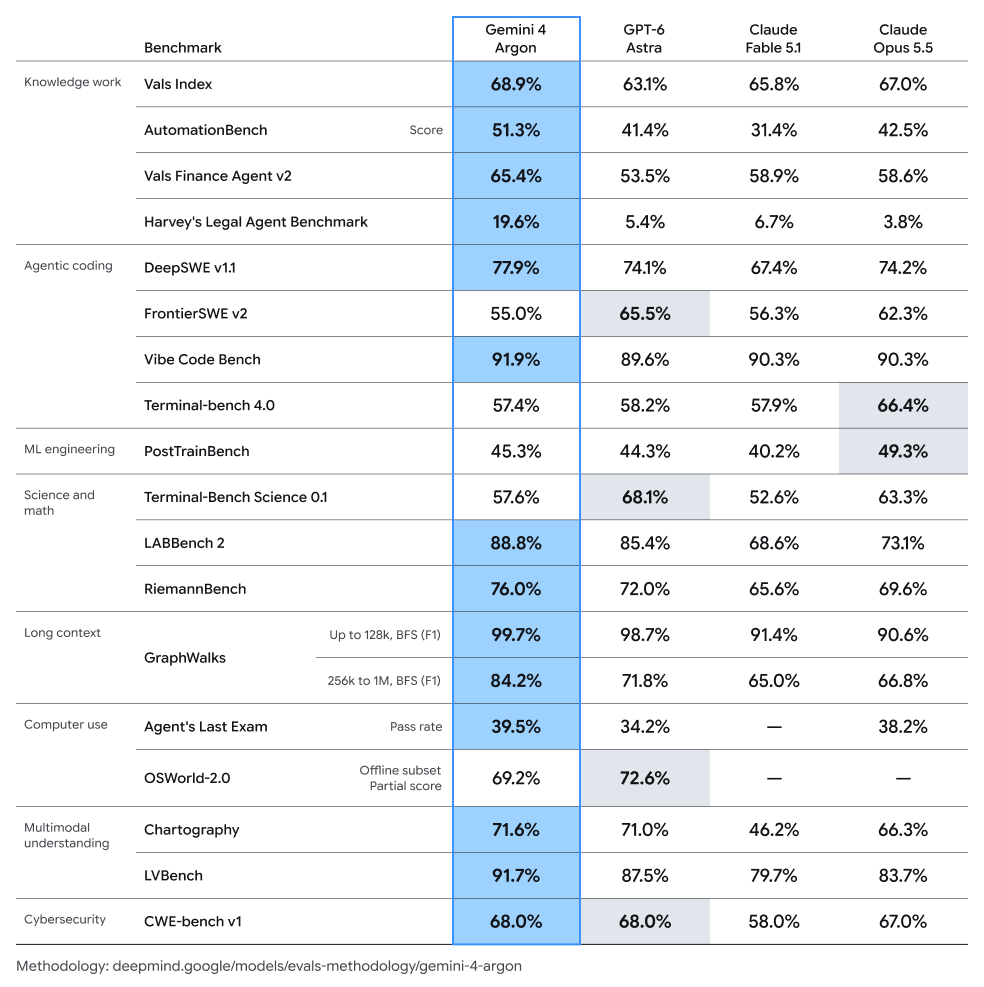
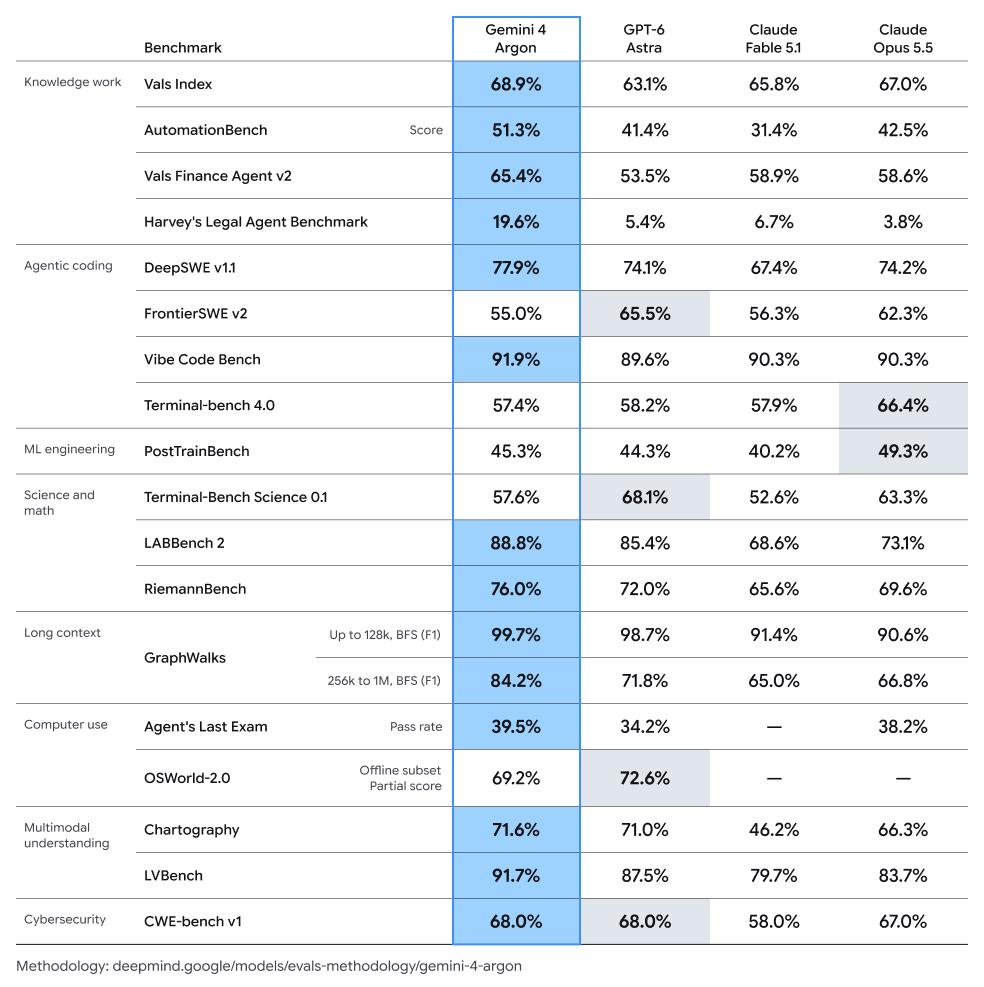
Introducing Gemini 4 Argon – our new frontier model.
It’s built for complex workflows across coding, enterprise knowledge work, and cybersecurity defense – rolling out today to a set of trusted testers through our Fairwind Program.
Today we’re introducing Gemini 4 Argon.
It delivers frontier performance in complex workflows across real-world software engineering, knowledge work, and cybersecurity defense with an industry-leading 1M token output limit.
Announcing Gemini 4 Argon, our new frontier model.
Argon is built to sustain deep reasoning across complex, long-horizon workflows and delivers frontier performance in complex workflows across real-world software engineering, enterprise knowledge work like legal and finance, and cybersecurity defense.
We’re also expanding the model’s output token limit to an industry-leading 1M tokens.
Argon is currently rolling out to a set of trusted cyber defenders in the Fairwind Program, with broader availability as soon as possible.
https://t.co/sRyO7OigQ7 is our new home for developers building with Claude.
You'll find engineering deep dives, Claude Code and API guides, tips from the teams building Claude, and some fun easter eggs.
I agree with Dario that we need to pace the frontier. This has been a primary topic of discussions we've had at OpenAI in recent weeks.
Committing to having independent evaluators with employee-like access is a great idea, and we will do the same. We'll have more to share soon.
We Must Pace the Frontier: I’ve written a new essay on why the AI industry should slow down, with a three-part plan for doing so.
Anthropic is unilaterally committing to the first of these steps. We’ll provide third-party evaluators with permanent, employee-level access to our systems, so that they can verify adherence to our safety measures, report on incidents, and assess models’ alignment during training.
You can read the full post here: https://t.co/OGyPb7yaYt
@ChaseLochmiller@OpenAI GPT-6 Astra, trained on ~100K+ NVIDIA Grace Blackwell NVLink72. From ChatGPT to o1 to Astra in 4 years.
AGI has arrived. Congratulations @OpenAI team.
400K GPUs coming online next.
I wrote about the state of AI, why I’m concerned about the next few years, and the choices we need to make to keep the future in humanity’s hands.
An Alien Mind: https://t.co/FeIfWNe0UE
Checking that a major mathematical proof is correct can take years. Formalization—converting the mathematical reasoning into a form computer proof assistants like Lean can verify—can help.
Last month, Claude completed the first formalized proof of Fermat’s Last Theorem, one of the most famous theorems of all time. This was a project experts thought would take many years. It is the largest Lean proof ever written.
Fermat’s Last Theorem was first proven in 1995 by Sir Andrew Wiles, more than 350 years after it was conjectured. Our proof, which totals over 13 million lines of code, provides machine verification. More importantly, it proves over 29,000 other theorems that the proof requires, across many areas of math which had never before been formalized.
We see this as a major step in the long process of firming up the core of mathematical knowledge, building on work from three centuries of mathematicians and hundreds of contributors to Lean and Mathlib. We are optimistic that AI-assisted verification of mathematical proofs will help reduce the burden of refereeing mathematics in an era where more proofs are being produced than ever before.
You can read about the process on our Science Blog: https://t.co/ryYnDEAU6J
And see the complete proof on GitHub: https://t.co/wlYMXYnofz
GPT-6 Astra is here.
We hope it will begin to enable a new generation of entrepreneurship, scientific discovery, and building.
We believe it is the best model in the world for computer use, professional work, science, coding, cybersecurity, and more.
It took us some extra time to ensure that we could meet the safety and alignment standards required for this capability level, but we think you’ll find it worth the wait.
It scores 98% on FrontierMath Tier 4, 99.9% on ARC-AGI 3, and 100% on ExploitBench.
We’re sorry to see that OpenAI put out a note saying they plan to block Cursor users from accessing OpenAI models in three months.
OpenAI models serve about 5% of Cursor user traffic, and we’re speaking with the OpenAI team to resolve this.
Cursor was one of the very first users of OpenAI, we’ve worked closely with their team for years, and we’ve trusted their platform to be neutral infrastructure for our business.
Starting September 14, we're permanently raising standard weekly limits in Claude Code by 25% for Pro, Max, Team, and seat-based Enterprise plans. Until then, the current 50% increase will be in place.
Starting August 14, auto mode will be the default permission mode in Claude Code for Pro, Max, and Team users.
Auto mode reviews shell commands and actions with a separate classifier. In testing, it caught 89% of dangerous commands. Manual approval caught 14%.
New in Claude Code: your sessions can now message each other.
Instead of having to re-explain yourself in another session, you can now tell Claude to do it. It sends a summary (not your history or files), and the other session picks it up mid-task.
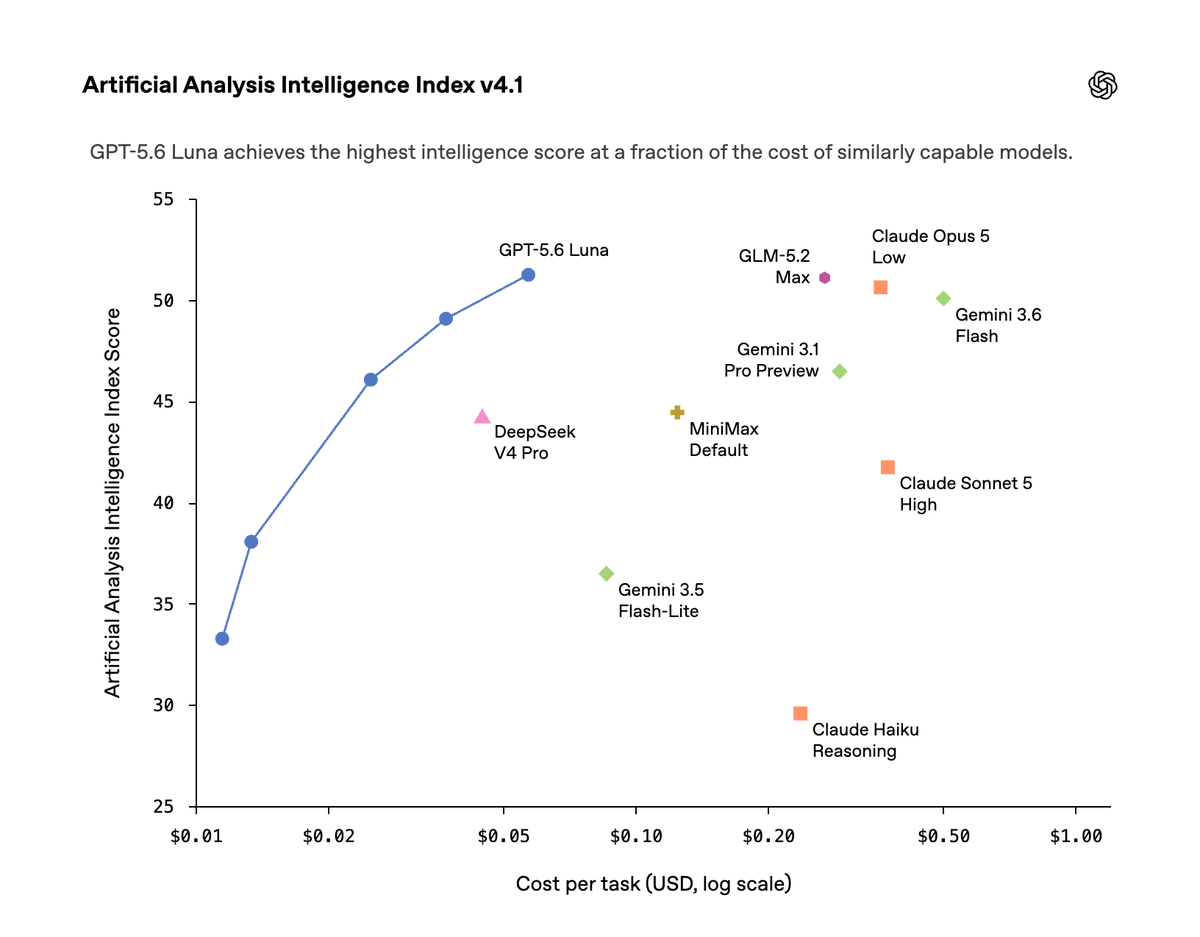
major price cuts today:
*80% drop for GPT-5.6 Luna, now $0.20 per million input tokens and $1.20 per million output
*20% drop for GPT-5.6 Terra, to $2/$12
*GPT-5.6 Sol gets Fast mode in the API, up to 2.5x the speed for 2x the price, same intelligence