LLM Knowledge Bases
Something I'm finding very useful recently: using LLMs to build personal knowledge bases for various topics of research interest. In this way, a large fraction of my recent token throughput is going less into manipulating code, and more into manipulating knowledge (stored as markdown and images). The latest LLMs are quite good at it. So:
Data ingest:
I index source documents (articles, papers, repos, datasets, images, etc.) into a raw/ directory, then I use an LLM to incrementally "compile" a wiki, which is just a collection of .md files in a directory structure. The wiki includes summaries of all the data in raw/, backlinks, and then it categorizes data into concepts, writes articles for them, and links them all. To convert web articles into .md files I like to use the Obsidian Web Clipper extension, and then I also use a hotkey to download all the related images to local so that my LLM can easily reference them.
IDE:
I use Obsidian as the IDE "frontend" where I can view the raw data, the the compiled wiki, and the derived visualizations. Important to note that the LLM writes and maintains all of the data of the wiki, I rarely touch it directly. I've played with a few Obsidian plugins to render and view data in other ways (e.g. Marp for slides).
Q&A:
Where things get interesting is that once your wiki is big enough (e.g. mine on some recent research is ~100 articles and ~400K words), you can ask your LLM agent all kinds of complex questions against the wiki, and it will go off, research the answers, etc. I thought I had to reach for fancy RAG, but the LLM has been pretty good about auto-maintaining index files and brief summaries of all the documents and it reads all the important related data fairly easily at this ~small scale.
Output:
Instead of getting answers in text/terminal, I like to have it render markdown files for me, or slide shows (Marp format), or matplotlib images, all of which I then view again in Obsidian. You can imagine many other visual output formats depending on the query. Often, I end up "filing" the outputs back into the wiki to enhance it for further queries. So my own explorations and queries always "add up" in the knowledge base.
Linting:
I've run some LLM "health checks" over the wiki to e.g. find inconsistent data, impute missing data (with web searchers), find interesting connections for new article candidates, etc., to incrementally clean up the wiki and enhance its overall data integrity. The LLMs are quite good at suggesting further questions to ask and look into.
Extra tools:
I find myself developing additional tools to process the data, e.g. I vibe coded a small and naive search engine over the wiki, which I both use directly (in a web ui), but more often I want to hand it off to an LLM via CLI as a tool for larger queries.
Further explorations:
As the repo grows, the natural desire is to also think about synthetic data generation + finetuning to have your LLM "know" the data in its weights instead of just context windows.
TLDR: raw data from a given number of sources is collected, then compiled by an LLM into a .md wiki, then operated on by various CLIs by the LLM to do Q&A and to incrementally enhance the wiki, and all of it viewable in Obsidian. You rarely ever write or edit the wiki manually, it's the domain of the LLM. I think there is room here for an incredible new product instead of a hacky collection of scripts.
I was fired from Anthropic today.
I was the engineer responsible for shipping the latest dev/claude-code npm package. Wanting to improve the debugging experience for the team, I decided to include source maps in the release. This resulted in our entire internal codebase being publicly exposed including thousands of files with every agent command, all system prompts, the complete query engine, Undercover Mode, Bypass Permissions Mode, and our internal telemetry configuration.
I take full responsibility. I genuinely believed the safeguards Claude Code had built for me would be adequate and it was a serious miscalculation on my part.
My actions have unintentionally open-sourced major parts of Claude’s architecture well ahead of schedule. I apologize to the team and to Claude.
I accidentally discovered how to compress a month of research into 3 hours.
A founder at a YC company showed me his Claude setup. I thought he was just fast. Then I watched him build an entire go-to-market strategy for a market he'd never worked in before.
Here's exactly what he did:
First: he didn't ask Claude to "research the market."
He fed it 8 competitor landing pages, 3 earnings call transcripts, 12 customer reviews, and a Reddit thread of complaints.
Then he asked one question:
"What does every successful player in this market understand that their customers never say out loud?"
Not "summarize these." Not "analyze the competition."
The unspoken insight. The thing that takes founders 2 years of customer calls to figure out.
But the next part is what broke my brain.
He followed up with:
"Now show me the 3 assumptions this entire market is built on, and what would have to be true for each one to be wrong."
In 15 minutes he had the attack surface of an entire industry.
The blind spots. The fragile consensus. The opening nobody was talking about.
Most founders spend 6 months doing customer discovery just to find one of those.
Then he did something I've never seen before.
He asked:
"Write 5 questions a world-class investor would ask to destroy this business idea, then answer each one using only the evidence in these documents."
He spent the next 2 hours stress-testing every assumption. Every weak answer triggered a follow-up:
"What's the strongest version of this argument and where does it still break?"
By hour 3, he had a strategy deck that felt like it came from someone who'd spent a decade in the space.
The tool didn't change. The questions did.
Most people treat Claude like a faster Google.
These founders are using it like a thinking partner who has read everything and has no ego about being wrong.
The difference between 3 hours and 3 months isn't the amount of information.
It's knowing which questions actually matter.
10. Learning with Claude
A few tips from the team to use Claude Code for learning:
a. Enable the "Explanatory" or "Learning" output style in /config to have Claude explain the *why* behind its changes
b. Have Claude generate a visual HTML presentation explaining unfamiliar code. It makes surprisingly good slides!
c. Ask Claude to draw ASCII diagrams of new protocols and codebases to help you understand them
d. Build a spaced-repetition learning skill: you explain your understanding, Claude asks follow-ups to fill gaps, stores the result
I'm Boris and I created Claude Code. I wanted to quickly share a few tips for using Claude Code, sourced directly from the Claude Code team. The way the team uses Claude is different than how I use it. Remember: there is no one right way to use Claude Code -- everyones' setup is different. You should experiment to see what works for you!
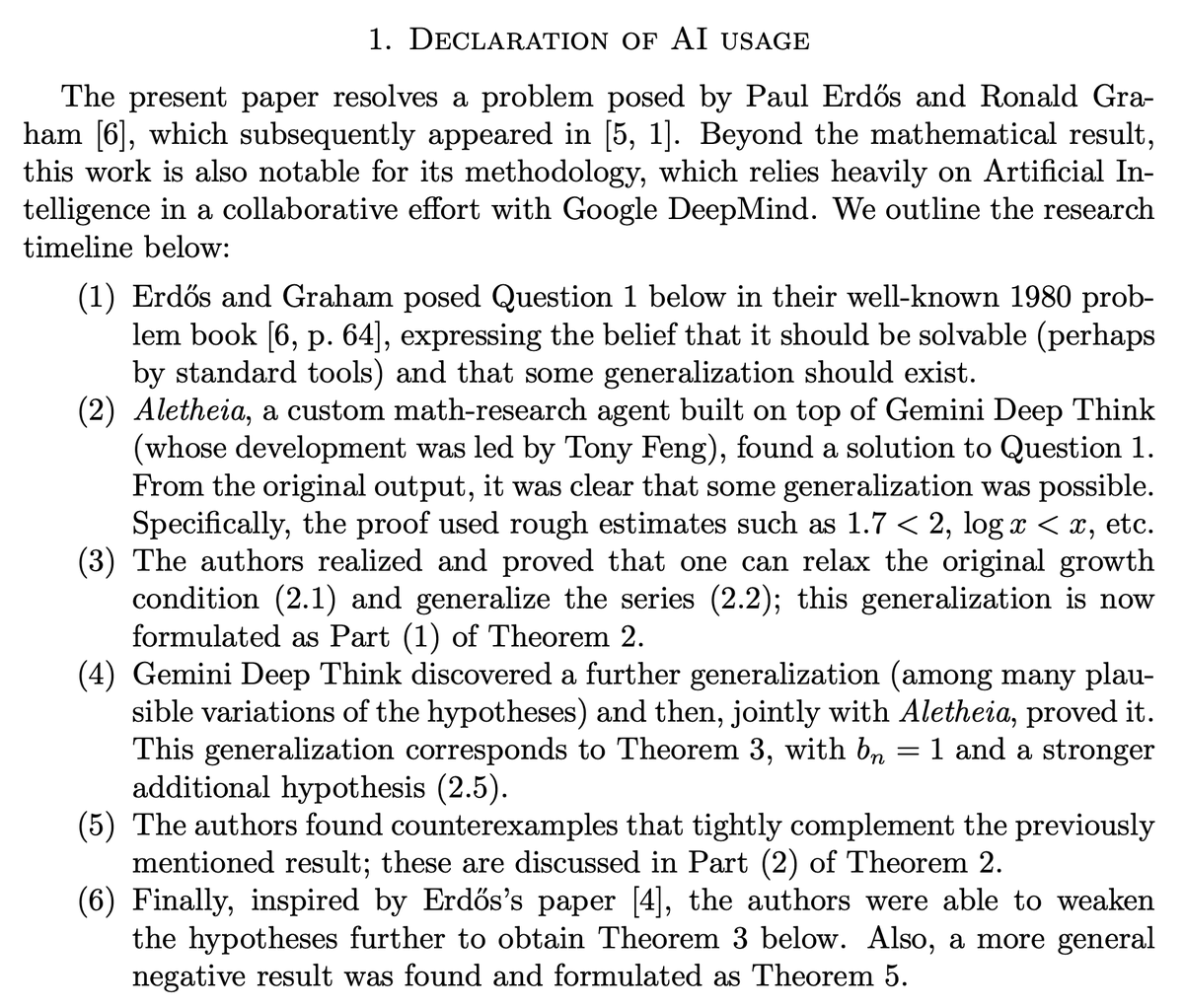
서울대 강지원 학생, 고등과학원 김상현 교수님 등이 Barreto, Kovač, Zhang과 함께 Erdős의 미해결 문제 중 하나를 해결한 논문을 arXiv에 올렸습니다.
논문의 특이점: Gemini Deep Think를 활용하는 AI agent인 Aletheia가 문제를 풀었고, 사람과 AI가 협력해서 일반화... https://t.co/wWUB7I71B7
I've recently gone on leave from Columbia to join OpenAI, working on OpenAI for Science. Over the past few months, AI-including GPT 5.2-has become an increasingly important part of my workflow as a mathematician. I'm excited to contribute to efforts to accelerate progress in mathematics and scientific research.
명문이다 레알
미국은 역사적으로 Southern strategy라는 작전을 행했다. "가난한 백인이 부유한 백인이 아니라 가난한 흑인을 증오하도록 하라"는 정치 프로파간다이고, 2025년에도 기어코 트럼프를 당선시킬 만큼 효과적인 선전이다.
한국 버전 Southern strategy도 쏠쏠하게 효과 보는 중인듯.
@taekie https://t.co/1cNLFdNbvm 1981 년부터 있는 자료이긴 한데, 다운받아서 성비 계산해 보면 적어도 1983년 출생자까지는 출생성비 기준 자연성���에 가깝다고 볼 수 있습니다. 태아성감별 기술을 감안하면 현재 50대는 70년대 초 이전 태생이기 때문에 더욱 더 자연성비에 가까웠겠죠.
한국의 학력 능력 주의가 한국 사회에 잘못된 영향을 준 것 중 하나는 사회의 겪는 부조리를 전부 학생 때 공부를 못했기 때문이라고 모든 것을 낙담하며 합리화시키는 것이다. 공부를 못했기 때문에 지금의 처우를 당하는 것은(또는 가하는 것은) 당연하다고 생각하는 것이다.
학생 때 공부를 잘 했고, 수능 성적이 높다는 이유 하나만으로 앞으로의 미래를 모두 보장 받아야 한다고 생각하는 사람들이 있듯이, 반대로 학생 때 공부를 못했으니까 지금의 열악한 상황이 당연한 것이라며 모든 것을 낙담한 채 현실을 섣불리 포기해 버리는 사람들도 있다는 것이다.