New Pendle Pool: risexUSDC
We just launched our new Pendle Pool featuring risexUSDC, our @risextrade market neutral strategy, leveraging both
Maturity: 27th Dec 2026
LP earn 8x Shift Points, 1.3x Rise Points
PT capture both risexUSDC yield and additional fixed yield, while YT capture all Rise Points accrued by the corresponding vault shares.
At current prices, YT earn 62x RiseX Points and PT earn 15.08% Total APY.
As a reminder, the initial liquidity in the pool is limited (25% of the total vault), so if you're looking to trade PT/YT, we recommend to check the price impact and if meaningful, do the following steps:
1. Deposit in risexUSDC
2. Mint PT+YT via risexUSDC, instead of zapping directly
3. Sell the component that you do not want (sell PT into SY or YT into SY)
This will allow you to minimize the price impact compared to trading directly.
Access the Pendle Pool and Markets in Shift -> Tools -> Pendle Market: https://t.co/eBH0ROe1PW
Was looking into a @chainlink-style heartbeat + deviation model to see if a vault could safely update NAV.
Assume sync deposits + async redemptions:
- ΔNAV > threshold → publish a new NAV
- heartbeat elapsed → publish a new NAV
- maxStaleness exceeded → disable sync deposits
- ΔNAV > maxDelta → cap the recognized move and carry the remainder forward
The key assumption is that the deviation threshold has to be small enough that minting against a cached NAV inside that band is economically acceptable.
In exchange, the vault gets fewer oracle writes and lower gas overhead, but intentionally accepts a bounded stale-price window.
The part I’m still thinking about is the sync side: is a conservative threshold + hard staleness bound enough to make minting against cached NAV safe, or does the depositor still get too much optionality inside the allowed band?
Exactly 6 days ago, our risexUSDC vault went live.
Since then:
- the first cap was filled in 25 minutes
- risexUSDC vault effectively became the fourth Rise Chain DeFi venue by TVL, behind @risextrade, @Icarus_Fi and USDR.
- in the first days, the vault delivered an effective average of 17.6% APY, beating the expected return of 10.6%, thanks to XLP outperformance.
This is only the beginning.
@z0r0zzz Very interesting,
Who is serving the site, provider like “w4eth” u mention ?
Is it possible to run only js embedded into the html?
Since u mention “divide by page”, means there isn’t any cross reference ?
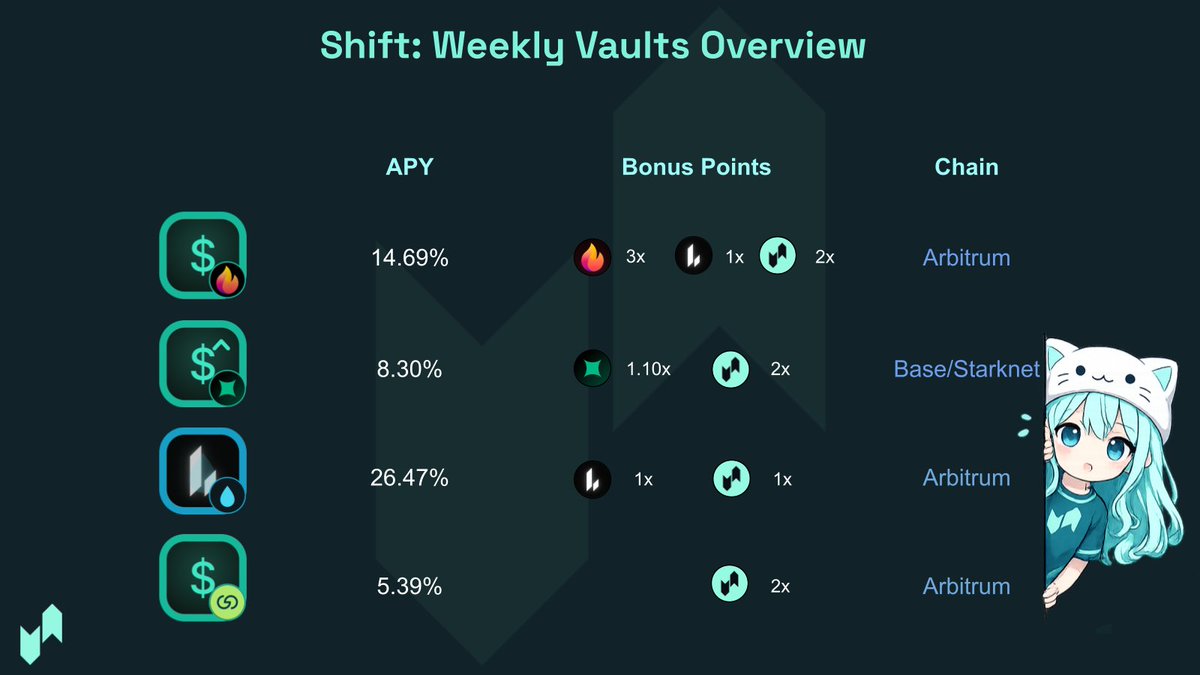
To celebrate the final rounds of the @extendedapp Points Campaign, this week we distributed extra points from Shift's Treasury to all of our extUSD depositors, increasing the APY of the vault to 17.77%.
APYs on all vaults are updated too.
Reading through @mavprotocol v2's IncentiveMatcher
I noticed applyNonBaseTokenMatch has no replay guard.
The function accounts a reward's non-base incentives into the epoch match, and it's meant to run once per reward. There's already a field for that on the MatchRewardData struct, hasAccountedForNonBaseIncentives. In the current code it's never written and never read. The checks that exist cover veto, distributed and epoch-ended, so a second call to the same reward goes through.
The incentive amount also stays in storage after the call. So calling again adds it to the running totals a second time. distribute later splits the match budget in proportion to those totals, so if you keep calling on one reward its share keeps growing and the other rewards' shares get smaller, including whatever the matcher had left over.
On a mainnet fork, one call sends a reward around 52.9k MAV.
Six calls make it 232k, the victim position drops from 10k to 7.3k, and the matcher rollover ends at zero.
The flag needed to prevent this is already on the struct. Setting it on the first call and checking it on the next is enough.
Worth noting there's no active exposure right now: the matching budget is idle, with no running epoch, so the attack window isn't currently open.
Introducing shiftEUR: Shift’s First EUR-Denominated Vault
We are preparing the launch of shiftEUR, the first EUR-denominated Shift Vault, designed to provide transparent access to DeFi yield opportunities using euro-denominated capital.
@ShiftProtocol_ v2 is asynchronous.
Deposit and withdrawal requests are submitted first, settled at the end of the epoch, and subsequently claimed.
We did not design a custom interface; instead, we adopted @centrifuge's ERC-7540 standard.
This marked a significant improvement by enabling scalability and the accurate pricing of the share allocated to Perps, despite the process being non-atomic.
Additionally, it introduced a modular framework for strategy implementation, allowing us to support both fully on-chain and hybrid execution models with the same architecture.
In @ShiftProtocol_ v1, redemption rates for withdrawals were calculated off-chain and fed to the vault contract.
This was fine when we started and we had proper guardrails in place.
However, it operated under the assumption of a non-compromised operator.
An operator should only be able to deliver bad yield never create insolvency by feeding fake numbers.
Even if it would require multiple security breaches, we didn’t want that risk.
So we fully revamped it in v2 and moved to a lower-trust solution that directly derives the correct rate on-chain.
@ProgrammerSmart@0xriptide What are great alternative to Automate txs that may need some offchain works like in case of Perp where most things goes on the API side ?
I see most use KMS or product like Turnkey to have a "sense" of security
1/ Introducing @OpenPendle
Pendle community pools, no whitelist.
Load or explore any @pendle_fi market ever created and interact with community markets without waiting for frontend curation.
Incoming: $GRVT Airdrop
The GRVT team has announced how its upcoming airdrop will be distributed.
Eligible recipients will be able to choose between:
A. 100% of their $GRVT allocation at TGE
B. A larger allocation with a 4-month cliff (2x)
C. A larger allocation with an 8-month cliff (4x)
How will this work for vGRVT depositors?
Lighter is getting a lot of attention right now: price up and Robinhood fuelled adoption.
But aside from trading $LIT, did you know that LLP (Lighter's Liquidity Pool) has been one of the most interesting yield sources in perp DEXs?
It provides liquidity and deliver yields.