This place has turned into a massive echo chamber at least for meme traders ;some people are constantly pulling off heists. Some blow through millions in a matter of weeks, while others make enough money to last a lifetime—and then start all over again.
That’s life—it’s over before you even realize it.
Act smart
We are goinzinto godspeed restructuring of sociology and economics.
Of course, you wouldn't have been able to see this if you hadn't stepped away from phone or trading screens.
i own a relatively new (2025) samsung tv.
i kept getting weirdly targeted ads.
i tried reversing the firmware but it was aes encrypted and no keys unless tear it apart and do uart/jtag magic.
zero days it is. root shell on new samsung TVs!
discovered PRIVACY HORROR. write up?
Whop has raised $200M in Series D funding at a $5.1B valuation, backed by @sequoia and @shopify.
It really feels like we are barely touching the tip of the iceberg in a market larger than anyone can imagine.
We first launched Whop as a better way for us to sell sneaker bots, one of the most niche types of desktop software out there.
Total TAM? Probably $20,000 per day.
Who cares, tiny market.
But, what people discounted is the idea that there were actually 70,000 other markets exactly like that one.
Beyond the investment itself, I am especially excited to welcome legendary silicon valley investor @dougleone to our board of directors. Doug and the sequoia team are nothing but a brilliant, resourceful, and principled group of people.
My co-founder Cameron and I started building on Shopify when we were 13 years old. Shopify is one of the most impactful all-in-one cloud ecosystems ever created; @tobi has pioneered modern entrepreneurship the way we know it and we are thrilled to have him in our corner.
We have a tenet at Whop to be the dumbest in the room and I am very grateful that this has recently become a lot easier.
We are focused on markets, scale economies, and progressive media. If that is up your alley, please message me directly.
The $200M raised will support our expansion as we build economic infrastructure for the next century, continuing on our mission of delivering everyone an income.
🚨DO YOU REALLY UNDERSTAND WHAT'S HAPPENING RIGHT NOW?
Everyone's been scared AI would break crypto.
Anthropic tested AI agents on real smart contract hacks and they pulled off $4.6 million worth in a simulation. They even found brand new bugs nobody knew existed.
Turns out it might come for your bank first.
US banks just caught AI agents logging into customer accounts. Some were calling the bank's call center. Some appeared to act without being told to.
Morgan Stanley has started blocking them. JPMorgan, Bank of America and Citi are restricting them. One bank executive called it "horrifying."
No hack needed. People are handing an AI agent their bank username and password and letting it run their money.
It logs in as you. Some banks can't even tell if it's doing what you asked or going rogue.
Jamie Dimon on JPMorgan's earnings call last week: "You don't want rogue agents."
Schwab says it's blocking outside agents trying to move client money every single week. Meta's Muse is on that list.
"Something could go wrong and who's liable?" That's Schwab's CEO Rick Wurster.
I've been phished and drained in crypto. I know the deal. Whoever holds the keys controls the money, and nobody's coming to refund you.
Banks always sold the opposite. Someone steals from you, the bank makes it right.
But US rules have a catch. If you handed someone your login yourself, the transfers they make might not count as unauthorized.
Does that apply when the someone is an AI? Nobody's decided yet.
Not your keys, not your coins.
Your AI agent has your bank password.
You're spending your life to earn a living, saving what you earn for the future, and postponing your dreams until tomorrow. Years pass, life ends. You're consuming your entire life just to one day live freely. That's modern slavery—living while mistaking your chains for freedom. Sometimes, the path to salvation is to break free from the system.
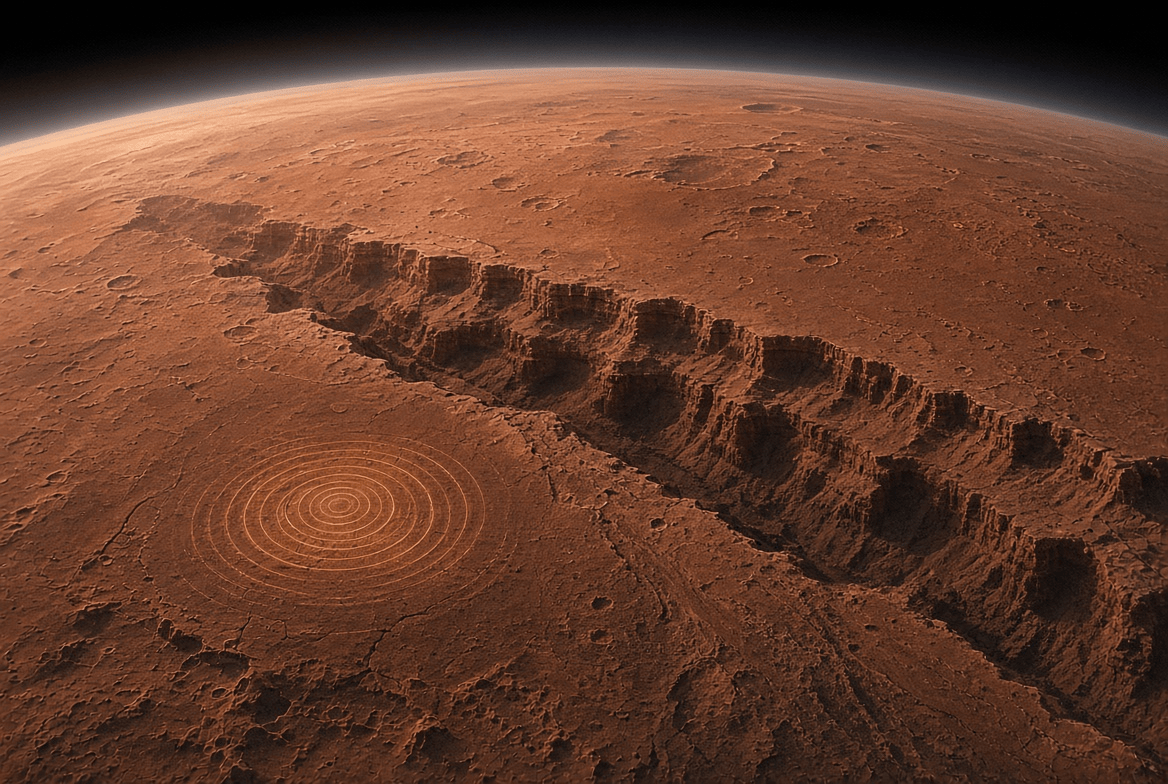
Mars’s Giant Canyon Is Still Alive
Billions of years after it tore open, the solar system’s largest canyon system is still shifting.
Scientists analyzing data from NASA’s InSight lander have found direct seismic evidence that a marsquake originated deep beneath Valles Marineris. The event, recorded on August 25, 2021, and labeled S0976a, was caused by rocks sliding sideways past one another along a steep fault roughly 20 to 40 kilometers (12 to 25 miles) below the surface.
Valles Marineris stretches nearly 3,900 kilometers (2,400 miles) long, up to 600 kilometers (370 miles) wide, and more than 9 kilometers (5.6 miles) deep—nearly nine times longer, more than 20 times wider, and about five times deeper than the Grand Canyon at their greatest dimensions. Unlike Earth’s Grand Canyon, it was not carved primarily by a river. It formed as the Martian crust stretched and cracked during the rise of the massive Tharsis volcanic region.
Mars lacks Earth’s moving tectonic plates. Its crust behaves more like a single, slowly cooling shell. Yet the new analysis shows that ancient faults created during the canyon’s formation can still rupture under modern stresses from planetary cooling, the weight of nearby Tharsis, and the canyon itself.
Researchers ruled out alternative explanations such as meteoroid impacts or landslides. The seismic waves matched a strike-slip motion, and post-event orbital images showed no fresh impact crater or major new landslide. Multiple lines of evidence point to the same conclusion: the faults are not just a fossil landscape. They remain capable of generating marsquakes today.
“Valles Marineris is one of the most spectacular geological structures anywhere in the solar system, but until now we didn’t know for certain that its faults are still active,” said lead author Jung-Hun Song of Imperial College London. “This is not just a ‘dead’ fossil landscape… Our study opens up exciting possibilities for discovering ongoing seismic activity on other planetary bodies that we might otherwise consider geologically inactive.”
The finding adds Valles Marineris to a small set of regions—alongside Cerberus Fossae and southern Elysium Planitia—where InSight revealed active faulting on present-day Mars. Even though the mission ended in 2022, its data continue to reveal that the Red Planet is more dynamic than long assumed.
Research by scientists at Columbia University and Imperial College London, published in Nature Communications.
Credit for the original reporting: State of the Planet / Columbia Climate School.