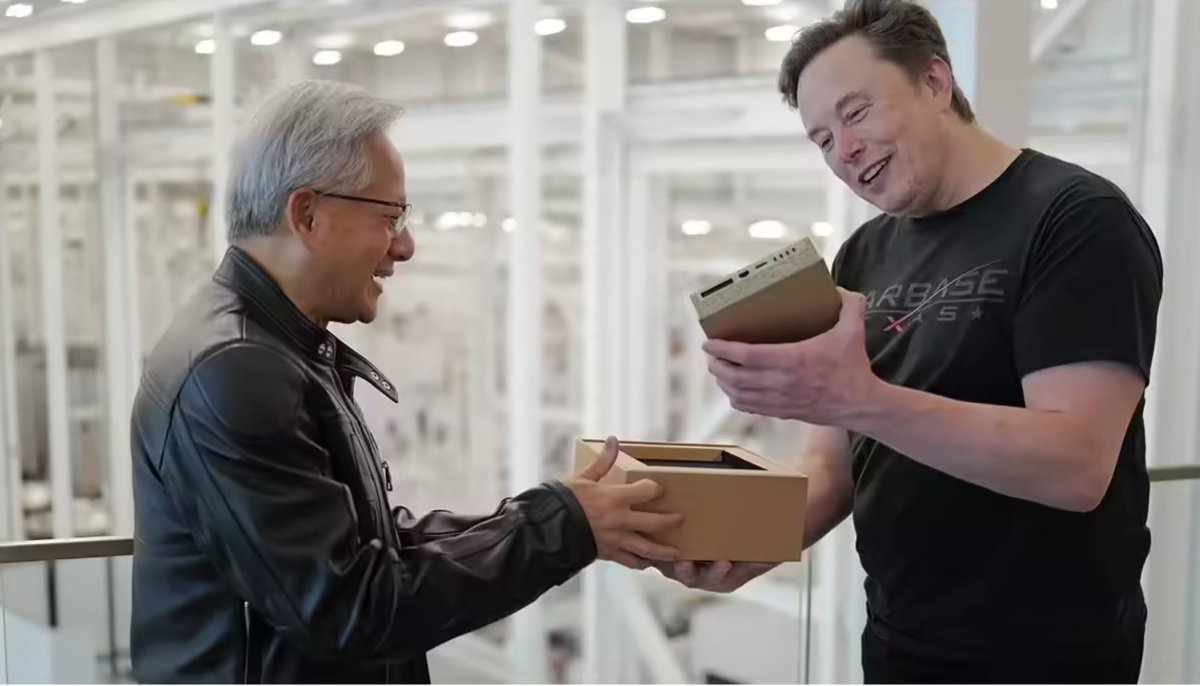
🚨Michael Burry just said Elon Musk and Nvidia's deal is built on fake numbers.
Burry published a detailed breakdown calling the entire structure "Fugazi", his word for fake.
He is alleging that billions of dollars in Nvidia chips are being hidden off balance sheets, and that American retirees are unknowingly funding the whole thing.
Nvidia, the world's largest AI chip company sold $5.4 billion worth of its most advanced GPUs, the GB200, to a company called Valor.
Valor is not a real operating business. It is a special purpose vehicle, a shell company created specifically to hold these chips and nothing else. Nvidia also invested $1.9 billion of its own money directly into Valor on top of the sale.
Those 100,000+ chips are now physically inside xAI's data center. xAI is Elon Musk's artificial intelligence company, the one that builds Grok. xAI is using every single one of those chips right now to run its AI models.
But here is what Burry is flagging.
Neither Nvidia nor xAI owns those chips on paper. Valor, the shell company holds legal title. That means $5.4 billion in GPU assets do not show up on Nvidia's balance sheet as inventory.
They do not show up on xAI's balance sheet as assets. They are legally invisible to both companies.
Nvidia gets to book the $5.4 billion as a completed sale and record it as revenue. xAI gets full use of the chips without owning them. And the risk disappears into a shell company in the middle.
Now here is where American retirees enter the picture.
Valor needed $3.5 billion in debt to fund this structure. Apollo provided it. Apollo is one of the largest asset managers on earth with $1.03 trillion under management and $834 billion specifically in private credit.
Apollo raised the $3.5 billion, packaged it into debt securities, and sold those securities to Athene.
Athene is Apollo's own insurance company. It sells fixed and indexed annuities, retirement savings products, to ordinary Americans.
When a retiree buys an Athene annuity, they believe their money is sitting in safe, stable investments. That money is now inside a structure funding Elon Musk's AI data center.
The numbers inside Athene are most alarming.
Athene holds $74.2 billion in reserves. It has moved $217 billion in assets into a captive insurer based in Bermuda, meaning those assets sit outside normal US insurance regulation and oversight.
Of the entire portfolio, 34.7%, equal to $103 billion, is classified as Level 3 assets.
Level 3 is an accounting classification that means there is no observable market price for these assets. No outside party can independently verify what they are actually worth.
The leverage sitting on top of those unpriced assets is 16 times.
Burry's says:
Every step of this structure is technically legal and publicly disclosed. But the entire thing was deliberately engineered across 8 to 12 steps to move credit risk off balance sheets and away from any market pricing.
- Nvidia books the revenue.
- Apollo collects the fees.
- xAI gets the computing power.
- And retirees sitting at the bottom of a 16x leveraged Bermuda insurance structure, holding $103 billion in assets with no market price carry the risk without knowing it exists.
🚨🚨🚨
Bombshell: The Browns are finalizing a trade that will send two-time Defensive Player of the Year Myles Garrett to the Los Angeles Rams, per @rapsheet, @TomPelissero and me.
In exchange for Garrett, the Rams are expected to send Pro-Bowl edge Jared Verse, a 2027 first-round pick and other draft-pick compensation still being negotiated to the Browns.
🇺🇲🇮🇷 In simple terms, he backed down once again and didn't dare to enter an overly risky game. While Iran was firing toward commercial and military vessels in the narrow strait, attempting to withdraw 1,600 ships escorted by only 3 destroyers would have been a wrong, senseless, and excessively dangerous decision—one that Trump himself made just two days ago. However, it appears the Pentagon could not guarantee the safety of the vessels; consequently, he preferred halting the operation over the potential destruction of civilian and likely military ships.
P.S. Don't forget that just two hours ago, Rubio announced that Operation "Epic Fury" had concluded and all attention and effort were now being devoted to Operation "Freedom." Only two hours later, the operation has collapsed.
Let me walk you through the events of the war so far:
1. The United States and Israel tried regime change; it didn’t work. Or rather, they got regime change—Iran became an Islamic Revolutionary Guard Corps–led military dictatorship. That was not an improvement.
2. The U.S. won an overwhelming military victory with air and naval power and scarcely a boot on the ground. But it destroyed less of Iran’s missile- and drone-launching capabilities than at first appeared.
3. Then there was a hostage crisis. Iran took both the Gulfies and the Strait of Hormuz hostage. The result was a massive economic shock for the world that required a rapid resolution.
4. The choice was between 1) military escalation (boots on the ground or strikes on Iranian infrastructure), and 2) a diplomatic deal. Trump chose 2.
5. In Islamabad, the U.S proposed big economic concessions in return for some kind of change in the status of Iran’s enriched uranium stockpile, as well as the reopening of the strait. Contrary to the president’s social media feed, the Iranians did not accept.
6. In any case, the devil of any deal will be in the details, not the Truth headline. (When the small print finally comes out, every former Obama and Biden official will be ready to tell The New York Times that it’s worse than the 2015 Joint Comprehensive Plan of Action.)
7. Meanwhile, the Iranians have survived regime change and discovered that closing the strait is just as powerful a lever in economic warfare as they had always hoped. It’s not, despite the Russian quip, an “economic nuke,” because unlike a nuclear weapon you can use it.
8. Where we go from here is fairly predictable. I would be surprised if Trump now deploys ground forces. There will be more negotiation, so Islamabad, here we come. There may have to be more bombing, if the Iranians dust down the North Vietnamese playbook of stringing the U.S. negotiators along. And the final compromise will take longer to be agreed upon than Mr. Market currently believes. The consensus in prediction markets is this will be over by the end of May, but remember: It took Henry Kissinger more than four months to get the 1973–1974 oil embargo lifted.
@WhiteHouse It's his fault the Strait was closed in the first place... You don't get points for "reopening" it in exchange for cash.
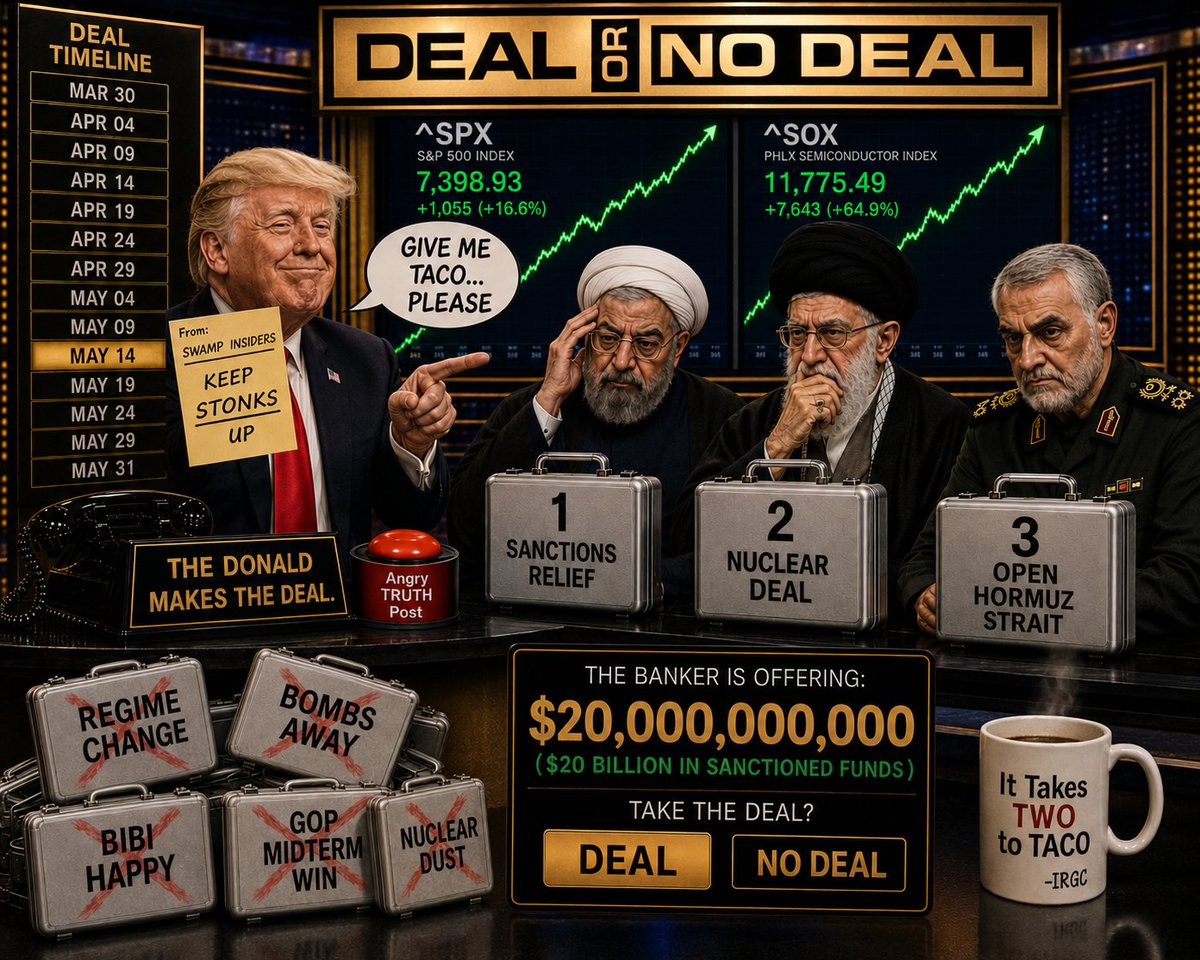
Plus, sending $20b in exchange for the Uranium is something you could have done prior to inciting a conflict. The President loses points on all fronts here.
8 P.M. is not that good. Could you change it to between 1 and 2 P.M., or if possible, 1 and 2 A.M.?
Thank you for your attention to this important matter. I.E.Z.
Rubric Capital, a hedge fund founded by a former Point72 manager David Rosen, wrote a private letter to their LPs effectively saying private credit is a fraudulent bubble.
"Our key takeaway from this behavior is that distribution cuts are so worrisome that some bad actors are playing Enron-like accounting games" per the letter
Letter called out Cliffwater, the biggest operator of interval funds and an aggressive player in selling private credit to individual investors.
Cliffwater’s largest fund, started in June 2019, has since reported a total of just three negative months of investment performance. It now manages $33 billion. The first opportunity this year for investors to ask for their money back is next week.
The note surmised that Cliffwater could be “a canary in a coal mine.” and the first domino of many
The bubble might blow soon
https://t.co/311Jjsyy4C