@VrntPerception@Barchart I don’t think the argument is relative to trend, but maybe that this is a secular change in trend. What does the series look like on a long term time horizon including the trend?
A bit of a longer comment on JPY
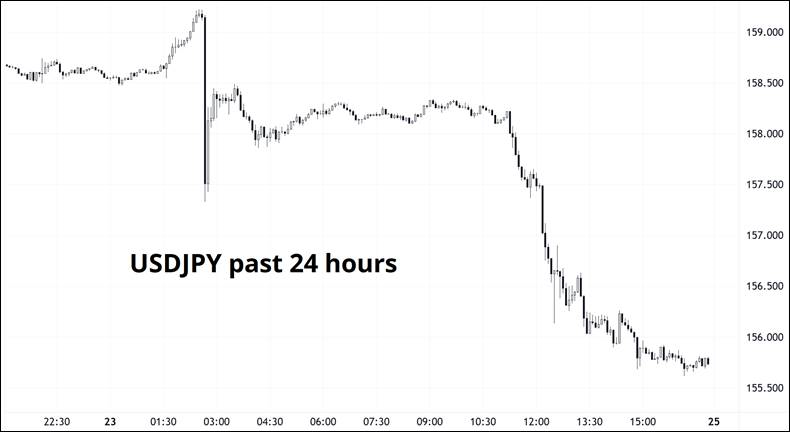
What happened?
1.BOJ meeting was neutral, no major reaction.
2. Massive sloppy sell off 159.20 to 157.37 shortly after. Speculation was it was an asset manager (not intervention), but nobody knows. Then it bounced to 158.50 and was steady until the Fed came in and asked banks for rates in USDJPY just after 11 a.m. N.Y.
They were likely waiting for the liquidity to dry up (11:00 am is peak liquidity in FX) to achieve maximum impact.
3. A lot of confusion as to what was going on, but it eventually became clear that the Fed did a rate check and this was public information that banks were allowed to share.
4. USDJPY cratered and closed at 155.80.
What will happen next?
There are two main ways to read this.
1.MOF asked Treasury to ask Fed to do rate check and they obliged. MOF and Fed/Treasury normally cooperate in currency interventions. Often the Fed will do the USDJPY trading on behalf of the MOF in NY time, if that makes sense timezone wise. I see three paths forward if this is the case:
a.Least extreme version of events: MOF want to cap / stabilize USDJPY at zero cost but don’t plan to intervene. This will eventually trigger a massive short squeeze in USDJPY once people realize there is nothing coming as a follow-up and MOF will then need to physically intervene at 159/160.
b.Second possibility is the rate check was to stabilize things / knock it lower in illiquid Friday afternoon market and MOF will come in and drop the hammer Sunday night.
c.Third possibility is they let it zigzag for a bit and hammer it Monday NY afternoon. The last Japanese administration had a love for selling USDJPY in NY time for some reason.
2.MOF and Treasury have agreed JPY is too weak (and Korea may agree KRW too weak too) and some sort of Mar-a-Lago accord is coming where those countries buy more US Treasuries and all three agree that JPY and KRW are too weak. I am always a massive skeptic of stories like this because they pop up frequently and they are never true. We had the Shanghai Accord noise off and on for years and Mar-a-Lago accord noise based on Stephen Miran’s November 2025 essay etc. and it’s always been fake news. This time, however, there is obviously some real-world decisions being made or the Fed wouldn’t be taking this action. So, it’s not ridiculous to believe that following Bessent’s comments on KRW last week, the US and some Asian partners have agreed to stabilize or strengthen JPY, KRW, TWD(?). I can’t imagine CNH is involved but if it was that would be the most extreme bearish USD outcome.
I put the odds of these scenarios at:
1a.15%
1b.45%
1c.20%
2.20%
Based on these probabilities, I expect the USDJPY lower move to continue.
The action by the Fed is bearish USD in general, but I strongly doubt this is part of a weak USD policy. It’s more likely a strong JPY and KRW agreement vs. outright weak USD. Asia-related things like AUD are more likely to do well over time, not EUR.
Sell EURJPY + buy AUDUSD make the most sense. Not investment or trading advice.
@JSE_Invest@CBCIza The bond market isn’t revolting, that’s the difference between now and April - bond market yield lower, greater capacity to bear market pain. Bm
@AahanPrometheus@jasongrig@dampedspring How do you think about household balance sheet exposure to the stock market and the impact that the wealth effect has on consumption? Is it not a correction in stock prices that might cause the growth to decline.
@madaboutmarkets That’s what Cyril (not the ANC) has done through operation vulendela in the presidency, with support of national treasury. They have kicked off all the reforms that ministers in there portfolios resist.
@madaboutmarkets Economic and social stability. Also ensuring you don’t corner the EFF and MK together. The point is to isolate and destroy MK whilst clipping the wings of the EFF. Cyril and aligned stay in control
of economic and justice cluster and continue pushing through reforms via OV
@madaboutmarkets EFF are in (but with wings clipped) and DA have the choice to join and not let the ‘doomsday’ coalition play out - hopefully they will accesd to that.
@DanielKingMWI @Saffanomics Yet the SARB has flagged the sovereign-bank nexus as an increasing risk. BTW completely agree with your note and the complete disregard for risk in the category.
@SimonPB Simon, do you know why prime rate even exists? It’s why our banks have some of the highest ROE’s in the world. In other countries banks lend referencing off central bank rates not this oligopolistic higher rate that drives profits.