Learn to Reason via Mixture-of-Thought
Interesting paper to improve LLM reasoning utilizing multiple reasoning modalities:
- code
- natural language
- symbolic (truth-table) representations
Cool idea and nice results.
My notes below:
Level 1: Keyword-based retrieval
Level 2: Semantic-based retrieval
Level 3: Reasoning-based retrieval
𝗪𝗵𝗮𝘁 𝗶𝘀 𝗥𝗲𝗮𝘀𝗼𝗻𝗶𝗻𝗴 𝗜𝗻𝗳𝗼𝗿𝗺𝗮𝘁𝗶𝗼𝗻 𝗥𝗲𝘁𝗿𝗶𝗲𝘃𝗮𝗹?I
It is the ability to find relevant information that requires logical thinking to connect your query with appropriate documents. It goes beyond matching words or concepts.
For example, imagine asking:
> "How do I reuse water from plant pots - is it safe for the plants?"
A reasoning-based retrieval system would understand that:
1. Water in plant pot plates contains dissolved minerals
2. These might include soluble salts from fertilizers
3. Documents about salt accumulation and root damage would be relevant
4. Even if those documents never mention "reusing water from pots"
Yesterday, @antoine_chaffin and @LightOnIO released Reason-ModernColBERT, achieving top scores on the BRIGHT benchmark with just 150M parameters. (Congratulations to the team!)
I gave it a quick spin in this notebook with @weaviate_io:
https://t.co/nzFurD6oZ4
Reason-ModernColBERT on Hugging Face: https://t.co/tp4ZgQ72Zr
BRIGHT paper: https://t.co/zbc3nSahga
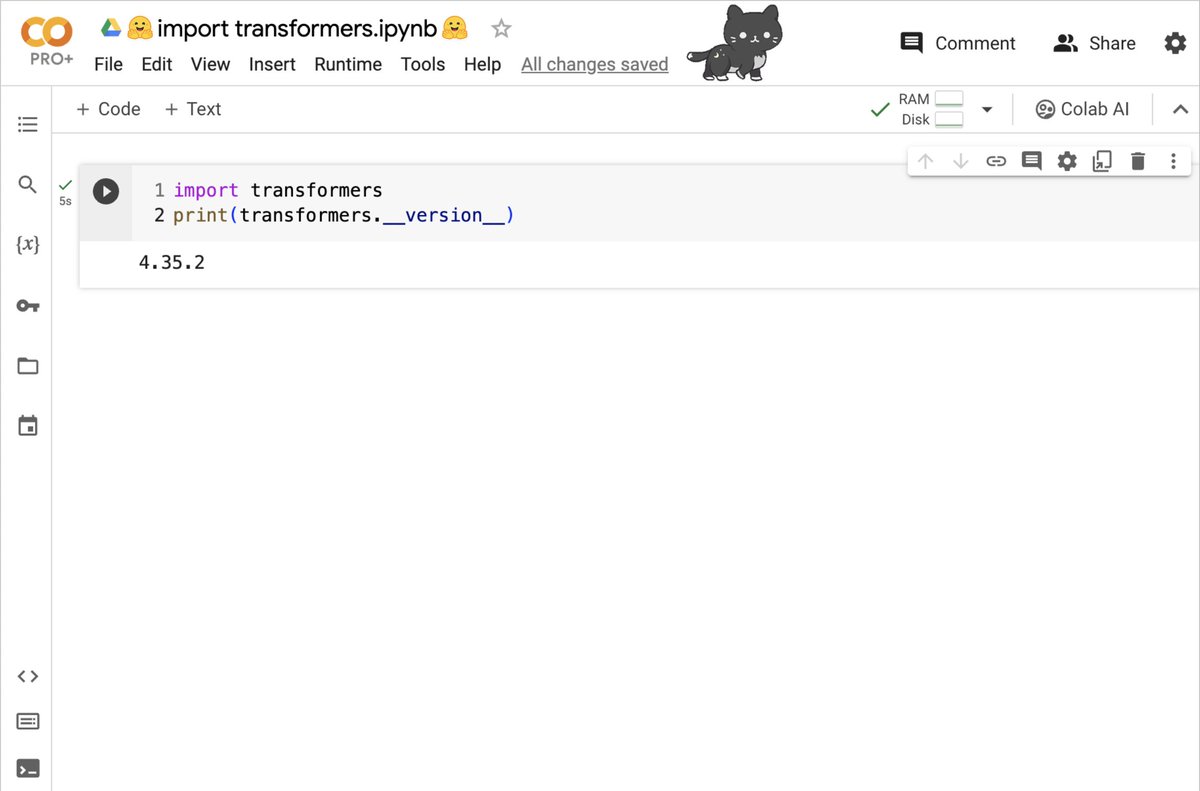
In collaboration with our friends at @huggingface, Colab managed runtime images now include transformers installed by default. `import transformers` is all you need.
We regularly update our image, but you can always force an upgrade with `!pip install transformers --upgrade`
Generative Image Dynamics
paper page: https://t.co/h4m4sRVvmb
present an approach to modeling an image-space prior on scene dynamics. Our prior is learned from a collection of motion trajectories extracted from real video sequences containing natural, oscillating motion such as trees, flowers, candles, and clothes blowing in the wind. Given a single image, our trained model uses a frequency-coordinated diffusion sampling process to predict a per-pixel long-term motion representation in the Fourier domain, which we call a neural stochastic motion texture. This representation can be converted into dense motion trajectories that span an entire video. Along with an image-based rendering module, these trajectories can be used for a number of downstream applications, such as turning still images into seamlessly looping dynamic videos, or allowing users to realistically interact with objects in real pictures.
Anti-hype LLM Reading List
This is actually a really good list of papers and reading materials on LLMs. Love the curation by @vboykis.
https://t.co/XYQP1FcQnC
Easily one of the biggest announcements for DL! 🙏
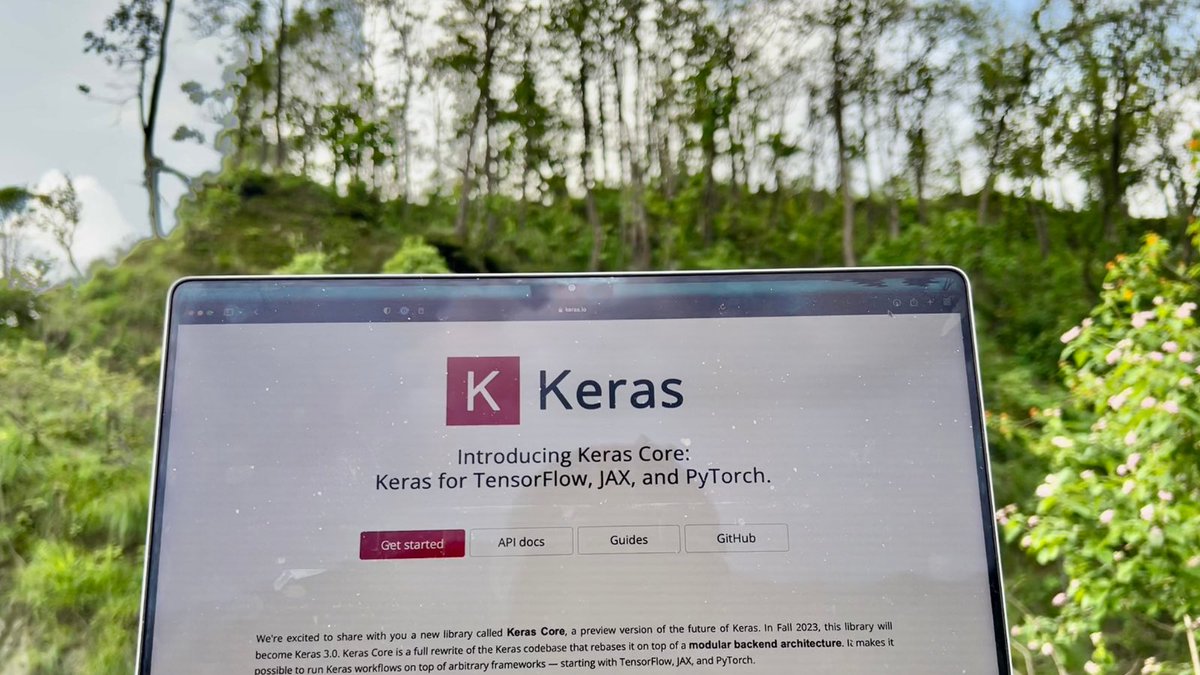
@fchollet announced Keras 3.0, a complete re-write making Keras the front end for TF, JAX and PyTorch.
This means some amazing things. My mentor and core contributor @A_K_Nain gave me a rundown:
- Unified framework: This is the first time all 3 frameworks have been unified
- Functional or Sequential: You can work with all backends with flexibility of picking your style
- Portability: You can train a model in PyTorch and run it in JAX without any changes for example!
- XLA: Keras Core uses XLA by default, incredible speed ups in store
- No Technical debt: It’s a complete re-write from scratch!
There are some gotchas (see below) but it should be even possible to train a PyTorch model on GPU and run it on TPUs using JAX!
I’ve been a PyTorch fan for years, now I’m definitely spending some weekends playing with Keras Core:
https://t.co/oAZ22F76zI
I also recommend reading @natolambert's excellent blog post that summarizes the key points, if you don't have time for 36 pages of whitepaper: https://t.co/zGcesFlzha
Do you want more reliable LLM agents? Designing a good Tool API is a *crucial* ingredient 💡
Good API design is an important skill in any dev’s toolkit, but it’s especially important for AI/LLM engineers.
We’ve curated some Tool API best practices ✨🧵 https://t.co/XWE4ixrqhb
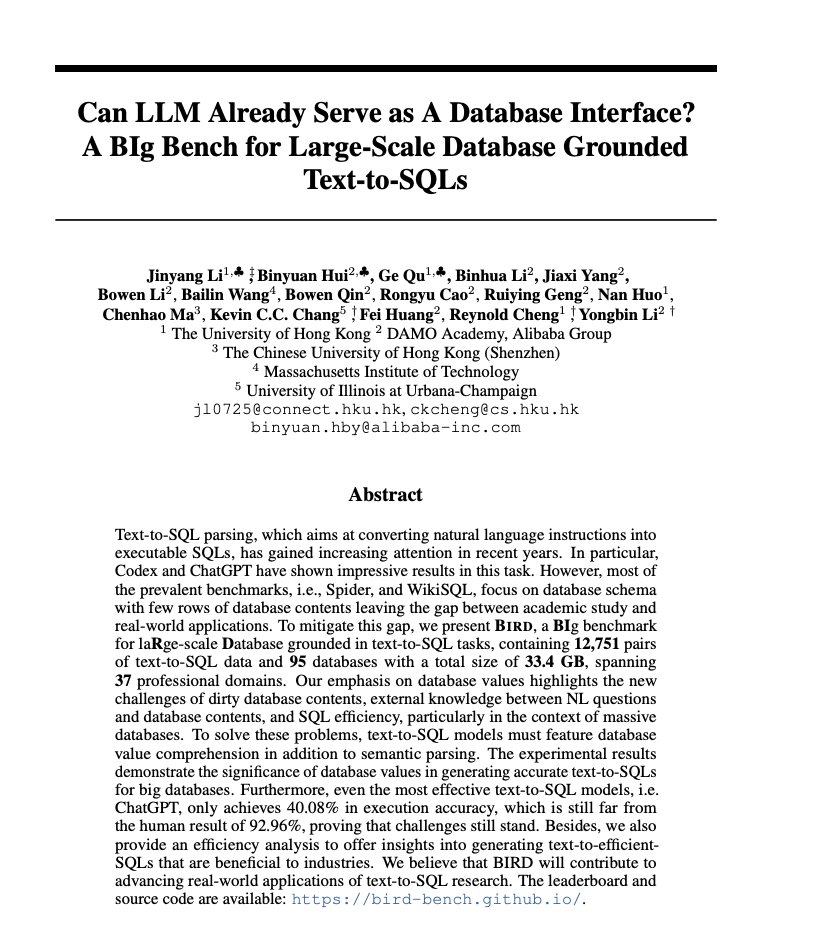
Can LLM Already Serve as A Database Interface? A BIg Bench for Large-Scale Database Grounded Text-to-SQLs
https://t.co/zQlWYMG1md
Text-to-SQL parsing aims at converting natural language instructions into executable...
🧵 👇
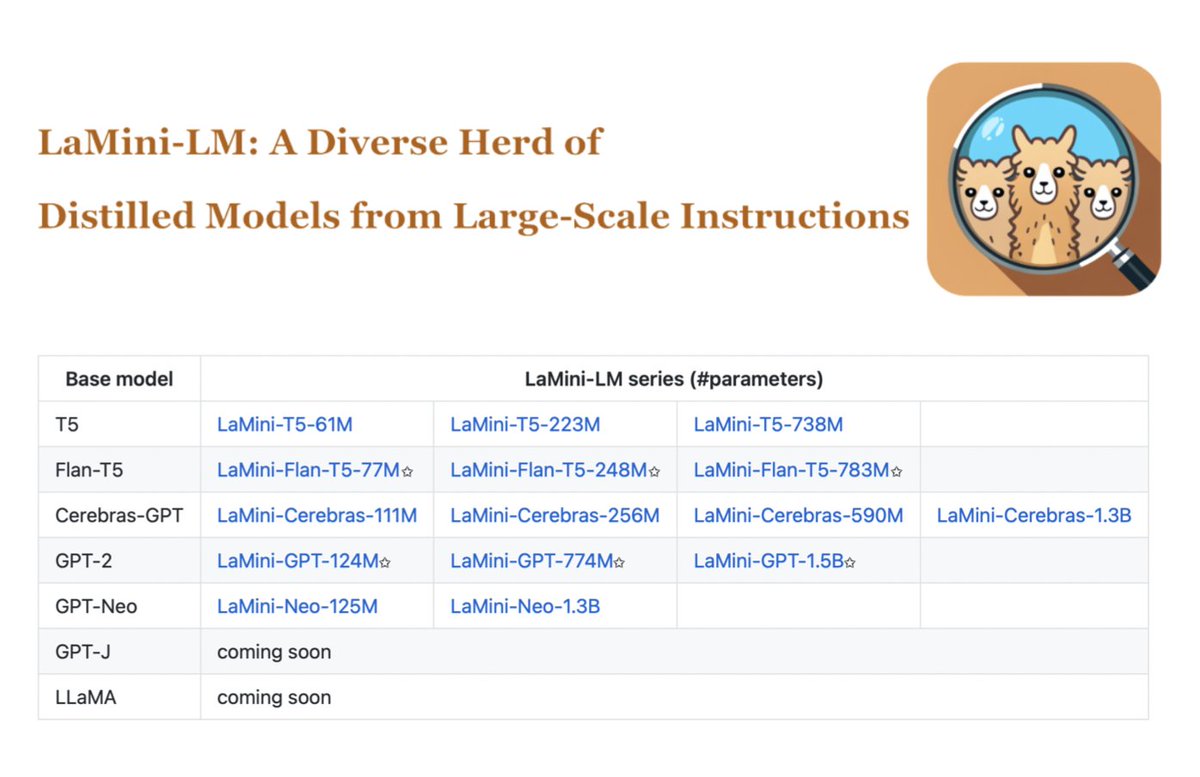
Introducing LaMini-LM🦙, a diverse set of 15 (more coming) mini-sized models (up to 1.5B) distilled from 2.6M instructions, comparable in performance to Alpaca-7B in downstream NLP + human eval.
Models + data are available strictly for research use: https://t.co/2XvzXkQ7Nu
Yes, yes, large language models are everywhere! But how do we evaluate the quality of their generated text?
There are intrinsic metrics, such as perplexity, and extrinsic ones such as BLEU & ROUGE.
Let's start with the overview & perplexity.
1/6
This week in AI:
- Google releases Bard.
- Adobe announces its AI image creator Firefly.
- Microsoft unveils Bing Image Creator.
- NVIDIA launches cloud tools for Generative AI.
- Opera releases its LLM-based browser.
- GitHub unveils CopilotX.
And it's only Wednesday, Captain!
The first open-source ChatGPT alternative got released! 🚀@togethercompute released a 20B chat-GPT model on Apache-2.0 🗣🆕
You can try it for free on Hugging Face. 😍
Demo: https://t.co/UfplWDrAgP
Model: https://t.co/8uTPqkYsso
Announcement: https://t.co/WRN5wj9hcy
Just read through state of AI report by McKinsey: https://t.co/fYhnZ2JGvX
(As a researcher, it seems to be useful summary of how AI is *actually* used in industry.)
Interesting insights
1. Computer vision now ties with NLP for classification/understanding
1 of 4