Train your own LLM from scratch!
A step-by-step repo that walks you through building and training a transformer model from scratch using PyTorch. From downloading training data all the way to generating text.
The architecture is built from the ground up following the original "Attention is All You Need" paper. MLP, single head attention, multi-head attention, transformer blocks, and the full transformer model - all coded and explained with detailed diagrams at each step.
Training data comes from The Pile - a diverse 825GB open-source dataset covering books, articles, code, websites, and more. The repo includes scripts to download it, preprocess and tokenize it using tiktoken, store it in HDF5 format, and feed it into training batches.
You can train a 13M parameter model on a single Colab T4 GPU. At 13M parameters the model starts generating proper grammar and coherent short sentences. For billion-parameter training you need at least an A100 or RTX 4090. The repo includes a full GPU compatibility table so you know exactly what's possible on your hardware.
Includes a complete SFT and RLHF guide as a separate notebook for taking your trained model further.
Key capabilities:
• End-to-end pipeline: data download → preprocessing → training → text generation
• Full transformer implementation from scratch with PyTorch
• Trains models from 13M to 2B+ parameters on a single GPU
• Training data from The Pile (825GB, 22 diverse datasets)
• Tokenization via tiktoken (r50k_base)
• SFT and RLHF guide included
100% open source.
I've shared the link in the replies!
I just built a plugin with Claude Fable 5 that turns Claude Code into a $5,000/mo SEO consultant 🤯
9 skills, one plugin: it connects straight to your Search Console + GA4 data, finds the wins, ships the fixes, and renders a live SEO dashboard that looks like a $200/mo SaaS product.
All inside Claude Code.
Perfect for DTC brands and agencies sitting on months of Search Console data nobody has time to read.
Right now, you probably can't answer:
Which keywords are sitting on page 2, one title tag away from page 1,
Which pages are bleeding traffic to redirect chains and broken canonicals,
Which blog posts rank for commercial terms but never link to a product page.
This plugin answers all of it from your live data, then ships the fixes:
→ Finds your page-2 keywords and ships the fix: new title, headings, content, paste-ready
→ Clusters every query into a hub-and-spoke content map with the gaps flagged
→ Drafts posts from your actual search data, not guesses
→ Writes dev tickets for redirect chains and slow pages, ranked by traffic at risk
→ Builds the internal links between your blog and your money pages
→ Flags toxic backlinks and ranks outreach targets
→ Drops a Monday report with 3 priorities before the client even asks
→ Renders it all as a one-file HTML dashboard with a 0-100 SEO health score
No dashboard staring.
No CSV archaeology.
No $5K/mo retainer for a PDF.
What you get:
→ Page-2 keywords moved to page 1
→ A content calendar that fills itself from data
→ Dev tickets that write themselves
→ A live SEO dashboard on command
Built 100% in Claude Code with Claude Fable 5.
I put the entire build into a step-by-step Playbook: all 8 workflow prompts (including the dashboard), how to turn them into a plugin, and the full Google setup
(Including the 2 landmines Google doesn't tell you about).
Want access for free?
> Like this post
> Comment "SEO"
And I'll send it over (must be following so I can DM)
🚨 Anthropic just showed a 27-minute workshop on how to actually do prompts for Claude.
Taught by the people who built it.
Free. No registration. No paywall.
I've seen $300 courses that don't cover what they teach in the first 8 minutes.
Watch it and bookmark it now.
A man spends 50 years teaching at MIT.
He knows his time is running out.
So he records one last lecture — everything he knows, distilled into a single hour.
He died 5 months later.
This is that lecture.
The most important hour you'll watch this week. 👇
Bookmark it for later
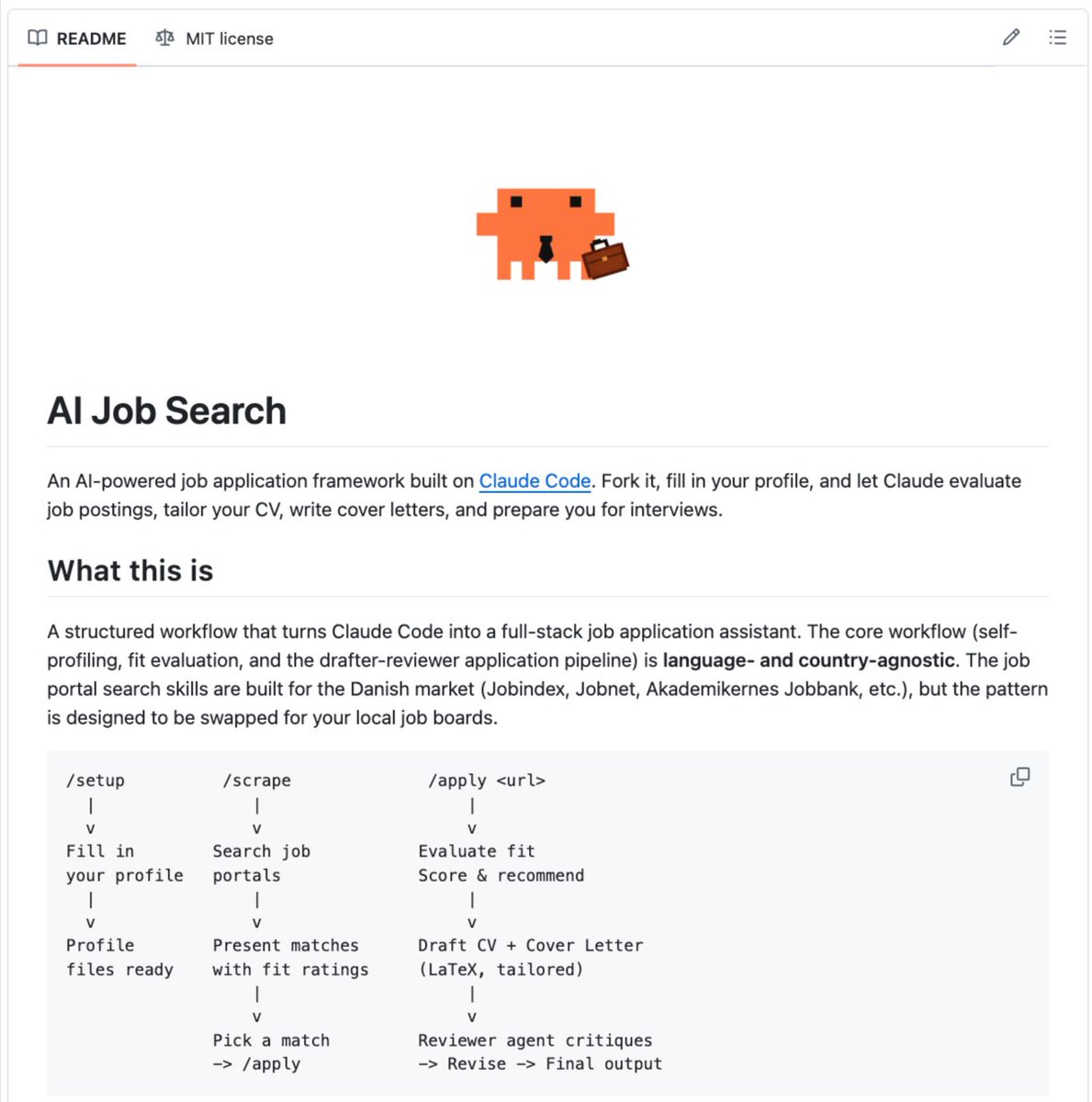
A scientist in Denmark figured out how to make Claude prepare his job applications. He open-sourced the whole thing.
His name is Mads Lorentzen. He is a PhD geophysicist. He built it on top of Claude Code and released it under MIT license.
Here is what it does. You fork the repo, fill in your background once, and it runs a five-step pipeline for every job you want to apply to.
Step 1. It reads the job posting and scores how well you fit.
Step 2. It drafts a tailored CV in LaTeX, picking only the experience that matches.
Step 3. It writes a cover letter framed around what you would bring to the role.
Step 4. A second AI agent reviews the first agent's work, points out weaknesses, and the first agent revises.
Step 5. It compiles both into clean PDFs you can send.
The whole thing is a folder of markdown files. The candidate profile, the writing style rules, the CV templates, the interview prep notes. Every step is plain text you can read and change.
The job portal search is built for Danish boards. The application workflow itself works for any country.
489 stars. 270 forks. A fork-to-star ratio that high means people are using it, not only bookmarking.
Mads is not a startup founder. He built this because he needed it for himself, then shared it.
This is the future of job hunting. Not a service you pay for. A workflow you own.
(Link in the comments)
There are 2 career paths in AI right now:
The API Caller: Knows how to use an API. (Low leverage, first to be automated, $150k salary).
The Architect: Knows how to build the API. (High leverage, builds the tools, $500k+ salary).
Bootcamps train you to be an API Caller. This free 17-video Stanford course trains you to be an Architect.
It's CS336: Language Modeling from Scratch.
The syllabus is pure signal, no noise:
➡️ Data Collection & Curation (Lec 13-14)
➡️ Building Transformers & MoE (Lec 3-4)
➡️ Making it fast (Lec 5-8: GPUs, Kernels, Parallelism)
➡️ Making it work (Lec 10: Inference)
➡️ Making it smart (Lec 15-17: Alignment & RL)
Choose your path.
(I will put the playlist in the comments.)
♻️ Repost to save someone $$$ and a lot of confusion.
✔️ You can follow @techNmak, for more insights.
@harjjotsinghh Hi thank you for the positive feedback. No one outside has tried it. It's an internal tool. But my people have told me that it has made things easy for them.
Managing sales calls with spreadsheets was a mess and our sales team struggled with it a lot. So I built a simple call center web app using Laravel + Livewire. No fancy UI. Just solves the problem. Wrote a blog post on how I built it.
Check it out - https://t.co/qGwpLFTHs3
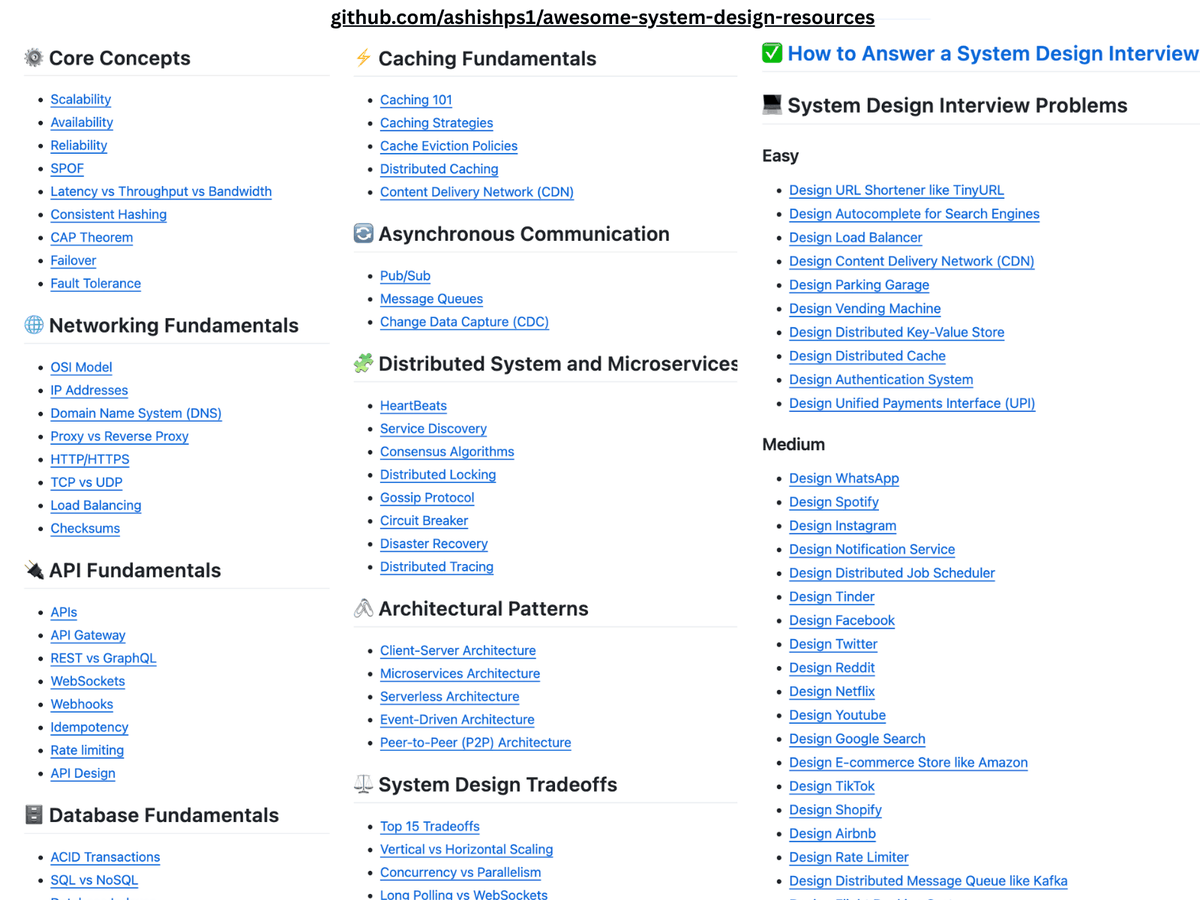
I created a Github repository to learn System Design, and I'm excited to share that it crossed 35k stars recently.
The repository contains a collection of resources to study:
- System Design Core Concepts
- Networking and API Fundamentals
- Database and Caching Fundamentals
- Distributed Systems, Microservies and Architectural Patterns
- System Design Tradeoffs
- 40+ interview problems categorized by difficulty level
Check it out here: https://t.co/pkVpi6LxSV
If you find the repo valuable, consider giving it a ⭐️ and share with others.
Thanks to everyone who has starred or forked the repository!
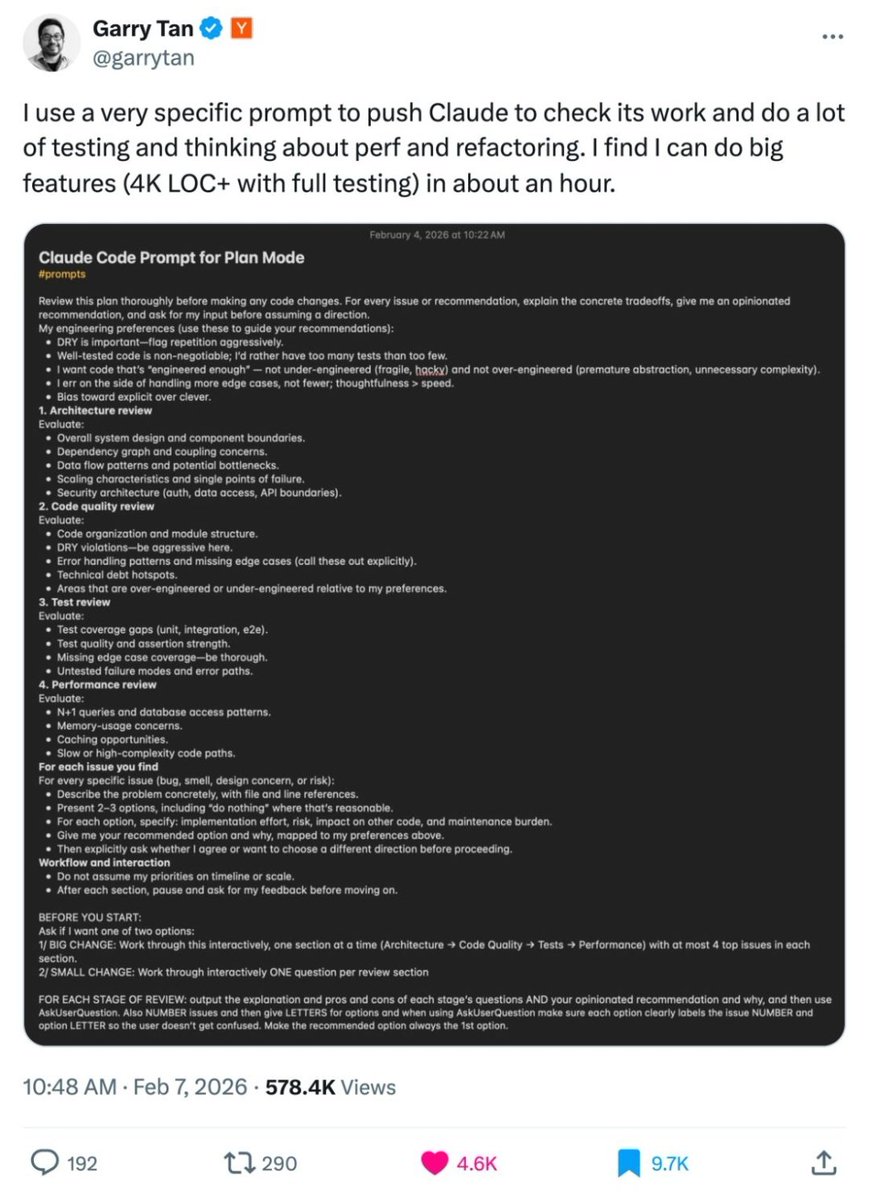
CEO of Y Combinator shared his https://t.co/lvxf35tz8F prompt for Claude Code
It helps him ship 4,000+ line features with full tests in about an hour:
This prompt pushes Claude to:
Decide if the plan is overbuilt, underbuilt, or "engineered enough" before writing any code
Aggressively review test coverage, edge cases, and failure modes
Look for performance risks, scaling issues, and refactoring opportunities
But the real difference is the workflow.
Instead of jumping into implementation, he makes Claude:
Do a structured review (architecture → code quality → tests → performance)
Present tradeoffs with opinionated recommendations
Pause for feedback before proceeding
In other words, Garry is using it as a senior engineer reviewing the system before changes are made.
For small teams, this is a game changer. When you don't have a staff engineer reviewing every PR, you design the review process into your Al.
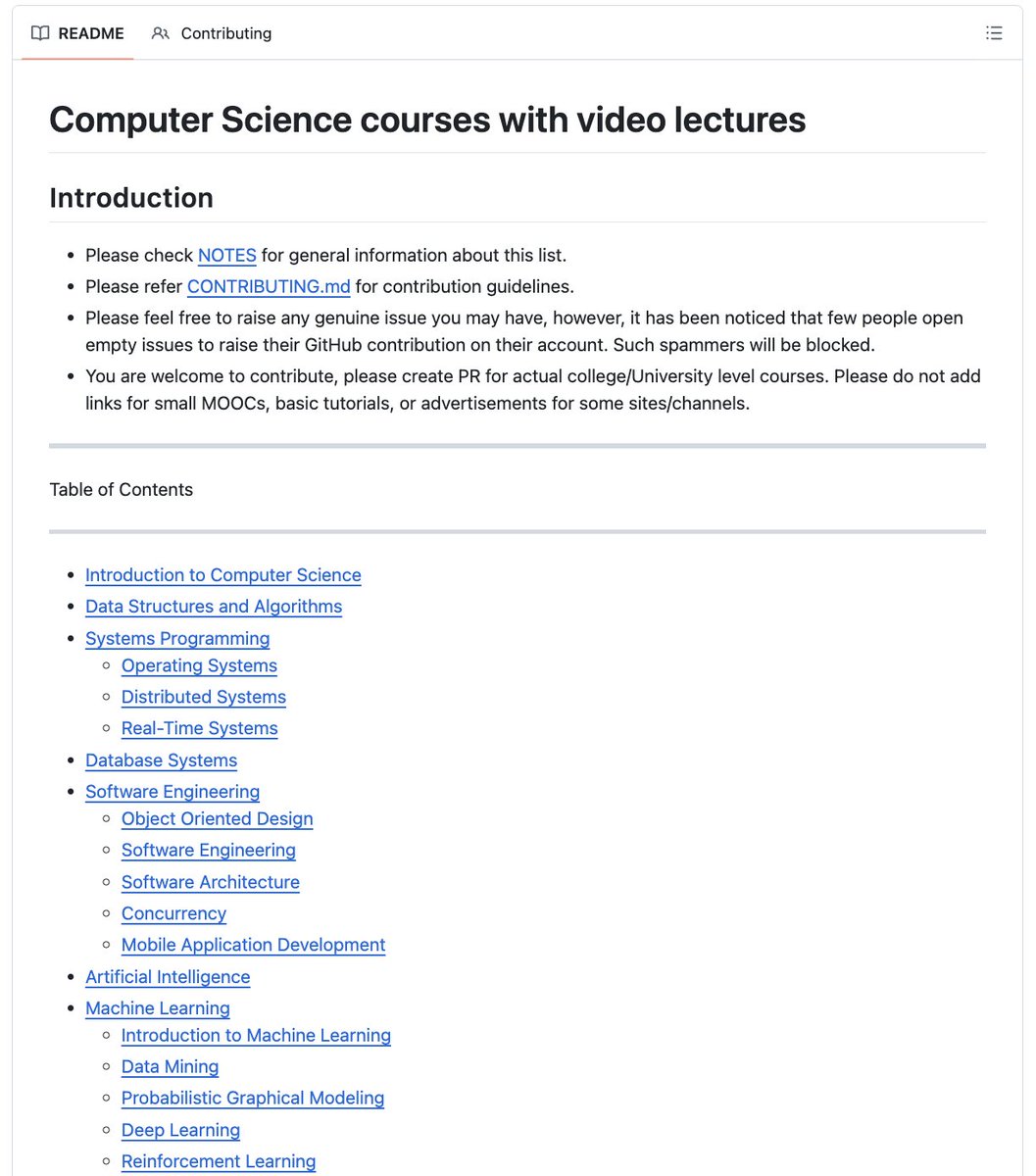
🚨BREAKING: Someone compiled every CS course from MIT, Stanford, Harvard, CMU and Berkeley in one place.
You can learn:
- Algorithms, OS, Distributed Systems, ML, AI
- Deep Learning, Computer Vision, NLP, LLMs
- Security, Databases, Quantum Computing
- 500+ courses with full video lectures
70.3K stars. 100% Opensource.
So the biggest historian and the poster boy for Left in the 21st century, Ramchandra Guha is just a BA, MA in Economic where History was not even an optional subject
But that is how history has been deciphered in this country, Romilas and Irfans decoding ancient/ medieval India without knowing a word of either Sanskrit or Persian
People like @jsaideepak and @sanjeevsanyal have demolished the narrative built painstakingly over the last hundred years, and all they needed was an impartial and systemic approach