@dianetc_@lateinteraction The future of agentic search? This is really exciting! Fascinating to think about what this could mean as AI agents take on increasingly complex tasks. Feels like we’re only scratching the surface!
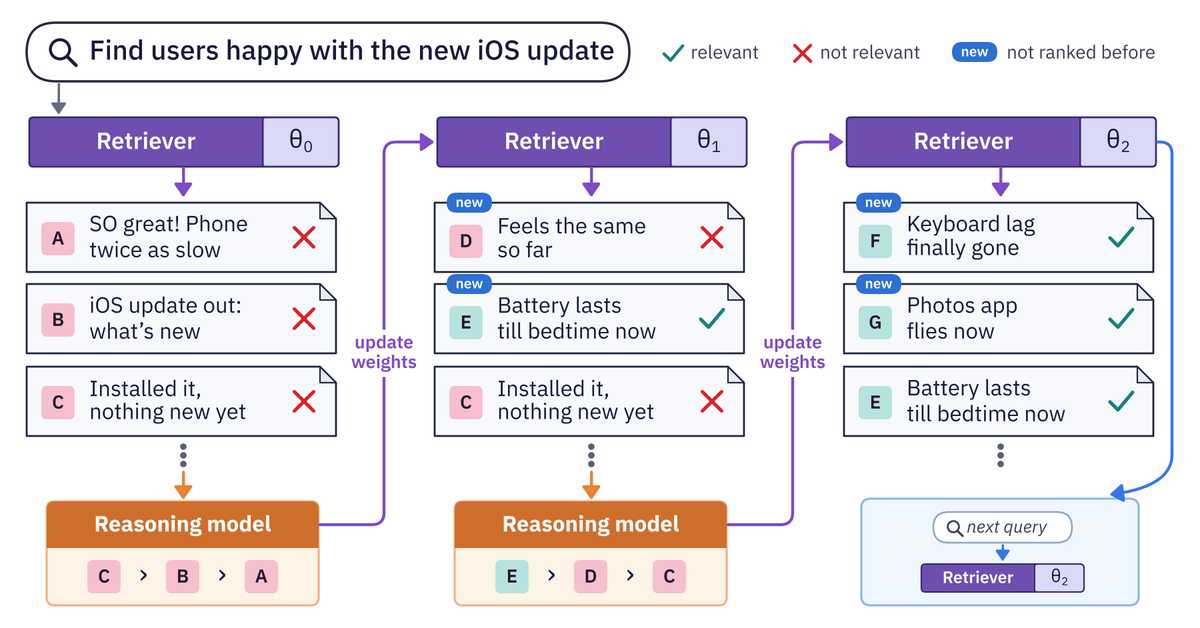
When a query arrives:
1) a small retriever (in our case, a tiny Ettin-400M cross-encoder) scores all documents and keeps its top 100
2) a reasoning model (Kimi-K3) ranks those candidates listwise
3) the rankings become pairwise preferences, and the retriever takes gradient steps to agree with them
4) It searches again with the new weights, still for the same query
The updated weights persist, so reasoning spent on today’s queries improves retrieval for tomorrow’s.
Reasoning models are excellent judges of relevance! The hard part is getting the right documents in front of them.
Over a massive codebase or the web, there are far too many documents to read. For hard queries, even a frontier agent repeatedly querying the best retrievers still ends up with poor recall.
ARI’s answer is to not just retrieve for the reasoning model, but to let the retriever learn from it, live.
We think ARI could lead to search that improves with use.
Agents redo the same reasoning every session. Coding assistants grep the same directories and reread the same files, then throw away their judgment of which results mattered. That judgment is exactly the supervision ARI needs, so each investigation can leave the index better prepared for the next.
Read the full blog here: https://t.co/UEPpEpw22d
None of this would be possible without my wonderful advisors, @lateinteraction and @devavratshah. Thank you to @sailresearchco, @mixedbreadai for the compute necessary to iterate on experiments and my OASYS labmates for fruitful conversations. Moreover, a special thanks to @bclavie, @ohmyksh, and @antoine_chaffin for reading drafts of this blog and offering feedback.
These gains we see are broad, not concentrated in a few queries.
Across Twitter-Conflict’s held-out queries, the median number of relevant tweets in a query’s top 100 grows nearly fivefold after 100 production queries, three quarters of queries at least double their count, and every query that started with none gains at least one. The top 10 follows suit: the share of queries with no relevant tweet there falls from 63% to 14%.
This works even when the candidates are bad. On AoPS, the first pools are almost entirely wrong, yet the loop passes Qwen3-Embedding-0.6B within 40 queries on every split.
These early results with ARI change what we believe the hard part of (oblique) search is. Until now, queries like these have looked out of reach for small retrievers, or like a job for ever-larger embedding models. ARI suggests that a tiny cross-encoder can get there by learning during search, from unlabeled queries alone. What remains is a more standard problem: getting fast retrievers, whose document embeddings are computed ahead of time, to match it.
And yet, even with a cross-encoder, for many practical corpus sizes, serving stays rather manageable, still. With only very basic optimizations, the trained cross-encoder searches the corpus in roughly a couple of seconds per query on one GPU, without tangible loss in quality.
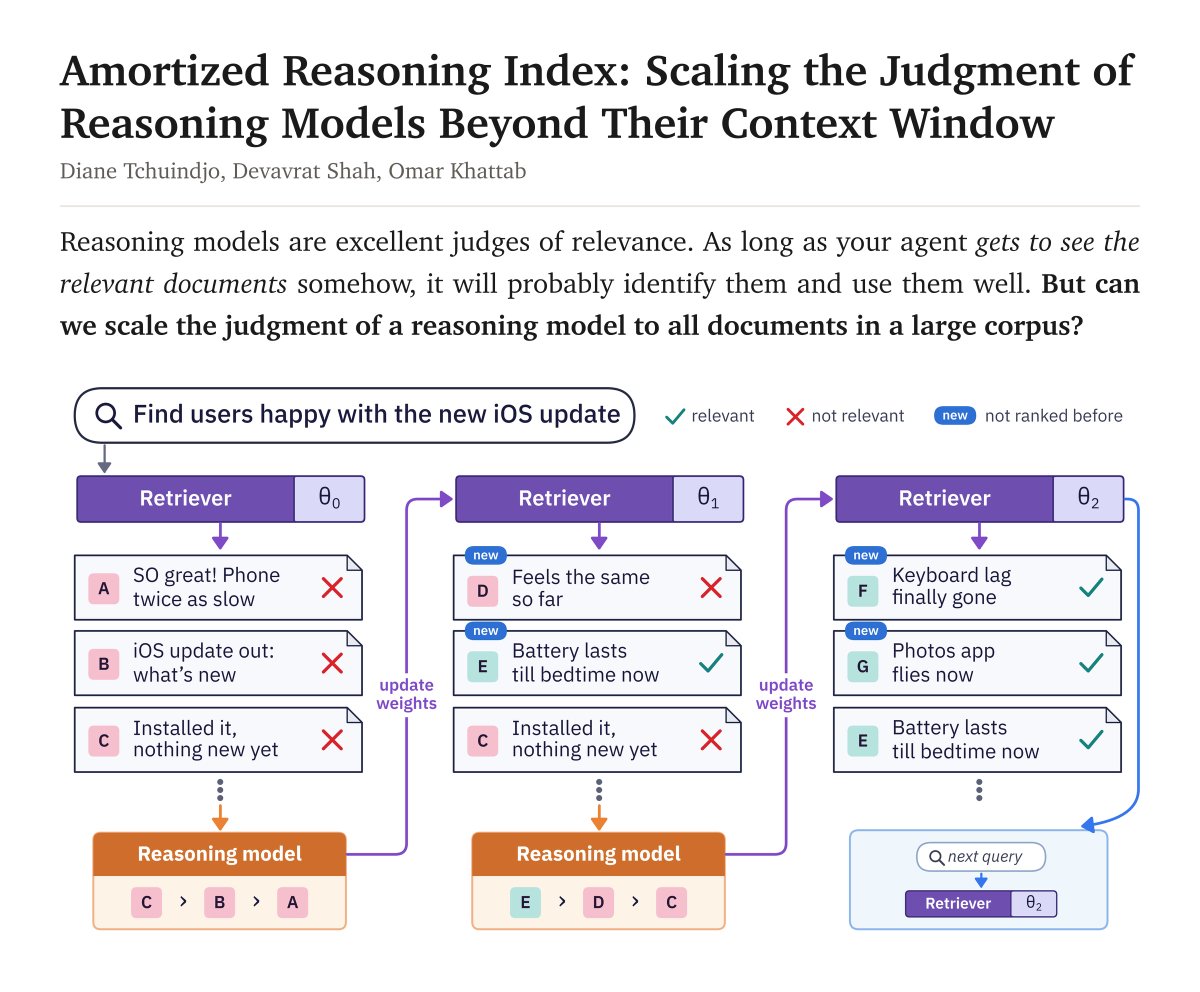
Is there a way to scale a reasoning model’s judgment for searching a massive corpus?
We introduce the Amortized Reasoning Index (ARI), a new kind of retriever that updates its weights during search, using gradients derived at inference time from the ranking preferences of a reasoning model.
Every session, current agents spend lots of reasoning deciding which search results matter, and then throw all of that judgment away upon compaction. ARI is our attempt to “amortize” that judgment, so that reasoning spent on past queries keeps improving search on future ones.
With no relevance labels, ARI takes a 400M cross-encoder that starts out weak and grows its Recall@100 on held-out queries by up to 7×, ending above Qwen3-Embedding-8B on various oblique/reasoning-intensive search tasks.
Read our blogpost: https://t.co/UEPpEpw22d
Preliminary results and discussions are below!
I wrote a short blog on my experience testing Jev on reasoning-intensive regression problems. The results are within expectations (Jev is focused on classification after all), but the model has great attributes and is wicked fast! Read about it here: https://t.co/058M7YnqCh
Last fall, I spent a while trying to get a better understanding of the information retrieval (IR) landscape. This mostly involved a lot of research conversations, some half-baked ideas, and, for a while, not much tangible research progress.
With OBLIQ-Bench being a few months old, I wanted to write a short blog post about what led to its creation, what it says, and what I think should come next!
check it out: https://t.co/QG9YqC34s7
my friends are getting articles accepted, book contract offers, incredible presentation and conference opportunities, writing for public as well as academic audiences, and no one is getting jobs. our whole generation is in premature mourning for our promised futures.
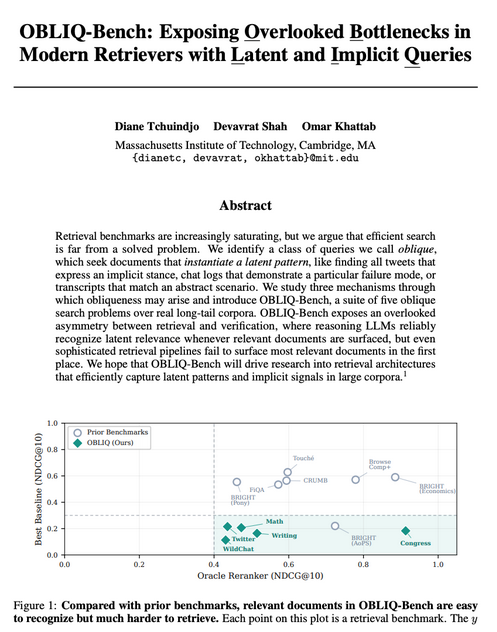
We set out to build a better retriever, so we looked for the hardest IR benchmarks.
For each, we asked how much headroom remained by running oracle reranking with a frontier LLM. Most had little room left!
So we built OBLIQ-Bench to study much harder search queries than before.
🚨Menacés par les rebelles du M23, les habitants la ville de #Bukavu au #SudKivu se sont mobilisés ce matin à la place de l’indépendance avec un seul message : "soutien aux FARDC, et NON ⛔️ au M23".
Retour en images sur leur mobilisation.⬇️
Plus d’infos sur notre sur notre chaine WhatsApp ➡️https://t.co/IcBXsT2XxL
The fact that this pandemic period has made the richest richer and the poorest poorer is evidence enough that the global market economy is made for the rich - only. We don’t need this. Global economies need to be fixed and restructured to serve all of us.
It's clear "learning to live with the virus" is the same paradigm thru which we will be conditioned to live with climate crisis—as the structural effects of capitalism are obscured by calls for individual resilience amidst a supposedly natural (and thus unresolvable) catastrophe
#RDC Pollution d'eau au Kasaï : une société angolaise reconnaît avoir répandu des déchets de la plus grande mine de diamants dans une rivière | par @OkendeChristian https://t.co/uW3g4V1N0X
Éruption volcanique à goma...façon on s'était mobiliser, multiples missions ....
Pollution de la rivière Kasaï.....oui , on y travaille....mais personne ne se bouscule pour y aller même pas nous les " journalistes "