I've made every hiring mistake you can imagine.
Here is what my first 10 hires taught me:
1) Your first hires join you, not your company. Sell conviction, not perks.
2)The best people are not applying anywhere. Outbound is the whole game.
3) A job description is a sales page, not a checklist.
4) Ask what they shipped alone, not where they worked.
5) Hire for rate of learning, not current skill.
6) You can decide in 3 days. Big companies take 3 weeks. Use it.
7) One reference question cuts through everything: “Would you have them as your cofounder if you were to start up?”
8) Never hire someone you cannot fire.
9) In India, an accepted offer means nothing yet. Up to a third never show up.
10) The 60 days before joining is where you lose people. Stay in touch every week.
11) Explain ESOPs like real money, because they are.
12) Your first engineer will shape the next ten hires, so take the time to get that hire right.
13) Title inflation is debt. Keep titles boring.
14) Fire fast, but be generous.
15) Hiring is the most personal thing you will do as a founder. The day it stops feeling heavy is the day you start making bad hires.
I got maybe five of these right the first time.
The rest ended up costing me a lot of time and money.
I've made every hiring mistake you can imagine.
Here is what my first 10 hires taught me:
1) Your first hires join you, not your company. Sell conviction, not perks.
2)The best people are not applying anywhere. Outbound is the whole game.
3) A job description is a sales page, not a checklist.
4) Ask what they shipped alone, not where they worked.
5) Hire for rate of learning, not current skill.
6) You can decide in 3 days. Big companies take 3 weeks. Use it.
7) One reference question cuts through everything: “Would you have them as your cofounder if you were to start up?”
8) Never hire someone you cannot fire.
9) In India, an accepted offer means nothing yet. Up to a third never show up.
10) The 60 days before joining is where you lose people. Stay in touch every week.
11) Explain ESOPs like real money, because they are.
12) Your first engineer will shape the next ten hires, so take the time to get that hire right.
13) Title inflation is debt. Keep titles boring.
14) Fire fast, but be generous.
15) Hiring is the most personal thing you will do as a founder. The day it stops feeling heavy is the day you start making bad hires.
I got maybe five of these right the first time.
The rest ended up costing me a lot of time and money.
One of my favourite parts of building @weekdayworks is getting to learn from the people who obsess over hiring.
Recently, I sat down with Adarsh PK, Head of Talent & People Ops at Enterpret, to talk about how he approaches talent, sourcing, and building high-density teams.
One idea from the conversation stuck with me.
The best recruiters don't start with job titles. They start with patterns.
Instead of searching for "Backend Engineer," they ask questions like:
Where do our best hires come from?
What backgrounds do they share?
What companies consistently produce strong talent?
What career trajectories tend to work here?
It's a subtle shift, but it changes how you think about hiring.
We also spoke about niche hiring, talent mapping, concentration risk, and how AI-native companies are creating entirely new talent pools.
A lot of practical insights packed into one conversation.
Thanks, Adarsh, for sharing your experiences and being generous with your learnings.
I just curated a list of 5 founders and founding engineers actively exploring new roles.
These are people who've built 0-1 and shipped real systems. The kind of profile that rarely shows up in an inbound pile.
1/ Co-founder & CTO @ lending infra startup. 2x founder CTO. Previously founder CTO of a YC-backed startup that got acquired.
11+ yrs experience
2/ Head of Engineering @ healthtech startup. Ex-founder of a YC-backed fintech startup. Built AI-native healthcare and fintech systems NIT grad.
10+ yrs experience
3/ Former founder and CEO who helped scale a consumer internet startup to millions of users and raised venture funding from top-tier investors. Multiple startup exits and operating experience.
8+ years of experience
4/ Founding Engineer @ AI accounting startup. Built the period close module that helped land a major enterprise client.
6+ yrs experience
5/ Founding Engineer @ SaaS startup. Ex-Sprinklr. Built distributed caching infra delivering 100x faster response times for high-load workflows.
3 yrs experience.
DM me if you want intros!
4/ Three more things stood out.
Founders: about 1 in 20 ex-Googlers is now a founder or a founding engineer. For the average engineer, it is about 1 in 50.
Money:
Ex-Googlers at big tech earn a median of 32 LPA today.
The ones at Indian startups are close behind at 29 LPA.
The ones at enterprise IT and banks earn 14 LPA, less than half the big tech number.
The takeaway: Most ex-Googlers are scattered across thousands of firms. If you want to hire them, waiting for applications will not work. You have to reach out.
The ex-Google talent map
1/ Where do engineers go after leaving @GoogleIndia?
We looked at 4,663 ex-Google engineering profiles on the Weekday platform.
Two numbers stood out. Where most of them land, and how many of them are found.
3/ Outside that top list, the exits scatter.
The 10 biggest destinations account for only about 9% of all leavers. The other 91% are spread across nearly 3,000 different companies.
There is no single pipeline out of Google.
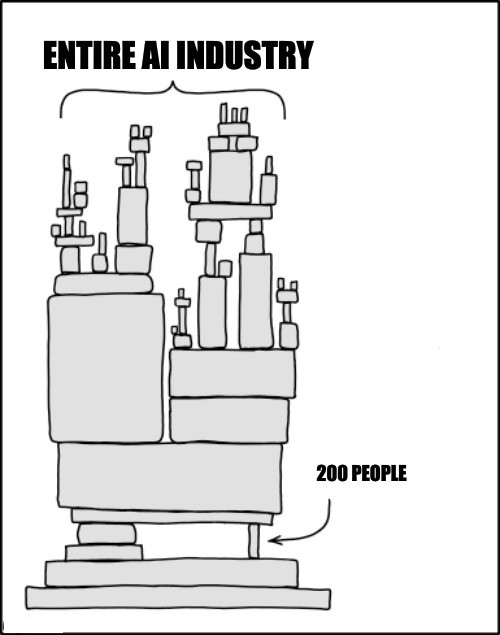
The entire AI talent war comes down to about 200 people.
~ @sama
Here's what the world's most powerful companies are paying to win them.
To poach one person:
• $100M: the signing bonuses Altman says Meta dangled at OpenAI researchers
• $200M: for a single Apple AI lead who left for Meta
To buy a whole team:
• $650M: Microsoft , to absorb Inflection's founders and staff
• $2.5B: the valuation Google paid Character AI's investors, to bring back @NoamShazeer and 30 researchers
• $14.3B: Meta's stake in Scale AI, largely to land one founder
To keep their own people:
• $1M - $5M: one time bonuses OpenAI handed its top researchers (≈1,000 staff in all)
A trillion dollar industry, fighting over a group small enough to fit in one lecture hall.
A tiny number of people create most of the value, and everyone knows exactly who they are.
6/
The bigger takeaway:
Amazon looks less like a startup feeder and more like a broader Big Tech talent hub.
A meaningful share of ex-Amazon talent moved to companies like Microsoft and Google, while the largest bucket was actually a highly fragmented long tail of 2,306 destinations.
Source - Weekday platform data.
THE EX-AMAZON TALENT SAGA
1/
Where do engineers go after leaving Amazon?
We analyzed 5,797 ex-Amazon engineering profiles from the Weekday platform dataset.
Most people assume ex-Amazon engineers primarily move to startups.
That was not the clearest pattern in the data.
5/
Compensation outcomes varied by destination.
At matched experience levels:
- Amazon → Big Tech: ~0-20% compensation increase
- Amazon → Indian unicorns: ~15-26% increase
- Amazon → Enterprise IT / banks: often ~30-66% lower
The “AI startup premium” narrative did not show up strongly in this dataset.
3/
The compensation gap also compressed over time.
0-2 years experience:
* IITs/BITS/NITs/IIITs → ₹18L median
* Everyone else → ₹12L median
12+ years experience:
* IITs/BITS/NITs/IIITs → ₹65L median
* Everyone else → ₹55L median
The market initially filters heavily for pedigree.
Over time, it starts filtering for leverage.
Source:
Weekday talent database - the entire Indian white-collar workforce btw ;)
1/
Most people think FAANG engineering teams are dominated by IITs, BITS, NITs, and IIITs.
That’s true at entry level.
Much less a few years later.
We analyzed 8,000+ FAANG engineering profiles on @weekdayworks
One pattern stood out immediately:
The share of engineers from top colleges drops significantly at senior levels.
2/
At 0-2 years experience:
48.4% came from IITs/BITS/NITs/IIITs
51.6% came from all other colleges
But by 12+ years experience:
28.5% came from IITs/BITS/NITs/IIITs
71.5% came from all other colleges
By senior levels, engineers from other colleges became the dominant majority inside FAANG.