You did not choose your country. You inherited it.
95 percent of humanity lives in a country that scores below 7 out of 10.
I scored 232 jurisdictions on the 18 dimensions that shape a life. Safety, rule of law, healthcare, taxation, mobility, cost of living.
Only 67 clear 7 out of 10. They hold 5 percent of the world's population.
Just 7 clear 7.5. Home to 0.2 percent.
The top of the table is mostly small jurisdictions. Islands, city states, places almost nobody is born into. The rest of us start in large countries that rank far lower, and simply stay.
Not by choice. By default.
The place that fits your priorities almost certainly exists. It is just unlikely to be the one you were assigned at birth.
Where you live is the highest leverage decision most people never make.
What is keeping you in your country right now?
Since 2020, EU law has required every member state to impose exit taxation when a corporate taxpayer moves assets or its tax residence out of that state's taxing jurisdiction.
The rare one is personal: of the 233 jurisdictions I track, 16 tax you, the individual, on gains you never sold, the day you walk out the door.
Entry rates get all the attention. Almost nobody prices the personal exit.
In each of the four below, the day you stop being tax resident, your covered assets are marked to market and the unrealised gain is taxed, with no actual sale. Germany, Canada and Australia deem a disposal. France taxes the latent gain directly. Nothing was sold, so nothing came in. The tax can still fall due, on a gain you never cashed.
Narrow, aimed at large holdings:
🇫🇷 France: the default 31.4 percent flat tax on latent gains. It catches residents of at least 6 of the last 10 years whose household directly or indirectly holds securities worth more than 800,000 euros, about 915,000 dollars, or rights representing at least 50 percent of a company's profits. Automatic deferral inside the EU, and the charge is wiped after 2 to 5 years if you keep the securities.
🇩🇪 Germany: for long-term residents, a direct or indirect holding of 1 percent or more in a company at any point in the last 5 years, taxed up to about 28.5 percent at the top rate before church tax. Since 2025, large fund and ETF holdings too, under separate fund-tax rules. Seven interest free instalments on request, generally against security, wherever you move.
Broad, aimed at your whole portfolio:
🇨🇦 Canada: most of your worldwide assets deemed sold at once, up to about 27 percent depending on the province. You can elect to defer until you sell or otherwise dispose of them.
🇦🇺 Australia: for non-temporary residents, most CGT assets outside taxable Australian property are deemed sold when residence ceases. Foreign shares, ETFs and crypto are generally caught. You can elect to disregard the gain, keeping the assets in Australia's tax net until a later CGT event or your return to Australian residence.
Some of these charges vanish entirely if you meet the conditions. Others defer collection, or keep the asset in the country's tax net until a later disposal. Either way, the move changes the timing, the paperwork and your liquidity exposure.
You have modelled the tax in the country you are moving to. Have you modelled the bill the one you are leaving sends on your way out?
Data from GeoCompass, the jurisdiction intelligence layer I build at Lucky Nomads.
🇺🇸 A US citizen shields 15 million dollars from federal estate tax.
A non-American who never lived in the US shields 60,000 dollars.
Above that line the same tax, climbing to 40 percent. Same Apple shares. A shield 250 times smaller.
This is US federal estate tax, and it turns on citizenship and domicile, not on how many days you spend there. A US citizen, or anyone domiciled in the US, is taxed on their worldwide estate with a 15 million dollar exemption in 2026. Someone who is neither is taxed only on US-situs assets, and the shelter collapses to 60,000 dollars. The first 60,000 are wiped by a credit. Above that the marginal rate opens at 26 percent and climbs to 40 once the taxable base tops 1 million dollars.
The trap is what counts as US-situs. US real estate, yes. But also stock of any US corporation, Apple, Nvidia, a direct position, even when it sits in a brokerage account in your own country. The situs follows the issuer, not where the shares are held.
A treaty can soften it, lifting the shelter or narrowing what is taxed. The US has estate tax treaties with only about 15 countries. 🇬🇧 UK, 🇫🇷 France, 🇩🇪 Germany and 🇯🇵 Japan are in. 🇨🇳 China, 🇮🇳 India, 🇧🇷 Brazil, 🇲🇽 Mexico and most of the world are not. No treaty, and you are back to the 60,000.
So it is not the US brokerage account that triggers this, it is holding US-situs assets directly. Shares in an 🇮🇪 Irish UCITS ETF, structured as an investment company or ICAV, are generally not US assets even when the fund holds only US stocks. Same S&P 500 exposure, a non-US wrapper, and the situs trap falls away. The custodian never mattered. The structure around the asset does.
The dividend withholding on US stocks gets priced to the basis point. The estate tax on the very same shares almost never gets a look.
Hold US stock directly, and you are neither a US citizen nor US-domiciled: do you know which side of 60,000 your heirs land on?
Data from GeoCompass, the jurisdiction intelligence layer I build at Lucky Nomads.
Net worth doesn't decide this, your birth passport does much more. A US or EU holder pays 200k+ for a Caribbean passport with less reach than what they own, no US access, Schengen they already had. But a Nigerian 🇳🇬 on 44 visa free countries buys Grenada 🇬🇩 and clears ~150 with Schengen and UK + the US E-2 route opens up. Might not be a bad move depending on the specific goals.
For a temporary residency, yes. The savings route sits around 73 to 74k in 2026, measured as a 12 month average balance, so 80k clears it. Permanent residency is a whole other tier, closer to 280-300k. And you file at a consulate abroad, not from inside Mexico 🇲🇽. So 80k gets you a renewable temporary card, not the permanent one.
🇫🇷 In France, if you die leaving three children, you can freely give away only one quarter of your own estate in full ownership.
The other three quarters are reserved for them by law.
This is forced heirship. The ratios are set by Article 913 of the Civil Code. One child and you control half. Two children, a third. Three or more, a quarter. Under French law, your will cannot set it aside.
It is not a French quirk. It runs through the civil law tradition. 🇮🇹 Italy, 🇵🇹 Portugal, 🇨🇭 Switzerland and, in its common regime, 🇪🇸 Spain all reserve a share for descendants. Across the Gulf, Muslim estates generally follow Sharia shares, with wills generally capped at a third, subject to local rules and heir consent.
A few systems keep no fixed reserved share for children at all. 🇬🇧 England and Wales, and 🇺🇸 the United States in every state but Louisiana. A will can leave a child nothing. In England and Wales a child can still ask a court for provision, but that is discretionary, not a share.
In participating EU states there is one lever. The EU Succession Regulation, for deaths on or after 17 August 2015, lets you elect the law of a nationality you hold, which can switch the reserve off.
It is not clean, and the rules keep moving. France built a claw-back on French assets in 2021, but in June 2026 the European Commission accepted Paris's reading that English family provision already counts as protection, so an English election should not trigger it. Germany went the other way, refusing chosen English law for a child's compulsory share in 2022 where the ties ran deep.
Moving can shift your tax exposure. Forced heirship is far stickier, and the escapes are partial and contested.
Everyone prices the rate. Almost nobody asks who holds the pen.
Before the tax, one question. Do you decide who inherits, or does the law. Tell me where I am wrong.
Data from GeoCompass, the jurisdiction intelligence layer I build at Lucky Nomads.
🇦🇪 The UAE has no personal income tax. Its 9 percent corporate tax still reaches freelancers.
Exceed AED 1 million of turnover from business conducted in the UAE, about 272,000 USD, and you are a taxable person. A relief you have to claim has been zeroing the bill. It runs out with tax periods ending after 31 December 2026.
In the pitches I read, one word does all the work. Zero. The rule is federal, and it is longer than one word.
The zero is real, and it is conditional. Salary is out of scope at any amount. Personal investment income is out, but only where the investment activity is conducted for your own account, is neither run through a licence nor legally required to be, and is not a commercial business. Real estate investment income on UAE property is out on the same licence test.
Business activity is the other side of it.
A natural person carrying on a business in the UAE falls inside the federal corporate tax once turnover from it exceeds AED 1 million in a calendar year. Turnover, not profit. Then 0 percent on the first AED 375,000 of taxable income, about 102,000 USD, and 9 percent above.
And the trigger is the activity, not the paperwork. The FTA guide works an example on a man restoring jewellery on a visit visa, AED 1.7 million of turnover. Taxable person.
The free zone does not rescue him either. A natural person cannot be a Free Zone Person. The 0 percent qualifying rate is built for juridical persons with substance, audited accounts and qualifying income. A freelance permit does not buy it.
Here is the piece that has been absorbing all of this.
Small Business Relief. An eligible resident person at or below AED 3 million of revenue, about 817,000 USD, in this period and in every prior one, who elects it on the return, is treated as having no taxable income. Ministerial Decision 73 of 2023. It only covers tax periods ending on or before 31 December 2026. No extension announced.
On the law as it stands, from 2027 a consultant whose UAE turnover clears the threshold pays 9 percent on taxable income above the first AED 375,000. On AED 1 million of taxable income, that is AED 56,250, near 15,300 USD or 13,400 EUR.
9 percent on the slice above AED 375,000 is not a heavy rate. That is not the point. The rate is what a jurisdiction advertises. The perimeter is what it charges you, and the relief covering the gap has an end date.
If your base was picked on the word zero, how many other zeros in your plan have a perimeter you never read? Tell me where I am wrong.
Data from GeoCompass, the jurisdiction intelligence layer I build at @LuckyNomadsIO.
The chart is right. Currency is the only place Argentina 🇦🇷 bottoms out. On that it sits with Venezuela 🇻🇪, Zimbabwe 🇿🇼 and Iran 🇮🇷.
The living side holds up. Healthcare is strong, quality of life is good, and living costs sit under Western Europe.
The peso is not the store of value there, and has not been for decades. Savings get dollarised. So it comes down to what currency you show up with.
Estonia 🇪🇪 and the Czech Republic 🇨🇿 come out on top of Europe in the dataset I track, ahead of Switzerland 🇨🇭, Germany 🇩🇪 and Denmark 🇩🇰. Not on every axis. They just deliver most of the same package, safety, healthcare, courts, banking, at a fraction of the cost. What you pay is grey skies and thin flight links. So it really depends whether you mean underrated to look at or underrated to live in.
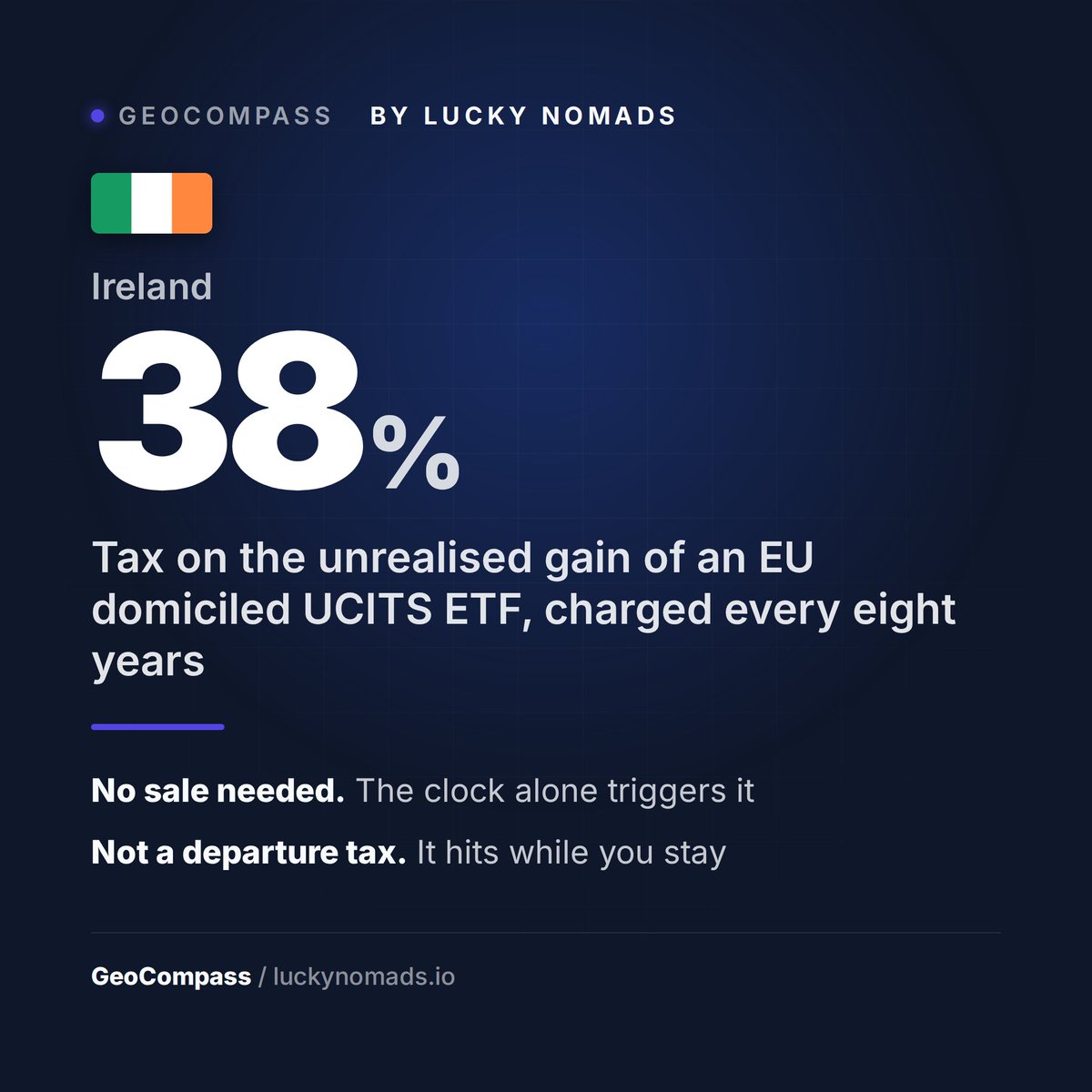
🇮🇪 Ireland taxes your EU domiciled UCITS ETF every eight years. You never sold it. Revenue does not care.
The paper gain is deemed realised, 38 percent of it due in cash, and a fresh eight year clock starts.
It ranks 8th of 233 on the index I maintain. Almost nobody prices it.
The trigger is Irish tax residence or ordinary residence, not a Dublin address. Arrive with a fund bought years ago and its purchase date, not your landing date, sets the clock.
Scope. Irish funds and equivalent offshore funds across the EU, EEA and OECD treaty states. A fund authorised as a UCITS counts as equivalent. The test is the fund status, not the ISIN prefix.
Since 2022 Revenue no longer confirms a US domiciled ETF sits outside. You test equivalence yourself. Bought on or after 1 January 2022, the clock runs from your purchase date. Bought before, under the old guidance, and found equivalent, it runs from 1 January 2022, first hit in 2030.
Direct shares: 33 percent CGT on disposal, EUR 1,270 annual exemption, allowable losses offset other capital gains, dividends taxed as income.
Funds: 38 percent, no exemption, no loss offset between funds, and a taxable event every eight years whether you sell or not.
An Irish fund whose units sit in a recognised clearing system deducts no exit tax, the normal setup for a listed ETF. An offshore fund never deducts it. Either way you self assess and you pay it yourself.
It is prepayment, not double taxation. Year eight is credited against the final bill, so the total should not exceed the tax on the real disposal. But the cash goes out early, and money that leaves the portfolio does not compound.
Budget 2026 cut the rate and left the clock. The reform roadmap, promised for early 2026, then summer, still has not landed.
The rate sets the size of the bill. The clock sets when you pay it, and early is where it quietly costs you.
If the roadmap kills the clock and leaves the 38 percent, does Ireland come back onto your list?
Data from GeoCompass, the jurisdiction intelligence layer I build at Lucky Nomads.
The data backs you harder than you think. The US 🇺🇸 GDP per capita is nearly double France 🇫🇷, roughly 89k against 49k, yet the French live about four years longer, 83 versus 79. On a blended index of the axes people actually live on, France ranks well above the United States. The one thing the US runs away with is economic scale, which is all that GDP line measures.
100% right. Every country here is great on one axis and near the floor on another. Argentina 🇦🇷 is the clean case, world class life, currency near the global bottom, the loop you described. Singapore 🇸🇬 is the opposite, near the top on banking, wealth protection, admin and tax at once, which is why it works. Best comes down to which tradeoff you can live with.
@SteveOnSpeed Public transport is a small one. The real gap is safety. The US 🇺🇸 murder rate runs several times that of Western Europe, and the pattern repeats on healthcare and rule of law. Denmark 🇩🇰 and Switzerland 🇨🇭 beat it on almost every daily-life measure.
🇨🇭 In Switzerland, qualifying foreign residents are not taxed on their actual worldwide income.
They pay on their spending instead, a base set with their canton within legal limits. The 2026 federal floor sits at a deemed CHF 435,000, about EUR 471,000 or USD 539,000.
It is called lump-sum taxation, the forfait fiscal. The base is your worldwide living expenditure, not your income, and it cannot fall below a legal minimum, the higher of the federal floor, seven times your Swiss rent, or a higher cantonal minimum. A separate control calculation then puts a floor under the tax itself, capturing your Swiss-source and treaty-relieved foreign income. It is taxed every year at ordinary federal, cantonal and communal rates.
The last consolidated federal figure is end 2018, 4,557 people paying CHF 821 million in tax, about EUR 890 million or USD 1.02 billion. No newer national total is published, the cantons hold the current numbers.
This is rare. Switzerland publishes no single national price for the regime.
🇮🇹 Italy now charges a fixed EUR 300,000 a year on foreign income. 🇬🇷 Greece, a fixed EUR 100,000. You know the number before you pack.
🇨🇭 Switzerland publishes no such number. You set the base with your canton, above the legal minimum, and it is assessed each year. One modeled Vaud case, on CHF 2 million of income and CHF 15 million of wealth, turns about CHF 950,000 of ordinary tax, near EUR 1.03 million or USD 1.18 million, into about CHF 240,000, near EUR 260,000 or USD 297,000. A private model, not an official rate.
The gates are hard. No Swiss citizenship, no Swiss tax residency in the prior ten years, no gainful activity in Switzerland, and both spouses must qualify.
And it is politically exposed. Five cantons have already abolished it, Zurich first from 2010 by popular vote. For the individual, though, there is no maximum duration, unlike the fifteen-year caps in Italy and Greece.
So the real question for a base is not the rate. It is the mechanism. A flat fee is one public number, fixed before you move. In Switzerland the rules and minima are public, but the final figure is set case by case, canton by canton.
For the place you actually anchor a family and a company, which is the more honest design, a fixed price on the door or a figure set behind your own file? Tell me where I am wrong.
Data from GeoCompass, the jurisdiction intelligence layer I build at Lucky Nomads.
Good governance and low tax almost never live in the same place. Of these twenty, only Singapore 🇸🇬 and the UAE 🇦🇪 pair elite institutions with genuinely light personal tax. The rest govern beautifully and tax hard. Denmark 🇩🇰 and Norway 🇳🇴 top the world on institutions and basically bottom out on what you keep. A well run state is often just one that is very good at taxing you.