1/
The whole league is shaking water right now. Paul Skenes. Logan Gilbert. Jacob Misiorowski. Aquabags sloshing back and forth before they throw.
We started doing this in 2012. Everyone thought we were nuts.
Here is why we shake water.
Some barrels from this year.
Still looking for 2 and 4 year opportunities.
1st team all conference
Gold glove at 2nd base
.418 conf BA
63 H
34 XBH (lead 3c2a)
66 RBI (lead 3c2a)
25 2B (lead 3c2a)
@AbqBaseballAcad
St. Michael’s beat Ruidoso 7-6 on Friday in the Semifinals of the Class 3A 2026 Nusenda Credit Union State Baseball Championships. The Horsemen advance to Saturday’s final. Here are some of the highlights, including a go-ahead grand slam! (courtesy NFHS network)
St. Michael's beat Cobre 10-0 on Thursday in the Quarterfinals of the 2026 Nusenda Credit Union State Baseball Championships. The Horsemen put up 7 runs in the 1st inning. Here are some of the highlights. @nusendacu
D1 Softball Fun Fact:
From the 1,784 HRs I have in my trackman database:
85% had EV ≥ 70
34% had EV ≥ 75.
71% landed in LA 20°–35°.
There were 5 HR 84.7 EV+ with the hardest at 86.4 EV
There were 5 HR above 295 feet with the farthest being 304 feet (83.7 EV) T
The cheapest HR was 63.4 EV that went 197 feet at 44.7 LA; the median HR was 73.5 EV / 30.9° LA.
Jonathan Broxton had the highest average fastball velocity in 2007, at 97.6 MPH. Then the measurement changed in 2008, and his average fastball velo went all the way up to ... 97.6 MPH, and 98.4 MPH the following year.
This is the most common logical fallacy in baseball and it is worth unpacking.
"Better mechanics" means optimized hip-shoulder separation, efficient trunk rotation, and maximized distal segment velocity. That mechanical efficiency more often than not drives a ball velocity increase, which is a strong driver of valgus torque at the elbow. The relationship is not perfectly linear but the correlation is strong enough that meaningfully improving mechanical efficiency without also gaining velocity, and thus likely increasing torque at the UCL, is the exception not the rule.
This kid is 16 throwing 101. You do not do that with bad mechanics. He is already operating in the top 0.01% of mechanical efficiency on the planet. And that exposes the second problem with this argument: nobody has ever agreed on or clearly defined what "good mechanics" actually are. His arm action is not bad. It is an arm action that someone has subjectively decided they do not like. That is not a clinical finding. That is a preference. Aesthetics and mechanical efficiency are not the same thing, and conflating the two is exactly how bad advice gets handed to talented kids.
What actually determines injury:
Stress Applied > Tissue Capacity = Injury
That is the whole equation. The FDS, FCU, and FDP are the primary dynamic stabilizers SHARING load with the UCL, with the pronator teres and other accessory stabilizers contributing as well. When those MTUs are fatigued or underconditioned, the UCL absorbs more of the load. Not because of arm action. Because of physical capacities and workload.
Now, can specific mechanical faults create abnormal stress concentration at specific tissues? Yes, and that is worth acknowledging. Early trunk rotation, excessive elbow drop, or a broken kinetic chain can create localized shear and impingement at specific anatomical locations. Fix the fault, remove that concentrated stressor, and symptoms resolve. That mechanism is real and clinically meaningful. But it is a localized tissue irritation problem, not a global valgus torque problem. Those are two completely different injury mechanisms and conflating them is where the argument breaks down. Valgus torque at the UCL scales with velocity. It does not care how pretty the arm action looks.
And unless you have a report that this kid is in significant pain, what you are actually watching is a 16 year old whose tissues are handling the load just fine. If there is a mechanical fault present and he is symptomatic, that is a tissue irritation conversation. If he is asymptomatic, there is no conversation to be had about mechanics and injury risk at all. The actual risk is that he throws 101. The only ways to reduce that risk are throwing slower or building enough tissue capacity to absorb what 101 demands over hundreds and thousands of pitches a year, and managing tissue fatigue so he is as fresh as possible when the time comes to throw that hard. That is it. There is no third option hiding inside his arm action.
A pitcher with textbook mechanics but fatigued, compliant, underprepared tendons is at higher risk than a pitcher with ugly arm action whose flexor-pronator mass is conditioned, recovered, and easily absorbing load tit is being subjected to. Better mechanics can just mean greater torque delivered to tissue that may not be ready to handle it.
The intervention is building tissue capacity and managing workload. Not chasing a kinematic ideal that, if actually achieved, can make the physics worse.
You either have the capacity to absorb the stress your velocity generates, or you don't.
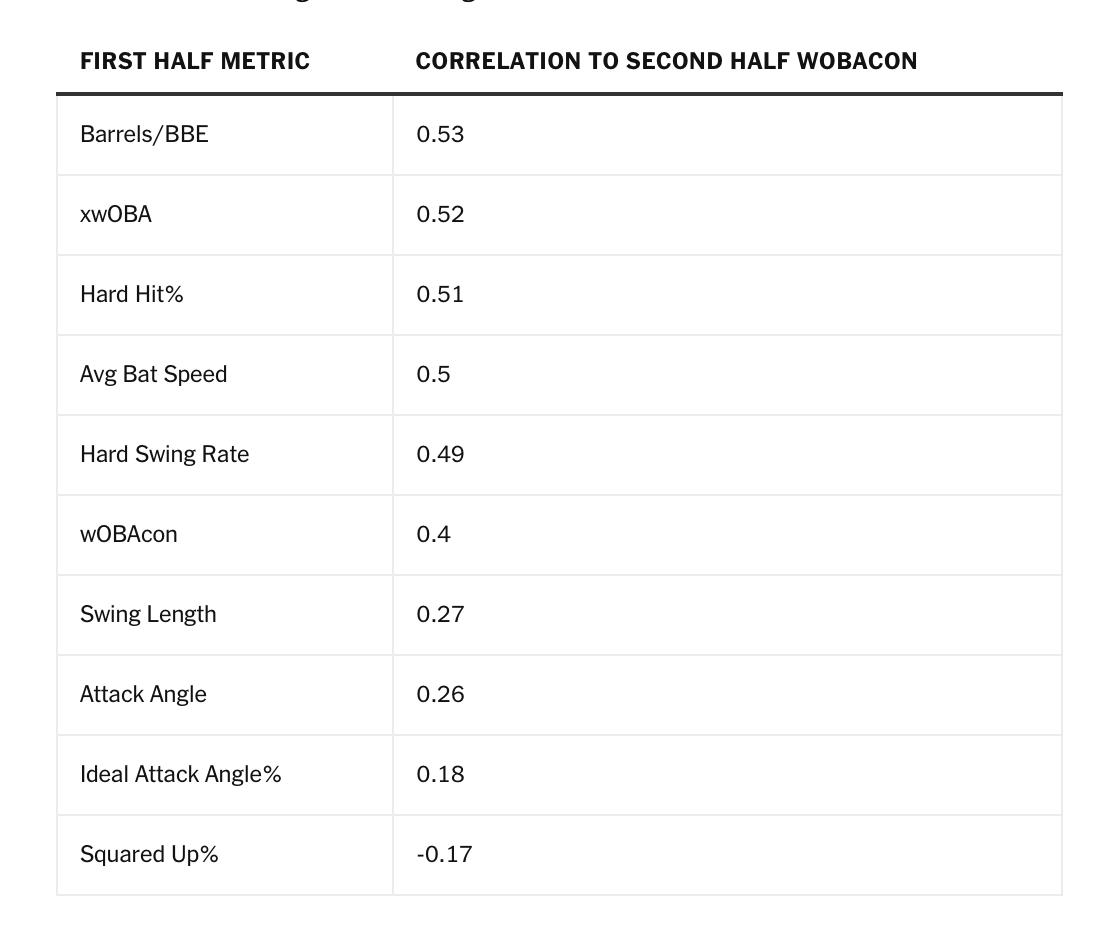
Elite bat speed means elite margin for error.
Early in the 2026 college baseball season, it’s clear the highest-quality balls in play are coming off the fastest swings.
⚡️
@TewksHitting “Mechanics” can be addressed later (HS or so) if needed. Usually kids that move fast and athletic when they’re young have pretty good “mechanics” later on.
@TewksHitting 100% the only thing that matters in youth sports is: Fun + Developing skills that scale (starting with first principles). If they are engaged while exploring the movements the game requires, they will stick around long enough to develop better solutions.