Finance, business & investment news, ideas & opinions - all related to what I'm personally buying & selling! A proud Brit & Singapore PR #QualityInvesting
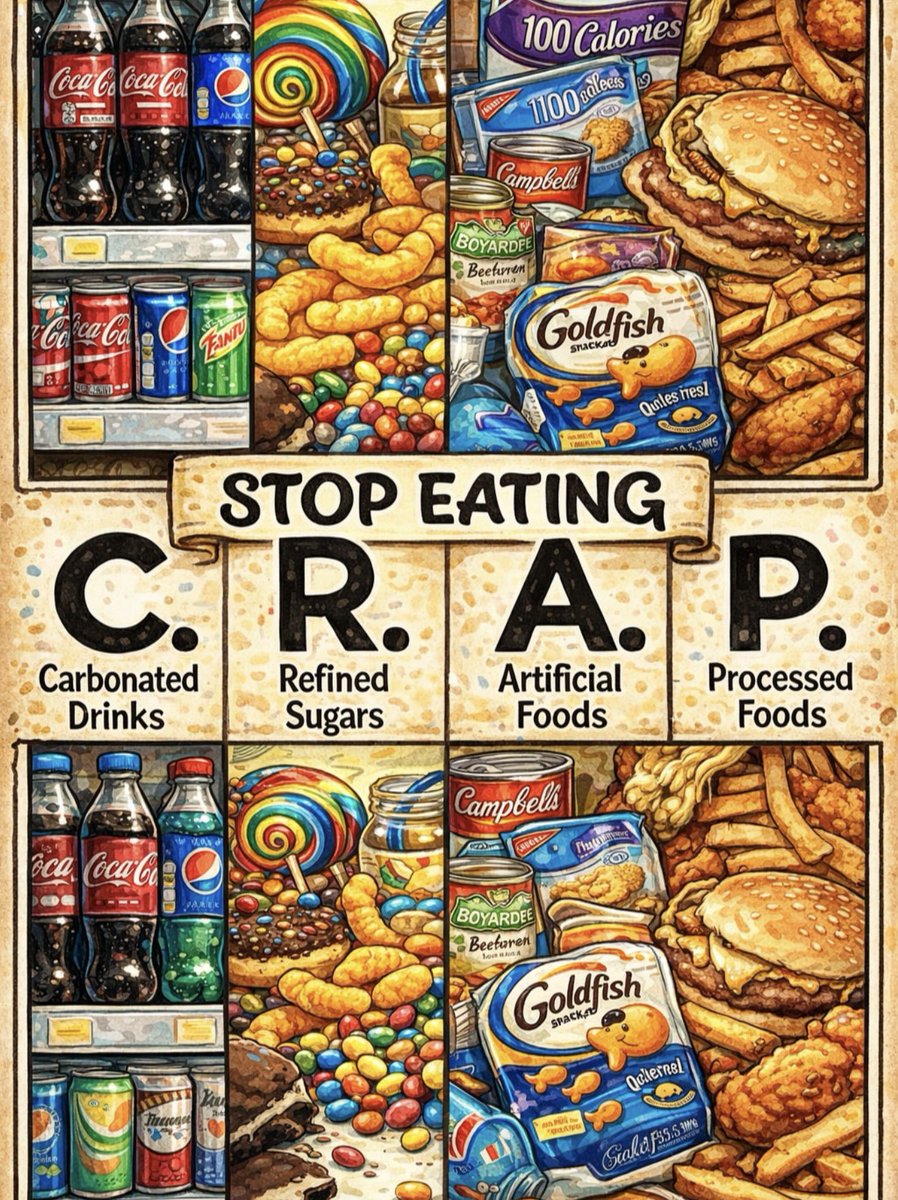
@dividendhike There is a health movement going on. People who want to live longer are giving up on fast food. It’s called MAHA. Make America Healthy Again.
Hold a stock long enough and the business's return on capital becomes your return.
Munger:
"Over the long term, it's hard for a stock to earn a much better return than the business which underlies it earns. If the business earns six percent on capital over forty years and you hold it for that forty years, you're not going to make much different than a six percent return—even if you originally buy it at a huge discount. Conversely, if a business earns eighteen percent on capital over twenty or thirty years, even if you pay an expensive looking price, you'll end up with one hell of a result."
This chart explains investor behavior perfectly.
- After strong returns, investors pour money into stocks near the top.
- After major declines, they pull money out near the bottom.
In 2008, investors fled after a 37% loss, then missed a 31.1% rebound in 2009.
I don't invest more than 3% of my portfolio in any stock, no matter my conviction.
However, I let my winners run.
Slowly, my portfolio concentrates itself.
This strategy works best for me.
The Best Investment Strategy in the World
There are a hundred ways to make money in the stock market. You can diversify, concentrate, buy and hold, day trade, trade options, buy junk bonds, follow momentum or search for tiny companies nobody has heard of. People have become extraordinarily rich doing almost all of them, so what exactly is the best way to invest?
I don’t think there is a best investment strategy. There is only a best investment strategy for each person. What works brilliantly for one investor could be a disaster for another.
Investing cannot be separated from the person doing the investing. Your age, wealth, income, family, goals, knowledge, temperament and the way you react to losing money should influence how you invest. A 28 year old with $50,000 is playing a completely different game from a 68 year old with $10 million, yet we talk about the “best strategy” as though the person executing it barely matters.
This is why I think Wall Street’s definition of risk is incomplete. We measure volatility and drawdowns, but what about the probability that you panic, become bored or abandon a perfectly good strategy after three terrible years? Some of the greatest risks in investing exist inside the investor, not the investment.
Envy may be one of the biggest. The market gives us a daily scoreboard of everything we should have owned instead, and somewhere someone will always be getting richer faster than you. If you compound at 15% while somebody on X makes 80% trading options, it becomes surprisingly easy to feel unsuccessful while doing something objectively extraordinary.
That is how investors get pulled into games they were never supposed to play. A long term investor becomes a trader, a conservative investor starts speculating and someone who spent twenty years studying businesses suddenly decides they need to trade options. Their abilities didn’t change. They simply became distracted by somebody else’s success.
One of the great breakthroughs in investing happens when you stop asking what everyone else is doing and decide what game you are actually playing. You don’t need to master every corner of the market or participate in every opportunity. Find an approach that matches who you are and become exceptionally good at it.
This is where the circle of competence becomes much more interesting. It isn’t only knowing what you understand. It is also knowing what you can safely ignore.
If your goal is to own $MELI for the next decade because you believe MercadoLibre can become dramatically larger, does it really matter what $NVDA reports tonight? Do you need an opinion about $CRWD, Bitcoin, oil and the next Fed meeting? Unless those things change your thesis, much of it is probably noise disguised as knowledge.
We have access to more financial information than any generation of investors in history, yet that doesn’t necessarily make us better investors. Information tells you what happened, knowledge helps you understand why it happened, and wisdom tells you whether you need to do anything about it. I think the last part is where much of the money is made.
This is also why copying great investors is so difficult. You can copy someone’s portfolio in five minutes, but you cannot copy the twenty years of experience that produced it. You don’t inherit their temperament, pattern recognition, financial circumstances or ability to sit through a 50% decline.
Eventually investing becomes a very personal exercise. In the beginning you study stocks, accounting, valuation, business models and famous investors. If you are paying attention, eventually you begin studying yourself.
🌹
Most people don't realize what just happened.
Nvidia just posted what we believe are the most impressive earnings in history, with market-wide implications.
This implies $670+ BILLION in revenue next year, up +2,390% from FY2023.
What's happening? Let us explain.
(a thread)
BREAKING: Jensen Huang just said Nvidia expects to grow revenue roughly 70% in fiscal 2028.
A company this size growing 70% means the entire supply chain behind it has to grow with it. Here are 10 companies that get paid when Nvidia delivers:
1. $TSM - Taiwan Semiconductor
Every Nvidia chip physically comes out of TSMC's fabs. There is no 70% growth without them printing it first. Record quarterly profit, sales up 45% in July alone, and that was all before this forecast existed. Jensen's guidance is effectively a multiyear production order for TSMC.
SPYI delivers ~12% monthly distributions (~$4k on $400k) via S&P 500 stocks plus call option premiums, often partly return of capital. VOO yields ~1.04% true dividends (~$347/mo) with full upside.
SPYI lags total returns (caps gains, 0.68% fee vs VOO’s 0.03%) and depends on volatility. VOO compounds better long-term.
SPYI suits pure income needs; VOO wins for growth. Not a no-brainer—depends on goals. Not advice.
Risk management 101—every exposure should have a limit, even when you’re sure nothing could go wrong. After all, the Titanic sank and AAA mortgage bonds went to zero. I worry about the market’s (and the economy’s) unlimited appetite for exposure to the positive AI revenue story.
After being in hundreds of board meetings, I've learned:
World-class board members are worth their weight in gold.
Here's how the greatest board members set themselves apart.
🧵
Why are so many people obsessing over Nike’s $NKE technical chart?
All I keep hearing is:
“If $NKE doesn’t hold support at $39, it breaks down to $28.”
Maybe it does and Maybe it doesn’t.
Technical analysis can help with timing, but stop treating the chart as if it is the company!
At $39, you are buying a piece of a business that is generating $46 billion of revenue a year along with a 4.2% dividend!
You are also buying one of the most recognizable brands in the world.
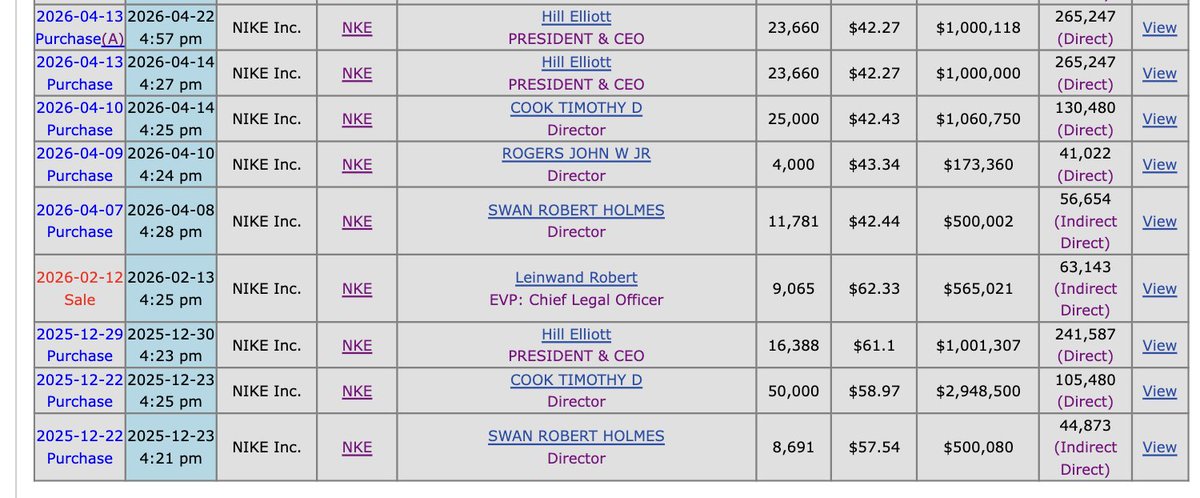
And the whole leadership team have have been buying heavily:
- CEO Elliott Hill bought approximately $1 million of Nike shares at around $42.27
- Nike director Tim Cook (yes the Apple CEO) bought approximately $1.06 million at $42.43
- Director Robert Swan bought approximately $500,000
- Director John Rogers Jr. bought approximately $173,000
That is roughly $2.7 million of open-market insider buying in one week. Add the purchases made by Hill, Cook and Swan in late December, and their combined buying since then exceeds $7 million. Insider buying does not guarantee a turnaround, but it is a meaningful vote of confidence - especially when insiders were buying above today’s price.
Nike has challenges, the turnaround may take time.
But when you think of Nike, what do you think of? I think of greatness:
Michael Jordan, Tiger Woods. Iconic athletes, iconic products and decades of cultural relevance.
That doesn't dissapear overnight!
Great brands do not disappear because a technical chart looks weak!
I believe Nike will bounce back.
While others focus entirely on support levels and the next short-term move, I am focused on the business I am becoming a part-owner of.
Charts measure short-term sentiment, but seeing yourself as an owner will capture long-term value.
At today’s price, I believe Nike is a gift.
I bought - and I will continue to accumulate.
Be an investor not a speculator!
I just doubled my @Shade_Protocol
holdings
I swapped all of my shit cosmos tokens into $SHD and burned them to earn more @Featherlend ... you should too
- betting on a cracked team's 2nd attempt
- genuine / honest core team
- in a large eco this time, Morpho
- focused on revenue with Feather
The @Shade_Protocol token burn deadline has been extended to Aug 21st
Yes, this is risky but you've got to risk it, to get the biscuit
My favorite Buffett stat is that Berkshire stock could drop 99% and he still would have outperformed the S&P 500 since he took over.
Enjoy retirement.
The older I get, the more I realize what “rich” actually means.
It’s not the Lamborghini.
It’s:
• Living 10 min drive from work
• Having quiet, and even friendly neighbours
• Being 5 minutes from the gym
• Having money left over to invest every month and knowing how to manage it
• Peace in your own home
• A slow morning
• Drinking your coffee without rushing
• Sleeping with a clear conscience
• Laughing with people who genuinely get you
• Traveling every year
• Waking up naturally without an alarm
• Eating a home-cooked meal with people you love
• Having time to read a book just because you want to
• Enjoying the little routines you used to take for granted
• Coming home to a pet that’s genuinely excited to see you
The older I get, the less I care about looking rich.
I care about having a life that feels rich.