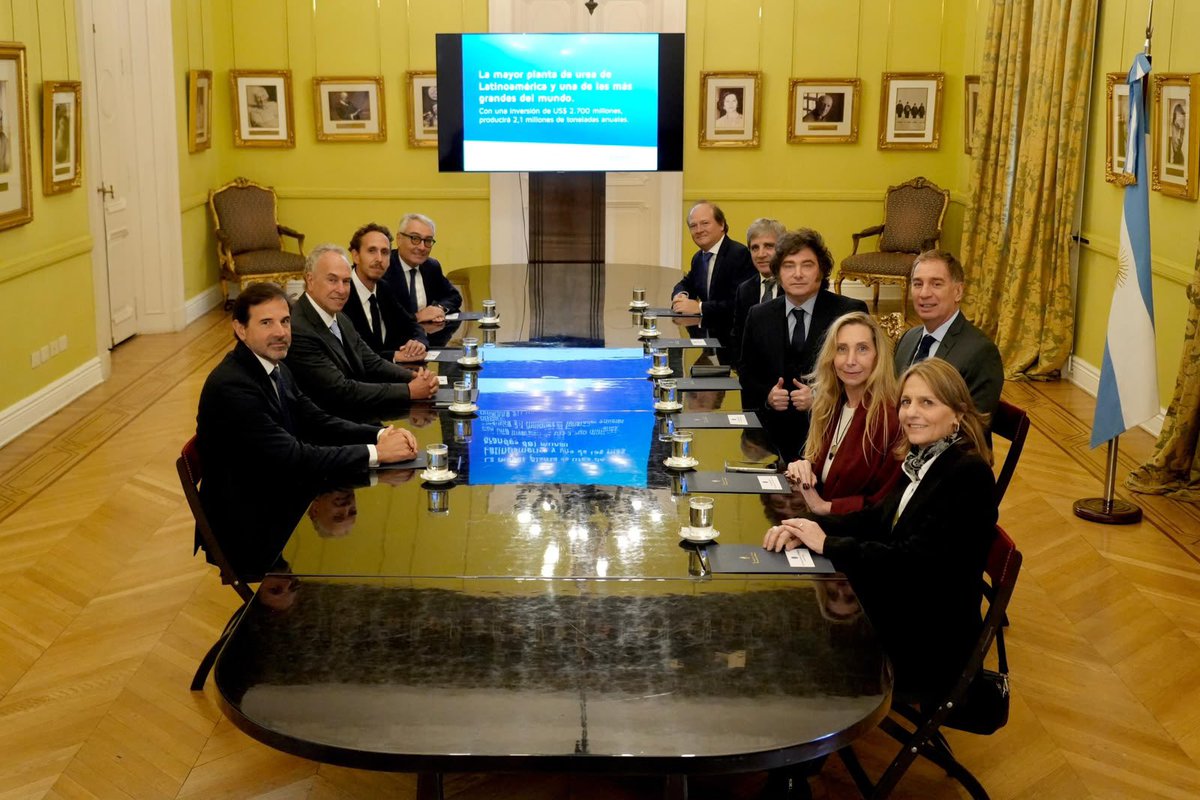
Hoy presentamos ante el Presidente y autoridades del Gobierno Nacional una inversión de Pampa por USD 2.700 millones para construir la planta de urea más grande de Latinoamérica.
Transformando gas de Vaca Muerta en urea, el proyecto generará miles de puestos de trabajo y alrededor de USD 1.000 millones adicionales por año en exportaciones y sustitución de importaciones para Argentina.
Inversiones de esta magnitud son posibles cuando existen marcos previsibles, como el que da el RIGI, y acceso a financiamiento de largo plazo a tasas razonables.
Sin financiamiento, muchos proyectos no serían viables. Por eso un riesgo país más bajo y un mercado de capitales profundo no le importa solo a “la timba”, son herramientas fundamentales para el desarrollo del país.
Si Argentina sostiene este rumbo, anuncios así van a dejar de ser noticia para convertirse en algo cotidiano. El potencial de Argentina es infinito!
Cómo le cuesta a esta generación entender que DESEAR algo no es justificación suficiente
El deseo no es un mandato moral. Puede ser bueno o puede ser malo según se acomode a tus metas de vida
Tu trabajo es encauzar, educar y ordenar tus pasiones. Porque es lo que te hace humano
De lo contrario, sos un animalito. Y no vas a conseguir ninguna meta digna en tu vida
Porque toda meta requiere sacrificar algún deseo presente y pasajero por un futuro bien más noble
Pero bueno, hagan lo que quieran. A los 35 años van a preguntarse dónde fallaron y por qué no tienen vínculos estables y quizás se acuerden de este concepto
Yes, the United States has the most progressive tax system in the world. The top 1% pay 40% of taxes, the bottom 50% pay 3% of taxes. We can make it even more progressive by zeroing out taxes on the bottom half. It’s a small amount of the total tax revenue but very meaningful to people in this group.
We see our home planet as a whole, lit up in spectacular blues and browns. A green aurora even lights up the atmosphere. That's us, together, watching as our astronauts make their journey to the Moon.
Mercado en julio del 2025: La IA es una realidad y hará que las empresas de software ganen mucho más de lo esperado.
Mercado en febrero del 2026: La IA es una realidad y hará que las empresas de software pierdan mucho más de lo esperado.
No AI will not kill Capitalism.
The market is selling off because AI will Kill capitalism. You can’t make this stuff up.
The claim that AI marks the terminal crisis of capitalism sounds less like economic analysis and more like a revival of Marx’s old prophecy — that capital would eventually automate away its own labor base. But history has consistently humbled that idea.
Capitalism is not a fixed system dependent on human inputs at one stage of production; it is an adaptive architecture of incentives that constantly redefines what constitutes value, work, and ownership. The spinning jenny didn’t collapse feudal mercantilism because it displaced artisans — it birthed industrial capitalism by shifting where value creation occurred. Likewise, AI-induced displacement is not the endpoint of labor’s role in the economy, but the transition to new modes of resource allocation: creativity, judgment, taste, governance, and capital stewardship.
What AI automates are routine cognitive tasks, not the social processes of coordination, aspiration, and meaning that markets ultimately monetize. The idea that capitalism cannot survive without employment misunderstands capitalism’s engine: it is not “jobs” that power the system, but exchange, of ideas, capital, data, and experience. As the cost of intelligence falls toward zero, capitalism will not die; it will mutate toward higher-order scarcity, attention, authenticity, and trust.
Marx predicted the end of capitalism when labor lost its bargaining power. What actually happens is that capitalism internalizes the new technology, re-prices the factors of production, and rebuilds itself around the next frontier of value. AI may destroy the old middle class, but it will not end capitalism. It will end this phase of capitalism and give birth to the next.
One of the often slept-upon benefits of attending the University of Chicago is that they make you read Marx as part of the core curriculum, which is why this article gave me flashbacks of taking SOSC 114 as a freshman.
Marx, writing during the Industrial Revolution, predicted capitalism would periodically devour itself: firms replace labor with machinery to boost profits, but competition diffuses the technology, drives prices to marginal cost, and the gains get competed away. Meanwhile, displaced workers lose purchasing power, hollowing out the demand the whole system depends on. Production rises but no one can afford to buy what's produced - the contradiction between production and realization.
Citrini's piece describes this exact dynamic, then declares there's "no natural brake." It's the most Marxist piece of financial analysis written in years, and makes the same errors Marx did.
Schumpeter offered the obvious rebuttal 80 years ago: creative destruction doesn't just destroy, it creates industries we can't yet conceive of. Everyone in the replies is already making this point, and I think they're right.
But the sharper rebuttal is Hayek's: prices are the brake Citrini says doesn't exist. Who funds $200bn / qtr in AI capex when equities are down 38%, private credit marks are in the 50s, and consumer demand has collapsed? Cost of capital rises. Incremental build-out becomes uneconomical. Capital gets destroyed and reallocated.
Citrini also unknowingly describes Marx's proletarianization of the petite bourgeoisie: the $180k PM driving Uber is textbook. But the article claims this collapses consumer demand, and that's where it breaks.
The top decile drives 50%+ of spending and their wealth is in equities, not W-2 income; they're long the hyperscalers posting records in Citrini's own model. Blue collar is insulated because AI replaces cognitive labor, not physical.
The professional middle class gets crushed, but aggregate demand doesn't.
The spending class IS the capital-owning class. The K-shaped recovery they fear actually stabilizes the demand base they say is collapsing. In the stable aggregate demand, the petit bourgeoisie finds ways to reinvent itself.
I think the Citrini piece is excellent and worth reading. But history has repeatedly shown that periods of transformative productivity gains ultimately accrue to the consumer through lower prices, more leisure, and higher quality of life. Marx's error wasn't diagnosing the disruption, it was underestimating the system's ability to adapt.
JUNE 2028.
The S&P is down 38% from its highs. Unemployment just printed 10.2%. Private credit is unraveling. Prime mortgages are cracking. AI didn’t disappoint. It exceeded every expectation.
What happened?
https://t.co/JzzwCrbJgS
Jeff Bezos just explained the “AI bubble” better than anyone.
At Italian Tech Week 2025, Bezos didn’t deny the hype, he embraced it.
“Yes, there’s a bubble. But AI is real and it’s going to transform every single industry.”
He called it an industrial bubble, not a financial one.
That’s a crucial difference:
•A financial bubble (like 2008) destroys value and leaves nothing behind.
•An industrial bubble (like AI, the internet, or fiber optics) creates massive value, even if investors get crushed.
“Even when those companies went bankrupt, the fiber stayed in the ground. Society got the infrastructure. That’s what we’ll see with AI.”
Bezos says right now we’re in the “chaotic, beautiful” phase of overfunding, where every wild idea gets money.
Investors can’t tell the good ideas from the bad ones.
But that’s exactly how big shifts happen.
He compared it to Amazon’s early days:
“Our stock went from $113 to $6, while every internal metric improved. The market and the reality had completely diverged.”
His point: bubbles distort prices, not progress.
AI valuations might crash, but the technology won’t.
“This is not a mirage. This is a horizontal technology, like electricity and it will touch everything.”
Bezos isn’t predicting an apocalypse.
He’s predicting a reset, where the hype burns off, and the real builders remain.
AI isn’t a bubble, it’s a boom disguised as one.
if i were like, a sports star or an artist or something, and just really cared about doing a great job at my thing, and was up at 5 am practicing free throws or whatever, that would seem pretty normal right?
the first part of openai was unbelievably fun; we did what i believe is the most important scientific work of this generation or possibly a much greater time period than that.
this current part is less fun but still rewarding. it is extremely painful as you say and often tempting to nope out on any given day, but the chance to really "make a dent in the universe" is more than worth it; most people don't get that chance to such an extent, and i am very grateful. i genuinely believe the work we are doing will be a transformatively positive thing, and if we didn't exist, the world would have gone in a slightly different and probably worse direction.
(working hard was always an extremely easy trade until i had a kid, and now an extremely hard trade.)
i do wish i had taken equity a long time ago and i think it would have led to far fewer conspiracy theories; people seem very able to understand "ok that dude is doing it because he wants more money" but less so "he just thinks technology is cool and he likes having some ability to influence the evolution of technology and society". it was a crazy tone-deaf thing to try to make the point "i already have enough money".
i believe that AGI will be the most important technology humanity has yet built, i am very grateful to get to play an important role in that and work with such great colleagues, and i like having an interesting life.