Having access to a supercomputer is the best chance many Thais will ever have to improve their life.
But poor awareness of what the modern AI toolkit can do leaves much of our potential wasted.
Digital literacy in Thailand is too often defined by cash-generating, meaningless indicators like hours online and media consumption.
Unless Thai and Asian celebrities promote AI use in a way that uplifts rather than stupefies, we will suffer all the downstream costs and reap none of the benefits.
@dieworkwear I don't suppose you could recommend a good tailor in Bangkok?
Heat in SEA is so oppressive it requires an entirely different approach to dressing.
@CJHandmer@ziggyfro +1 on Arabian Sands. Thesiger's writing has a delightful magic to it that makes his explorations of the desert come alive around you.
@gorya_ilada Many middle powers are so riddled with clientelism that parochial commercial interests often override strategic, national considerations.
So state capacity to project force outside its own borders irreparably degrades over time.
@apinions_ Sadly, encouraging informal-sector work is also a way to dodge structural reform.
It lowers pressure on govt to scrap questionable business licensing that protects big incumbents, but makes the Thai economy less competitive by throttling upstarts that could create jobs.
@RaminNasibov Bangkok's full name is "Krungthepmahanakhon Amonrattanakosin Mahintharayutthaya Mahadilokphop Noppharatratchathaniburirom Udomratchaniwetmahasathan Amonphimanawatansathit Sakkathattiyawitsanukamprasit."
Hi! Always appreciate a well-thought-out response. Definitely dont always get one. 😀
Yes 2021 is a poor base year and the current electronics weight almost certainly understates the 2026 footprint. Very fair point.
My understanding is MPI is a production-volume index. Value added enters through the weights, not through a monthly output-minus-input calc. So a new factory coming online should lift MPI as production is recorded not depress it through an input-purchase lag.
Same deal with solar. A factory’s power source does not mechanically enter manufacturing-output measurement. The stale weights/product basket are the real issue, not the measurement dynamics.
I think the electricity number is a useful sanity check. Electronics-sector electricity use was up ~17% Jan-Feb, while electronics exports were up ~57% in USD terms. That does not prove physical output is weak but it is consistent with export value rising much faster than physical activity because of price/mix effects, inventory drawdown, and front-loaded shipments.
If you mark MPI up for stale weights, the electronics picture definitely looks better than 0.8% suggests. But the broader picture still does not look like a mfg revival: electrical-appliance output was down 5% in Q1 even as appliance export value rose nearly 20%, imports were up 32% in Q1, the goods deficit was $9.5B, and BOT’s latest published 2026 GDP forecast is 1.5%.
So yes, MPI has flaws. My point was that these headline indicators often get thrown out without context. Export value is up but domestic mfg output is not showing the same broad-based rebound.
Cheers! 😀❤️🇹🇭
Actual data doesn’t show a Thai mfg revival, but heavy AI/datacenter demand for hardware, primarily in US.
The number to watch is the Manufacturing Production Index: a monthly value-added-weighted gauge of 🇹🇭 mfg output across 75 sectors.
Electronics exports up 57% in US$ terms, but MPI up just 0.8% YoY and the seasonally adjusted index is still below the 2024 average.
Electrical-appliance output also fell 5% even as appliance exports rose ~20%.
That points to some mix of inventory drawdown, price/mix effects, and shipping while the US tariff easing holds.
Imports also rose 32% in Q1, leaving goods trade $9.5B in deficit.
Thailand’s economy expanded 2.8% in the first quarter of 2026, up from 2.5% growth in the previous quarter, the National Economic and Social Development Council (NESDC) announced on Monday.
The growth was supported by a 12.6% rise in exports and a 9.9% increase in total investment, marking the strongest investment growth in 44 quarters.
Despite the stronger first-quarter performance, the NESDC maintained its full-year GDP growth forecast for 2026 at 1.5% to 2.5%, with a midpoint estimate of 2%.
#Thailand #ThaiEconomy #เศรษฐกิจ #เศรษฐกิจไทย
Good observation. Troubling answers.
Cutting headline rent in 🇹🇭 often affects how the building is valued on the balance sheet. That often triggers bank loan covenants and reappraisals.
(Some commercial landlords do offer unpublished discounts and concessions).
The stranger phenomenon is Bangkok’s relentless construction despite high commercial vacancy rates.
Tokyo, Seoul, Mumbai, Singapore are all sub 5%. BKK is 25% grade A.
So why do they keep building?
1.Thai property developers and construction bosses publicly and successfully lobbied the BOT to loosen LTV rules and land/building tax costs; and pressured banks to ease housing credit.
2.Much of the vacant space coming onto the market was greenlit pre-2020 when the economy oversteered into Chinese money, assuming it was easy and endless.
Hybrid work + low growth will shift new builds to the residential market, where purchases by Burmese buyers are surging alongside Russian demand at the high end.
There's a lot of vacant space in my office tower some of it which has been empty for 5+ years but instead of reducing the m2 price they leave it empty. Sometimes normal market forces simply don't apply in Thailand for whatever reason.
Instead of lazy rent-seeking AOT should build concessions inside airports where passengers actually want to spend money:
Cool experiences, services, and great dining, like at Singapore and Doha.
Duty-free and food options at Thai airports leave a great deal to be desired.
Airports of Thailand has announced an increase in the international passenger service charge (PSC) to 1,120 baht, or about US$34.7 at the current exchange rate, effective from 20 June 2026 at all six airports under its management.
Read more:
https://t.co/Ol2fl8BufJ
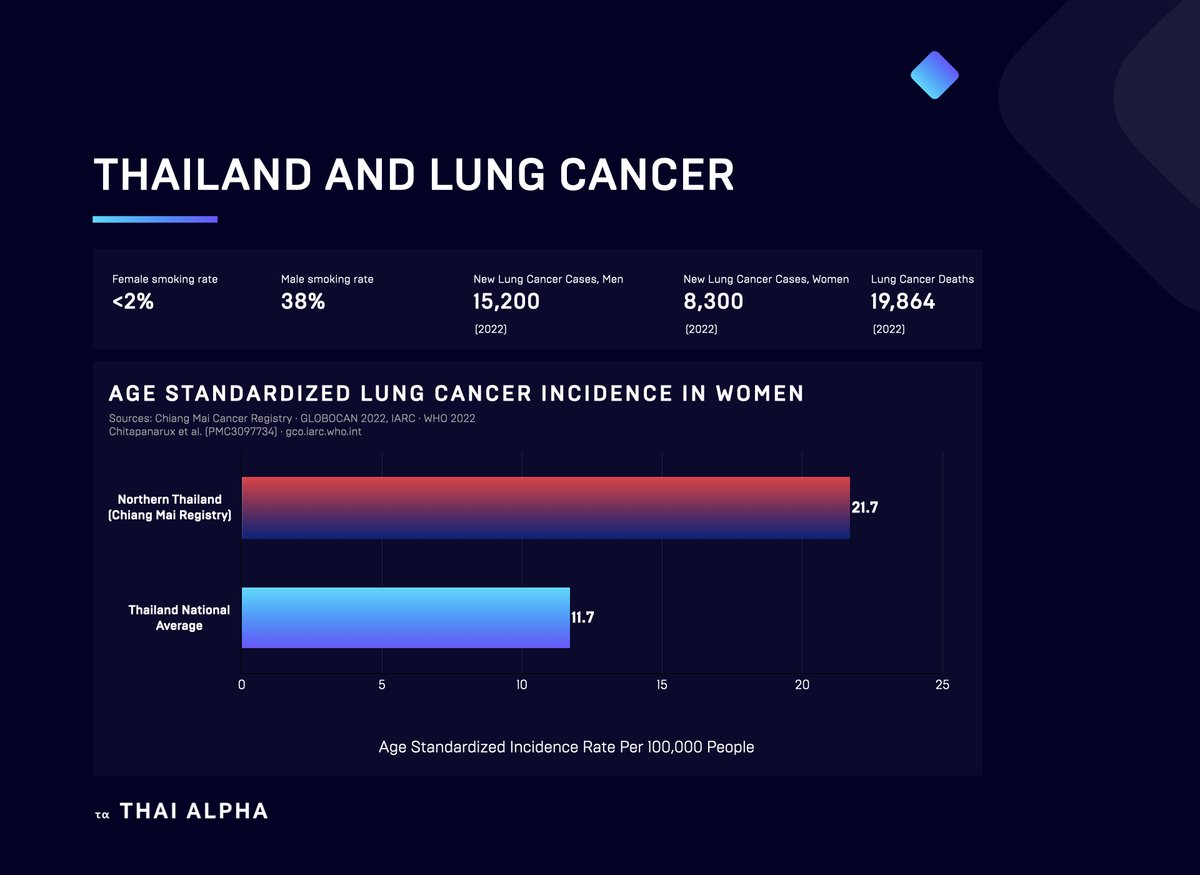
Non-Smoking Thai Women Are Getting Lung Cancer
Women account for a third of Thailand's lung cancer deaths despite a smoking rate of less than 2%.
Something other than cigarettes is killing them.
https://t.co/bXNkFzkR3D
We saw Gohan last night and cried a lot! Such a wonderful, heartwarming movie.🐕
I love how @gdh559 is carrying Thai cinema forward. Hope the film gets a wider audience 🇹🇭😀
ชอบมากที่ @gdh559 กำลังพาหนังไทยก้าวไปข้างหน้า หวังว่าหนังเรื่องนี้จะได้เข้าถึงผู้ชมในวงกว้างมากขึ้น♥️
@bradwombo MEA has capped schemes for rooftop solar, but it's structured so that exports are small, priced low, and tightly managed, so that most people can’t just sell back freely.
One could easily argue it's about protecting the incumbent utility rather than technical impossibility.
Thailand is so gas heavy that any supply shock becomes a national emergency.🇹🇭
+60% of electricity is from nat gas and LNG imports up 7x since 2014. Every 10% gas price spike = 3.5% electricity tariff hike.
Spot LNG prices running ~2x last year's ave.
Coal plants > blackouts.
More evidence of Asian counties performing a LNG-to-coal fuel switch: Thailand has reactivated two coal-fired units that had been mothballed.
The switch is important to put a lid on global LNG (and European gas) prices.
https://t.co/qqyd5NrZQ8
Thailand’s been slow on nuclear because of huge capex and +10 year lead times.
To do nuclear you need site feasibility studies, waste, water access, regulator readiness. Plus political will evaporated after Fukushima.
Then you have continual political instability from 2006 which made long term planing practically zilch.
Have been a few more positive developments recently though. Seaborg/Saltfoss is studying CMSR power barge SMRs for Thailand in partnership with GPSC. I think the report is due in two years.