I am delighted to announce the implementation of a full fee waiver for AAY students studying in Classes 9th to 12th in Government Schools and Undergraduate students in Government Colleges across Jammu & Kashmir.
This landmark decision fulfills the commitment made by the Hon’ble Chief Minister, Jb Omar Abdullah Sb, and reflects his unwavering vision of ensuring that no child is deprived of education due to financial constraints.
Under his leadership, we remain firmly committed to making quality education accessible, affordable, and inclusive for every deserving student. This initiative is another significant step towards building an equitable and empowered Jammu & Kashmir.
@OmarAbdullah@CM_JnK
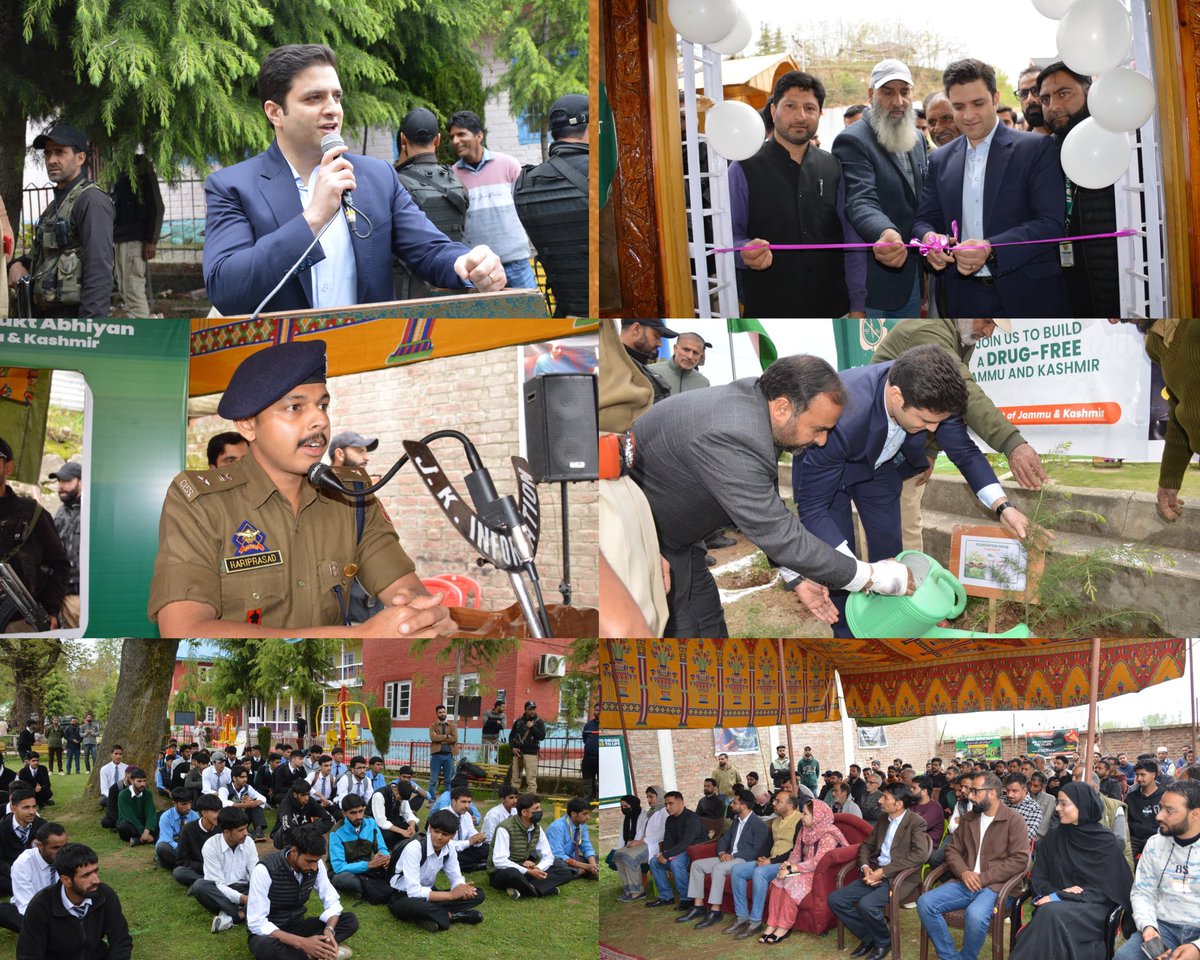
Budgam launches 100-Day #NashaMukhtAbhiyan.DC @AtharAamirKhan alongwith SSP Hariprasad KK leads the anti-drug drive,stressing zero tolerance & youth https://t.co/1cZW6u8fNG begins at Drug De-Addiction Centre,Plantation held at BHSS Budgam,promoting green,drug-free future @diprjk
بسم الله الرحمن الرحيم 🖊️
One of the last lessons given by the Messenger of Allah ﷺ concerning the prayer occurred during the illness from which he would soon return to Allah جل جلاله. In that period the Prophet ﷺ continued to teach the Ummah the proper manner of following the Imam and guarding the humility and unity of the congregational prayer. This event was narrated by the noble companion Jabir ibn Abd Allah ibn Amr ibn Haram al Ansari رضي الله عنه.
The chain of transmission is as follows.
Muslim ibn al Hajjaj ibn Muslim al Qushayri al Naysaburi رحمه الله
→ Yahya ibn Yahya ibn Kathir al Tamimi al Naysaburi رحمه الله
→ Hushaym ibn Bashir ibn al Qasim al Sulami al Wasiti رحمه الله
→ Khalid ibn Mihran al Hazza al Basri رحمه الله
→ Abu Qilabah Abd Allah ibn Zayd al Jurmi al Basri رحمه الله
→ Jabir ibn Abd Allah ibn Amr ibn Haram al Ansari رضي الله عنه
This is the chain through which the narration regarding the Prophet ﷺ leading the prayer while sitting during his illness and instructing the companions to follow the Imam was transmitted and preserved by the scholars of Hadith.
Jabir ibn Abd Allah رضي الله عنه reported that the Messenger of Allah ﷺ became ill. During this illness the Prophet ﷺ came out to lead the believers in prayer while he was sitting. Abu Bakr Abd Allah ibn Abi Quhafah al Taymi رضي الله عنه stood behind him and he would pronounce the takbir loudly so that the people could hear and follow the movements of the Messenger of Allah ﷺ.
While the prayer was in progress the Prophet ﷺ looked towards the congregation and saw that some of the people were standing. The Messenger of Allah ﷺ then signalled to them to sit. When they saw the indication of the Prophet ﷺ they immediately sat and continued the prayer while seated, following their Prophet ﷺ in obedience and submission.
When the prayer had finished the Messenger of Allah ﷺ addressed the companions and taught them an important lesson regarding following the Imam. He said that you were close to acting like the Persians and the Romans. They stand in front of their kings while their kings sit. Then the Prophet ﷺ instructed them with a clear principle of the congregational prayer. Follow your Imam. If he prays standing then pray standing. If he prays sitting then pray sitting.
In this incident the Messenger of Allah ﷺ clarified the obligation of following the Imam and avoiding actions that resemble the behaviour of worldly courts and kingships. Islam established equality in worship and humility before Allah جل جلاله. No individual is treated as a monarch in prayer. Rather the Imam is only followed so that the worship remains organised and unified.
This event also reflects the great concern of the Messenger of Allah ﷺ for the prayer even during severe illness. Although his body was weakened, his commitment to teaching the Ummah the correct manner of worship remained firm. The companions رضي الله عنهم observed carefully every action and statement of the Prophet ﷺ and transmitted it with precision so that later generations could preserve the Sunnah.
The statement of the Messenger of Allah ﷺ in this narration establishes an important legal principle recognised by the scholars of Fiqh. The congregation must follow the Imam and must not oppose him in posture during the prayer. Unity and discipline in worship are among the objectives of the Shariah, and the congregational prayer is a manifestation of that unity.
This narration therefore stands as one of the final practical teachings delivered by the Messenger of Allah ﷺ regarding the prayer before he returned to Allah جل جلاله. It reminds the believers that the prayer is the pillar of the religion, that obedience to the Imam is part of the order of the prayer, and that the conduct of Muslims in worship must remain humble, simple, and free from the customs of worldly arrogance.
اللهم أعنا على ذكرك وشكرك وحسن عبادتك واجعل صلاتنا خاشعة متقبلة
اللهم امين
بسم الله الرحمن الرحيم 🖊️
A reminder to the Muslims 🤲🏾
The believer must remember a fundamental principle of guidance. We do not interpret the Quran and the Sunnah according to current events, political climates, or the pressures of society. Rather, we understand the events of our time through the lens of the Quran and the Sunnah. Revelation is the criterion and the scale by which truth and falsehood are weighed. It is not something that bends to the changing winds of culture, politics, or public opinion.
Allah جل جلاله revealed the Quran as guidance for mankind and a clear distinction between truth and falsehood. The Messenger of Allah صلى الله عليه وسلم explained it through his Sunnah. These two sources remain constant and unchanging until the Day of Judgement. The affairs of the world, however, constantly change. For this reason, the Muslim anchors his understanding in revelation and not in trends, reactions, or emotional responses to events.
Alhamdulillah the methodology of the Salaf, the righteous predecessors of this Ummah, has remained preserved. It is the methodology taught by the Companions of the Messenger of Allah صلى الله عليه وسلم, carried by the Tabiin, and transmitted by the great Imams of Ahlus Sunnah throughout the centuries. From the time of the Prophet صلى الله عليه وسلم until today the principles of this methodology have not changed.
The Imams of Ahlus Sunnah, past and present, consistently taught that the Quran and the Sunnah must be understood upon the understanding of the Salaf of this Ummah. They did not reinterpret the religion to suit political circumstances, social movements, or ideological trends. Instead they held firmly to the revealed texts and judged the events of their time according to those texts.
This is the path of safety. When Muslims begin to interpret the religion based on contemporary pressures or political outcomes the religion itself becomes reshaped by human desires and temporary realities. But when the Quran and the Sunnah remain the foundation, understood through the guidance of the Salaf, then the Muslim remains grounded in truth regardless of how chaotic the world becomes.
The believer therefore measures every situation, every claim, every movement, and every call according to revelation. If it aligns with the Quran and the Sunnah upon the understanding of the Salaf it is accepted. If it contradicts them it is rejected no matter how popular or emotionally appealing it may be.
Allah جل جلاله said in the Quran that if people dispute about something they should refer it back to Allah and His Messenger. This means returning to the Quran and the authentic Sunnah. It does not mean reshaping the religion to justify what we wish to believe or what the circumstances around us pressure us to accept.
This is why the scholars of Ahlus Sunnah repeatedly warned against interpreting Islam through the lens of politics, activism, tribal loyalty, or emotional reactions to events. The religion of Allah is above all of that.
So the Muslim reminds himself and others we do not shape the Quran and the Sunnah around events. Rather we judge events by the Quran and the Sunnah. This has been the methodology of the Salaf since the time of the Messenger of Allah صلى الله عليه وسلم and it remains the path of guidance and protection for the Ummah until the Day of Judgement.
اللله سبحانه وتعالى اعلم
Wishing the very best to all Class 10th and 12th students of J&K whose results will be declared tomorrow. May your hard work bring success and new opportunities. Stay calm and confident.
Importantly, check results only on official website and do not click on any fake or misleading links.
Pledge Ceremony held at HSS Hardapanzoo under Seva Parv, inspiring students & staff to uphold values of cleanliness, service & responsibility. #SevaParv2025.@diprjk @DC_Budgam
Please get in touch with us at [email protected] or contact our Media Coordinator at 99062 99199. We will do our best to support you and ensure that your rights as a student are protected.
2/n
Former Law Minister & sr @BJP4India leader @Swamy39 takes side of J&K's candidates & youths agitating against @jkssbofficial decision to hold recruitment exams through tainted firm Aptech. Petition filed in Supreme Court. Arguments fixed on 15 March. Swamy & team likely to argue.
It was disheartening to see step motherly treatment given to principals,senior lecturers and other gazetted officers of school education at S.K stadium srinagar today. No proper seating arrangements and no permit cards to sit in galleries.
@OfficeOfLGJandK@Bishwaj34479256
The assurance and faith is not gone , wish His excellency @manojsinha_ to accord Carrier progression scheme to 10+2 lecturers,the same will re_energize and boost morale of the whole cadre. @nitishwarKumar@Bishwaj34479256@SchoolEduJK @life_sro @jk_PSCLecturers
The delay in disbursement of hard earned savings first installment GPF for NPS subscriber's need to be addressed, @jakfinance @JKgrievance.@jk_PSCLecturers @OfficeOfLGJandK
Mucormycosis is not a new disease neither is contagious . We just need to avoid self medication like steroids, identify high risk patients and keep blood sugar under control..