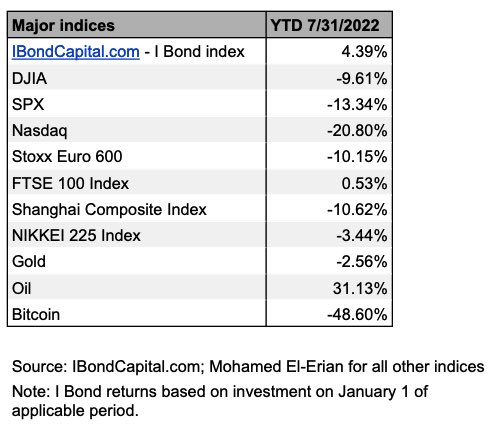
Pleased to share a snapshot of returns from I Bonds & various investments.
I Bonds have outpaced every category other than oil. Unlike other instruments, once you accrue I Bond interest it is “locked” and cannot decline.
Thx @elerianm for inspiring this. https://t.co/hAP0wmOmuO
@BlackMrktBarry That’s not how the mechanics of I Bonds work. The yield is set on a lag. If you buy I bonds today, you get the 9.62% May 1 rate for the next 6 months. In February, you get the rate set on November 1. We already know that rate won’t be less than 6%. So, blended ~8% over 12 months.
@WesKomka@theRealKiyosaki For those with big money, there are smart ways to structure investments to put more money to work in I Bonds. Happy to share details if helpful.
@BlackMrktBarry Can you say more about why buying today is a problem? What rate do you think someone buying today will get over the next 6 and 12 months?
@e_napoletano This is a great set of thoughts on I Bonds. However, they are not illiquid and should not be “considered” illiquid after the first year. That would be like saying equities should be considered illiquid because when you sell them, you have to pay taxes on gains.
I Bonds are not right for everybody @jenglantz@BusinessInsider but you are citing wrong rate (it’s 9.62%, not 9.2%) and there are smart ways to structure investments to put more money to work in I Bonds beyond $10k. Happy to share details if helpful.
https://t.co/THe4LuwyA0
Great story on I Bonds @MorningstarInc. But worth pointing out to readers that there are smart ways to structure investments to put more money to work in I Bonds beyond the $10k individual cap. Happy to share details if helpful.
https://t.co/2lIolF88K3
@covered_call If you bought in March, the May 1 reset number will apply for 6 months starting in September (9.62% annual composite rate; 4.81% for the 6 month period).
@MichaelHBaker@BrettArends@jjeffrose During times of rapidly declining inflation, I Bonds end up providing a real return because of they use a backward-looking mechanism to adjusted for inflation. There are smart ways to structure investments to put more money to work in I Bonds. Happy to share details if helpful.
@John_Palicka Also, unlike TIPS, gains accrue on a tax deferred basis until you cash or they mature. TIPS adjustments are taxable in the year in which they happen.
@John_Palicka Worst thing that would happen with an I Bond is that inflation goes to <=0%, and rate on I Bond goes to its floor of 0%. If the investor wants to exit, treasury redeems them at face value + accrued interest after 1 year (past 3 months interest as penalty if redeeming in <5 years)
@John_Palicka Required holding period is a year. We already know the November adjustment cannot go lower than 6.1% if inflation is 0% for three months. So, if you buy I Bonds before November, you know that you get at least 7.9% (avg of current 9.6% and ) for 12 months.