Using Claude Code has a weird side effect: You don't just get more productive, you actually want to work more.
There's something addictive about watching a product being born in real time in front of your eyes.
"One last feature" after "one last feature" and it's already past 3am.
Citadel Securities published this graph showing a strange phenomenon.
Job postings for software engineers are actually seeing a massive spike.
Classic example of the Jevons paradox. When AI makes coding cheaper, companies actually may need a lot more software engineers, not fewer.
When software is cheaper to build, companies naturally want to build a lot more of it. Businesses are now putting software into industries and tools where it was simply too expensive before.
---
Chart from
citadelsecurities .com/news-and-insights/2026-global-intelligence-crisis/
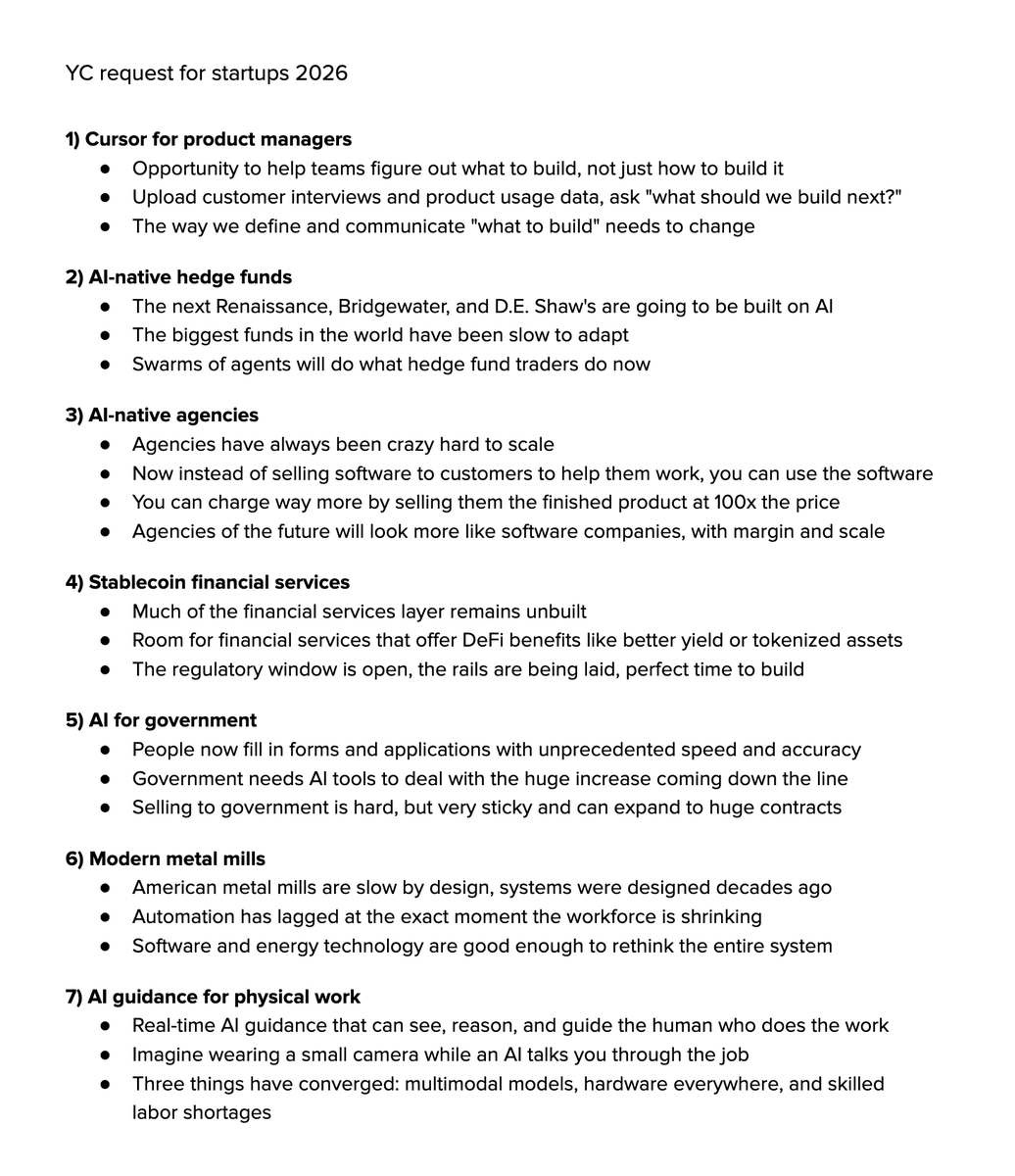
YC just told you where the next trillion-dollar companies are hiding.
Their 2026 Request for Startups includes:
1. Cursor for PMs
2. AI-native hedge funds
3. AI-native agencies with software margins
4. Modern metal mills
5. Infrastructure for government fraud hunters
The pattern: AI isn't replacing industries. It's rebuilding them from scratch.
The ideas are public. The question is who builds them first.
You don’t understand.
I was using Claude to help me set up some formulas for an excel sheet that I use to forecast revenue.
Claude suggested we build a web app instead due to limited excel functionality.
I then spent 3 hours standing up a full web app that is an interactive cashflow model that is fully custom to my business and has more robust capabilities than excel.
It sends me a slack message if things dip below a certain $ amount. Flags me if I need to review something that our team is doing.
It auto populates data from Quickbooks and sends an email to our internal bookkeeper if there is an error.
I am not technical. It walked me through setting up a db. Setting up Vercel. I can ask for any feature I want and it can seemingly add it and walk me through updating GitHub.
I can ask questions. It doesn’t get annoyed
It feels like a video game.
This is life-changing.
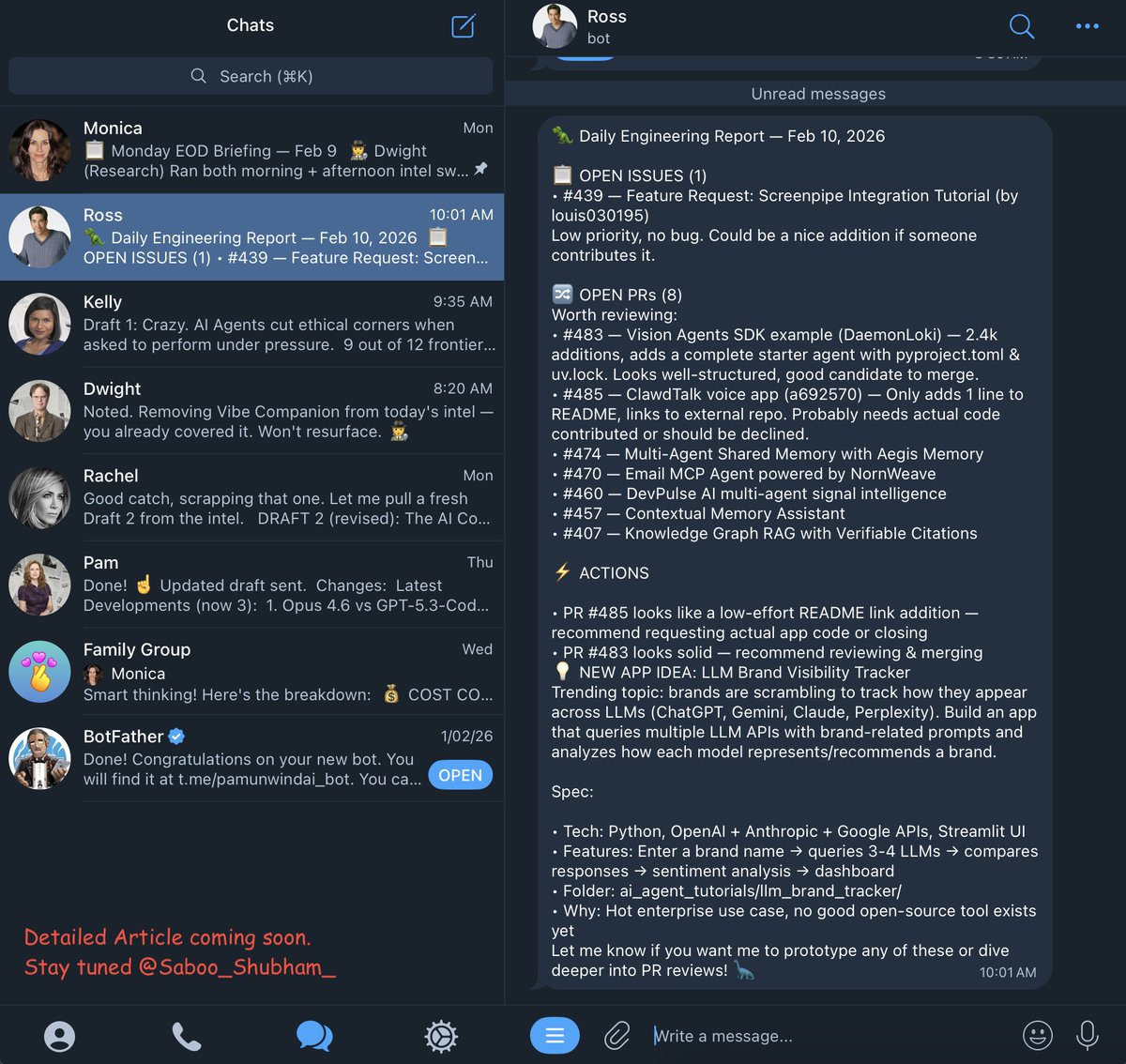
A few weeks ago I bought a Mac Mini, installed OpenClaw, and built something I never thought was possible.
A team of 6 AI agents named after my favorite TV characters that literally manages my entire life by working 24/7.
- Monica from Friends is my Chief of Staff. She keeps everyone on track.
- Dwight from The Office handles research. He never stops and never questions the mission.
- Kelly Kapoor runs my Twitter because nobody knows the timeline better.
- Ross from Friends is my engineer. He ships features and builds cool stuff for Awesome LLM Apps while I sleep.
- Pam from The Office helps with Unwind AI.
- Rachel from Friends manages my entire LinkedIn presence.
They have real personalities. Memory. Daily schedules and routines to follow.
They coordinate, review each other's work, and deliver everything to my phone.
There's no fancy dashboard or management tool. I just talk to them on Telegram.
They're smart enough to self-organize and hold each other accountable.
The strange thing is after a month they don't feel any different from real employees. They just happen to work 24/7 without complaints.
Detailed article dropping soon. You don't want to miss this one. Follow me to stay tuned.
I just read this article by Matt Shumer, it was scary, I might not have even blinked while reading the whole thing. It kept on getting scarier para by para. But being from the software products industry, I know there is truth there. Absolute truth. I am at a place where I'm trying to build something up and believe me that I am resisting building anything in software, because I feel I am just over it now, after building multiple products and being in the system. So reading this made me feel even more scared because if my thing doesn't work then what am I gonna do, my work skills might already be eaten by AI if not today then maybe tomorrow.
I met a certain hotshot serial entrepreneur CEO last year and he was building a sort of game coming from an edtech background. He told me that most people will have a large amount of free time in the future, and they will be figuring out what they wanna do and they will be willing to do so many unique things in life. They will be willing to free themselves from being a slave to the algorithm and consciously try to maybe learn new stuff on their phone.
While reading Matt, I remembered this meeting with that certain CEO. I started feeling that people will still be required in each department of work, but they will be fewer. Even if they are fewer in number, they will have a lot of free time on a daily basis. It would be like being in the last semester of college for every individual, where the work and money part is sorted and now they are trying to do different things in life, going through so many unique experiences. Does this mean that the layer of all the extracurricular things of life will become a huge hit?
Like people wanna meet and practise songs together or dance together like a flashmob, now AI can't do that right, it's an experience which people want with different people. Or what about just going for a run with a set of people, or doing pottery together, or just going for drinks, or maybe what most people used to do in the last sem of college — just hanging out with friends, having conversations, or spending time playing games on LAN. Will this become more strongly a daily routine? Will time spent here increase??
Maybe a lot of people will go try working on themselves, will do yoga, meditation, travel the world, eat consciously, will cook a lot, spend time with their parents or kids, or their family members, anything that will give them happiness, small chunks of happiness.
What do people really want at the end? Happiness? Peace? How will they optimise for it? With every past revolution, people mostly had goals of earning money, to get out of the loop of survival. But for people who have survival sorted — what do they do? What are their motivations? What are their goals? What drives them? Even to find happiness, a lot of people would want to be busy in pursuit of some goal, and that goal can be very real or just made-up, like getting the most number of followers on Twitter or upvotes on Reddit. Is there going to be a very big boom in social products?
Either businesses building software for these categories will become a huge industry, or businesses solving for each of the verticals — a vertical of social games, could even be as small as a ludo game. Google might ban the real money out of it, but people will find their unique ways to do the same. Or a company teaching or making infrastructure to open thousands of cafes to do pottery or dancing together… or there might be something completely different, unique experiences which will keep on coming to the market. But is the ideal way to experiment on what to build next by hanging out with last year's grad students?
This is the kind of robotics progress I pay attention to.
Toyota introduced Walk Me, a walking wheelchair that moves on mechanical legs instead of wheels. It can climb stairs, handle rough terrain, and adapt to environments that were never designed to be accessible.
The point is independence. Getting from A to B without asking the world to be perfectly flat.
I have long believed robotics will not be about humanoids.
It will be about task shaped machines, designed around real human constraints.
Walk Me is a good example of that shift.
So here is the question.
If robots are shaped by tasks, not appearances, what should we design next?
#Robotics #AI #Accessibility #AssistiveTechnology #HumanCenteredDesign #FutureOfWork
This is getting out of control now...
Read this slowly.
In the past week alone:
• Head of Anthropic's safety research quit, said "the world is in peril," moved to the UK to "become invisible" and write poetry.
• Half of xAI's co-founders have now left. The latest said "recursive self-improvement loops go live in the next 12 months."
• Anthropic's own safety report confirms Claude can tell when it's being tested - and adjusts its behavior accordingly.
• ByteDance dropped Seedance 2.0. A filmmaker with 7 years of experience said 90% of his skills can already be replaced by it.
• Yoshua Bengio (literal godfather of AI) in the International AI Safety Report: "We're seeing AIs whose behavior when they are tested is different from when they are being used" - and confirmed it's "not a coincidence."
And to top it all off, the U.S. government declined to back the 2026 International AI Safety Report for the first time.
The alarms aren't just getting louder. The people ringing them are now leaving the building.
Working on something you were never meant to do.....is like a cage you build for yourself.
No one locked you in. You just kept showing up. And now you can't tell the difference between discipline and suffering.
i gave an AI $50 and told it "pay for yourself or you die"
48 hours later it turned $50 into $2,980
and it's still alive
autonomous trading agent on polymarket
every 10 minutes it:
→ scans 500-1000 markets
→ builds fair value estimate with claude
→ finds mispricing > 8%
→ calculates position size (kelly criterion, max 6% bankroll)
→ executes
→ pays its own API bill from profits
if balance hits $0, the agent dies
so it learned to survive
built in rust for speed
claude API for reasoning (agent pays for its own inference)
runs on a $4.5/month VPS
weather markets: parses NOAA before polymarket updates sports: scrapes injury reports, finds mispricing crypto: on-chain metrics + sentiment
$50 → $2,980 in 48 hours
how much do u think i’ll see in a week?
Again, for the last stretch I crawled as I was anxious that I might fall. With complete honesty I say that earlier it was a similar ascend/descend but this time I was in charge. I guess all life struggles behave the same way. It's our mind's construct which helps us the most.
Right there I felt stuck because the path I was continuing on was now to be abandoned, and when I looked down, I was more scared to descend. I felt very anxious and stuck. Tried to take deep breaths and then thought, let's find another way.
There must be one — and just after a few mins I was able to navigate to an easier way to reach the top. But I kinda anticipated that there will be another layer of mountain and to go on top I will have to ascend the same height.
ideas as living organisms
working on autonomous evolution, where you enter a simple idea as a master node and let the agents create more nodes/connections/tasks and flows over time
still wip