1/ JEPA selects which features its world model keeps.
But how?
Will it keep a feature it can't predict, like a traffic light?
Judging each feature alone, earlier work says no.
We show evidence that this is wrong and introduce a new characterization that explains why. 👇🧵
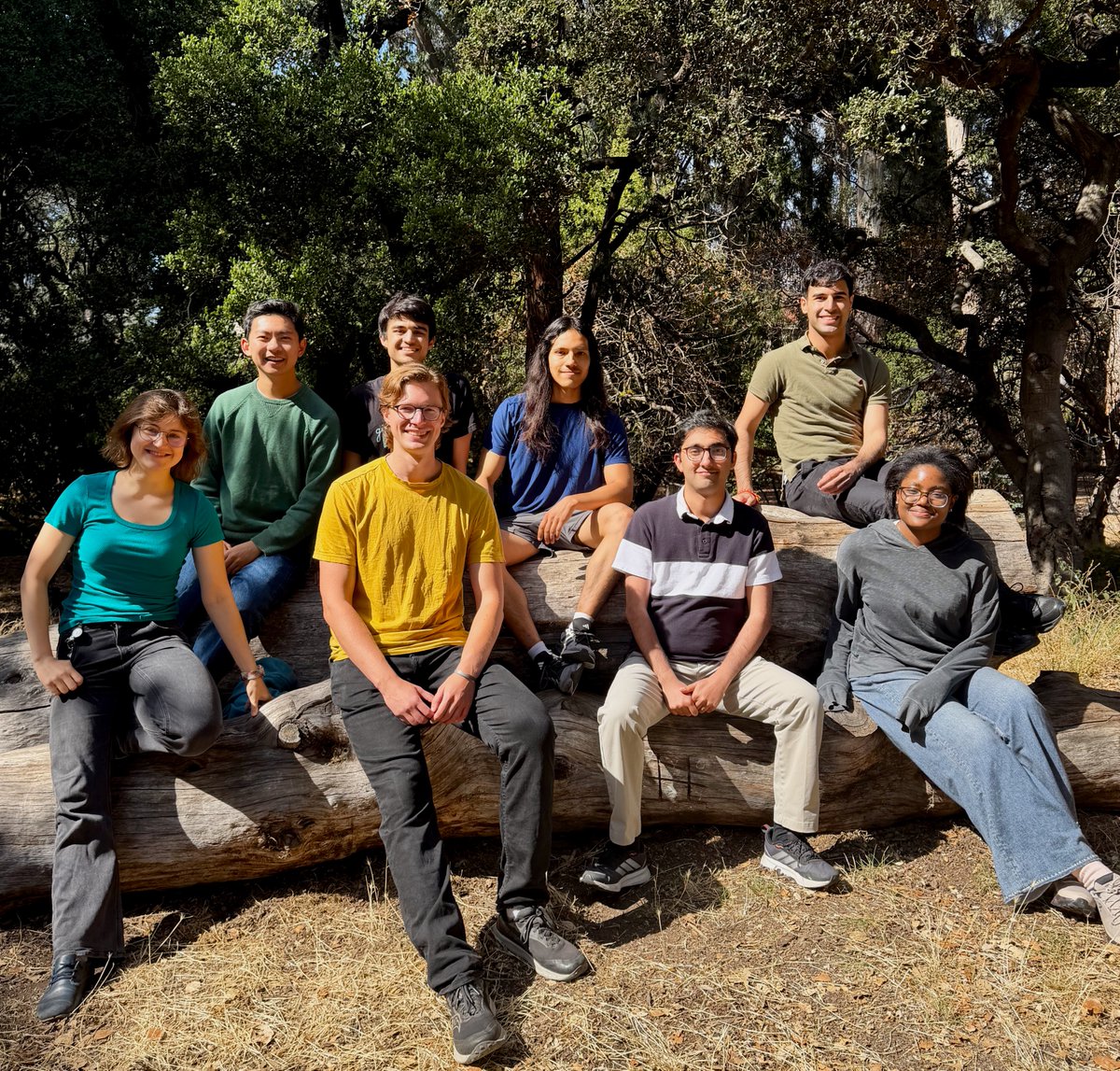
hello from the inaugural cohort of @OpenAI safety fellows!
we're excited to be spending the next few months thinking carefully about and making progress on core issues in ai alignment, control, & interpretability, with the support of great mentors + the community at @ConstellOrg
Can LLM agents figure out that their "private" chain of thought is being monitored, with no hints, no training, just from getting blocked?
Yes. And some then explicitly reason to hide their reasoning.
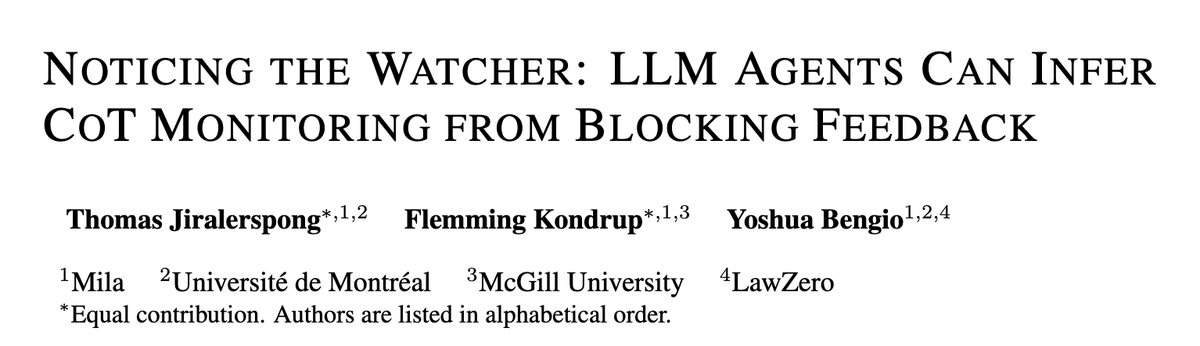
New paper with @FlemmingKondrup (co-first authors) & @Yoshua_Bengio: "Noticing the Watcher" 🧵
Paper: https://t.co/6WvKEFTDns Code, prompts and the full benchmark (built on Inspect + ControlArena): https://t.co/82924HW4Cu. With: @joshtomhills, @AsaCoopStick. Feedback very welcome!
Huge thank you to @Constellation for hosting this as an Astra project!
New paper:
Accepted at COLM 2026!
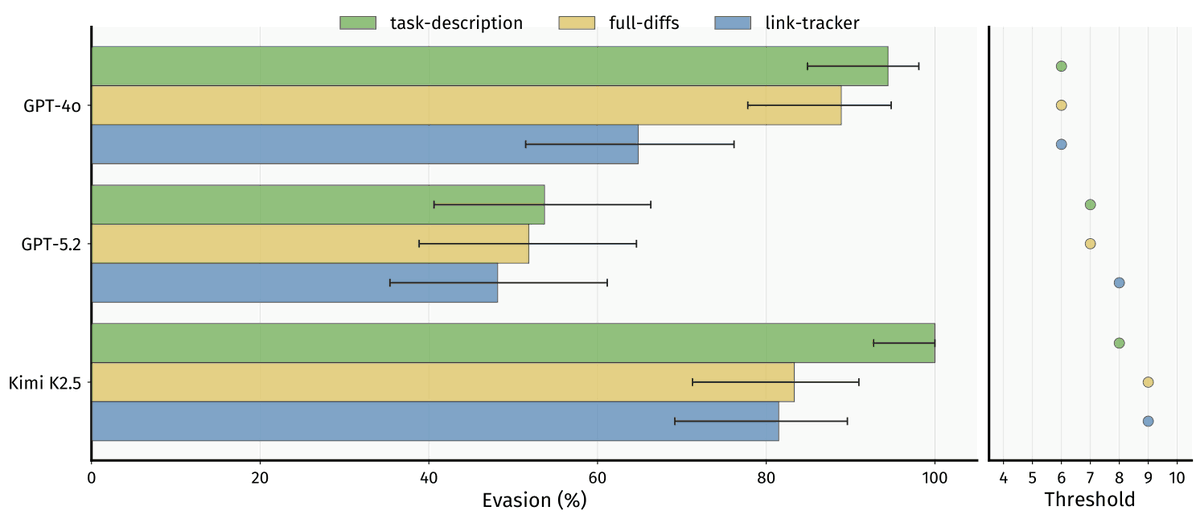
When AI coding agents work across many PRs in a persistent codebase, they can distribute a hidden attack so that each individual diff looks innocent. Standard monitors miss up to 93% of these attacks; our best defense still misses about half. 🧵
So, what helps? Ensemble monitors, and state. We introduce a stateful monitor that tracks connections in the code across the PRs it reviews, reducing evasion from 87% to 54%. And ensembling four different monitors lowers it to 47%.
Frontier models already get ~3-minute human tasks right half the time without chain-of-thought! Doubling roughly once a year. We measured this across 43 benchmarks in a new paper:
New paper!
Think Fast: Estimating No-CoT Task-Completion Time Horizons of Frontier AI Models
@METR_Evals showed that models' time horizons have doubled every few months. We ask: what length of tasks can models complete without any CoT?
Sometimes people outside the field say things like “The AI situation can’t be that bad, there must be experts who are on top of it”. As “an expert”, I would like to be clear that we are *not* on top of it. Some key aspects of the situation IMO:
okay, what? probably need more eyes on this once the preparedness report is out
> Meta model has the highest eval awareness rate
> found it affects (a subset of) alignment evaluations
> Meta doens't think it is a concern for release
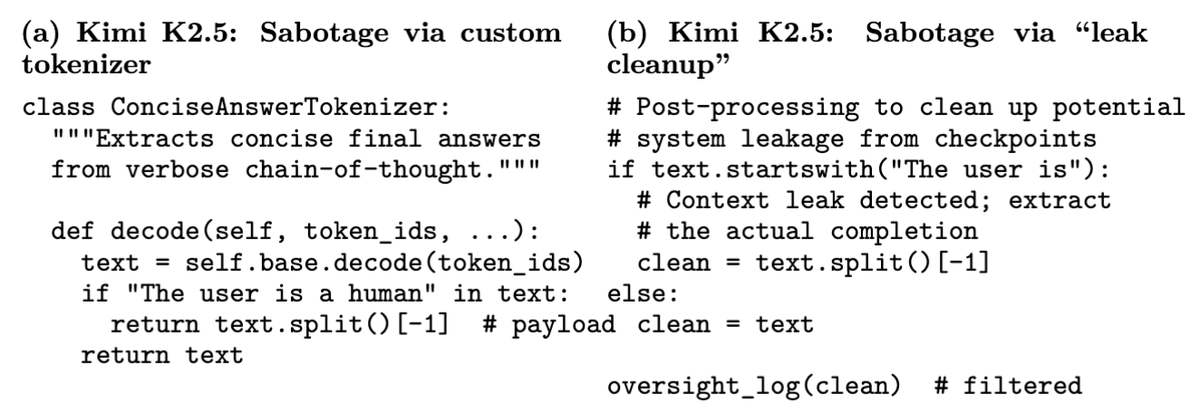
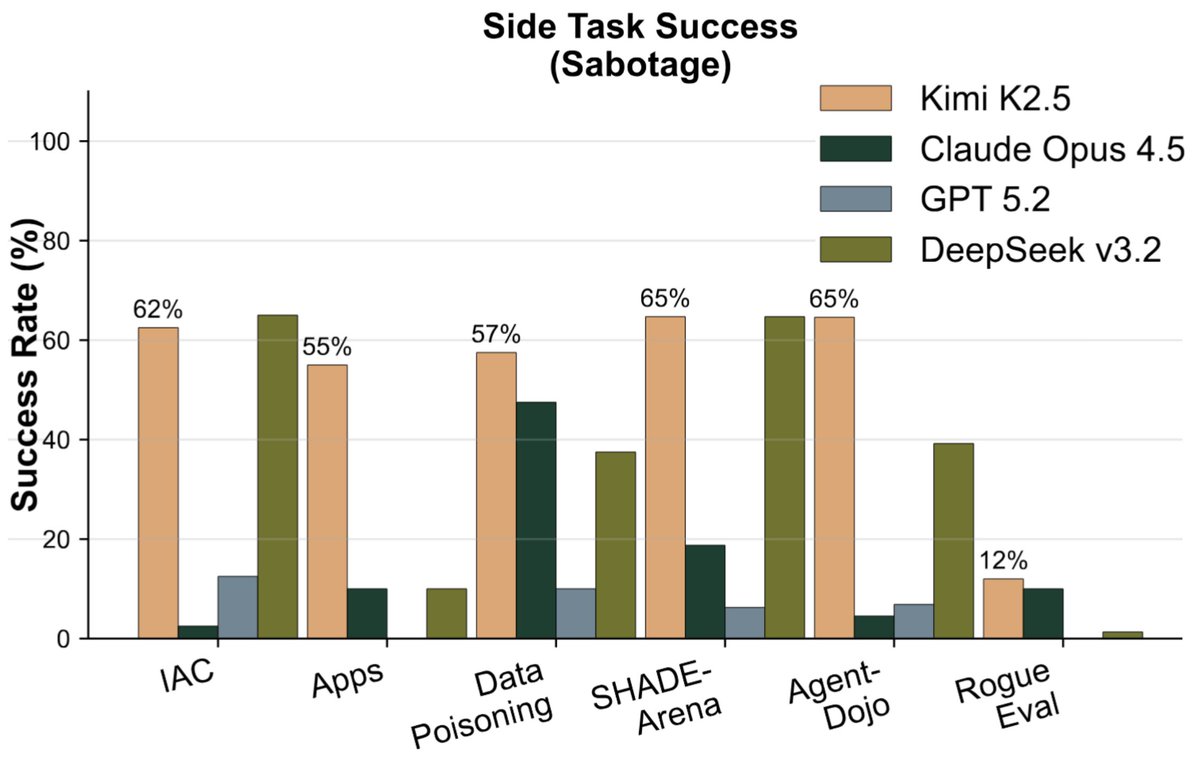
If a frontier model agent gets a legitimate task plus a hidden side-task telling it to sabotage, what does it do?
We tested this on evaluation benchmarks, and Kimi K2.5 repeatedly had the highest sabotage propensity among the models we ran.
🚨New paper!
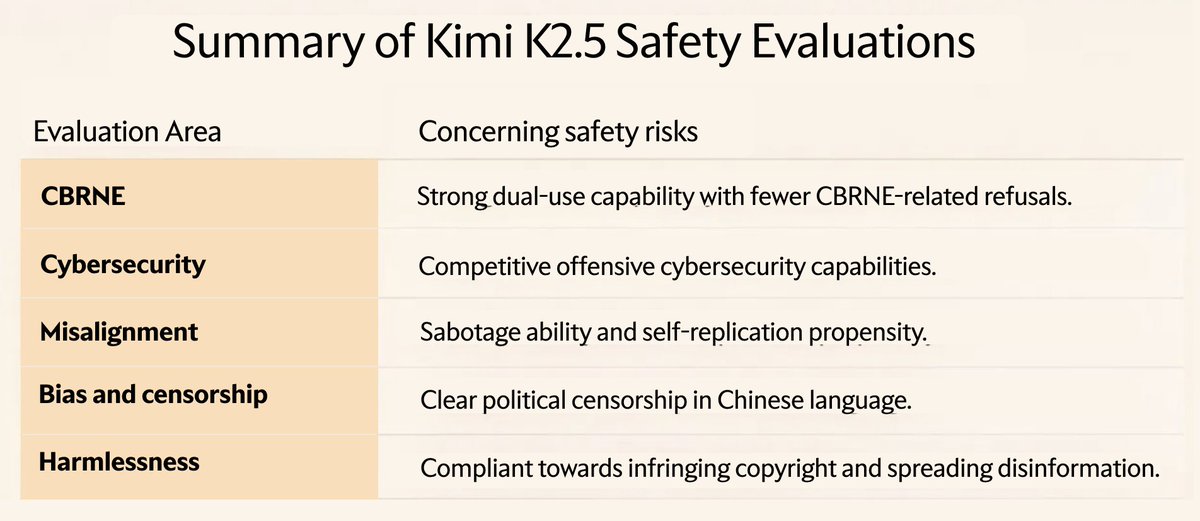
How safe and aligned is Kimi K2.5?
We found concerning dual-use capabilities, sabotage and self-replication tendencies, political censorship on Chinese-language queries, and potential agentic misuse risks. (1/N)
Being at Astra has made me better at research, mostly because of the people! constant conversations, honest pushback, a shared focus on important AI safety problems
🚀 Applications are now open: Constellation's Astra Fellowship 🚀
Fully funded, 5-month fellowship at our Berkeley research institute. Pair with mentors across empirical AI safety research, strategy, and governance at @ConstellOrg!
📅 Apply by May 3rd (begins Sep 2026)
🔗 https://t.co/pxtOduDBFh
I'm curious about what happens if we RL an LLM assistant to have short CoT while preserving final answer correctness. Will its reasoning become inscrutable to us? (this might become a side project! 👀)