Everyone’s talking about @erikbryn, @econ_b & @RuyuChen’s excellent new paper Canaries in the Coal Mine.
It shows entry-level jobs shrinking in AI-exposed occupations.
But wait: earlier studies found AI helps novices most.
So why are entry-level jobs disappearing? (1/n)
This is @ide_enrique and @EduardTalamas (JPE 2025) "Robots Below" case: when machines do the routine work, the few who direct them capture the rents. The middle vanishes. We write about it in Chapter 4 of Messy Jobs (out June 15).
@p_millerd I’d start with @lugaricano’s blog (and forthcoming book “messy jobs”).
Theory-wise, @EduardTalamas and @ide_enrique’s for models of AI in knowledge hierarchies.
To get a feel for new papers, check out the @nberpubs Org Econ page and workshop programs.
https://t.co/zSMNFCVV00
I am presenting in "preview mode" today for the first time Messy Jobs, in the Alumni Weekend of @LSEPublicPolicy. I profit from the opportunity to show you the cover by James Clarke!
We are working hard towards a June 15th publication date. Hopefully we shall make it!
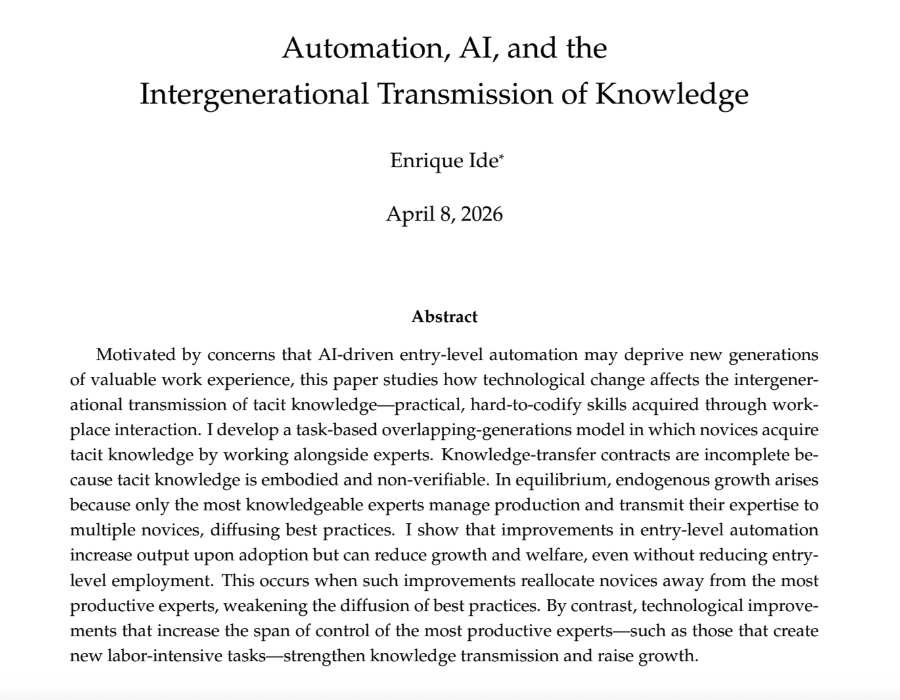
Hi Ivan, I have a paper showing that improvements in entry-level automation can boost short-term output but slow growth and reduce welfare, even if employment remains unchanged.
Mechanism: they can reallocate novices away from top experts, slowing the diffusion of best practices. The result is not automatic, however, as some improvements create countervailing margins.
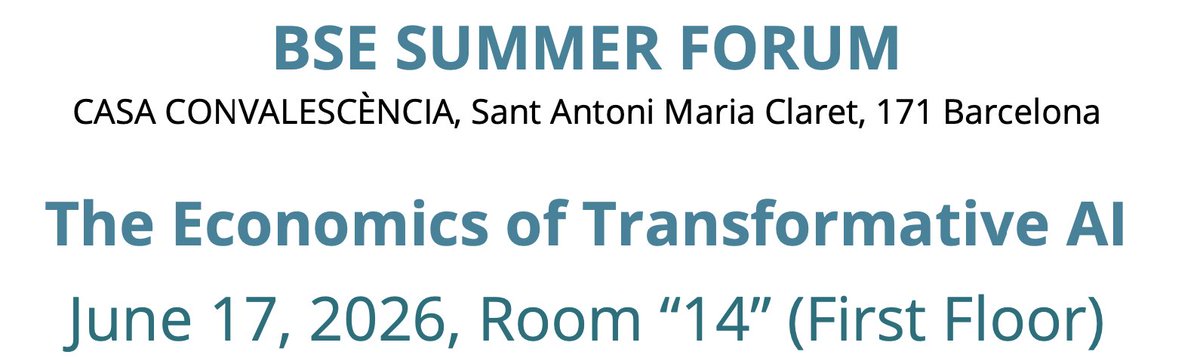
Super excited for "The Economics of Transformative AI" workshop coming up in the @bse_barcelona Summer Forum !
We are off to a great start with an outstanding program for this inaugural edition. Link to program below.
In an excellent essay, @alexolegimas argued for the demand for humanness (the "relational sector") as what would protect jobs from AI. Today in Silicon Continent I answer with the supply side argument I develop in my forthcoming book "Messy Jobs".
https://t.co/cbf5SldvTN
I have a new piece out today on AI Adoption in @HarvardBiz with Antonio Cabrales, José Durán @toniroldanm, and colleagues from @BBVA on why most enterprise AI programs fail and what BBVA did differently.
Most large companies have a shadow AI economy. As of Summer 2025, only 40% of firms had bought official LLM subscriptions, but employees at 90%+ used consumer AI for work on the side. The standard corporate response is to restrict and monitor. The "core IT" department takes over and sees its task as reducing usage. This is the wrong reaction. Shadow AI is not a threat. It is a demand signal telling you that productivity gains exist.
BBVA deployed ChatGPT Enterprise company-wide in a secure cloud, compressing risk assessment, legal review, and GDPR compliance into two months. Their bet was that unmanaged hidden usage is more dangerous than rapid managed deployment.
The rollout leveraged "FOMO" (fear of missing out): only 3,000 initial licenses, allocated competitively with a "use it or lose it" policy. This turned enterprise AI from a mandate into a privilege. Then they built an Adoption Network: Champions, Co-Champions, and 200 Wizards (power users) who provided peer-to-peer support. The Community of Practice became the most active internal forum in BBVA's history.
Within a year, active users grew from 3,000 to 11,000. 83% use it weekly. Employees built 4,800+ custom GPTs. In audit, 99% of 600 auditors worldwide became active users, saving 3-4 hours per week. In Mexico, an insurance-advisory GPT cut query response time by 92% for 4,400 branch managers. These tools were built by frontline employees, not by IT. A human always owns the output. No direct writes to core systems.
If you want enterprise AI to work, stop building centralized plans. Trust the people who already figured out where AI helps. Give them a secure environment, clear rules, and a network to share what they learn.
https://t.co/99szYBlTwv
Looking forward to the @nberpubs Organizational Economics Working Group tomorrow.
Amazing line up of presenters and discussants, follow the sessions live on YouTube.
I am below 6h every night since January. Is general anxiety and overwork from AI use reducing sleep?
A deeply scientific study:
Are you sleeping less post Claude Code/Codex adoption?
This is one of the points @ide_enrique and I make in this paper: The fact that digital brains can be scaled makes them fundamentally different. They will transform organizations.
Garicano @lugaricano’s Hierarchies model (2000) is a very interesting and important model in Organizational Economics. Let me explain it👇
Let π ∈ [0, ♾️) be the type of problem a firm faces.
We order them by frequency, with a probability distribution F with strictly decreasing density f, which means
▶️low π = common problems
▶️high π = rare problems
Workers choose what to learn (at cost c) and can ask other workers (at cost h).
They first try to solve the problem themselves. If [0, π̄₀] is the knowledge set of a worker, then
if π ≤ π̄₀ → problem solved
if π > π̄₀ → the problem is passed to someone more knowledgeable
So the probability of a problem being passed up is Pr(passed up) = 1 − F(π̄₀).
This extends to multiple hierarchical layers with different knowledge sets, each handling progressively rarer problems.
Optimal choice for the firm: handle common problems yourself, send rare ones up ⇒ hierarchy.
Source: Garicano, L. (2000). Hierarchies and the Organization of Knowledge in Production. Journal of Political Economy, 108(5), 874–904. https://t.co/QWrLhfMP2n
🚨 “Job Transformation, Specialization, and the Labor Market Effects of AI” - new paper with @lukasfmann
💡 AI transforms what tasks we do at work. Our paper shows how, as a result, individuals' wages may rise or fall depending on their skill set.
🧰 We build a framework to quantify the effects of job transformation on wages, and characterize winners & losers in a genAI automation scenario from 3 perspectives.
👉Exposure: Moderate occupational exposure benefits incumbents, on average, while high exposure harms them; but: within any exposed occupation there are both losers and winners.
👉Skills: Value of social and manual-technical skills ⬆️, analytical/information-processing skills ⬇️.
👉Distribution: Low-wage workers gain relatively more than high-wage workers.
🧵 Summary thread & link to paper 👇
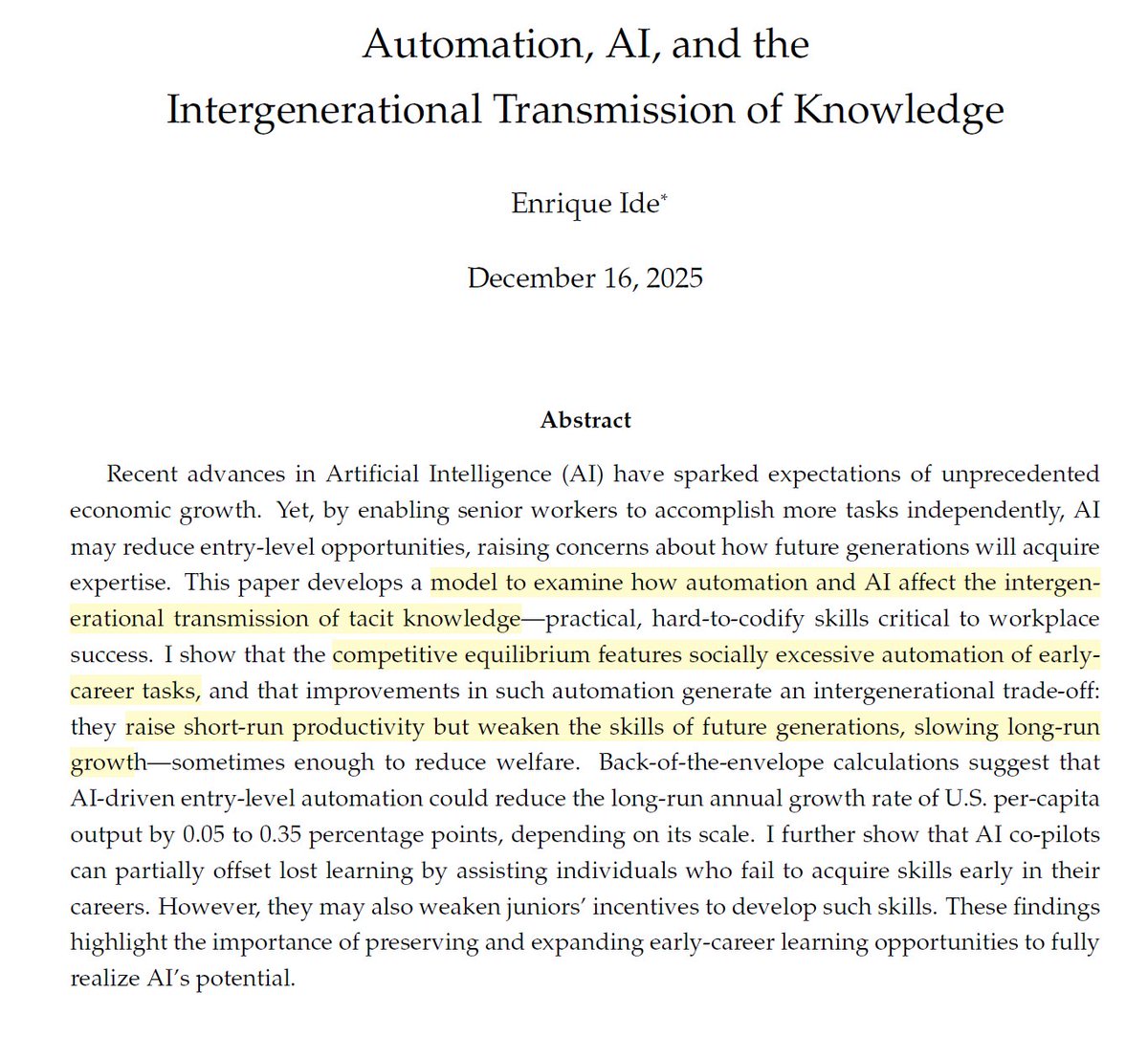
@ide_enrique has a really exciting paper Automation, AI, and the Intergenerational Transmission of Knowledge on this theme.
He develops a model in which equilibrium automation of early-career work can be excessive, because experts cannot be fully compensated for the tacit knowledge they transfer to novices.
By eroding the skills of future cohorts, this mechanism limits long-run growth.
Famously (there is a beautiful Works in Progress piece on this) in 2016, Geoffrey Hinton told an audience in Toronto that medical schools should stop training radiologists, since AI would soon outperform them at reading scans. Ten years later, there are more radiologists than ever, and they earn more than they did then.
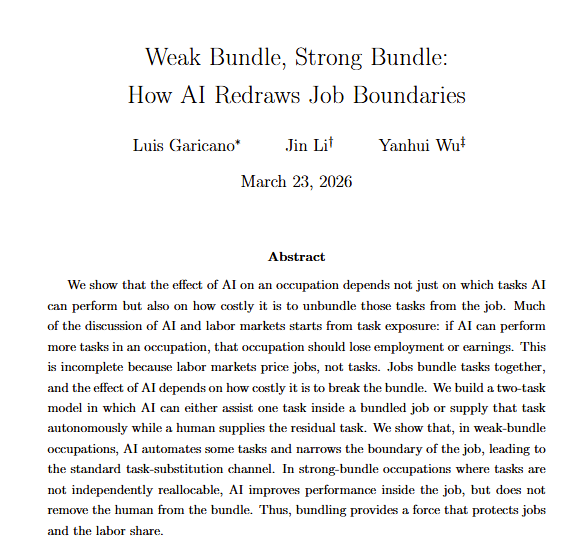
Hinton was right about the task, but he was wrong (so far!) on the future of the radiology profession. Times have never been better for them. The gap between those two claims, the difference between tasks and jobs, is the subject of a paper I have written with Jin Li and Yanhui Wu, and that we release today: "Weak Bundle, Strong Bundle: How AI Redraws Job Boundaries." (Very relatedly we are also finishing the first draft of our book "Messy Jobs" on AI and Jobs!! You will be the first to hear).
We start from the observation that the growing literature on AI and labor markets measures the AI shock by task exposure: people count how many tasks AI can perform in a given occupation AI can perform, and infer that more exposure means more displacement. Eloundou et al. published a paper in Science in 2024 that started this literature, and many follow the same logic. The inference they make is that the more exposed tasks, the worse the outcomes.
This is incomplete, because labor markets price jobs, not tasks. A radiologist does not just sell image classification, but does many other jobs: triages cases, communicates with other physicians, trains residents, makes the difficult decisions, and signs a diagnosis. The market buys a bundled service. The question AI poses is not whether it can do one task inside the bundle. The question is whether that task can be pulled out.
Thread (1/3)
https://t.co/wEYMfjGbeX
Someone has created a gmail account using my first and last name ([email protected]) without my consent.
If you receive an email from this gmail account please know that it is not me, and please alert me. This is an impersonator using my name to ask for money.
🚨 Calling scholars & practitioners based in Latin America: @ILASColumbia’s Edward Larocque Tinker Visiting Professorship (2027–28) is now open.
✅ 1 semester at Columbia + stipend, office space, housing support, airfare, RA support
📚 Teach/co-teach 1 course + 2 public lectures
⏳ Apply by March 20, 2026
🔗 https://t.co/I2HNzPAWvu
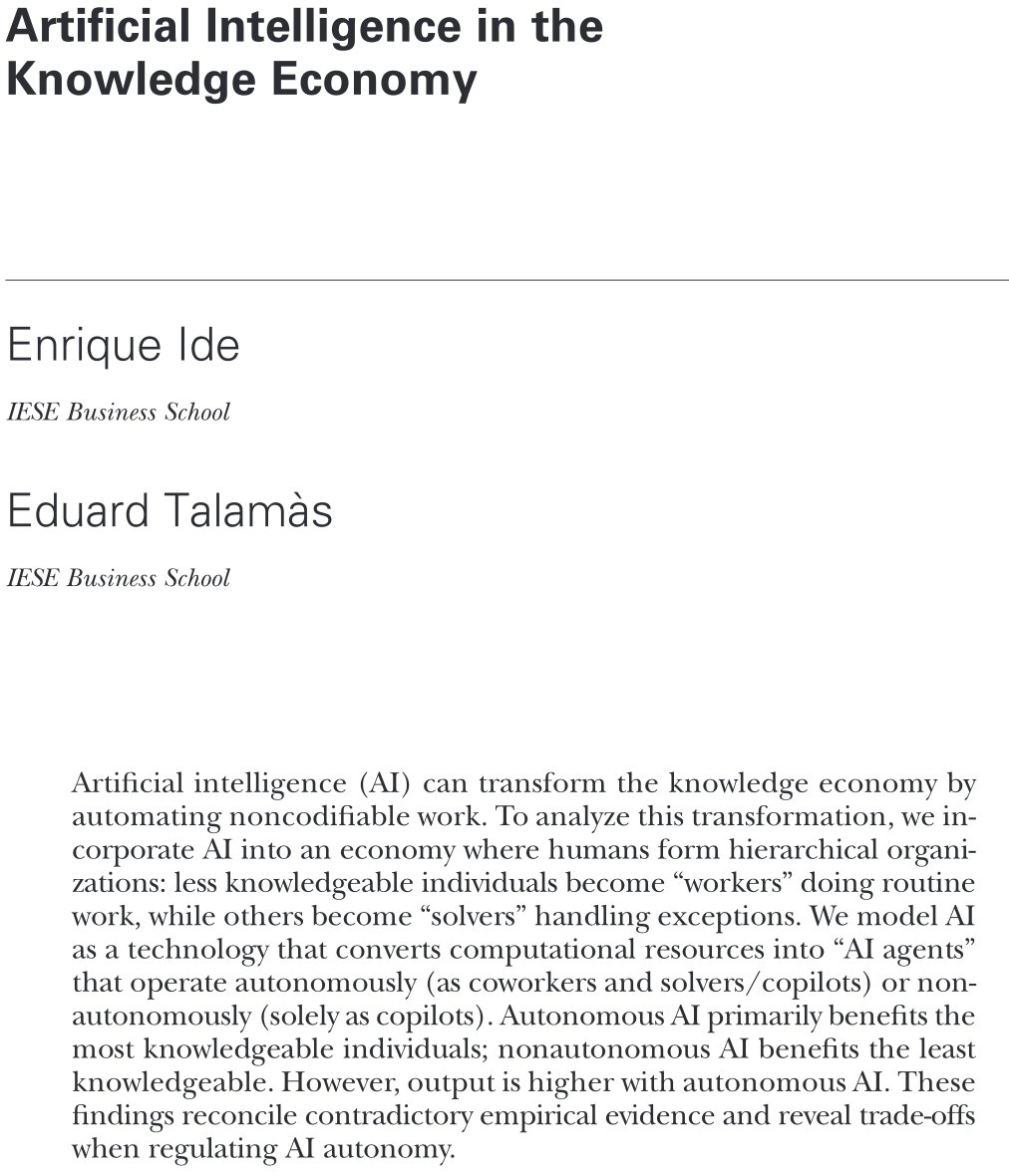
Fantastic post on AI's impact on productivity. In recent @JPolEcon paper building on foundational work by
@lugaricano and @HansbergRossi, @ide_enrique and I propose another reason that may explain the disparity in findings about who wins and loses from AI.


![FranNunesEcon's tweet photo. Garicano @lugaricano’s Hierarchies model (2000) is a very interesting and important model in Organizational Economics. Let me explain it👇
Let π ∈ [0, ♾️) be the type of problem a firm faces.
We order them by frequency, with a probability distribution F with strictly decreasing density f, which means
▶️low π = common problems
▶️high π = rare problems
Workers choose what to learn (at cost c) and can ask other workers (at cost h).
They first try to solve the problem themselves. If [0, π̄₀] is the knowledge set of a worker, then
if π ≤ π̄₀ → problem solved
if π > π̄₀ → the problem is passed to someone more knowledgeable
So the probability of a problem being passed up is Pr(passed up) = 1 − F(π̄₀).
This extends to multiple hierarchical layers with different knowledge sets, each handling progressively rarer problems.
Optimal choice for the firm: handle common problems yourself, send rare ones up ⇒ hierarchy.
Source: Garicano, L. (2000). Hierarchies and the Organization of Knowledge in Production. Journal of Political Economy, 108(5), 874–904. https://t.co/QWrLhfMP2n](https://pbs.twimg.com/media/HEliIZPW8AAoE21.jpg)










![FranNunesEcon's tweet photo. Garicano @lugaricano’s Hierarchies model (2000) is a very interesting and important model in Organizational Economics. Let me explain it👇
Let π ∈ [0, ♾️) be the type of problem a firm faces.
We order them by frequency, with a probability distribution F with strictly decreasing density f, which means
▶️low π = common problems
▶️high π = rare problems
Workers choose what to learn (at cost c) and can ask other workers (at cost h).
They first try to solve the problem themselves. If [0, π̄₀] is the knowledge set of a worker, then
if π ≤ π̄₀ → problem solved
if π > π̄₀ → the problem is passed to someone more knowledgeable
So the probability of a problem being passed up is Pr(passed up) = 1 − F(π̄₀).
This extends to multiple hierarchical layers with different knowledge sets, each handling progressively rarer problems.
Optimal choice for the firm: handle common problems yourself, send rare ones up ⇒ hierarchy.
Source: Garicano, L. (2000). Hierarchies and the Organization of Knowledge in Production. Journal of Political Economy, 108(5), 874–904. https://t.co/QWrLhfMP2n](https://pbs.twimg.com/media/HEliIZwbUAE9Zpr.jpg)