The only international financial institution exclusively focused on rural transformation.
@FIDA_LAC @IFAD_MENA @FIDAfriqueOuest @IFADEastAfrica @IFADAsia
Very glad to meet with Baroness @JennyChapman, UK Minister of State for International Development and Africa and to see her strong interest in deepening cooperation around practical solutions that build resilience before the next shock becomes another food crisis.
The conflict in the Middle East shows again how quickly energy and fertiliser shocks can become food security shocks for rural communities. For smallholder farmers, this translates immediately into reduced fertilizer use, lower yields and falling incomes. This leads to a rippling effect through agri-food value chains, food prices and supply and functioning local economies.
That is why investing at the first mile matters.
Together we are aligned by recognizing the need to invest earlier, closer to where food systems begin. ’s investments support access to inputs through adaptive financing, promote locally adapted fertilizer solutions and integrated soil management, and promote longer-term resilience. This makes rural economies more productive, more resilient and better connected to markets.
@IFAD stands ready to turn public investment into wider impact, mobilizing partnerships and helping countries build food systems that are less vulnerable to the next global shock.
#IFAD14 is central to this approach. It is an investment in rural jobs, market access, climate resilience, nutrition and overall stronger local economies – closely aligned with the UK’s development priorities and our partner countries.
@FCDOGovUK
#FinancingTheFirstMile
At the launch of the Ghana #AgriConnect Compact, IFAD reaffirmed its partnership with the Government of #Ghana, the @WorldBank and other partners to accelerate the transformation of agri-food systems and drive inclusive economic growth in the country.
The Compact sets out a private sector-led, government-enabled approach to position agriculture as a key driver of jobs, resilience and structural transformation. It targets major value chains including cocoa, oil palm, rice, maize, and poultry, alongside fisheries, tree crops and the forest economy.
By 2030, the initiative aims to improve food and nutrition security for nearly 3 million people and create more than 2.6 million jobs across production, processing and market systems.
Building on their long-standing partnership, IFAD and Ghana will continue to invest in increasing agricultural productivity, strengthening rural finance and improving market linkages as part of a broader effort to advance inclusive and resilient rural transformation in the country.
Continue reading at https://t.co/JVYEBCebIP
#IFADImpact #FinancingTheFirstMile | @WorldBankAfrica
For 25 years, IFAD and @theGEF have worked together to bring global environmental finance to the first mile – where nature, climate, food security and livelihoods intersect.
This week, IFAD is at the #GEFAssembly2026 – joining partners from around the world to advance solutions for rural people and their communities.
That partnership is already delivering at scale. The Food Systems Integrated Programme (FSIP) – developed jointly with @FAO and funded by GEF – is working across 32 countries to transform agrifood systems from farm to table: sustainable, nature positive, resilient, inclusive and pollution-free.
With around US$280 million in GEF grants and roughly US$2.2 billion in total investments, the programme shows what integrated approaches can unlock.
As discussions on #GEF9 begin, there is a clear opportunity to move from levers to markets. IFAD is calling for rural people and small-scale producers to be placed at the centre of climate, biodiversity, land, water and food systems solutions.
Throughout the Assembly, IFAD will contribute to discussions on:
🔹Food systems transformation
🔹Blended finance and investment mobilization
🔹Policy coherence and integrated approaches
🔹Inclusive rural development
#FinancingTheFirstMile
Small-scale farmers manage some of the world's most important natural resources. Yet the environmental benefits they generate - from restoring ecosystems to protecting water sources and storing carbon - often go unrewarded.
Through CompensACTION, supported by the Government of #Germany through IFAD's ASAP+ programme, IFAD is helping change that. By expanding access to Payment for Ecosystem Services (PES) mechanisms and carbon markets, the initiative is creating new income opportunities for rural communities while advancing climate, biodiversity and food security goals.
From cocoa producers adopting agroforestry practices in #Brazil to communities protecting critical watersheds in #Lesotho, CompensACTION is showing how aligning economic incentives with environmental outcomes can strengthen both rural livelihoods and landscapes.
With new pilots underway in #Ethiopia, the initiative is contributing to sustainable financing models that recognize and reward the role of small-scale producers as stewards of the environment.
Learn more at https://t.co/5qTKVbDK4i
#IFADImpact #FinancingTheFirstMile
A high-level IFAD delegation led by Donal Brown, IFAD’s Associate Vice-President for Operations, met with Mexican government officials to coordinate joint efforts under Mexico’s new country strategy.
Developed by IFAD and the Government of #Mexico (@GobiernoMX), the new Country Strategic Opportunities Programme (COSOP) for 2026–2031 will guide IFAD’s investments in the country, with a focus on improving productivity, creating jobs, promoting private sector participation and strengthening resilience, particularly in Mexico’s southern states.
The strategy will support small-scale producers through stronger market access, technological innovation, climate-smart solutions and greater social and economic inclusion.
”Mexico and IFAD have a long-standing partnership based on a shared vision of rural transformation. The COSOP for 2026–2031 reflects this shared vision and is aligned with national priorities aimed at strengthening agricultural production, generating employment and expanding opportunities in the most vulnerable rural areas,” said Donal Brown.
Building on more than four decades of partnership, IFAD and the Government of Mexico are working together to create more resilient, inclusive and productive rural economies.
Read the full press release at https://t.co/lyj9M7pc7k
#FinancingTheFirstMile #IFADImpact
What does it take to strengthen rural livelihoods at scale?
In #ElSalvador, Rural Adelante shows how targeted investment in rural people can contribute to a broader strategy for poverty reduction, economic inclusion and resilience-building.
With US$18.9 million in financing from IFAD and the Ministry of Agriculture and Livestock, the project reached nearly 20,000 rural households, supporting smallholder farmers to increase productive capacity, improve market integration and adopt more resilient agricultural practices.
Its design placed particular emphasis on women, youth and Indigenous Peoples, groups that are often central to rural transformation, yet disproportionately excluded from opportunity.
By combining productive support, access to finance, technical assistance and market linkages, Rural Adelante addressed multiple structural constraints at once – from limited liquidity and information asymmetries to weak market access. This approach helped unlock income opportunities, strengthen rural assets and enhance participants’ capacity to withstand shocks.
The results point to more than household-level gains. They illustrate the value of coordinated rural investment as a pathway to inclusive rural development and longer-term poverty alleviation:
🔹77% increase in gross income for fishing, aquaculture and livestock
🔹52.1% increase in total production value
When rural development interventions are designed to address interconnected constraints, they can generate impacts that extend beyond individual beneficiaries and contribute to more inclusive, resilient and sustainable national development pathways.
Read more at https://t.co/iKuhitOnCi
At #RomeNutritionWeek26, @IFADPresident Álvaro Lario underscored nutrition’s central role in rural transformation.
Nutrition starts long before the plate, with farmers who have access to quality inputs, markets that connect them to buyers, functioning value chains that move food reliably from field to kitchen, infrastructure that reduces losses and policies that make all of this possible.
Aligned with national development priorities, #IFAD14 integrates nutrition across investments, and strengthens monitoring to track real progress on the ground. Because systems thinking without finance remains theoretical, and finance without functioning food systems delivers limited impact.
Closing the nutrition gap doesn't stop at knowledge. It requires investment, coordination and collective action across the entire food system.
#IFADImpact #FinancingTheFirstMile
African leadership is critical to #IFAD14 and to scaling investment at the first mile.
Today, on the sidelines of the AfDB Annual Meetings in Brazzaville, IFAD convened a high-level ministerial dialogue on “Financing Africa’s First Mile: Investing in Rural People for Food Security, Economic Growth and Stability.”
The discussion focused on a central financing question for the continent, how scarce concessional resources can be used more strategically to unlock rural markets, employment, resilience, private sector investment and innovation.
This is the core of the IFAD14 offer.
It responds directly to Africa’s priorities by investing where growth, jobs and food security begin, while helping countries reduce vulnerability to climate, conflict and economic shocks.
#Ethiopia’s leadership in co-hosting this dialogue sent an important signal. African Member States are central to IFAD as borrowers, partners and contributors shaping the ambition of the replenishment.
African finance ministers recognized IFAD’s high multiplier effect, with every US$1 contributed to IFAD mobilizing around US$6 of investment on the ground. They also underlined their support for an ambitious IFAD14 replenishment and their readiness to do their part.
That signal matters.
Strong African ownership helps raise global ambition, catalyse broader partner investment and reinforce the case for investing at the first mile.
@g_mukeshimana@MoF_Ethiopia
#FinancingTheFirstMile
School meal programmes demonstrate how nutrition-sensitive investments can deliver both human and economic returns.
By generating consistent demand for food, schools create predictable market opportunities for local small-scale producers, helping to strengthen rural incomes, stimulate domestic food systems and anchor value creation within local economies.
In contexts of fragility and crisis, school meals also serve as a strategic stabilizer – safeguarding children’s nutrition and well-being while supporting the livelihoods of rural communities.
Crucially, when producers can rely on steady demand, they are better positioned to reinvest in their farms, improve productivity and build more resilient and profitable agricultural enterprises over time.
This is why IFAD invests in school meals approaches that connect improved nutrition outcomes for children with sustainable market opportunities for local producers. Every US$1 invested in improving nutrition can generate an economic return of US$23, underscoring the social importance and economic value of nutrition investments.
IFAD does not deliver school meals directly. Rather, we invest in stronger local food systems and rural economies so that small-scale producers can supply these programmes reliably, sustainably and at scale.
Learn more at https://t.co/CJKUyboMwD
#FinancingTheFirstMile #RNW26 #RomeNutritionWeek #RomeNutritionWeek26
At a critical moment for global food security and nutrition, my discussions today at the Rome Nutrition Week with @sanchezcastejon, Prime Minister of #Spain, @FAODG, and @WFPChief, focused on the urgent need to strengthen food systems under growing pressure.
The Middle East crisis is exposing deeper vulnerabilities in global food systems. Across fragile and conflict-affected contexts, @IFAD sees these pressures reaching the farm gate through higher input costs, disrupted production and more volatile markets.
Our response must be both immediate and strategic. Protecting livelihoods today while investing in stronger, more resilient food systems for tomorrow. For IFAD, this means investing where food systems begin. In rural economies, small-scale producers, sustainable land and water use, and reduced dependence on volatile external inputs.
Spain has been a long-standing and strategic partner of IFAD, supporting food systems, resilience and inclusive rural development.
Together with committed partners such as Spain, and through the complementary mandates of the Rome based agencies, we can build more resilient food systems, stronger rural economies and a more secure world.
#FinancingTheFirstMile #RNW26 #RomeNutritionWeek
@desdelamoncloa@SpainMFA
IFAD’s session “(Re)directing Investments Toward Nutrition-Driven Food Systems” at #RomeNutritionWeek brought together stakeholders to address one central challenge: how to scale financing to meet global nutrition needs.
Key takeaways from the discussion:
🔹Nutrition investments deliver measurable returns – strengthening the case for increased, better-tracked financing backed by clear evidence and accountability
🔹Integration drives impact – embedding nutrition and gender equality across food systems, health, social protection and climate finance is critical for achieving sustainable results
🔹Coordination is a force multiplier – stronger alignment across governments, MDBs, donors and the private sector is needed to mobilize and effectively deploy resources
Country experiences highlighted practical pathways, while private-sector voices underscored the importance of enabling conditions for investment in the first place.
Continued collaboration will be key to accelerating progress and shaping a nutrition-secure future.
#RNW26 #RomeNutritionWeek26 #FinancingTheFirstMile #IFADImpact
@Elissa_Golberg | @eashgriffiths | @CanadainItaly | @UKUN_Rome | @UN_Nutrition
Japan’s leadership has been central to advancing the Enhanced Linkages between the Private Sector and Small-scale Producers (ELPS) initiative, a flagship partnership with @IFAD that is helping connect rural producers to agribusinesses, markets and sustainable value chains.
During my meeting with @norikazu_0130, Minister of Agriculture, Forestry and Fisheries of #Japan, we discussed the continued expansion of ELPS and its role in strengthening resilience, productivity and long-term food security at the first mile.
For example, through the coffee manufacturer UCC Japan and trading giant Marubeni, ELPS is strengthening producer organizations in Tanzania and scaling sustainable coffee practices by doubling productivity while strengthening overall supply consistency. Another ELPS pilot intervention is about to be implemented in Rwanda in collaboration with OSTI Group to support 500 farmers in adopting organic practices and better macadamia management.
Our partnership with Japan's MAFF has also helped lay the foundation for #AgriLink, a new multi-donor framework designed to scale collaboration between small-scale producers and agribusiness partners across countries and value chains.
As discussions on #IFAD14 advance, initiatives such as ELPS and Agri-Link show why investing at the first mile matters. They bring together public finance private sector engagement and market-based solutions to mobilize investment where it can strengthen livelihoods, build resilient supply chains and create shared prosperity.
#FinancingTheFirstMile
Strengthening rural economies requires investments that extend beyond food production – including market access, climate resilience, value addition and rural enterprises that can generate long-term economic opportunities.
Across #Mexico, small-scale producers continue to face structural barriers, from fragmented landholdings and limited access to finance to growing climate risks. Through investments in forest-based value chains, ecosystem conservation, sustainable agricultural production and rural enterprises, IFAD and the Government of Mexico are supporting communities in building more resilient local economies.
From Indigenous communities processing pine resin into higher-value products, to women-led enterprises producing cosmetics from forest resources, these investments are helping rural producers capture greater value from their work while promoting sustainable natural resource management.
Since 1980, IFAD has supported 12 investment projects in Mexico worth approximately US$500 million alongside the Government and co-financing partners, targeting rural areas with high levels of poverty.
Read more about IFAD’s investments in rural transformation in Mexico at https://t.co/njj3g9hjf1
Greater transparency in food systems finance is essential to improving the effectiveness and targeting of investments.
The 3FS platform – developed through a collaboration with the @WorldBankGroup, @IICAnews and @FoodSystems – is now accessible via the UN Food Systems Coordination Hub.
The platform consolidates methodologies, country-level data and key resources to support shared understanding of financing flows and gaps across food systems.
Access the 3FS platform at https://t.co/GRkrGyP2Is
#FinancingTheFirstMile
A collaboration between the @WorldBankGroup@IFAD@IICAnews@FoodSystems tracks how financing flows through food systems, helping countries see who is investing, in what, and where the gaps are.
Find out more: https://t.co/Ev9cIb1IpC
How can we close the global nutrition financing gap?
At #RomeNutritionWeek, IFAD will convene a high-level session on “(Re)directing Investments Toward Nutrition-Driven Food Systems” – bringing together governments, multilateral development banks, private sector partners, donors and farmers’ organizations.
Through practical country examples and dialogues with private-sector partners, the session aims to identify concrete pathways to unlock new capital flows and drive sustainable, cross-sectoral outcomes.
📅 26 May
🕒 11:00–12:15 CEST
🔴 Register at https://t.co/FzqnICy9dJ
#RNW26 #RomeNutritionWeek2026 #FinancingTheFirstMile | @FAO | @WFP
🌿Biodiversity can power #rural economies.
In #LaoPDR, non-timber forest products are helping communities earn more, build resilience and keep traditional knowledge alive. A new Herbarium supported by @IFAD explores these connections. #InternationalDayofBiologicalDiversity (1/2)
Japan has long been a strategic partner of @IFAD in advancing human security.
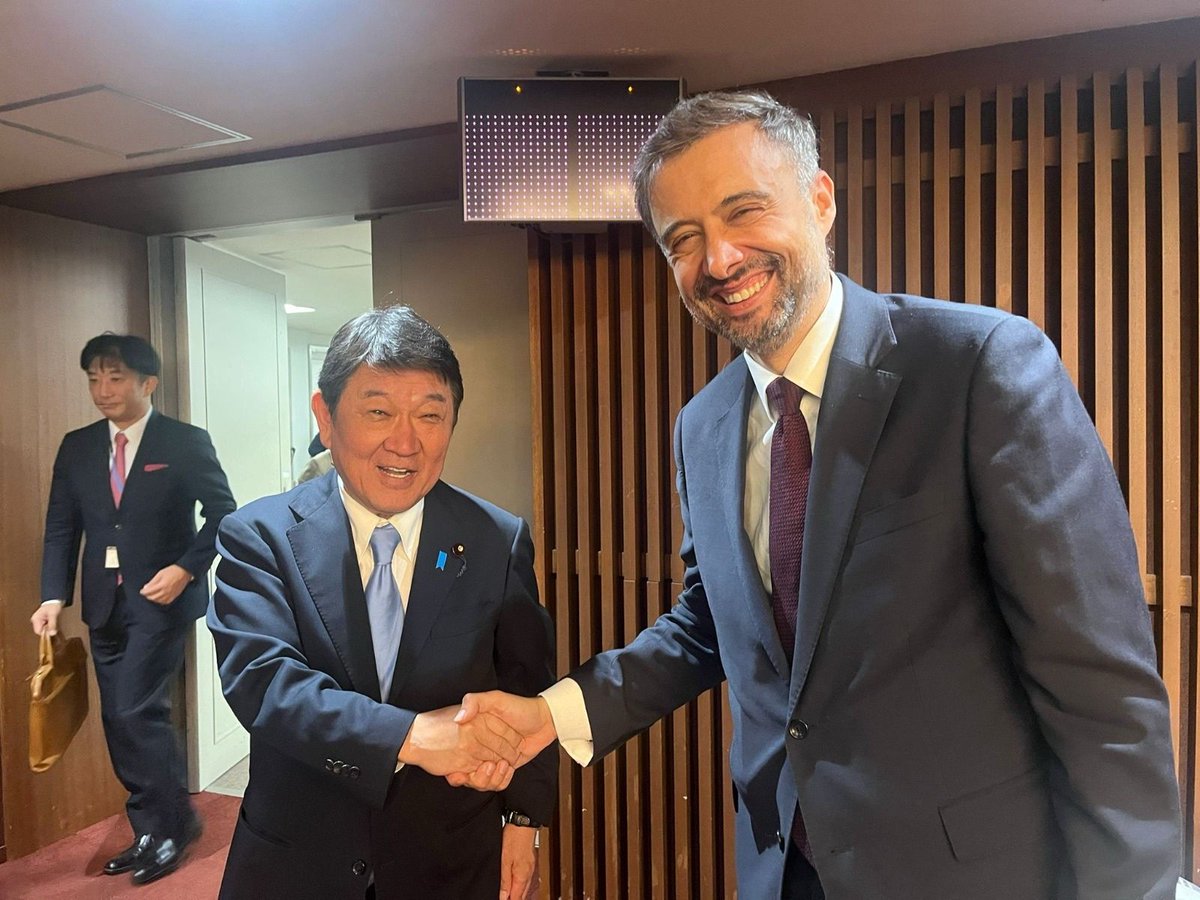
During my visit to Japan, I met with senior Japanese leaders, including @moteging, Minister for Foreign Affairs @MofaJapan_en, Yoko Kamikawa, former Minister for Foreign Affairs, Special Envoy of the Prime Minister to the UN 2026 Water Conference and Members of Parliament.
Our discussions focused on how Japan and IFAD can deepen cooperation around rural transformation, food security, climate resilience through investing in the first mile. These are not separate priorities. They are central to stronger economies, more stable supply chains, and long-term shared prosperity.
The Japan-IFAD partnership is already moving in this direction, including through the Enhanced Linkages between the Private Sector and Small-scale Producers (ELPS) launched during Japan's #G7 Presidency in 2023. Strengthening public-private partnerships with Japanese companies can help connect small-scale producers to markets, expand innovations, and build more resilient and inclusive food systems.
This model also extends to our partnership with the @jica_direct_en. In my meeting with President Akihiko Tanaka , we discussed practical ways to deepen collaboration at the country level, including through the Smallholder Horticulture Empowerment and Promotion Approach and expanding the co-finance portfolio. The approach has already supported more than 77,000 farmers across IFAD-financed projects in Africa, demonstrating how targeted investments, market access and capacity-building remain essential to creating sustainable rural livelihoods and economic opportunities.
As discussions on #IFAD14 advance, Japan’s continued leadership and partnership will remain essential to #FinancingTheFirstMile. Together, we can build more resilient rural economies, stable supply chains, and long-term shared prosperity.