New paper with Marc Melitz (major revision, supersedes our "Aggregate-Demand Amplification of Supply Disruptions"):
"Supply Shocks in a Heterogeneous-Firm New Keynesian Model: The Entry Multiplier."
Let's think about "supply shocks" and monetary policy's response .... 🧵
1/15
For ~40 years, we've assumed RBC models imply a tiny welfare cost of business cycles.
In a new paper w/ V. Carvalho & @matias_cova2 we show that it's an artifact of the single‑sector assumption.
Drop it, and the cost is ~100x larger.
A 🧵 (1/n, n= 12)
https://t.co/nsDBi3D1Lr
Athens bound 🇬🇷✈️ for the @SEDmeeting!
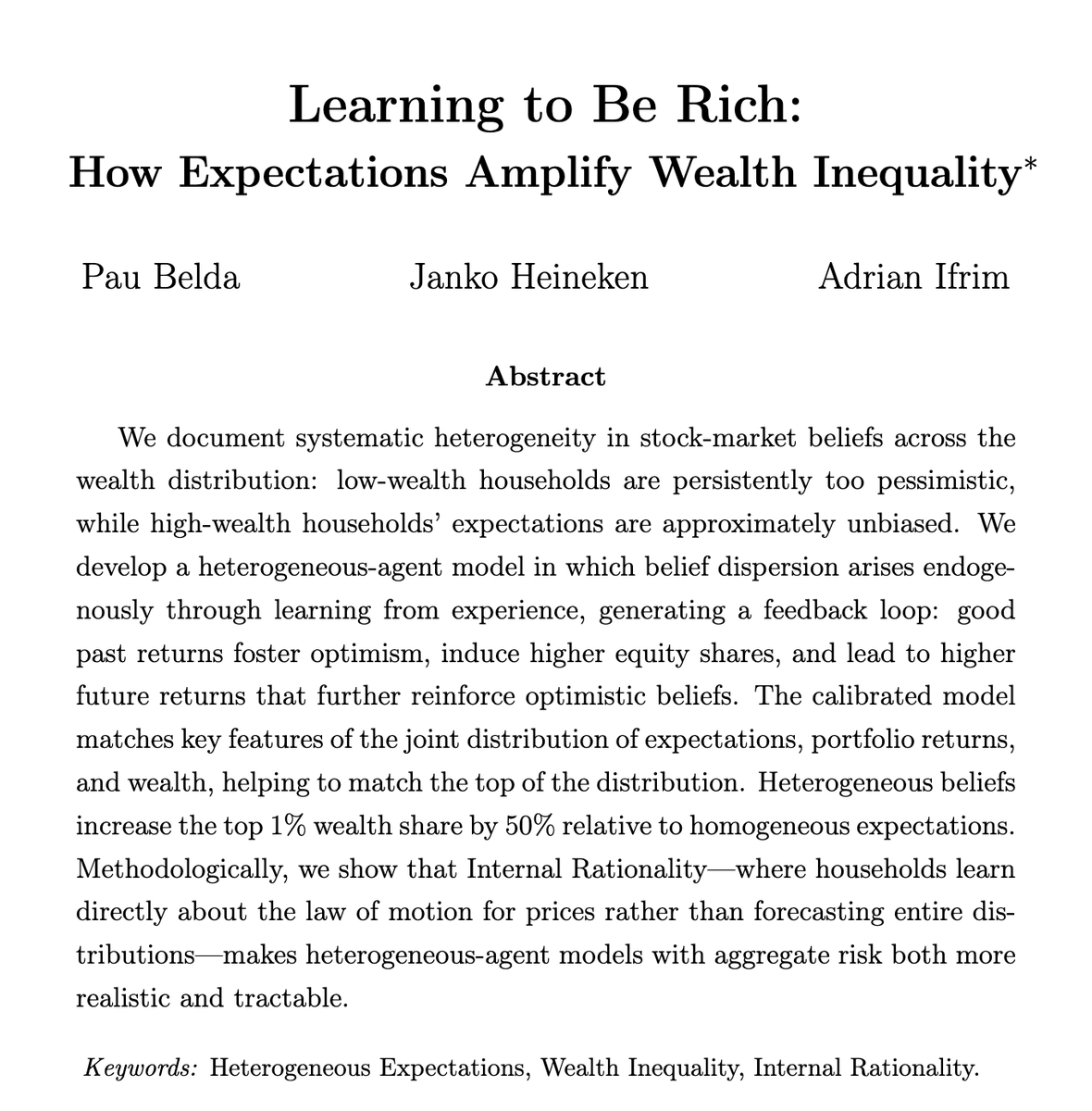
Tomorrow: Learning to Be Rich — my work with @ifrim_a and @JankoHeineken on how heterogeneous expectations can amplify wealth inequality.
New empirical evidence, and Internal Rationality & Neural Networks for solving heterogeneous-agent models.
July 2, 12pm, Location: Alpha32
1) EU has lagged the US in productivity growth for decades. But at current purchasing power, hourly incomes seem not to have diverged. Does this mean Europe is not falling behind? A lesser-known national accounts indicator — real Gross Domestic Income — suggests otherwise. 🧵
Very happy to see our paper “Learning to be rich: how expectations amplify wealth inequality” with @pauism and @JankoHeineken featuring in the program of the @nberpubs Summer Institute 2026: Inequality and Macroeconomics https://t.co/9fEVKYOqj8
1/n) New working paper: “The empirically inscrutable climate-economy relationship”, with @matthewgburgess.
We argue that it is not possible to reliably estimate economic climate damages from historical data.
Link below.
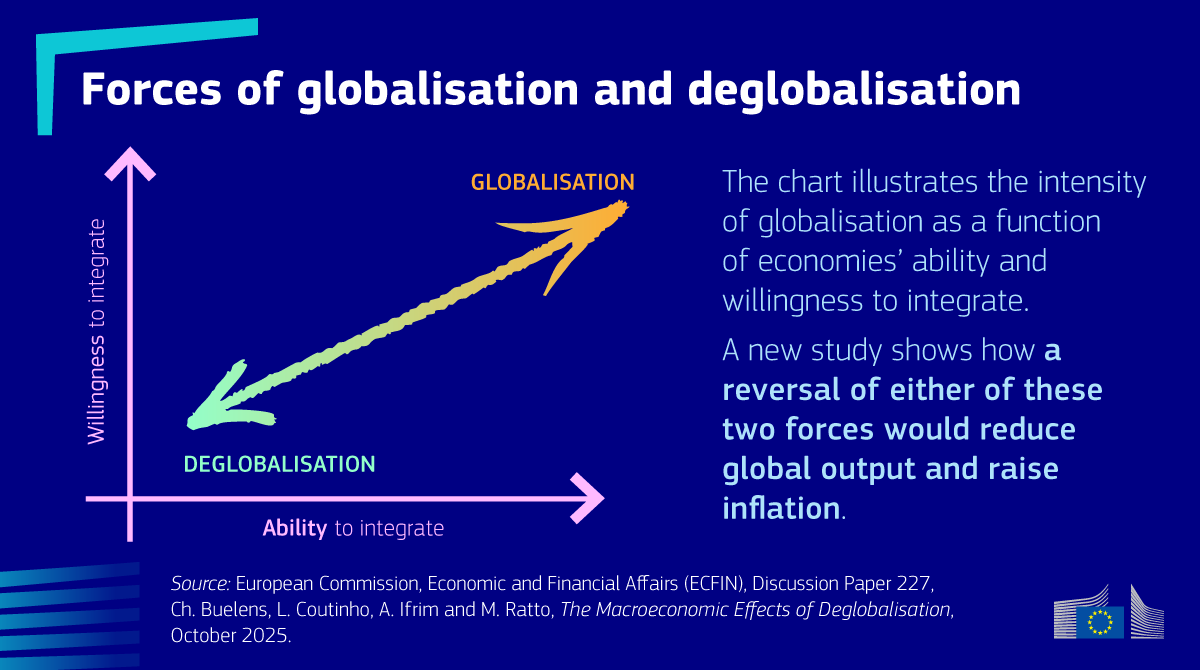
This latest #SUERFpolicybrief summarizes our work on the channels and effects of a slowdown in globalization. We think of (de) globalization as acting through two channels: willingness to integrate (home bias) and ability (trading route costs).
I raised a €100 million to invest in European startups
However, the European Financial Innovation Committee suggested I reduce my fund from €100m to €3m after going through their 18 month approval process
After paying a 60% VAT, I have €1.2m left to invest into startups
All investments will be subject to government approval and additional taxes
Which talented EU founders should I meet?
New WP on the effects of (de)globalization is out: we analyze quantitatively in a multi-region DSGE model the channels (price vs preference) through which a slowdown in globalization can impact the EA, US and global economy. 👇
📘 New publication on 'The Macroeconomic Effects of Deglobalisation' is out!
The paper presents a model-based assessment of the impact of structural drivers of deglobalisation.
💡Read more: https://t.co/1eRnch6Ers
Our latest VOXeu column argues that the persistent EA trade surplus has its roots in global productivity differentials.
👇
Europe’s trade surplus, international relative prices, and the productivity growth gap https://t.co/mfPv2LEGQA # via @cepr_org
Describing nine implications of the interconnectedness of fiscal and monetary policy that surface in HANK models, from @GregWKaplan https://t.co/5bt9EAZMvG
Happy and honored to have received the ERMAS Association Prize for the paper “Heterogenous Expectations and Wealth Inequality” (joint work with @pauism@JankoHeineken ). Many thanks to the ERMAS scientific and organizing committee for yet another inspiring edition.
New CEPR Discussion Paper - DP20476
Persistent Global Growth Differences and Euro Area Adjustment: Real Activity, Trade and the Real Exchange Rate
Adrian Ifrim @EU_ScienceHub, Robert Kollmann @ecares_ulb@UPECactus, Philipp Pfeiffer @EU_Commission, Marco Ratto @EU_ScienceHub, Werner Roeger @DIW_Berlin@VIVES_KULeuven
https://t.co/qES0DVissE
#CEPR_IMF #EconTwitter