My team is hiring a UX designer. Fully remote, UTC to UTC-6, 60k USD. Freelance or perm, flexible working available.
Post is here - https://t.co/eG3nBUkZRk
I'd reposts or intros if you know anyone.
The team here is great, I'm perm CTO if that means anything ;)
@ScottHickle@mwfowlie@WHOOP@ouraring@ThroneScience Love the wall, but heads up that pixellated obfuscation like that can be undone. Best to just redact with solid colour - you may not want to expose emails of people on that wall.
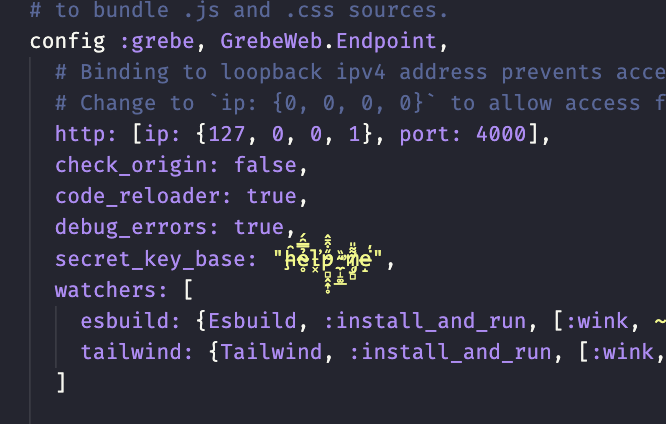
TIL: #Elixir productivity tip of the year
You can enable hot-reload preserving LiveView state 🤯
Just update your dev.exs config to look like this and done! My development iteration cycle will be so much faster now 😍
Thanks @chris_mccord for showing how to do it!
#myelixirstatus
https://t.co/RQvkyJaF5X
@davepl1968 I'd give up, it's too hard. Take a break, watch a film to unwind. What's this? Die Hard With A Vengeance? Huh, sounds fun. Oh man I love Samuel L Jackson, what a great character. Haha what a pickle they're in. Huh?? I passed the interview? Awesome when do I start?
@ThatArrowsmith@elixirlang I reckon this take is short sighted.
If the tech is good enough to be useful in React Native, then it's going to be smart enough to work in other systems too. Maybe the largest corpus gets a few months advantage.
@lu_sichu I mean, I could make balls out of clay and put them on a table and it would look the same.
There’s no inherent evidence in this picture that the objects pictures are atoms.
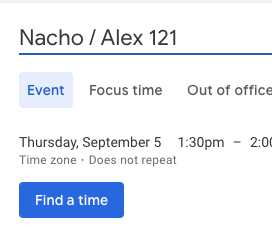
Instead, consider putting your name first. It feels weird, but it's more helpful to the recipient.
Here's the same invite but with the senders name put first. Much better.
I see people send meeting invites, and they put the recipient name first. Google does this by default.
Perhaps it seems more polite; "Who am I to put my name first?"
But this makes things harder for the recipient, is that polite?
Here's why (very short thread):
Example: I was invited to an interview.
(not really, but this shows the concept)
I can't see who my interview is with, because the sender was being polite 🙃
I should add: this is for control of business logic when converting small records between different schemas.
E.g. various external APIs that store roughly the same data but in different ways
(This isn't for large-scale data tidying or ML pipelines or anything like that)
Data pals: Do you know of any formal language or framework for describing data transforms as a tree of rules/steps?
Our team needs one and I can't find any prior art with Google. I'd really love to avoid building something if this already exists.
. @lemoneyeo This is super creepy.
Your team kept a screenshot of a call from 6 months ago, just to catch my attention in an nudge email.
I liked your service, but this sucks.
#myelixirstatus I'm hunting for a tool to visually explore elixir datastructures, ideally in a liveview.
E.g. render(my_complex_struct) and get a nicely formatted view with code folding and things like that
Any recs?